

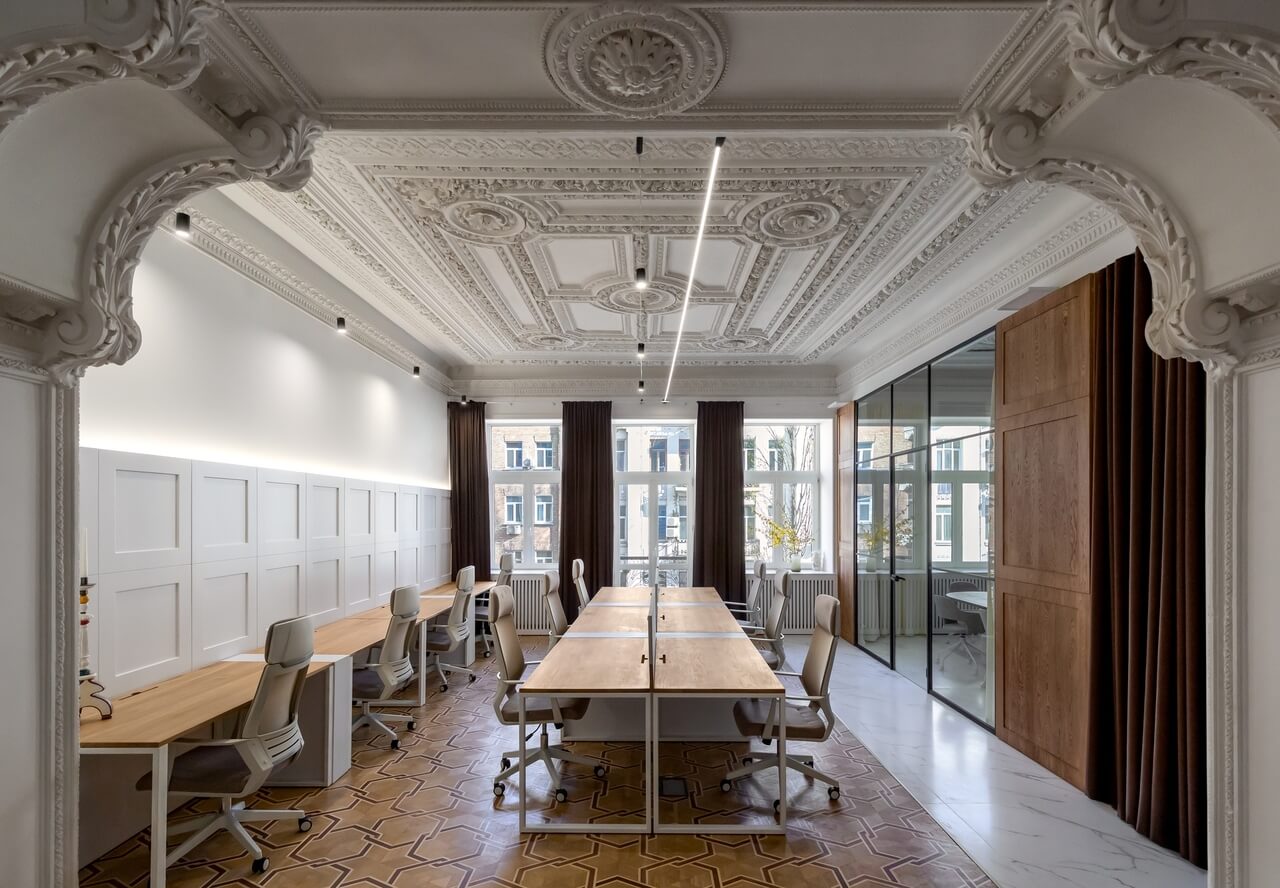
A damaged ceiling rose in Kyiv had a surviving counterpart in the flat next door. It gave Temp Project a way to restore one of the details that give this 180-square-metre office its period character. The studio fitted out the rooms of an 1896 building for a team of 20, retaining sections of parquet and finding a place for the work of contemporary Ukrainian designers.
What survived on the third floor
The office occupies the third floor of a four-storey building in a historic part of Kyiv. Designed by architect Andreas Ferdinand Krauss and built in 1896, the Neo-Renaissance building is a protected monument. The team began by researching late 19th-century interiors and surveying the rooms for features worth restoring.

The building originally belonged to a wine merchant who let the flats. Since the office, too, was intended for rent, the designers took a particular interest in what had attracted tenants to the property then and what might draw them to it a century later.
Old timber parquet was the first discovery, and the team retained sections of it. Above a plasterboard ceiling they found a plaster moulding, probably made during a renovation in the 1990s. To repair the damaged ceiling rose, the designers took a mould from an intact detail on the ceiling of the neighbouring flat.

Two tiled fireplaces
The studio also restored and updated the old ceramic-tiled fireplaces. One retains its original brown finish. The other was painted white to fit more quietly into the room. The plan provides two work areas, a meeting room, a place to take a break, the director’s office and a reception area.

White walls, pale wood and glass partitions give the people working here a calm, uncluttered setting in which to concentrate. Paintings made for the project hang on the walls. Alongside them are pieces by contemporary Ukrainian designers, chosen as understated references to the city’s cultural heritage.
Ukrainian craft in the office
Patterned parquet, ornate plasterwork and substantial fireplaces recall an older Kyiv. Blown glass, the Gunya rug and ceramics by Asha World and Parasolya Studio represent Ukrainian craft in the present day. The continuity between the two took on particular significance during the war, when Ukraine faced an attempt to seize its territory and lay claim to its culture.
Temp Project made the restored rooms practical and comfortable to work in. Giving Ukrainian culture a visible place in that everyday setting was perhaps the office’s most significant contribution at a time when that heritage was under threat.

Products used in the project
- Ceramics by Asha World
- Ceramics by Parasolya Studio
The office accommodates 20 people in an 1896 Neo-Renaissance building, with restored period details and separate spaces for different kinds of work. Find an interior architect for an office in a historic building in the PLNDesign directory.
See also:
- DXC Technology’s Warsaw office combines shared workspaces with quieter areas
- Two-person offices give lawyers space to concentrate in Warsaw