

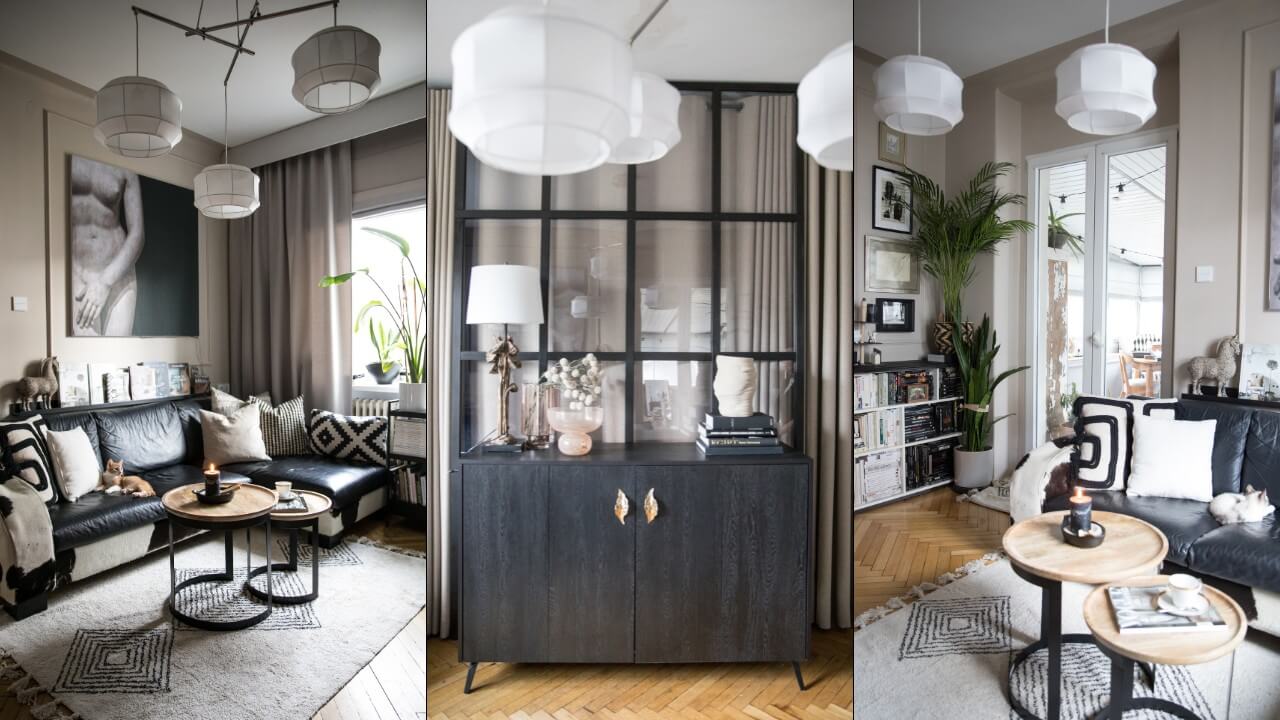
Beti, one half of the Polish design duo Pani to potrafi, wanted more order and a little more space in her own living room. She kept the sofa, armchairs and bookcase, designed a drinks cabinet and built a screen to separate a small bedroom. Curtains and Roman blinds from Marcin Dekor had two quite different jobs: to stop reflections on the television and to give the sleeping area some privacy.
The furniture that survived the move
Ania and Beti design and decorate interiors, restore furniture, stage homes for sale and make useful objects, sometimes from next to nothing. On their blog they share projects alongside ideas, practical solutions and brands they have put to the test. Beti’s living room became one such project.

“I furnished the living room about three years before the makeover, straight after we moved,” she recalled. “I brought the furniture and accessories from our previous flat because that was what I had, and at the time it had to do. But we needed a change. We wanted more order, more calm, more harmony and a bit more space, and not just for storage. Unfortunately you can’t stretch a room, so we had to do something about the furniture. Of the original line-up, the bookcase with its books, the sofa and the armchairs stayed. Everything else had to go!”
Mouldings around a growing collection of pictures
Beti wanted a contemporary take on a classical sitting room. Durable, high-density polystyrene mouldings frame a collection of prints and a large painting. The grey-beige paint looks cool at first glance, but has an undercurrent of warmth.

Beti designed the drinks cabinet and asked a joiner she knew to make it. “The crux of the design is in the unusual details, the legs and those beautiful Italian handles,” she said. A pale rug with a black geometric motif sits beside delicate timber coffee tables on metal bases. Coloured and textured glass vases and a stone serving dish complete the group.
Controlling glare from the window opposite the television
The previous blinds had done little to prevent reflections on the screen. Beti replaced them with a Roman blind with a semi-automatic mechanism. “With a standard Roman blind you pull the chain to raise or lower it,” explained Monika Kruszewicz of Marcin Dekor. “With the semi-automatic system a gentle tug on the chain is enough. The blind drops by itself and covers the window without any effort.”

Long curtains in the same fabric fall in soft folds from an economical MS1 metal track. The Wave system spaces the fabric at regular intervals to produce deep, symmetrical waves. “For that effect, if you also want to cover the window completely, choose a track rather than a conventional pole and install it so that the fabric can travel freely,” Kruszewicz advised.
Both blind and curtains are made from dimout fabric, which blocks almost all daylight. The distinction from blackout fabric becomes apparent with a torch. Blackout stops the beam completely, whereas dimout allows a faint glow through. The room can be substantially darkened without losing all sense of the world outside.

A translucent curtain for the bedroom screen
Beti made an inexpensive, industrial-style screen from timber battens and polycarbonate to separate a small sleeping area from the living room. The screen needed a curtain that would give the occupants privacy while allowing some borrowed light into the bedroom.

She chose a semi-transparent polyester fabric from Marcin Dekor woven entirely from recycled yarn. “It takes as many as 32 plastic bottles, weighing around 20 grams each, to produce one linear metre of this fabric. The result is astonishing. It’s soft, supple and pleasant to touch. It looks like linen!” she said. “It’s inspiring to think how many bottles we can recycle and help look after our shared environment, while supporting Polish producers too, because the fabric was made in Poland.”
The recycled fabric sits comfortably with the timber, stone and metal in the room and with a palette of pale beige, soft rusty pinks, brown and black.
Find an interior designer for a living-room refurbishment in the PLNDesign directory.
See also:
- A staircase becomes the centre of an artistic family’s Polish home
- A 60 m2 flat in a former rye mill near Poznań keeps its industrial character