

A yellow knight stands on one square of a chequerboard coffee table at the Ibis hotel in Warsaw. Martyna Wojtasik, founder of design studio Aure, chose chess as the theme for a hotel popular with business travellers. Her brief was to give the lobby, bar and restaurant a distinctive character on a modest budget.
The chequerboard in interior design
Chess appears in the work of Nabokov, Borges and Bulgakov, and its influence extends well beyond literature to film, fashion and interiors. Chess motifs were popular in Renaissance decoration and again in the interwar years. Black-and-white chequerboard floors still survive in some older apartment buildings. The pattern works across styles, lending a little movement to a room and looking equally at home in a classical or modern setting.

French designer and interior architect Andrée Putman made her name with the interiors of Morgans, a boutique hotel in Manhattan. The small budget called for ingenuity. Working with affordable materials, she used a minimal palette of black and white to striking effect.
A brief for a Warsaw hotel
Some 40 years later, the owner of the Warsaw Ibis, part of the Accor group, asked Wojtasik for something beautiful and original that would also be economical. The commission covered the lobby, reception, bar and restaurant. In the guest rooms the budget stretched to a refresh. Wojtasik’s studio specialises in hotels and had worked with Accor for years, including on the interiors of the Mercure in Tallinn.

Accor hotels are known for developing their interiors around individual themes. The Warsaw hotel attracted mainly business travellers thanks to its proximity to the airport. Wojtasik thought chess an apt subject for guests looking to unwind. She drew on the Netflix series The Queen’s Gambit, picking out references to its story in an eclectic mix of shapes, textures and patterns.
A pawn in the entrance hall
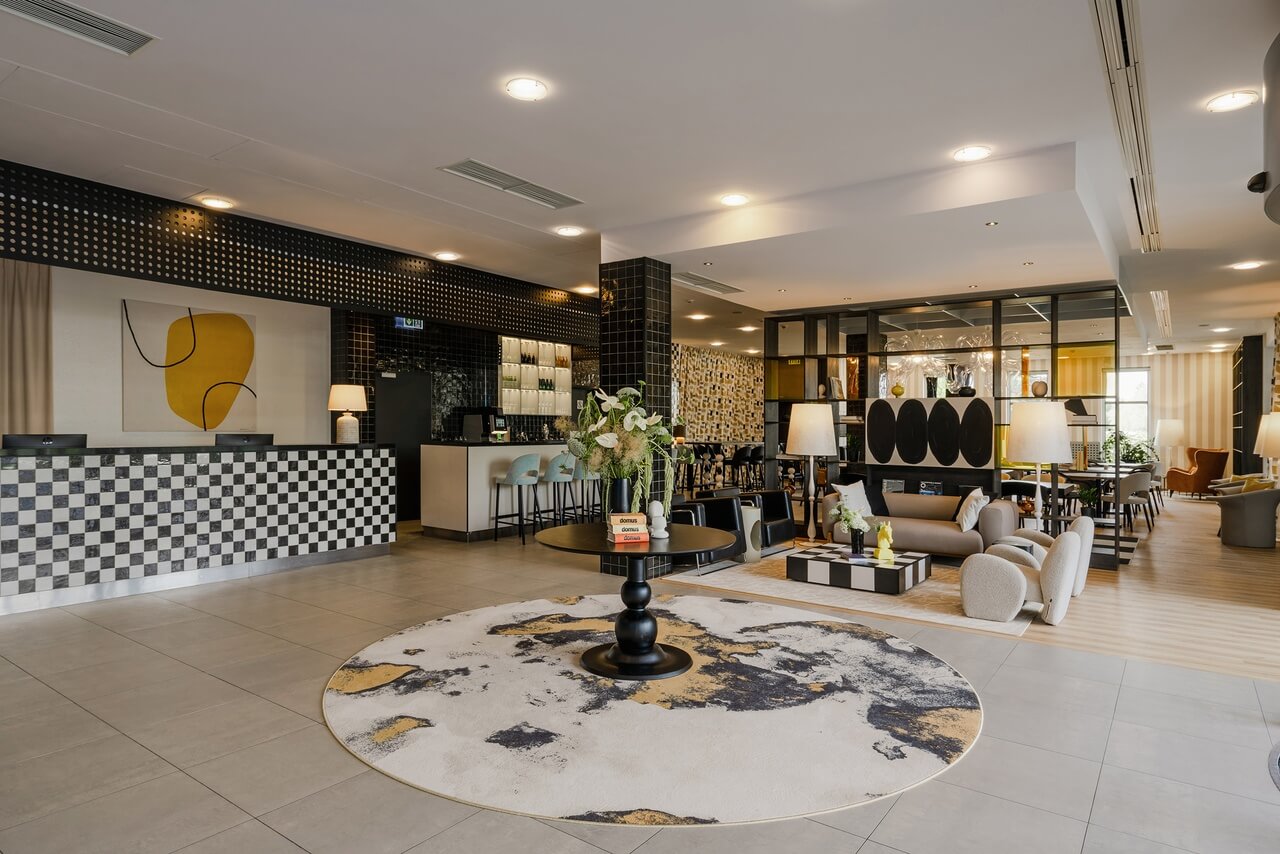
The public spaces underwent a complete redesign. One element that stayed was the large-format flooring in the entrance hall, neutral enough to work with the new scheme. In the middle of the hall Wojtasik laid a large round rug with an abstract pattern reminiscent of veining in stone. A black table on a turned pedestal stands on it, its profile recalling a pawn. A fresh bouquet, set out daily by the hotel, welcomed arriving guests.

Just beyond the table is a seating area with armchairs, a sofa and a low cube patterned like an oversized black-and-white chessboard. The yellow knight on one of its squares makes the reference explicit. Wojtasik set straight-lined modernist armchairs in black leather alongside lower, more futuristic seats upholstered in warm bouclé. A Scandinavian-style sofa with soft, flowing lines completes the group.
Black and white at the reception desk and bar
At reception, black-and-white mosaic tiles replace the old cherry-coloured laminate and pick up the perforated sheet metal below the ceiling. A painting by Warsaw artist Martyna Wójcik-Śmierska hangs behind the desk. Her work appears throughout the interior. She painted each piece specifically for the hotel, taking up its subject and colours.

The bar beside reception uses black and white differently. White counter fronts stand out against glossy, deep-black tiles, and an illuminated cube with shelves for bottles adds to the shine. The bar stools have soft seats upholstered in pale blue velvet.
Checks, bouclé and a place to work
Behind the seating area, a tall open shelving unit with transparent honey-coloured inserts echoes the grid of a chessboard. It loosely divides the lobby from the coworking and dining areas. The restaurant has a relaxed mix of tables, sofas and chairs in a variety of shapes and fabrics. Plain upholstery sits alongside checks in a muted, chess-inspired palette of warm beige, black, white, muted yellows and russets, with natural wood tones and darker finishes. Guests can take a seat at a dining table or settle on a sofa to eat.

Shelves for books and objects fill one wall. Beside them, generous wingback chairs and small tables with chequerboard tops offer somewhere to use a laptop, read, listen to music or rest. The tall worktables have legs shaped like strings of beads, a detail that lends them the look of jewellery. Generous folds of geometrically patterned fabric screen the breakfast service area from the dining room.
“Fabrics are very important to us,” says Wojtasik. “We like choosing them and putting different patterns, colours and textures together. It’s a hallmark of our studio.” Smooth wool sits alongside the small loops of bouclé, plain fabrics alongside broad checks and fine gingham. Much of the warmth and comfort of the public rooms comes from these contrasts in texture.

The luxurious furniture and specially commissioned art give guests a comfortable place to rest. “We wanted to surprise people, to catch them off guard with something unexpected, but to do it subtly, in a more sophisticated way,” says Wojtasik. Guests can read the references to the series a little differently on each visit.
The owner of the Warsaw Ibis wanted beautiful, distinctive hotel interiors on a modest budget. Chess became their theme. Find a hotel interior designer in the PLNDesign directory.
See also:
- A railway station and vineyards inform the interiors of Crowne Plaza Budapest
- Beige and blue divide a South Tyrolean retreat inspired by an old farm