

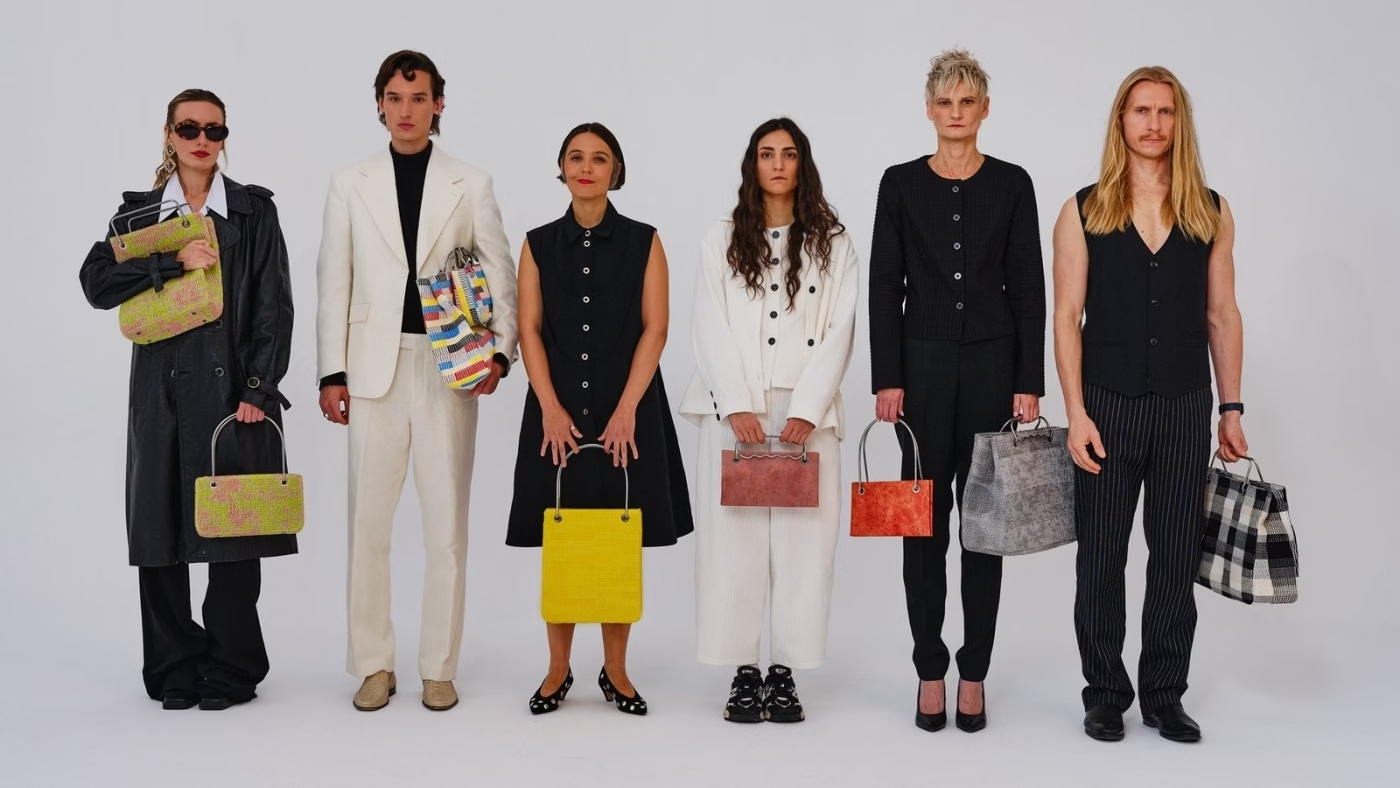
DRUTT. by Acephala has drawn on wire-handled bags popular at Polish markets in the 1970s for its debut collection. The new version pairs interchangeable stainless-steel handles with a body made from artist-designed textiles. A jewellery designer and artists specialising in weaving and textile dyeing worked on the collection, taking inspiration from sources including the Polish avant-garde.
From wire handles to five stainless-steel designs
The brand says its interest in the Polish People’s Republic era stems from admiration for the ingenuity of the time. It has used an everyday object as the basis for a collection it describes as collectible design. Another reference was the work of Katarzyna Kobro, particularly her approach to form and proportion.

These influences informed the handles, developed in collaboration with jewellery designer Daria Malicka. The five stainless-steel designs, Arch, Vintage, Bridge, Wave and Rhythm, were developed using parametric design, with 3D-printed prototypes used to refine their shapes. The handles can be swapped to change the look of the bag.
Checks, plant dyes and jacquards woven in Pabianice
Textiles play an equally important role in the collection. Master weaver Beata Wietrzyńska used a shaft loom to make fabrics that reference checks from the Polish People’s Republic era, with colours drawn from Kobro’s art. She holds the Mistrz Rzemiosł Artystycznych title (master of artistic crafts), awarded by Poland’s Ministry of Culture and National Heritage.
Artist and chemist Julia Kromolicka approached the material through colour. A specialist in plant-based textile dyeing, she used silk and traditional Polish dye plants to produce compositions resembling stone and marble. Each section of fabric has a different appearance.

Working with Iza Sojka, Zuza Wójcik drew on paintings by Władysław Strzemiński for three-dimensional jacquards woven in Pabianice. Alongside the checks and dyed silk, these fabrics place particular emphasis on texture.
The debut collection offers five handle designs and three textile ranges. Handles, fabrics and bag sizes can be freely combined. The original market bag has become a modular design whose final appearance is also shaped by the person carrying it.
Artist-designed textiles can also be a starting point for an interior, and an interior designer can help you plan how to use them at home. Find architects, interior designers and interior photographers in the PLNDesign directory.
See also:
- LEGO X-Files set – forest scene with a UFO on a clear stand and a grey alien
- IKEA takes inspiration from Himalayan wildlife for ALPTALL