

Nineteenth-century greenhouses and a park established by the Ulrich family have been restored as a public gathering place in Warsaw. WXCA adapted the former horticultural site, where pineapples were once grown for the city's aristocratic circles, while retaining its historic fabric. The project reconnects the gardens with the social and educational role of the original enterprise. Photography is by Bartek Barczyk.
A family business rooted in horticulture
The Ulrich family's business developed across several generations. Its founder, Jan Bogumił Ulrich, was the nephew of King Stanisław August Poniatowski's private gardener and trained from an early age in Warsaw's Saxon Garden. In 1805, he established his enterprise on the former Ceglana street in Wola. This was more than 70 years before the invention of the light bulb and more than a century before the first electric tram ran through Warsaw.

In the 1870s, his son Jan Krystian Ulrich moved the business to the suburban village of Górce, beside what is now Górczewska. Iron-framed greenhouses with central heating were built there to grow pineapples, citrus trees, palms and other exotic plants. The pineapples became well known among Warsaw's aristocracy. The family also established a fragrant display garden for customers, the present-day Ulrich Park, and a respected horticultural school.
Keeping the identity of the greenhouses
WXCA drew on archival documents and worked with conservation specialists. These included representatives of the Mazowiecki Wojewódzki Konserwator Zabytków, the regional heritage conservator. The aim was to retain the identity and historic material of the site while adapting it to contemporary use.
“The greatest design challenge was to preserve the unique identity of the Ulrich greenhouses, including their historic fabric, while ensuring that the place met the needs of contemporary residents and the highest environmental standards,” explains architect Marta Sękulska-Wrońska.

The complex consists of two greenhouses linked by a historic underground passage. In working with the nineteenth-century fabric, the architects drew on experience gained on projects including the museum complex at the Warsaw Citadel, the city's largest fortress. The existing masonry and original brick chimneys were retained and conserved.
“We preserved the walls of the historic greenhouses together with the underground corridor and the original brick chimneys, and subjected them to conservation work. In the underground areas, which once housed technical rooms, black deposits can still be seen on some walls from the time when furnaces and coal stores were located there, forming part of Warsaw's first central-heating system. We relieved walls that could no longer perform a structural role by introducing a support system. Missing sections were filled with bricks based on the originals, made at a brickworks to our specifications as a special order for the client,” says architect Monika Lemańska.

Rebuilding the roofs and recalling the planting
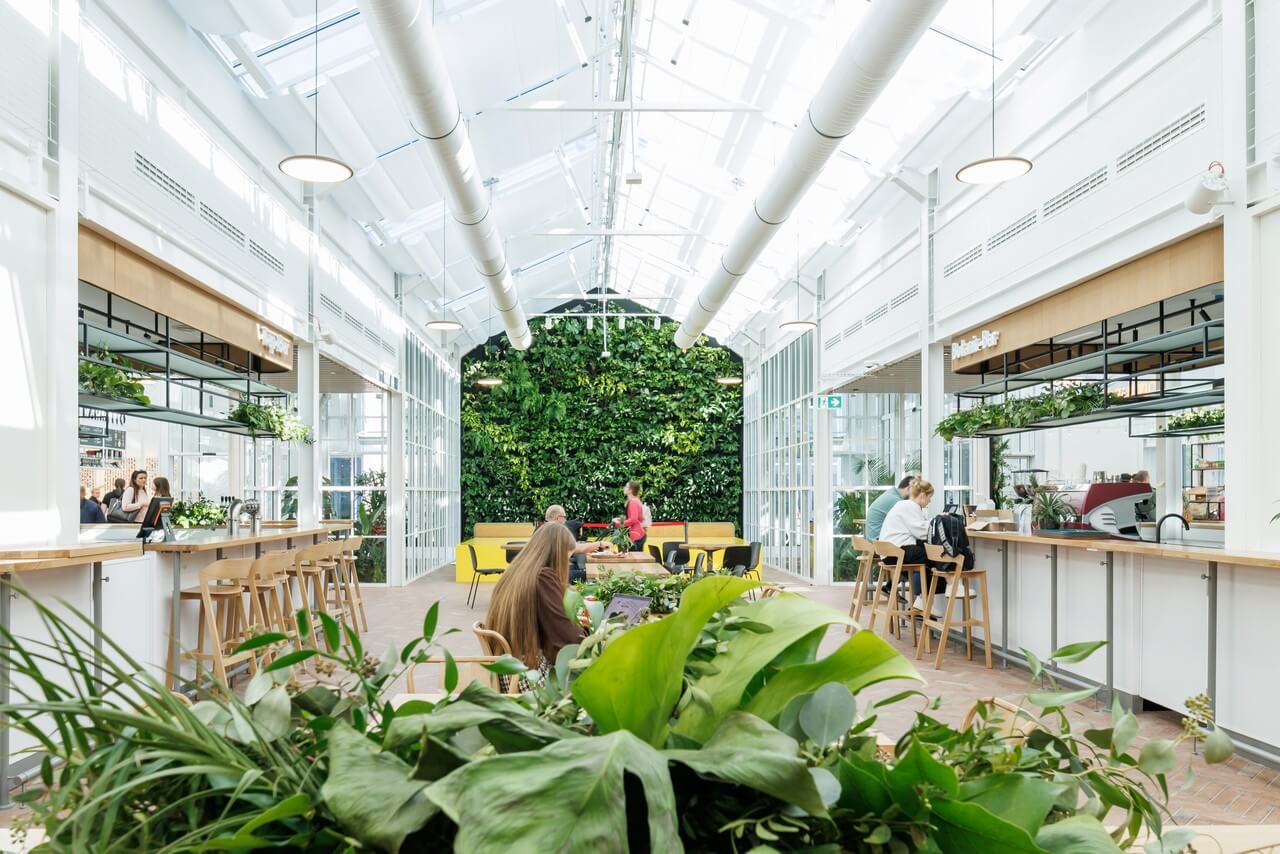
The architects reconstructed the above-ground steel structure, including the geometry of the original roofs, glazing details and white metalwork. Interior walls were limewashed in reference to traditional horticultural practice. Outside, a rusticated line and a change in façade texture mark the height of the historic buildings.

“We wanted to recover the memory of the site's original function. Inside, we designed a group of conservatories with the right temperature and humidity for exotic plants to grow as they once did, as well as a seven-metre wall of living greenery,” says Marta Sękulska-Wrońska.
The greenhouses accommodate cafés, restaurants and bars, together with a play space for children. The basement continues to serve a technical role, as it did historically. Visitors also enter this level to use the toilets.
Conservation work was combined with measures to reduce energy and water use. BREEAM assessment formed part of this environmental approach. The combination of technical and heritage considerations required collaboration across several disciplines.
“Adapting the Ulrich greenhouses was a complex undertaking requiring specialist knowledge from different disciplines. The success of the project depended on professional, collaborative work with the architects at every stage, as well as proper attention to the development's wider social role,” says Artur Drączkowski, Project Manager representing the client, Ingka Centres Polska.
A park designed for shared use
WXCA also designed the square and park surrounding the greenhouses. Outdoor dining areas extend into a square intended for cultural events and informal meetings. The greenhouses and square lead into parkland expanded over areas previously covered in concrete and replanted to restore its green character.

Rows of fruit trees were planned with misting nozzles to recall an orchard in the morning mist. Street furniture was introduced around the greenhouses. A community garden provides a local setting for environmental education, continuing the site's association with horticulture.
“Recognising and understanding the social context was one of our priorities. Before the design process, the client consulted residents of the district. In the past, the Ulrich family's greenhouses and park played an important social role, both educational and simply sociable. We restored them so that Ulrich Gardens could be full of life throughout the year, hosting events such as breakfast markets, outdoor cinema and Christmas fairs,” says Monika Lemańska.
A new building or a conversion starts with choosing the right architect. Find architects, interior designers and interior photographers in the PLNDesign directory.
See also:
- Three wings shelter a private terrace for the owners of a house near Warsaw
- Split-level house steps down a sloping site in Puszczykowo, Poland