

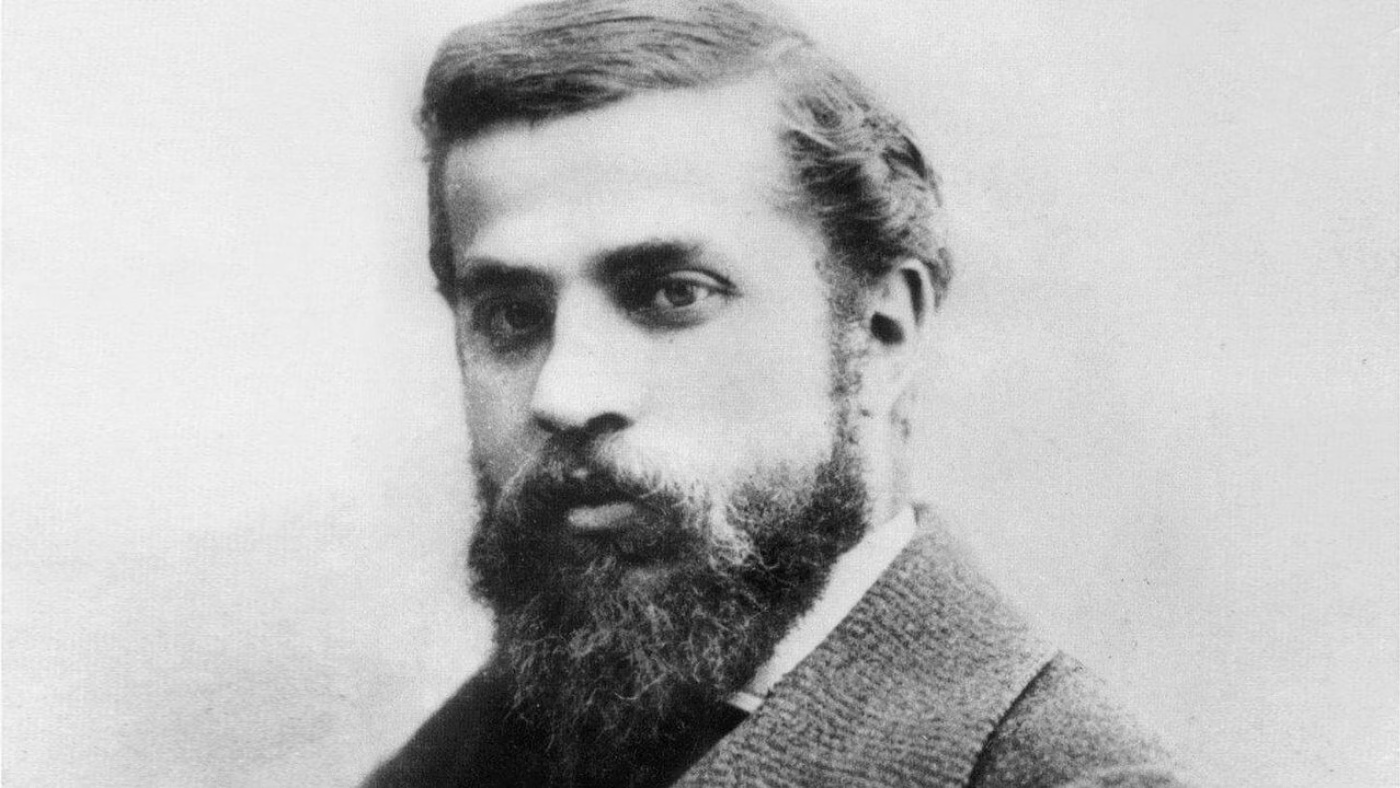
Antoni Gaudí (1852–1926) was a Catalan architect and the figure most closely associated with Catalan Modernisme, best known for the Sagrada Família, Casa Batlló, Casa Milà and Park Güell in Barcelona. He took his forms and structural solutions from nature, worked with three-dimensional models rather than detailed plans and designed his buildings down to the furniture. He directed the Sagrada Família for 43 years, the last 12 of them exclusively, and is buried in its crypt.
Antoni Gaudí at a glance:
- A Catalan architect born in 1852, he built most of his work in and around Barcelona, with three buildings outside Catalonia, in Comillas, Astorga and León.
- Seven of his works are inscribed on the UNESCO World Heritage List, among them Park Güell, Casa Milà and the Nativity façade of the Sagrada Família.
- Eusebi Güell, a Barcelona textile industrialist, was his main patron from 1878 until his death in 1918.
- He died on 10 June 1926, three days after being hit by a tram. In February 2026 the central tower of the Sagrada Família reached its full height of 172.5 metres.
Who was Antoni Gaudí?
Antoni Gaudí i Cornet was a Catalan architect whose life and work centred on Barcelona. He was born on 25 June 1852 in the Baix Camp district of Catalonia, the youngest of five children of the coppersmith Francesc Gaudí i Serra and Antònia Cornet i Bertran, three of whom reached adulthood.
Poor health, including rheumatism, marked his childhood. He spent long periods at the family house, Mas de la Calderera, in Riudoms, the village his father’s family came from, and the time outdoors there gave him the chance to study nature closely. At the Piarist school in Reus he drew for a school publication called El Arlequín.

At 16 he moved to Barcelona to finish his education and then studied architecture. He paid for his studies by working as a draughtsman for architects and builders including Josep Fontserè, Joan Martorell and Francisco de Paula del Villar. His grades were average and he failed some courses. When he graduated in 1878, Elies Rogent, director of the Barcelona architecture school, said the title had gone ‘either to a fool or a genius’ and that time would tell.
How did Gaudí’s career begin?
Gaudí’s career took off within months of his graduation, thanks to a display cabinet shown in Paris. His first project was a set of lampposts for Plaça Reial in Barcelona: he designed a six-armed model, two of which were installed in the square, and a three-armed one. In May 1878 he designed a display cabinet for the Esteban Comella glove factory, which was exhibited in the Spanish pavilion at the Paris World Exhibition that year. It caught the attention of Eusebi Güell, who became his most important client.
His first large project was for the Cooperativa Obrera Mataronense, a workers’ cooperative in Mataró, on which he worked from 1878 to 1882. The plans included a factory, workers’ housing, a social centre and a services building, but only the factory and the services building were completed. In the factory roof he used the catenary arch for the first time, and in the services building he used ceramic tile decoration for the first time.
Casa Vicens (1883–1885), a summer house in Gràcia for the stockbroker Manel Vicens i Montaner, was his first major commission and brought him wider recognition. Its tiles carry a marigold motif based on the flowers that grew on the plot. With El Capricho in Comillas, the Güell Pavilions and Palau Güell, it belongs to his orientalist period, when he drew on the art of India, Persia and Japan and on the Nasrid and Mudéjar art of Spain.
Who was Eusebi Güell?
Eusebi Güell (1846–1918) was Gaudí’s main patron and his friend for four decades. A Barcelona textile industrialist, he served as a city councillor, a provincial deputy and a senator, and King Alfonso XIII made him Count of Güell.
After seeing Gaudí’s cabinet in Paris, Güell gave him his first commission the same year: furniture for the pantheon chapel of the Palacio de Sobrellano in Comillas, which was being built for Güell’s father-in-law, the Marquis of Comillas. Further projects followed: the Güell Pavilions on the family estate in Pedralbes (1884–1887), entered through an iron gate in the shape of a dragon; Palau Güell (1886–1890), the family’s town house off La Rambla, inaugurated during the 1888 Universal Exhibition; the wine cellars at Garraf; the church for the Colònia Güell, the industrial village around his textile mill in Santa Coloma de Cervelló; and Park Güell. Güell also recommended Gaudí to two textile merchants from León with whom he did business, which led to Casa Botines.
In 1906 both men moved to Park Güell, Güell to the Larrard house and Gaudí to a house he owned on the estate, and they remained neighbours until Güell died there in 1918. Work on the Colònia Güell church had already stopped in 1914, when his sons ceased funding it, and only its crypt was built.
How did Antoni Gaudí die?
Gaudí died on 10 June 1926, three days after being hit by a tram in Barcelona. On 7 June, during his daily walk between the Sagrada Família and the church of Sant Felip Neri, a number 30 tram struck him on the Gran Via de les Corts Catalanes, between Bailèn and Girona streets, and he lost consciousness.
By then Gaudí ate frugally and wore old, worn suits, and passers-by took him for a beggar. He did not receive immediate help and was eventually taken to the Hospital de la Santa Creu, Barcelona’s old hospital for the poor. Gil Parés, chaplain of the Sagrada Família, recognised him the following day. Gaudí refused a transfer to a private clinic, saying his place was among the poor, and died in Santa Creu aged 73.

Around 30,000 people turned out for his funeral on 12 June, when the cortège carried his coffin from the hospital to the Sagrada Família. He was buried in the chapel of Our Lady of Mount Carmel in the basilica’s crypt. In June 2026, a hundred years after the accident, Barcelona City Council placed a commemorative plaque on the Gran Via at the spot where it happened.
What defines Gaudí’s architectural style?
Gaudí built his style on forms taken from nature and on structures he worked out with physical models. He found structural examples in reeds, rushes and bones and said that no structure was better than the trunk of a tree or a human skeleton. His columns branch and twist in double spirals, like the trunks and branches of trees.
He rarely drew detailed plans, preferring three-dimensional scale models and adjusting details on site as work progressed. For the church of the Colònia Güell he made a hanging model: he drew the floor plan on a board fixed to the ceiling and hung strings weighted with small bags of birdshot from the points where columns and corners would stand. Gravity pulled the strings into catenary curves which, inverted, gave arches that distribute their weight evenly. Catenary arches appear in Casa Milà, the Teresian College, the Colònia Güell crypt and the Sagrada Família.
He also worked with ruled geometric forms such as the hyperbolic paraboloid, the hyperboloid and the helicoid. They allowed him to do without the external buttresses that neo-Gothic churches relied on, and he associated the helicoid with movement and the hyperboloid with light.
Craft was part of his design method. As a student he attended workshops in carpentry, wrought ironwork, stained glass, ceramics and plaster modelling, and as an architect he designed every element of his buildings, from furnishings and lighting to ironwork. He introduced trencadís, a mosaic made of broken and waste ceramic pieces. The undulating trencadís bench in Park Güell is the work of his collaborator Josep Maria Jujol.

Which buildings did Gaudí leave behind?
Most of Gaudí’s buildings stand in Barcelona and its surroundings, and three are outside Catalonia: El Capricho in Comillas, the Episcopal Palace in Astorga and Casa Botines in León. Seven are inscribed on the UNESCO World Heritage List as the Works of Antoni Gaudí: Park Güell, Palau Güell and Casa Milà since 1984, and Casa Vicens, Casa Batlló, the Nativity façade and crypt of the Sagrada Família and the crypt of the Colònia Güell since 2005.
| Building | Years | Location | UNESCO |
|---|---|---|---|
| Casa Vicens | 1883–1885 | Barcelona | 2005 |
| El Capricho | 1883–1885 | Comillas | No |
| Güell Pavilions | 1884–1887 | Barcelona | No |
| Palau Güell | 1886–1890 | Barcelona | 1984 |
| Teresian College | 1888–1889 | Barcelona | No |
| Episcopal Palace | from 1889 | Astorga | No |
| Casa Botines | 1891–1892 | León | No |
| Casa Calvet | completed by 1900 | Barcelona | No |
| Bellesguard | 1900–1909 | Barcelona | No |
| Park Güell | 1900–1914 | Barcelona | 1984 |
| Casa Batlló | 1904–1906 | Barcelona | 2005 |
| Casa Milà (La Pedrera) | 1906–1912 | Barcelona | 1984 |
| Colònia Güell crypt | from 1908 | Santa Coloma de Cervelló | 2005 |
| Sagrada Família | from 1883 | Barcelona | 2005 (Nativity façade and crypt) |
Park Güell began as a private housing estate for Güell. The site was divided into 60 plots, but only two houses were built, neither designed by Gaudí, and the project was abandoned in 1914. Güell’s heirs offered the land to the city council, which bought it in 1922 and opened it as a municipal park in 1926.
Casa Batlló was a remodelling of an existing apartment building for the textile industrialist Josep Batlló. Gaudí reworked the façade, the main floor, the inner courtyard and the roof, and the mask-like balconies and bone-shaped pillars between the windows gave the house its local name, Casa dels Ossos, the House of Bones. Casa Milà, built for Pere Milà and Roser Segimon, was Gaudí’s last work of civic architecture. Its stone façade, which resembles an open quarry, earned it the popular name La Pedrera, ‘the quarry’.
The Episcopal Palace in Astorga was commissioned by Bishop Joan Baptista Grau after fire destroyed the old palace. Gaudí left the project in 1893, after the bishop’s death, and Ricardo García Guereta completed it. It was never used as a bishop’s residence and has housed the Museo de los Caminos since the 1960s. Casa Botines in León combined a textile warehouse on the ground floor with flats above and now houses a Gaudí museum. Bellesguard was commissioned by the widow Maria Sagués on the site of a residence of King Martin the Humane, and Casa Calvet won Barcelona City Council’s award for the best building of 1900.
What was Gaudí’s role in the Sagrada Família?
Gaudí directed the construction of the Sagrada Família from 1883 until his death. The first stone had been laid on 19 March 1882 for a neo-Gothic design by Francisco de Paula del Villar. After Villar was replaced over disagreements about the cost of materials, Gaudí took the project in a new direction.
As an expiatory temple, the church was to be funded only by donations, and Gaudí collected alms for it himself. From 1914 he worked on nothing else, and in 1925, months before his death, he moved into his workshop on the site. His design has 18 towers: 12 for the apostles, four for the evangelists, one for the Virgin Mary and the tallest, at the centre, for Jesus Christ. The only one he saw completed was the bell tower of St Barnabas, finished on 30 November 1925. In 1936, at the start of the Spanish Civil War, his workshop was set on fire and many of his plans and models were destroyed.

The central tower was completed a century after his death. On 30 October 2025 the lower arm of its cross took the basilica to 162.91 metres, above the 161.53 metres of Ulm Minster, and made it the tallest church in the world. The upper arm, installed on 20 February 2026, brought the tower to 172.5 metres, and on 10 June 2026, the centenary of Gaudí’s death, Pope Leo XIV celebrated Mass in the basilica and blessed the tower. Work continues on the tower’s interior and on the Glory façade, the future main entrance, and the Junta Constructora, which runs the works, expects to complete the vertical structure of the church within about ten years.
Did Gaudí design furniture?
Yes. Gaudí designed most of his interiors himself, down to the smallest details, and furniture was part of his work from the start of his career, beginning with a desk for his own office. For the chapel of the Palacio de Sobrellano in Comillas he designed a velvet-upholstered chair topped with two eagles and the Marquis of Comillas’s coat of arms, a bench with a dragon motif by the sculptor Llorenç Matamala and a prayer stool decorated with plants. He also made the furniture and counter for the Gibert Pharmacy, with marquetry showing Arab influence.
He went on to design all the furnishings of Casa Vicens, Casa Calvet, Casa Batlló, Casa Milà, Palau Güell and Bellesguard, as well as the liturgical furnishings of the Sagrada Família. Barcelona City Council also commissioned him to restore the Saló de Cent and the main staircase of the City Hall and to make a chair for Queen Maria Cristina. Only the chair was made, and the mayor, Francesc Rius i Taulet, presented it to the queen.
What is Gaudí’s legacy?
Gaudí’s work gained wide international appreciation decades after his death. By the 1950s his reputation was recovering, with Salvador Dalí and the architect Josep Lluís Sert among his champions. In Japan, Kenji Imai used trencadís on the Memorial for the Twenty-six Martyrs of Japan in Nagasaki, which won the Japanese National Architecture Award in 1962. Several architects who worked under Gaudí, among them Josep Maria Jujol, Joan Rubió and Cèsar Martinell, later established their own careers.
The centenary of his death made 2026 the Gaudí Year. The Gaudí Council presented a joint programme of celebrations in May 2025, and the Sagrada Família added its own events, running from autumn 2025 to Christmas 2026.
Lesser-known facts about Antoni Gaudí
Gaudí defended Catalan identity and spoke Catalan in public, including to King Alfonso XIII when the king visited the Sagrada Família. On 11 September 1924, the National Day of Catalonia, the Civil Guard arrested him on his way to a mass for Catalan patriots at the Basilica of Sant Just i Sant Pastor after he refused to answer in Spanish. He was released after paying 50 pesetas bail.
In 1908 he worked on a project for a skyscraper hotel in New York, the Hotel Attraction, commissioned by two American entrepreneurs whose names are unknown. It was never built. In 1910 the Grand Palais in Paris hosted an exhibition of his work during the annual salon of the Société des Beaux-Arts.
In 1902 the painter Joan Llimona used Gaudí’s features for Saint Philip Neri in his paintings for the church of Sant Felip Neri in Barcelona, the church Gaudí visited every day in his later years.
Antoni Gaudí – frequently asked questions
Where was Antoni Gaudí born?
Gaudí was baptised the day after his birth at the church of Sant Pere Apòstol in Reus, and most of his identity documents gave Reus as his birthplace. From 1915 onwards he himself named Riudoms, his father’s family’s village, as the place he was born.
Did Antoni Gaudí have children?
No. Gaudí never married and had no children. From 1906 he lived in his house in Park Güell with his father, who died that year at the age of 93, and his niece Rosa, who died in 1912.
Why did Gaudí never marry?
Gaudí proposed to only one woman, Josefa ‘Pepeta’ Moreu, a teacher at the Mataró workers’ cooperative, in the 1880s, and she turned him down. He remained single for the rest of his life and in later years lived ascetically.
What did Gaudí suffer from?
As a child Gaudí suffered from rheumatism. As an adult he kept strict religious fasts, and the Lenten fast of 1894 brought on a life-threatening illness. In 1911 he fell seriously ill again and, while convalescing in Puigcerdà in the Pyrenees, made his will.
Was Antoni Gaudí religious?
Yes. Gaudí was a devout Catholic whose faith deepened with age, and he belonged to Catholic Catalan associations such as the Cercle Artístic de Sant Lluc and the Lliga Espiritual de la Mare de Déu de Montserrat. The Archbishop of Barcelona, Ricard Maria Carles, proposed his beatification in 1998, and on 14 April 2025 Pope Francis declared him Venerable in recognition of his heroic virtue.
Gaudí designed his buildings as a whole, from the structure to the tiles, ironwork and furniture, and worked closely with craftsmen at every stage. A renovation or a new interior planned the same way, with layout, materials and furnishings decided together, needs a designer involved from the first sketch. Find architects, interior designers and interior photographers in the PLNDesign directory.
See also:
- Álvaro Siza: life, style and key buildings
- Alvar Aalto: buildings, furniture and the UNESCO-listed Aalto Works