

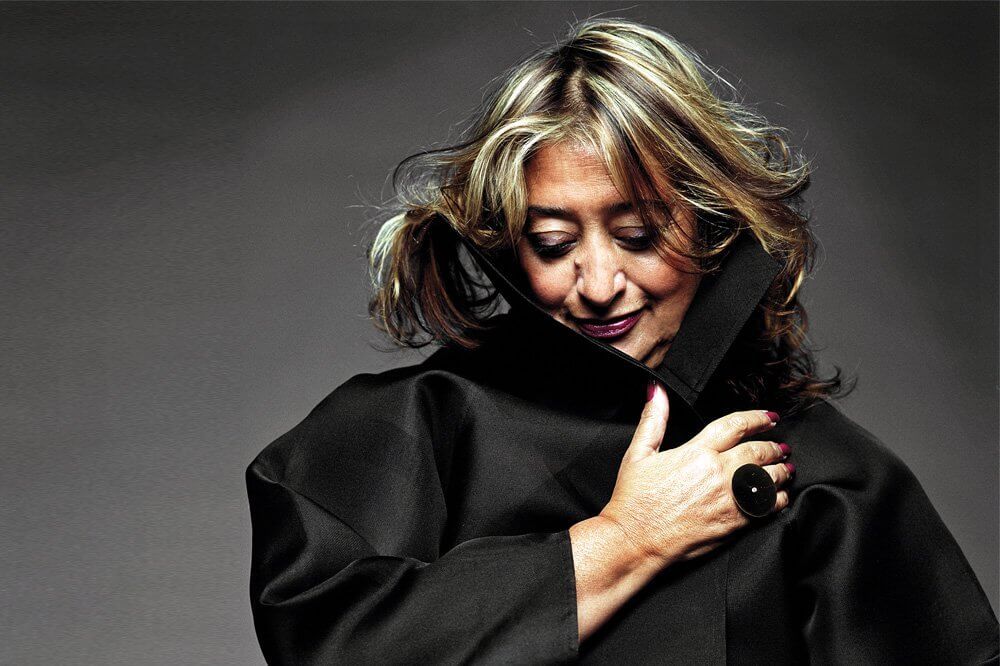
Zaha Hadid (1950–2016) was an Iraqi-British architect and the first woman to win the Pritzker Architecture Prize. For more than a decade her competition-winning designs stayed on paper, yet by the time of her death the London practice she founded had completed museums, an opera house, a bridge and an Olympic pool in fluid, curving forms.
Zaha Hadid at a glance:
- Born in Baghdad in 1950, she studied mathematics in Beirut and architecture at the Architectural Association in London, and founded her own practice there in 1979.
- The first woman to win the Pritzker Architecture Prize (2004), she also won the RIBA Stirling Prize twice and in 2016 became the first woman to receive the RIBA Royal Gold Medal in her own right.
- Her major buildings, among them the Heydar Aliyev Center in Baku, MAXXI in Rome and the London Aquatics Centre, are shaped by continuous curves and flowing surfaces.
- She died in Miami on 31 March 2016. Her practice continues as ZHA under Patrik Schumacher, and the Zaha Hadid Foundation cares for her archive in London.
Who was Zaha Hadid?
Zaha Hadid was born on 31 October 1950 in Baghdad. Her father, Muhammad al-Hajj Husayn Hadid, was an industrialist from Mosul and a co-founder of Iraq’s National Democratic Party, and her mother, Wajiha al-Sabunji, was an artist. Hadid later recalled that by the age of 11 she had ‘an instinctive sense that I would be an architect’. She first took a degree in mathematics at the American University of Beirut, then moved to London in 1972 to study at the Architectural Association.

At the AA her tutors included Rem Koolhaas, Elia Zenghelis and Bernard Tschumi. Her final project, Malevich’s Tektonik (1976), proposed a hotel on London’s Hungerford Bridge and took its cue from the Suprematist painter Kazimir Malevich. After graduating in 1977 she joined the Office for Metropolitan Architecture, the firm Koolhaas had founded with Zenghelis, as a partner, though she soon left to pursue her own ideas. Koolhaas described her as ‘a planet in her own orbit’.
In 1979 Hadid set up Zaha Hadid Architects in London. For more than three decades the practice worked from a former Victorian school at 10 Bowling Green Lane in Clerkenwell. She also taught at the AA and later held professorships and visiting chairs at Harvard, Yale, Columbia and the University of Applied Arts in Vienna.
Why were Zaha Hadid’s early designs left unbuilt?
Hadid’s early schemes called for forms that were costly and hard to engineer, and for years no client would build them. Her reputation rested on competition wins and on abstract paintings of her projects. The Design Museum notes that for a time she was better known for the buildings she had not built than for those she had.

The first of those wins was The Peak, a leisure club in Hong Kong, whose competition she won in 1983. It was never built. In 1994 she won the competition for the Cardiff Bay Opera House, but in December 1995 the Millennium Commission refused to fund the scheme, judging it financially risky.
Her first major building was the fire station on the Vitra furniture campus in Weil am Rhein, completed in 1993. Vitra now uses it for events and exhibitions of the Vitra Design Museum. The real breakthrough came in Cincinnati, where the Rosenthal Center for Contemporary Art opened in May 2003 as the first American museum building designed by a woman. The New York Times greeted it as the most important new building in America since the Cold War.
What awards did Zaha Hadid win?
Several of Hadid’s honours were firsts for a woman. She was appointed CBE in 2002, and in 2004 she became the first woman to win the Pritzker Architecture Prize. In 2005 she was elected a Royal Academician. She won the RIBA Stirling Prize in two consecutive years, in 2010 for MAXXI in Rome and in 2011 for the Evelyn Grace Academy, a school in Brixton, south London. In 2012 she was made a Dame for services to architecture. On 3 February 2016, eight weeks before her death, she received the RIBA Royal Gold Medal as the first woman to be awarded it in her own right.

How did Zaha Hadid die?
Zaha Hadid died on 31 March 2016 at Mount Sinai Medical Center in Miami, aged 65. She was being treated in hospital for bronchitis when she suffered a heart attack. She is buried at Brookwood Cemetery in Surrey, between her father and her brother Foulath.
What defines Zaha Hadid’s architecture?
Hadid’s buildings are made of curves, folds and sharp diagonals, with walls, floors and roofs running into one another. She described her aim as ‘a new fluid kind of spatiality’, built around multiple viewpoints. Her starting point was the Russian avant-garde of the early 20th century, above all the Suprematism of Kazimir Malevich. She worked out projects in abstract paintings, arguing that conventional architectural drawings could not convey how her spaces would feel.
In 1988 she was one of seven architects in the exhibition Deconstructivist Architecture at the Museum of Modern Art in New York, alongside Frank Gehry, Rem Koolhaas, Daniel Libeskind, Peter Eisenman, Bernard Tschumi and Coop Himmelblau. Her later buildings are dominated by curves, and the Guardian called her the ‘Queen of the Curve’. Several take their cue from nature: the London Aquatics Centre was conceived around the fluid geometry of water in motion, and the Guangzhou Opera House was shaped like two pebbles smoothed by a river.

What is parametricism?
Parametricism is a design approach in which a building’s form is generated from a set of linked variables, or parameters, defined and adjusted in software. The term comes from Hadid’s own practice. Patrik Schumacher, her partner, set it out in 2008 in the manifesto Parametricism as Style, presented at the 11th Venice Architecture Biennale. He argued that every architectural element should become adjustable, with scripts linking the properties of the parts, and presented parametricism as the next style after modernism, calling postmodernism and deconstructivism ‘mere transitional episodes’. In the Heydar Aliyev Center in Baku, advanced computing allowed the practice to control the continuous surface that runs from the surrounding plaza into the building.

Which buildings did Zaha Hadid leave behind?
Hadid’s built work spans museums, an opera house, sports venues, bridges, offices and an airport in Europe, Asia, the Middle East and the United States. Several projects were completed after her death. The table lists her major buildings in order of completion.
Among the cultural buildings, the Phaeno science centre in Wolfsburg lifts its exhibition hall on concrete cones above a public plaza, and its interior is shaped as an artificial landscape of crater-like hollows. MAXXI in Rome, completed in 2009, opened in 2010 and won the Stirling Prize the same year. The Guangzhou Opera House stands on the Pearl River. In the Heydar Aliyev Center in Baku the plaza and the interior form one continuous surface, and in 2014 it became the first architectural project to win the Design Museum’s Design of the Year, with Hadid the first woman to take the award.

The Bergisel Ski Jump in Innsbruck is a regular venue of the Four Hills Tournament, and two lifts take visitors to a café and viewing terrace at the top of the tower. The London Aquatics Centre was built for the 2012 Olympic Games, when it seated 17,500 spectators, and opened to the public on 1 March 2014. In Abu Dhabi, the steel arches of the Sheikh Zayed Bridge follow a sinusoidal wave. Archirodon, the contractor that built it, counts it among the most intricate bridges ever constructed.
Her British work began with a small Maggie’s Centre for cancer care in Kirkcaldy, Fife. The Evelyn Grace Academy in Brixton, the Riverside Museum of transport on the Clyde in Glasgow, with its column-free exhibition hall, the Aquatics Centre and the Serpentine Sackler Gallery in London followed.

In Beijing, Galaxy SOHO houses offices, shops and entertainment in four continuous, flowing volumes. Dongdaemun Design Plaza in Seoul, opened on 21 March 2014, combines exhibition halls, a conference hall and a design museum with a park of 30,000 square metres laid out around remains of the old city wall, uncovered by excavations before construction began. Beijing Daxing International Airport, designed with ADPI around a compact radial terminal, opened on 25 September 2019, three years after Hadid’s death.
Hadid also designed a tower for Warsaw. Lilium Tower, planned from 2007 next to the Marriott Tower and opposite the city’s central railway station, was to rise 260 metres. The project was put on hold in 2009 because of the financial crisis, and in 2014 her design was dropped as too costly.
What did Zaha Hadid design besides buildings?
Alongside architecture, Hadid designed furniture, interiors, tableware, jewellery, footwear and bathroom fittings. In a 2007 interview she pointed out that with a product the form is almost the finished object, which is not the case with a building. Her Z-Scape collection for Sawaya & Moroni (2000), with the Glacier and Moraine sofas and the Stalactite and Stalagmite tables, takes its forms from glaciers and natural erosion. In 2007 she designed the Mesa table for Vitra and the Moon System sofa for B&B Italia.
Collaborations outside furniture followed. She designed a boot for Lacoste in 2009 and objects for Alessi. In 2016 she created Lamellae, a collection of sterling silver jewellery for the Danish house Georg Jensen, and the same year saw the launch of Vitae, a bathroom collection by Zaha Hadid Design made by Noken for Porcelanosa and inspired by seashells and the way water flows through them.

What happened to Zaha Hadid’s practice after her death?
The practice she founded continues under Patrik Schumacher, who began working with Hadid in 1988, became a partner in 2003 and has led the firm since 2016. Since June 2026 it has traded as ZHA, through a new company, ZHA Architects Limited, owned by its employees. The change of name followed a dispute with the Zaha Hadid Foundation over a trademark licence Hadid granted in 2013, under which the practice paid 6% of its annual net income for the use of her name. In December 2024 the High Court ruled that the firm could not end the agreement. On 27 February 2026 the Court of Appeal overturned that decision, holding that a licence agreed to run ‘indefinitely’ could be ended on reasonable notice.

ZHA has 500 people from 55 countries in five offices and works on 58 projects in 23 countries, 36 of them under construction. Recent completions include the King Abdullah Financial District metro station in Riyadh, opened in December 2024, the 28,000-square-metre Masaryčka office and retail building next to Masaryk station in Prague, the Shenzhen Science and Technology Museum in the Guangming district, opened in 2025, and Navi Mumbai International Airport, whose lotus-inspired terminal opened in October 2025.
Hadid’s archive of more than 15,000 works is held by the Zaha Hadid Foundation, an independent charity she set up in 2013. On 3 November 2026 the foundation opened her former office at 10 Bowling Green Lane to the public. The Grade II-listed Victorian school, refurbished by Studio KA, opened with Zaha Hadid: Architecture of Performance, an exhibition of her stage designs.
Zaha Hadid – frequently asked questions
What is Zaha Hadid famous for?
Hadid is known for buildings of continuous curves and folded surfaces, from the Heydar Aliyev Center in Baku to the London Aquatics Centre. Her Pritzker Prize in 2004 was the first awarded to a woman.
What is Zaha Hadid’s most famous building?
Several buildings compete for the title. The Heydar Aliyev Center in Baku won the Design Museum’s Design of the Year in 2014, while MAXXI in Rome and the Evelyn Grace Academy in London both won the RIBA Stirling Prize.
Was Zaha Hadid a millionaire?
Yes. Her will valued her estate at £67m, and her international design businesses were placed in trust.
Why did Zaha Hadid win the Pritzker Prize?
The 2004 jury honoured her as ‘one of the great architects at the dawning of the twenty-first century’. Its chairman, Lord Rothschild, said she had moved away from existing building types and from high tech, and had shifted the geometry of buildings.
Houses and interiors with curved walls, unusual geometry or bespoke joinery need an architect who can resolve form, structure and detail from the first sketch to the finished site. Find architects, interior designers and interior photographers in the PLNDesign directory.
See also:
- STUDIO KONDE – a Poznań-based architectural firm co-creating the public space of Greater Poland
- Z3Z ARCHITEKCI designs garden-facing homes at Park Hill in Warsaw