

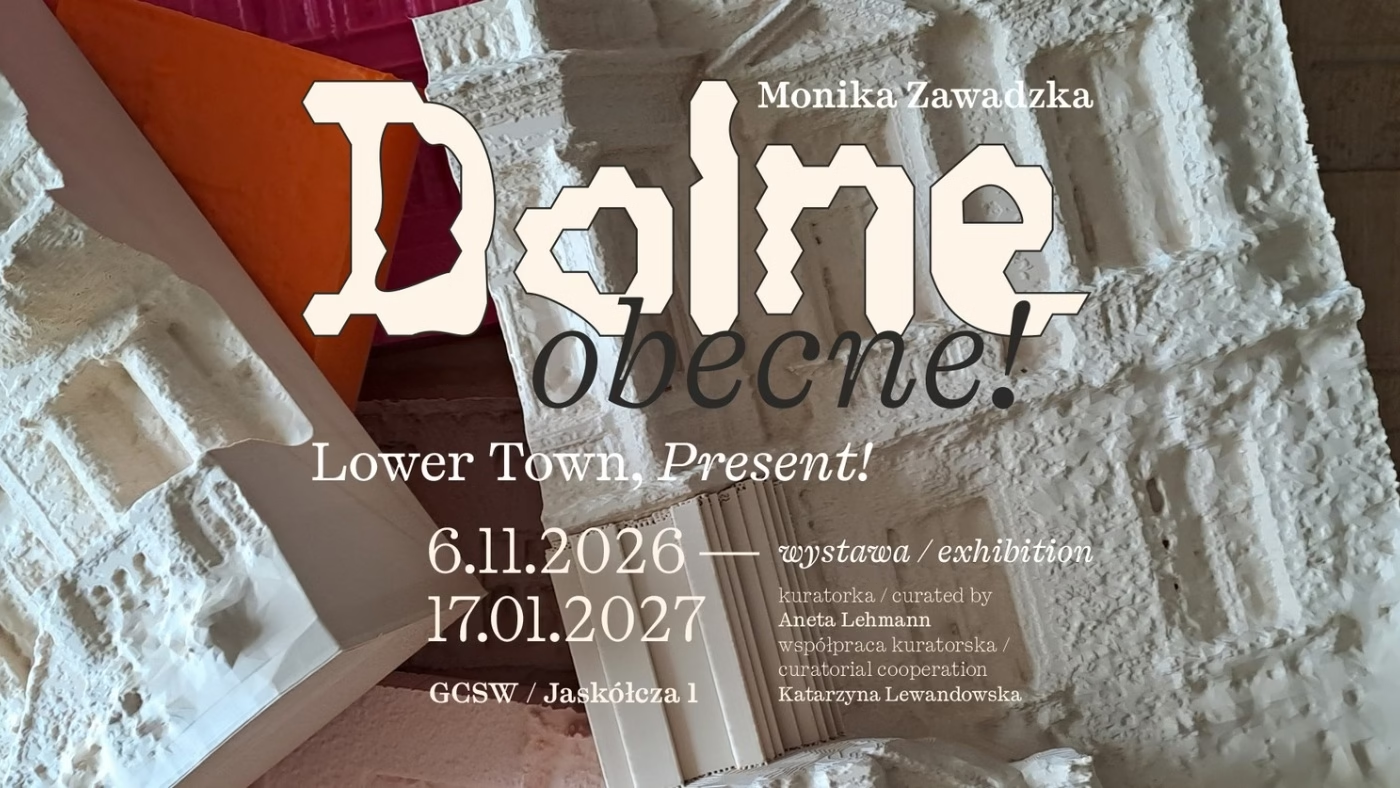
The façades of tenement houses in Gdańsk’s Lower Town are the starting point for Lower Town, Present!, an exhibition by Monika Zawadzka at Gdańskie Centrum Sztuki Współczesnej (GCSW). She looks at how the layout of buildings and streets affects the way people move around the district, meet others and come to feel they belong there. Collages, reliefs, texts, soundtracks and image sequences are meant to reveal connections that are easy to miss on an ordinary walk. The observations also raise a question about the future of the existing buildings: how to change them while keeping the conditions that let people live here in different ways.
Seeing the street up close
In her curatorial text Wystarczająco nośne ciała (the title translates roughly as ‘sufficiently load-bearing bodies’), Zawadzka describes getting to know a city through movement and the senses. What counts is the rhythm of one’s steps, stepping into shade, tiredness over distance or the way the view changes after passing another building. This understanding of place underpins her research and artistic work. She walks, returns, photographs, measures and compares, and drawings or analyses come only after direct contact with what she will later study.

Her attention rests on the ordinary houses lining the streets. Their walls have two sides: from the inside they enclose flats, from the outside they define streets and squares. Windows, shopfronts, doors and gateways allow contact between what is private and what is open to the public. Views repeated on everyday walks become familiar, even if we rarely notice how they are arranged.
Where the tenements meet
In Lower Town, Zawadzka is interested in façades joined into continuous street frontages. She looks especially closely at the points where one tenement meets the next. That is where small shifts, differences in proportion and departures from regularity become visible, and they affect how the whole street is perceived.

In her view, the district is recognisable because of repetition and small differences. The buildings share features but are not identical. The exhibition shows this by breaking urban forms into parts, changing their scale and putting them back together. Collages and reliefs are used to examine how the elements of the façades add up to a larger whole that people later recognise as a particular street or part of the district.
Lower Town bears traces of wartime destruction, rebuilding and demolition. Gaps opened up in the frontages, and later interventions changed the relationships between buildings. Zawadzka is interested in how the district keeps a recognisable character despite these breaks. The exhibition pursues this through an analysis of the buildings as they stand today, without reconstructing the order in which they were built.
How much a street makes possible
From the façades, Zawadzka moves on to the people who use the spaces between them. On the street we regularly pass people we do not know. Over time some faces become familiar. Knowing someone by sight can build a sense of belonging to a place, even when it never turns into a closer relationship.

The layout of the buildings matters for these encounters. The width of a street, the position of entrances, continuous frontages and access to public space affect where one can pass, stop, stay among others or withdraw. Architecture does not decide how people behave, but it makes some things easier and others harder.
Zawadzka calls this capacity the load-bearing capacity of urban form. She extends a term from structural engineering to the ability to support different ways of living. What matters to her is whether an existing layout can serve people with different needs and absorb further change. She also points out that the uses of buildings can pass more quickly than the built form itself.
What disappears when a passage closes
From this perspective, the future of the city depends on recognising the value of what is already standing. Zawadzka links this need to limited resources and to the need to think carefully about further building. Adaptation, repair or conversion should be preceded by checking what still works in a given place and what changes it can take. For her, technical wear is not a sufficient reason to replace existing buildings.

Losing the ability to use the city can, however, be less visible than demolition. Closing a passage, putting up a fence or cutting the link between a house and the street may seem like isolated, minor interventions. As they accumulate, they gradually narrow the available routes and the ways of spending time. Residents stay at the same address, but the conditions of their everyday life change.
Hence the text’s proposal to judge a city’s longevity by its capacity for continued use and adaptation. Preserving the walls is part of that task. Just as important is whether there is still room between them for residents’ different needs.
Faster research, more time to decide
Lower Town, Present! encourages continuous observation of the city. In the urban laboratory Zawadzka proposes, research continues after changes are made. Each intervention is followed by checking its effects, with room for correction. Walking, measuring and comparing make it possible to notice processes that a one-off assessment might miss.

This work also has room for scanners, drones, digital analysis and artificial intelligence. As the artist explains, these tools make it possible to study more districts and to identify repetitions and anomalies in large data sets. Direct experience of the street remains part of getting to know a place. Faster analysis is meant to give more time to consider what to keep, repair or transform. Zawadzka puts it briefly: ‘They speed up analysis so that we do not have to speed up intervention.’
Lower Town, Present! is on view at GCSW, Jaskółcza 1, Gdańsk, from 6 November 2026 until 17 January 2027. The opening is at 6pm on 6 November.
Planning work on an older building? Find architects, interior designers and interior photographers in the PLNDesign directory.
See also:
- Fast Textile returns to Rzgów, Poland, with fabrics for next season
- Bentley builds three one-off cars inspired by Copernicus