

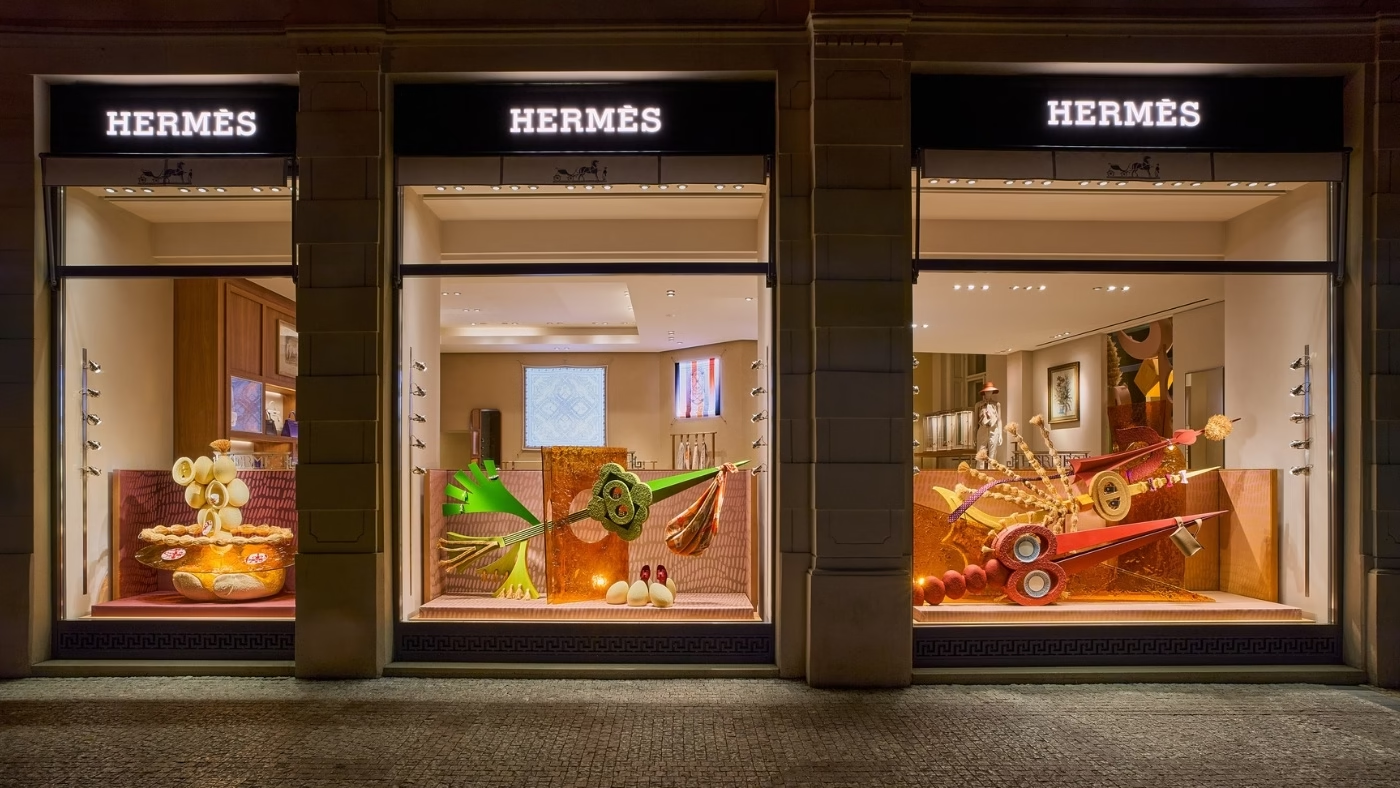
It is hard to find another fashion house with such a consistent and dedicated romance with the world of art. Hermès proves this closeness in an exceptionally spectacular way, transforming its shop windows into three-dimensional stories every six months. New storefronts, pulsating with movement and color and designed by Studio Ludism–an initiative brought to life by NOKE Architects and renowned artist Ola Niepsuj–have just been unveiled in Warsaw and Prague.
Venture Beyond in Warsaw and Prague
The new installation aligns with this year’s global theme of the Parisian fashion house: Venture Beyond. The spatial composition speaks of boldly stepping outside well-worn paths, provoking passersby to stop and immerse themselves in a created world.
“Passing Hermès storefronts in London, Paris, or Milan, we always thought: ‘Someone on the other side thinks exactly like we do.’ Today, we are the ones standing on the other side of the glass. Collaborating with this brand is a great adventure and a joy of creating with people who respect art, craftsmanship, and an original approach,” emphasize Piotr Maciaszek and Karol Pasternak of NOKE Architects.

The Meeting of Two Aesthetic Worlds
For Ola Niepsuj, the dialogue with the Parisian fashion house turned out to be a natural continuation of her own visual language.
“If someone asked me which brand impresses me most in its communication, I would point to Hermès without hesitation,” admits the artist. “Fantasy, wit, and an almost childlike joy of play have long lived on the other side of their windows. It’s a fascinating paradox: untamed frivolity stands in opposition to the seriousness of their products, although that same wit often winks at us from the detail of a silk scarf. Whenever I passed their displays, I thought: ‘How much I would love to make a design for them one day!’ Joy, magic, and an intellectual twist are exactly what I smuggle into my illustrations, collages, and posters. My aesthetic and that of Hermès are, at their core, the same language.”
A Year-Round Journey Beyond the Horizon
The return of the stork at the turn of winter and spring is a symbolic moment in our part of Europe–a promise of rebirth and prosperity. These birds create a natural bridge between continents, journeying each year from Europe deep into Africa.
“At the LUDISM brand, we always look for points of contact between ancient legends and contemporary design,” explains Ola Niepsuj. “In the storefronts in Warsaw and Prague, we created a sculptural home for the storks. And who better crosses horizons, connects seasons and continents, and speaks of beginnings and endings than our Polish stork? And who weaves a nest with the same precision with which Hermès crafts its iconic Picnic Bag?”

A story deeply rooted in our culture became the foundation of the narrative axis. The design process took a year. We followed the trail of the stork’s flight, translating Slavic heritage into spatial form. The stork became the main protagonist and guide to the idea of Venture Beyond–a symbolic embodiment of crossing boundaries.
“In my practice as an illustrator, I constantly look for ways to create worlds and invite the viewer into them. Ensuring that the entire composition has a completely immersive character is a key mechanism of Hermès windows,” adds Niepsuj.
Cubist Theatre and Scale Challenges
The process of creating the characters required juxtaposing extreme textures and forms.
“When work began, I knew from the start that the characters had to function like actors on a theatrical stage,” recounts the illustrator. “I wanted to build a pure, authentic relationship with the viewer. Our whole team translated the concept into a series of precise mock-ups and working models. We constructed the characters based on a combination of seemingly opposing qualities: geometric forms enter into a dialogue here with organic ones, deep solids with flat accents, and raw, rough textures with perfectly smooth planes.”

This opposition of materials became the key to interpreting the brand’s slogan. The horizon turned out not to be a straight line, but a mysterious place where top meets bottom, warmth meets cold, and East meets West.
“I reached for the principles of Cubism. I was inspired by Braque’s paintings, ceramic forms, and Picasso’s paper sculptures, balancing on the line between figurative art and pure abstraction,” explains the artist.
However, Hermès has its own unwritten bible of guidelines, which can be summarized in one word: magic. Objects must give the impression of floating in mid-air, emphasizing the bond between freedom and imagination.

The greatest engineering challenge proved to be translating miniature mock-ups–originally fitting inside a shoebox–into real scale.
“3D modeling, visualizations, color tests, and preparing object models were a task for Monika Zajk from Noke. Colliding this crazy little theatre with physics required compromises. We were supported in this by the teams from Formy Scenografia and Spółdzielnia Scenograficzna,” says Piotr Maciaszek.
Craftsmanship, Light and Detail
The final shape of the installation relies on a dialogue between traditional materials and craftsmanship.
“The windows in Warsaw and Prague had to breathe with the horizon,” explains Karol Pasternak. “We built them on the contrast of two fields: unique bent and fused glass that refracts light like the sky, and traditional Czech-Polish basketry. It became the clasp connecting the artistry of Hermès with our native tradition.”

Hundreds of glass transparency tests conducted by Grzegorz Olczak from Białystok, precise scale matching, and lighting management served one purpose: to ensure that a passerby standing in front of the glass saw not the engineering effort, but pure, organic magic. The whole composition is complemented by fabrics produced by the Polish company Davis Fabrics, featuring patterns designed individually for each storefront by Ola Niepsuj.
“When everything was ready, we had to transport dozens of elements to Prague and Warsaw and carry out the assembly in cooperation with Malwina Rytych from Window Stories and the Hermès team,” says Karol Pasternak. Assembly work is a huge logistical challenge. The entire process takes place under the cover of night, within a strict time slot between the closing and reopening of the boutiques. This requires precise coordination so that in the morning, the new scenography can be unveiled to captivate passersby with pure magic from the very threshold.

The final effect proves that a commercial display can become a fully-fledged work of art, backed by uncompromising craftsmanship.
“For us as a team at NOKE and LUDISM, this collaboration is proof that our local symbols, Slavic sensitivity, and craftsmanship possess a universal power capable of enchanting the entire world.” concludes Piotr Maciaszek.
Products used in the project
- Fabrics with patterns designed by Ola Niepsuj: Davis Fabrics
A shop window can be more than a backdrop for products, becoming a stage set with a story of its own. An architect or interior designer can help you plan a display for a brand or commercial space. Find architects, interior designers and interior photographers in the PLNDesign directory.
See also:
- Biuro Kreacja shapes Gdynia centenary exhibition with waves of fabric
- Klaudia Rutkowska brings textile motifs to a mural in Brzeziny