

Biuro Kreacja has designed an undulating fabric installation for a centenary exhibition at the Emigration Museum in Gdynia. Inside the historic Marine Station, all 21 districts come together, from Babie Doły to Orłowo, taking in Śródmieście, Witomino and Wzgórze Św. Maksymiliana. Titled GEN.100 – gdyński kod wspólnoty (with a subtitle meaning ‘Gdynia’s community code’), the exhibition brings together history, nature and everyday relationships in place of a conventional historical narrative. Its route rises and falls like the sea, tracing the lives of the city, its port, residents and animals. The exhibition runs until 28 February 2027. PLNDesign
A city told through 21 districts
At 100 years old, Gdynia is difficult to describe in a single voice. It has a port and forests, concrete quays where birds nest, housing estates built from prefabricated concrete panels, and former farming estates. Some residents arrived from the other end of Poland; others belong to families that have lived here for generations. The Emigration Museum’s centenary exhibition takes visitors through these different experiences without trying to fit them into a conventional account of the city’s history.

The route follows Gdynia’s 21 districts, from Babie Doły to Orłowo. The history of the port and urban planning decisions is set alongside residents’ biographies, while nature is treated as a city resident in its own right. Underpinning the exhibition is the idea of Gdynia as a home where sea, forest and concrete meet: a place that has changed continuously for a century while allowing people, plants and animals to put down roots.
The narrative has three strands. The first considers urban planning and demographics, tracing how districts were established and expanded, and how planners’ decisions affected residents’ lives. The second explores society through the biographies of people whose lives became entwined with the city’s history. The third takes a biogeographical perspective, giving a voice to nature, from birds nesting on concrete quays to species that arrived in ships’ ballast water and stayed.

For the architects at Biuro Kreacja, the challenge was to give each of these voices room without overwhelming visitors. Their exhibition projects include The Complete Kachu. The Art of Kazimierz Ostrowski, currently on view at Gdynia City Museum, and the extensive, wide-ranging The Woman Question 1550–2025, shown earlier this year at the Museum of Modern Art in Warsaw.
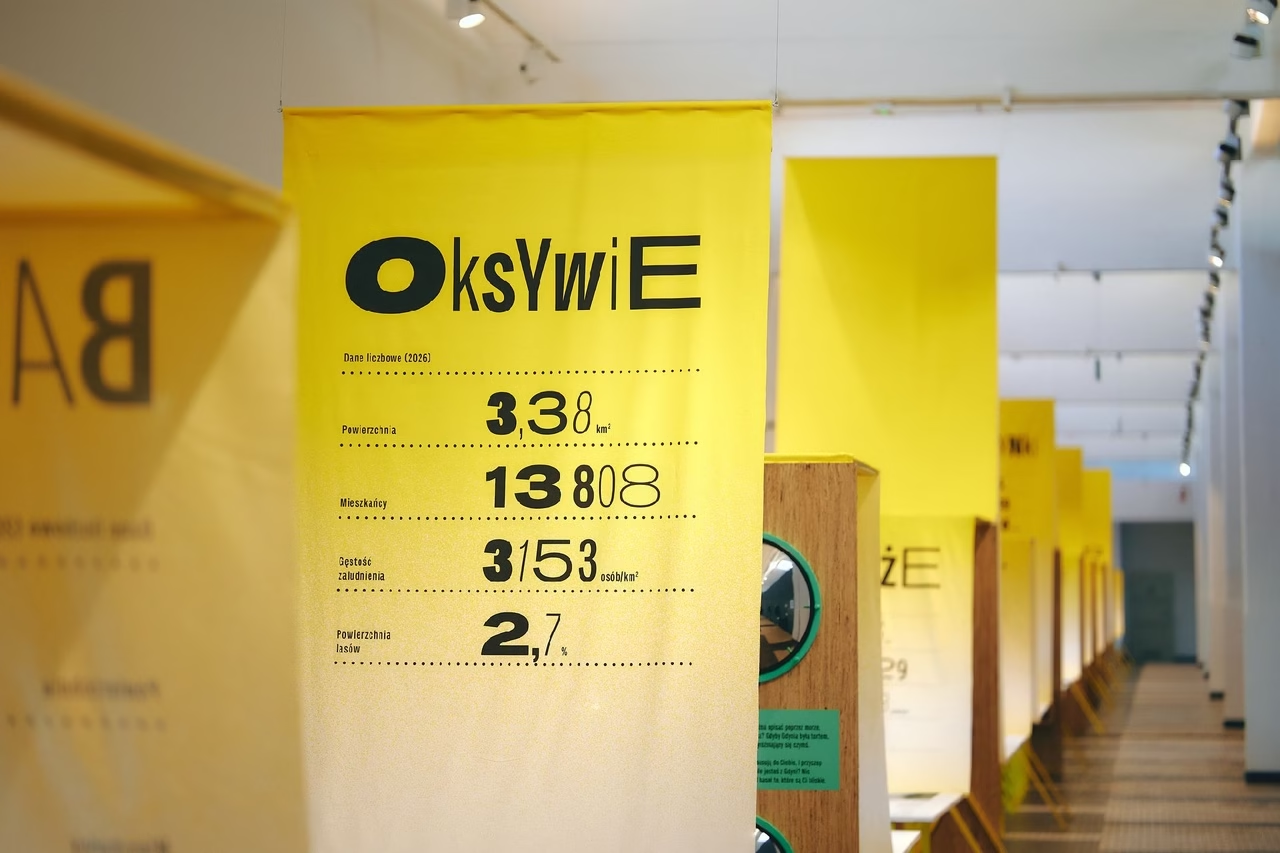
Dorota Terlecka and Wiktoria Krawczyk devised a simple, visually expressive response. Each district has its own strip of fabric, draped in an arc from a lightweight structure, with the strips forming a long wave that rises and falls like the sea. Anita Wasik’s graphic design follows the same approach to simple, clearly defined forms. Her palette of yellow, mint and white, and references to Polish typography of the 1990s, complement the spatial design.
The sea as a shared reference
‘I’m from Gdynia, and to me it has always been a collection of things that don’t seem to belong together: the port, the forest, prefabricated concrete blocks of flats, modernist Śródmieście, villages that at some point became part of the city, and people from different parts of Poland. Yet somehow it all holds together. We wondered what the common denominator was, and we realised it was the sea,’ says Dorota Terlecka of Biuro Kreacja, describing the idea behind the exhibition design.

‘It affects the climate, nature and the way we experience space. It becomes a reason to stay here and build a life. The sea is constantly moving and changing, just like this story, which is still unfolding.’
Across the hall, the installation forms a continuous, undulating ribbon, like a large scroll recording the city’s complexity. Gdynia’s story is still being written, with each new layer of history laid over the last. Lightweight fabric carries accounts of the districts’ history, daily life and residents, alongside the nature that has helped shape the city from the outset. It hangs in gentle curves above visitors’ heads and stirs with every movement of air, bringing the rhythm of the sea into the hall and making the display feel like a living record.
Each district uses the same arrangement of elements, giving its different stories a shared visual language. A printed strip bearing the district’s name descends from a yellow frame and continues onto a display table holding archival photographs, plans and texts. Timber frames already held by the museum form the structure of the exhibition. Instead of being returned to storage, they were repainted yellow and paired with newly designed tables, using what was already available to establish a rhythm of forms recalling the port’s utilitarian structures.

Materials with a life beyond the exhibition
The materials are also part of the exhibition’s message, an approach shared by the architects and the Emigration Museum. The design began by considering what would happen to the installation and its materials once the exhibition closed. Following circular economy principles, the project seeks to keep products and resources in use for as long as possible, both through recycling and by designing out waste from the outset.
Its most characteristic building material is Strumber Hemp board, made from industrial hemp stalks. Its plant origin and natural texture relate to an exhibition that interweaves the city’s history with its natural surroundings. The boards’ environmental credentials were another reason for their use.

‘We used timber frames from previous exhibitions, while the partitions and other structural elements are made from hemp boards. What’s good about this is that hemp is an annual plant,’ says Terlecka. ‘Wiktoria and I thought that making display elements for a temporary exhibition didn’t have to mean using timber, which has a considerably greater environmental impact when it is harvested.’
The architects also tried to use the largest possible sections of hemp board so that designers of future exhibitions could reuse them. Offcuts became animal figures that guide visitors through the exhibition, along with small elements for the educational trail. The printed fabric is 100 per cent cotton, allowing it to have a second life after the exhibition.
This approach to materials leaves plenty of room for colour. Hemp boards are combined with the strong yellow of the frames and fabrics, alongside mint and white. The project includes numerous new and unconventional solutions that had to be tested as work progressed, presenting a considerable challenge, Terlecka acknowledges. GEN.100 is both a bold experiment and an exploration of how temporary exhibitions can be designed more responsibly and thoughtfully.

A city of hidden corners
Smaller, more intimate spaces interrupt the rhythm of the main display, offering places to pause over an individual biography or look at the city from another perspective. The architects wanted visitors to do more than receive a finished narrative. Throughout the exhibition, they are invited to lift, uncover or move something, or choose what they want to see and hear.
In one installation, lifting contemporary views of Gdynia reveals archival photographs of the same locations. Another lets visitors use strings to plot their own routes on a city map. Questions about shared responsibility for Gdynia can be answered by leaving a contribution within an installation. Other spaces offer the perspectives of less visible inhabitants, including animals and people whose everyday work often goes unnoticed.

Physical interaction is central to these spaces. In place of more screens and conventional multimedia stations, visitors encounter retro telephone handsets, fringed fabric partitions, movable elements and small hiding places to discover for themselves. This also makes the exhibition approachable for families with children. Learning about the city involves activity, play and curiosity as well as reading and looking.
Foxes, wild boar and gulls
Animals appear throughout as unexpected guides. Three-dimensional figures are tucked among the displays and into corners, encouraging visitors to look more closely. They do more than decorate the installation: they are reminders that Gdynia’s community extends beyond its human population.
The port, quays, parks and former industrial sites also provide habitats for many other species. Over the years, they have adapted to urban life and, in some cases, become part of the city’s history. Animals greet visitors at the entrance and reappear between successive stories, recalling the coexistence of people, nature and a changing urban landscape.

A place where paths cross
‘What particularly amuses me about this exhibition is that I’m working on it with Anita Wasik, whom I first met at nursery in Gdynia. Years later, our paths are crossing again, this time through a story about a city where thousands of such encounters take place. People arrive, leave and return. New districts emerge, old places disappear, and new plant and animal species appear. Some stories last a moment; others remain for generations,’ says Terlecka.
‘It’s hard to think of a better example of what this exhibition is about: a city taking shape through all these intersections, often entirely unplanned.’

That is a useful starting point for a visit. Beyond introducing individual districts and the people who shaped them, the exhibition presents Gdynia as a place of continual encounters: between people from different backgrounds, past and present, city and nature, and planned events and chance occurrences. It portrays a city that has been remaking itself for a century, its character formed by many histories, inhabitants and relationships.
‘I’m simply a Gdynia local, proud of my city, someone who loves Gdynia and is very fond of wild boar,’ Terlecka says with a laugh. ‘I’m delighted to be making an exhibition about my own city, and I warmly invite everyone to come.’ PLNDesign
GEN.100 – gdyński kod wspólnoty is on view at the Emigration Museum in Gdynia, Polska 1, until 28 February 2027.
Exhibition dates: 17 October 2026 to 28 February 2027. Opening reception: 16 October 2026 at 18:00. Admission is free.
Exhibition spaces call for a considered approach to materials and visitor routes. Find architects, interior designers and interior photographers in the PLNDesign directory.
See also:
- No Architects reworks modernist Prague house with blue windows
- Architaste reworks an 87-square-metre family flat in Kraków