

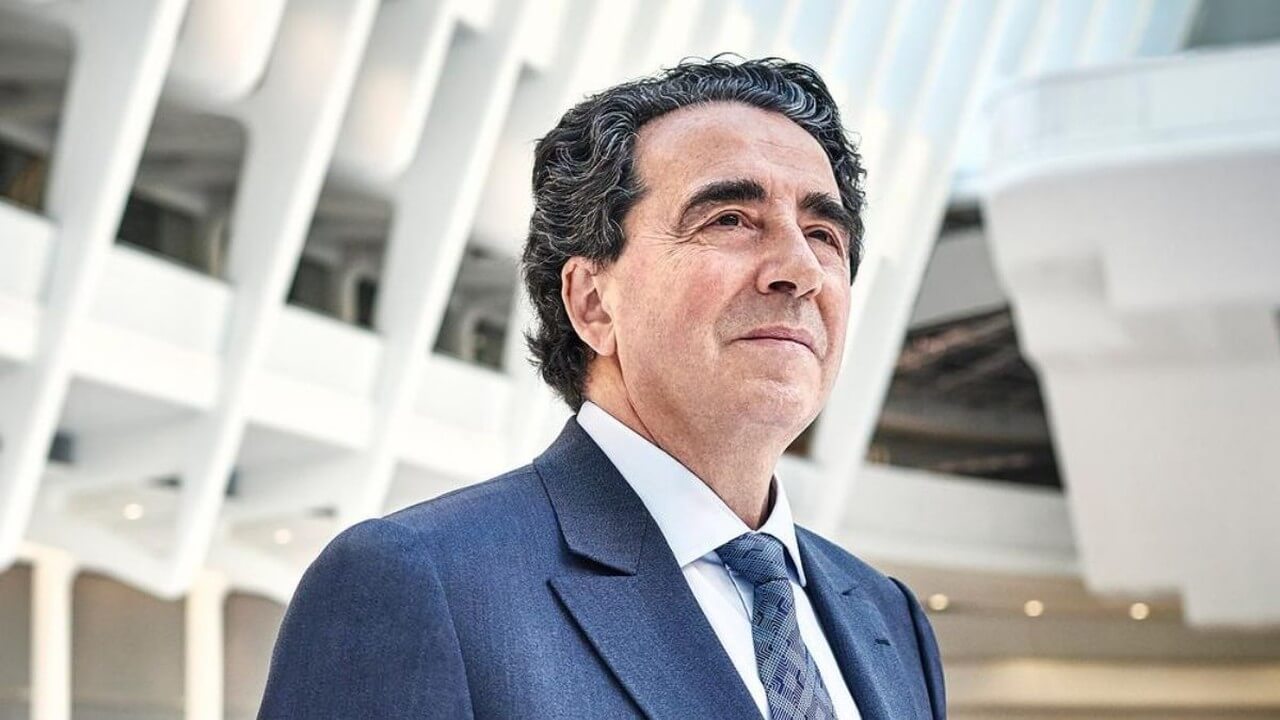
Santiago Calatrava is a Spanish architect and structural engineer, as well as a sculptor and painter, known for bridges, railway stations and public buildings whose steel and concrete structures often include moving parts. Born in Valencia in 1951, he qualified as an architect there and as a civil engineer at ETH Zurich, and has run his own practice in Zurich since 1981. His work stands on several continents, from the Alamillo Bridge in Seville to the World Trade Center Transportation Hub in New York.
Santiago Calatrava at a glance:
- Spanish architect and engineer born on 29 July 1951 in Valencia, who qualified as an architect there in 1974 and as a civil engineer at ETH Zurich in 1979, completing his doctorate in 1981.
- His buildings leave the structure on show, take their shapes from birds, trees and the human body, and often have roofs, wings or decks that move.
- His best-known works include the City of Arts and Sciences in Valencia, the Alamillo Bridge in Seville, the Turning Torso in Malmö, the Quadracci Pavilion in Milwaukee and the World Trade Center Transportation Hub in New York.
- Several projects drew criticism for cost overruns and defects, and disputes in Valencia, Venice and Oviedo ended with Calatrava paying for repairs or damages.
Who is Santiago Calatrava?
Santiago Calatrava is an architect and structural engineer who also works as a sculptor and painter, with projects across Europe, the Americas and the Middle East. He was born on 29 July 1951 in Benimàmet, now part of Valencia, and has been based in Switzerland since he went to study in Zurich in the 1970s. ArchDaily describes him as one of the few architects of his time who were also fully trained as engineers, and his practice operates as a firm of both architects and engineers.
His wife, Robertina Calatrava, whom he met while studying at ETH Zurich, is his partner in the business. In 2018 their son Micael became chief executive of Calatrava International, the firm’s Dubai-based arm.

How did Calatrava become an architect and engineer?
Calatrava trained first as an architect in Valencia and then as a civil engineer at ETH Zurich, and he has worked in both professions since 1981. He started art classes at the age of eight, at the Arts and Crafts School (Escuela de Artes y Oficios), and in 1968 went to Paris to enrol at the École des Beaux-Arts. The city was gripped by student protests, classes were cancelled and he returned to Spain. He later named a visit to Notre-Dame that year as the moment that turned him towards architecture, and a book on the architecture of Le Corbusier persuaded him that he could be both an artist and an architect.

Back in Valencia he studied at the Escuela Técnica Superior de Arquitectura, graduated in 1974 and went on to postgraduate studies in urbanism. While still a student, he published two books on the vernacular architecture of Valencia and Ibiza with fellow students. In 1975 he enrolled at ETH Zurich, qualified as a civil engineer in 1979 and in 1981 completed a doctorate on the foldability of space frames.
The same year he opened his own architecture and engineering practice in Zurich. The first commissions were small: a balcony for the Baumwollhof building in Zurich (1983), a warehouse for Ernsting in Coesfeld, Germany, and a canopy for the PTT postal centre in Lucerne (both 1983–1985). In 1983 he won his first competition, for Zurich’s Stadelhofen station. Completed in 1990, the project added a third track cut into a steep hillside, with a curved glass canopy, a promenade, three footbridges and an underground shopping arcade. International attention came with his first major bridge, the Bac de Roda in Barcelona.
What defines Calatrava’s style?
Calatrava’s buildings leave their structure on show: ribs, arches, cables and cantilevers carry the loads and also form the architecture people see. ArchDaily describes his buildings as neo-futurist. Many forms start as images from nature or from the human body, often worked out first in his sculptures. The roof of the Lyon Saint-Exupéry station comes from a sculpture of a bird about to take flight, the platform roof at Lisbon’s Oriente station is a grid of steel-and-glass trees, and the Turning Torso in Malmö grew out of a sculpture called Twisting Torso.
Movement is the other recurring theme. The sunscreen of the Milwaukee Art Museum pavilion opens and closes like a pair of wings, the ‘eyelid’ of L’Hemisfèric in Valencia lifts, the Samuel Beckett Bridge in Dublin swings 90 degrees to let ships through, and the roof of the UAE Pavilion at Expo 2020 Dubai opens on movable wings. Kinetic elements also appear in his sculpture and in public works such as the Wall of Nations in Athens.
What are Calatrava’s most famous bridges?
Bridges first brought Calatrava international attention. The Bac de Roda Bridge in Barcelona (1984–1987) is a 128-metre road bridge with pavements: a central vertical arch holds the deck on tie rods, flanked by side arches inclined at 60 degrees, and locally it is known as the Calatrava bridge. The Alamillo Bridge in Seville (1987–1992) was built for Expo ’92 over an arm of the Guadalquivir. Its single pylon, 142 metres high and inclined at 58 degrees, carries a 200-metre span on 13 pairs of cables.

The Sundial Bridge in Redding, California, opened on 4 July 2004, and its 66-metre pylon serves as the gnomon of a working sundial, one of the largest in the world. In Dublin, the Samuel Beckett Bridge opened in December 2009, with an outline that evokes a harp lying on its edge. The Peace Bridge in Calgary, a red helical steel tube for pedestrians and cyclists, opened in March 2012 and crosses the Bow River on a 126-metre span with no supports in the water.
Dallas has two Calatrava bridges over the Trinity River. The Margaret Hunt Hill Bridge, opened on 29 March 2012, is a cable-stayed bridge with a single arch-shaped pylon carrying six traffic lanes. The road lanes of the Margaret McDermott Bridge opened in 2017, but its steel arches with walking and cycling paths opened only on 10 June 2021, four years late, after wind vibration broke cable anchor rods in 2018. In Italy, the San Francesco di Paola Bridge in Cosenza opened in January 2018, with a single inclined pylon 104 metres high.
Which railway stations did Calatrava design?
Railway stations and transport hubs form the second large group of Calatrava’s works, from Zurich and Lyon to Lisbon, Liège, New York and Mons. After Stadelhofen came the TGV station at Lyon Saint-Exupéry Airport (1989–1994), won in a competition. Its central hall spans about 120 metres, and a 180-metre steel gallery leads to the airport terminal. Gare do Oriente in Lisbon opened on 19 May 1998 as the main transport link for Expo ’98, with eight tracks under a steel-and-glass roof set on a 17-metre grid. Bilbao Airport’s terminal, opened in November 2000, spreads into two symmetrical wings and is nicknamed ‘La Paloma’ (‘the dove’).
In Belgium, Liège-Guillemins station opened on 18 September 2009 with a steel-and-glass vault over nine tracks and five platforms. From October 2022 to June 2024 its glazing carried Daniel Buren’s coloured installation Comme tombées du ciel, les couleurs in situ et en mouvement (‘As if fallen from the sky, colours in situ and in motion’, 2022). The AV Mediopadana station in Reggio Emilia, the only stop on the high-speed line between Milan and Bologna, opened in June 2013 under a 483-metre canopy of steel portals that forms a wave.

The World Trade Center Transportation Hub in New York, known as the Oculus, opened on 3 March 2016 after 13 years of design and construction. Calatrava describes its form as a bird released from a child’s hands. The newest station stands in Mons, Belgium. Planned for the city’s year as European Capital of Culture in 2015, it opened to passengers on 18 December 2024 and was inaugurated on 31 January 2025, about ten years late and far over budget. Its 165-metre gallery, 15 metres wide, spans the tracks, and in November 2025 the Prix Versailles named it one of the world’s seven most beautiful passenger stations of the year.
What is the City of Arts and Sciences in Valencia?
The City of Arts and Sciences is a complex of science, cultural and leisure buildings that Calatrava designed for his home city on a 35-hectare site in the dry bed of the Turia river. He won the commission in 1991, and the buildings line a raised walkway with gardens and reflecting pools on either side.
The first to open, on 16 April 1998, was L’Hemisfèric, a building of about 13,000 square metres shaped like a human eye, with an IMAX dome cinema and a planetarium. Its ‘eyelid’ of articulated metal slats lifts open, and the building sits in a 24,000-square-metre pool. The Museu de les Ciències (Príncipe Felipe Science Museum) followed on 13 November 2000, then L’Umbracle, a landscaped promenade over a car park, in 2001, and the Palau de les Arts Reina Sofía opera house on 8 October 2005. The Assut de l’Or Bridge, 180 metres long, opened in December 2008, and the Àgora was completed in 2009. Since June 2022 the Àgora has housed CaixaForum València, converted by Enric Ruiz-Geli.
L’Oceanogràfic, the aquarium on the site, is not Calatrava’s design. It opened on 14 February 2003, its roofs were designed by Félix Candela with the engineers Alberto Domingo and Carlos Lázaro, and with 110,000 square metres it bills itself as the largest aquarium in Europe.
What are Santiago Calatrava’s best-known buildings?
Outside Valencia, his best-known buildings include the Quadracci Pavilion in Milwaukee, the Turning Torso in Malmö, the Auditorio de Tenerife, the Museum of Tomorrow in Rio de Janeiro and, at the World Trade Center in New York, both the transport hub and the St Nicholas Greek Orthodox Church. The Quadracci Pavilion of the Milwaukee Art Museum was completed in 2001. Its sunscreen, the Burke Brise Soleil, has a wingspan of 66 metres and 72 steel fins, opens or closes in about three and a half minutes and folds automatically in winds above 37 km/h. In Milwaukee the building is often called just ‘the Calatrava’, and Visit Milwaukee, the city’s tourism bureau, uses it in its logo.

The Turning Torso in Malmö, a 190-metre residential tower with 147 apartments, opened on 27 August 2005. It is built from nine five-storey cubes, and each floor is rotated 1.6 degrees against the one below, so the tower turns 90 degrees from base to top. It was the tallest building in Scandinavia until September 2022, when Karlatornet in Gothenburg passed it while still under construction.
For the 1992 Olympic Games in Barcelona, Calatrava built the 136-metre Montjuïc Communications Tower for Telefónica. The tower leans at the angle of the sun at the solstice, and its shadow on Plaça d’Europa marks the hours like a sundial. For the 2004 Olympic Games he redesigned the Olympic Sports Complex (OAKA) in Athens, adding new roofs over the Olympic Stadium and the Velodrome, the Agora with its steel arcades, the Plaza of Nations, entrance plazas with canopies and the kinetic Wall of Nations. The wall, about 250 metres long and 20 metres high, has 960 vertical elements moved by 480 motors. The stadium roof hangs from two steel arches spanning 304 metres and rising 72 metres, which were slid into place.
The Auditorio de Tenerife (Adán Martín) in Santa Cruz de Tenerife opened on 26 September 2003, with 1,616 seats in its Symphony Hall. Its roof rises to 58 metres and rests on just two points, and Calatrava compares it to a crashing wave. The opening programme included Fanfarria Real (‘Royal Fanfare’, 2003), written for the occasion by the Polish composer Krzysztof Penderecki and performed by the Orquesta Sinfónica de Tenerife under Víctor Pablo Pérez.

In Rio de Janeiro, the Museum of Tomorrow (Museu do Amanhã) opened on 17 December 2015. Its height was limited to 18 metres, its roof cantilevers 75 metres over the plaza in front and 45 metres towards the bay, and the roof carries movable solar ‘wings’. At the World Trade Center, the St Nicholas Greek Orthodox Church and National Shrine replaces the church destroyed when the South Tower collapsed on 11 September 2001. The new building has a domed nave between four corner towers and draws on Hagia Sophia, the Chora Church and the Rotunda in Thessaloniki. Its Pentelic marble cladding is lit by LEDs at night. The church was consecrated on 4 July 2022 and opened for regular services on 6 December 2022.
Two more recent buildings also move. The Innovation, Science and Technology Building of Florida Polytechnic University in Lakeland opened with the university on 16 August 2014, and above its glass roof 94 louvred arms rise and fall during the day to follow the sun. At Expo 2020 Dubai, his UAE Pavilion, about 15,000 square metres and inspired by a falcon in flight, opened its roof with 28 movable carbon-fibre wings in about three minutes. The pavilion remains at Expo City Dubai, and Calatrava also designed the Qatar Pavilion for the same Expo.
Does Calatrava also work as a sculptor and designer?
Yes. Calatrava has made sculpture, drawings, paintings and ceramics throughout his career, and he says: ‘My sculpture precedes my work as an architect.’ Several buildings began as sculptures, and the Oculus in New York grew out of his 1990 sculpture Mother and Child.
His art has been shown in major museums. The Metropolitan Museum of Art in New York held Santiago Calatrava: Sculpture into Architecture in 2005–2006, the State Hermitage in St Petersburg opened The Quest for Movement in 2012 as its first retrospective of a contemporary architect, and the Vatican Museums presented about 140 works in The Metamorphoses of Space in 2013–2014. The Museo di Capodimonte in Naples showed about 400 works, including more than 50 ceramics, in In the Light of Naples (2019–2020), co-curated by Robertina Calatrava. The Glyptothek in Munich set 14 wrought-iron sculptures and 30 works on paper among its ancient statues in Beyond Hellas (2022).
In 2021 he completed a permanent installation in the Church of San Gennaro at Capodimonte, which reopened after 50 years with his painted walls, stained glass, silk textiles and ceramics made with the Real Fabbrica di Capodimonte. His public sculptures include Wave (2002) at the Meadows Museum of Southern Methodist University in Dallas, 129 bronze bars that move in a wave over a black granite pool. The obelisk on Madrid’s Plaza de Castilla, unveiled in December 2009, is a 92-metre steel tube covered with 462 bronze bars designed to move hydraulically, and it has stood still since around 2012, when the city dropped its maintenance contract.
Design work runs alongside the architecture. For the Tabourettli cabaret theatre in Basel (1986–1987), Calatrava designed the bar, light fittings and furniture, including a mobile bar in chromed steel and pearwood. He designed the Montjuic floor lamp for Artemide, and stage sets for Las Troyanas (‘The Trojan Women’, 2001) in Valencia and Ecuba (‘Hecuba’, 2003) in Rome.
Why is Santiago Calatrava controversial?
Criticism of Calatrava centres on cost overruns, delays and defects in public projects, and several disputes ended in court or in settlements under which he paid for repairs. The City of Arts and Sciences in Valencia cost more than €1 billion, about four times its original budget. A Valencia court ruled that the name of a website critical of him, ‘Calatrava te la clava’ (‘Calatrava rips you off’), was insulting and awarded him €30,000, while finding its content to be legitimate criticism.
At the Palau de les Arts in Valencia, pieces of the trencadís, a mosaic of broken ceramic tiles, came off the roof on 26 December 2013. Performances were cancelled, the building closed and the regional government announced legal action. In January 2014 Calatrava’s office and the contractors, Acciona and Dragados, agreed to pay for the repairs. The mosaic was removed, the opera house reopened on 23 February 2014, and a new trencadís was laid between November 2014 and October 2015 at no cost to the public.

In Venice, the Ponte della Costituzione over the Grand Canal opened on 11 September 2008. Its cost rose from €6.7 million to about €11.5 million, and construction took 2,052 days instead of the planned 456. The glass steps became slippery in rain and needed costly maintenance within months. In 2015 the regional section of Italy’s Corte dei conti cleared Calatrava, but in August 2019, on appeal, he was ordered to pay €78,000 for gross negligence: a design error had raised construction costs and the glass steps had raised maintenance costs. In May 2026 the city began testing a new material on the first steps.
In Oviedo, part of the Palacio de Exposiciones y Congresos collapsed during construction on 9 August 2006, lightly injuring three workers, and a roof canopy designed to move never worked and was fixed in place. In June 2013 a court in Oviedo set the damages at €10.55 million, minus €7.28 million in unpaid fees, and in February 2014 the provincial appeal court reduced the amount Calatrava had to pay to €2.96 million.
In New York, the cost of the World Trade Center Transportation Hub rose from about $2 billion, when the design was announced in 2004, to $3.9 billion. Other disputes include the Bodegas Ysios winery in Laguardia, completed in 2001, whose owner, Domecq Bodegas, sued Calatrava and the builder Ferrovial in 2013 for about €2 million over a leaking roof. In Bilbao, the glass deck of the Zubizuri footbridge (1997) is slippery in wet weather, and there Calatrava was the claimant: in 2009 a court awarded him €30,000 after a walkway was attached to his bridge without his consent.

In Athens, the Olympic Stadium and the Velodrome were closed on 29 September 2023 after an engineering study found that their steel roofs did not meet the minimum level of structural adequacy, a condition made worse by corrosion and nearly two decades without maintenance. In February 2024 the Technical Chamber of Greece judged the stadium safe once the roof’s polycarbonate panels had been removed, and a restoration contract was signed in May 2025. Calatrava himself, in a 2015 interview with El Mundo, said he accepts criticism of his work as long as it rests on professional criteria and arguments.
Which Calatrava projects were never built or are still under way?
Several of Calatrava’s largest designs were never built or are still waiting for construction. The Chicago Spire, a twisting tower of 150 floors and about 610 metres, would have been the tallest building in the Western Hemisphere. Work began in June 2007 and stopped in October 2008 during the financial crisis. The project was abandoned by the end of 2010, and in November 2014 the site passed to the developer Related Midwest, whose 400 Lake Shore towers, designed by SOM, are now rising there, with the first due for completion in spring 2027.
The Dubai Creek Tower for Emaar takes its form from a minaret, with cables that recall the ribs of a lily leaf. Ground was broken on 11 October 2016, but work stopped in April 2020. In February 2024 Emaar’s founder, Mohamed Alabbar, said the tower would not be as tall as the Burj Khalifa. In January 2026 the company announced a construction tender within three months, then postponed it in June 2026 over material costs, and no completion date has been set.
In Doha, Calatrava’s 2013 masterplan for the Sharq Crossing proposed three bridges linked by short submerged tunnels across Doha Bay. The project was postponed in 2015, and in August 2025 Qatar’s public works authority, Ashghal, commissioned a new needs assessment and concept study. In Chicago he was one of five finalists in the 2019 competition for the O’Hare Global Terminal, won by Studio ORD, a team led by Studio Gang. In Taoyuan, Taiwan, his Yuan Ze Arts and International Conference Hall, with a 1,200-seat concert hall and a 480-seat theatre, has been under construction since April 2021.
What awards has Santiago Calatrava received?
His main honours include the Prince of Asturias Award for the Arts (1999), the Gold Medal of the American Institute of Architects (2005) and the European Prize for Architecture (2015). Earlier he received the Auguste Perret Prize of the International Union of Architects (1987), the Fazlur Rahman Khan International Fellowship of the SOM Foundation (1988) and the Gold Medal of the Institution of Structural Engineers (1992). In 2005 Spain gave him its National Architecture Prize, and in 2023 the Florence Biennale presented him with the Leonardo da Vinci Lifetime Achievement Award for Design.
Santiago Calatrava – frequently asked questions
What is Santiago Calatrava famous for?
He is known for bridges and railway stations in which the load-bearing structure is the visible design, and for buildings with roofs and wings that move. He has also exhibited as a sculptor at museums including the Metropolitan Museum of Art and the Vatican Museums.
How many bridges has Santiago Calatrava designed?
Calatrava has designed more than 50 bridges around the world. They range from the Bac de Roda Bridge in Barcelona, built in the 1980s, to the San Francesco di Paola Bridge in Cosenza, opened in 2018.
Where is Calatrava’s practice based?
The practice has been based in Zurich since 1981. It opened offices in Paris in 1989, Valencia in 1991 and New York in 2004, and today works from Zurich, New York and Dubai.
Is Santiago Calatrava still working?
Yes. His station in Mons opened in December 2024, and the Haus zum Falken, an office building next to Stadelhofen station in Zurich, was completed in November 2025. A retail and office complex under a vaulted roof on Düsseldorf’s Königsallee is due in 2028.
A bridge, a station roof or a building with moving parts depends as much on structural engineering as on design, and the choice of practice decides whether an ambitious form can be built on budget and on schedule. Find architects, interior designers and interior photographers in the PLNDesign directory.
See also:
- Zaha Hadid: life, famous buildings and legacy
- STUDIO KONDE – a Poznań-based architectural firm co-creating the public space of Greater Poland