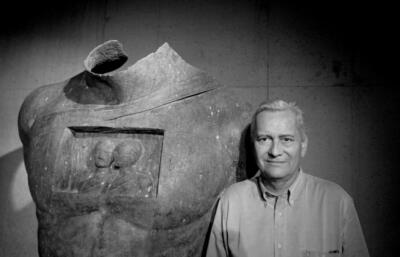


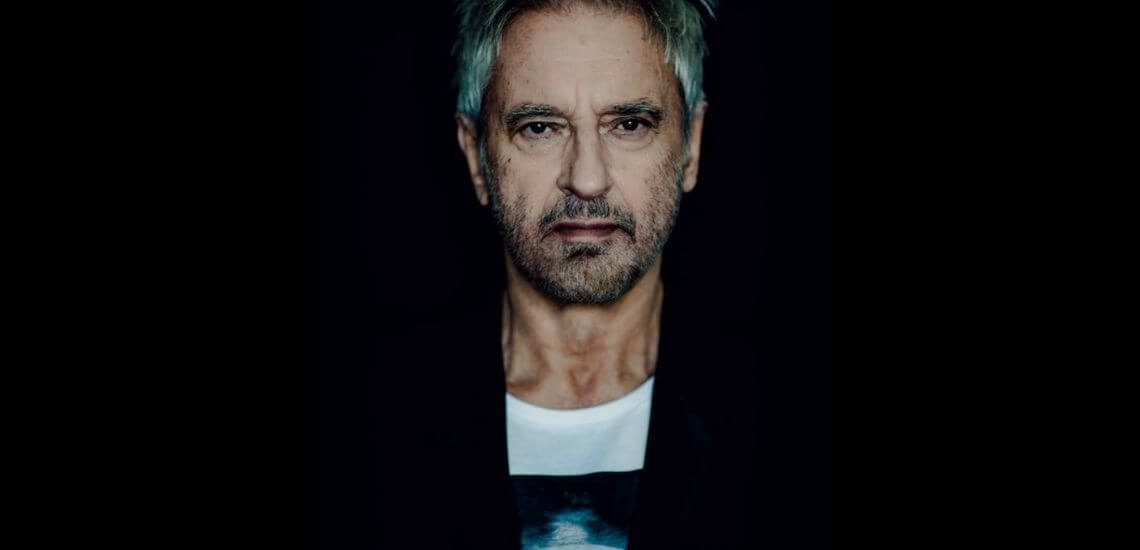
Rafal Olbinski is a Polish painter, illustrator and poster designer, born on 21 February 1943 in Kielce, Poland, and now 83. Trained as an architect, he spent 33 years in New York making covers for Time and Newsweek, then came back to Poland and settled in Warsaw, where he lives and paints. He calls his style ‘poetic surrealism’.
Rafal Olbinski at a glance:
- Born in Kielce in 1943, he graduated in architecture from Warsaw University of Technology in 1969 and spent the 1970s as graphic editor of the magazine Jazz Forum.
- He left Poland in 1981 and, with martial law closing the way back, built a career in New York as an illustrator for American and German magazines.
- His paintings join the metaphor of the Polish poster to a realist technique, and René Magritte is the painter he is most often compared with.
- He has received more than 150 awards, and his work is in the collections of the Museum of Modern Art in New York and the Library of Congress.
Who is Rafal Olbinski?
Rafal Olbinski is a Polish painter, illustrator and poster designer associated with the Polish School of Posters. He was born on 21 February 1943 in Kielce, the eldest of seven children, and went to secondary school there before studying architecture at Warsaw University of Technology. His teachers included Bohdan Pniewski and Jerzy Hryniewiecki, and he graduated in 1969.
While still a student he entered a state competition for a poster marking the centenary of Lenin’s birth and came second. After graduating he moved into graphic design: from 1970 to 1980 he was graphic editor of Jazz Forum, and he designed record sleeves for musicians including Krzysztof Klenczon and the band Breakout. In 1981 he made a poster for Andrzej Wajda’s Man of Iron (Człowiek z żelaza).
The tradition he is linked with built a poster around a single metaphor that the viewer had to decode. Olbinski kept that method when he moved on to press illustration and, later, to painting.

Why did Olbinski move to New York?
Olbinski left Poland in 1981, first for Paris and then for New York, and the declaration of martial law on 13 December 1981 kept him from going back. He already knew the city from a three-month stay in 1978. He would go on to live there for 33 years.
His first American commission was a cover for Psychology Today in March 1982. Covers for Time, Newsweek, The New Yorker, The Atlantic Monthly and Business Week followed, along with illustrations for The New York Times. For almost two years Newsweek’s art director asked him nearly every week for a cover idea, an experience Olbinski later described as ‘a fantastic school of conceptual illustration’. Time also put him on a cover: its art director photographed him for an issue on new immigrants to the US, and his likeness appeared among the figures on the cover.
For the German news magazine Stern he painted a series illustrating essays on moral values, published in seven consecutive issues. The paintings then went on tour, and the first exhibition was hosted by Eva Luise Köhler, wife of the then German president. Alongside his commissions he taught, from 1983 to 1988 at the Tyler School of Art at Temple University in Philadelphia and later at the School of Visual Arts in New York, until 2001.

What is Olbinski’s ‘poetic surrealism’?
‘Poetic surrealism’ is Olbinski’s own name for his approach: a realist painting built around a visual metaphor that the viewer has to read. Asked about his influences, he has answered ‘everybody’, naming in particular Saul Steinberg, Milton Glaser, Marshall Arisman and Brad Holland.
René Magritte is the surrealist he is most often compared with, as the writer Richard Burgin points out in his essay for the album Olbinski: malarstwo / painting. Burgin, who published Olbinski’s covers in his literary magazine Boulevard, draws a distinction between the two: Magritte celebrated the irrational and the absurd, while Olbinski’s pictures carry meaning and deal with the conscious mind as much as with the unconscious.

Writing about his exhibition at the SZOKART gallery in Poznań, art historian Małgorzata Marszałł argues that his idyllic, dreamlike landscapes lack the anxiety of historical surrealism and that his figures are idealised and statuesque, closer to classical art. She lists the motifs that keep returning: women in red dresses, doves and swans, water, architecture, celestial bodies, musical instruments and nature clipped like a baroque garden. Olbinski himself treats each painting as the starting point for a story the viewer can make up, and asks that his pictures not be taken too seriously.
Reviewing his exhibition at Salon Desa Unicum in Warsaw for Rzeczpospolita in September 2011, critic Monika Małkowska wrote that he had been relying on the same devices for years and copying himself in series. Among the faults she listed were ‘banality of thought, a tendency towards sentimentality, graphomaniac associations’.
What are Olbinski’s best-known posters and opera designs?
Two strands run through his poster work: commissions for New York, including the official New York City Capital of the World poster of 1995, and opera posters such as Salome for New York City Opera. The New York design won an invitational competition judged by a jury led by Mayor Rudy Giuliani. A year earlier he had received the Prix Savignac in Paris, an award for the world’s most memorable poster, for an anti-drug poster, as well as the Creative Review award for the Best of British Illustration in London.

In Salome, after Richard Strauss’s opera, he placed the eye of John the Baptist on an intimate part of Salome’s body. The image caused a scandal, but it worked as advertising and won awards from the design magazines Print and Communication Arts. For the US Information Agency he designed a poster for the 25th anniversary of Earth Day, and from 2002 to 2010 a selection of his paintings was part of the Earth Day projection at Grand Central Terminal in New York, alongside work by Keith Haring, Roy Lichtenstein, Robert Rauschenberg and Andy Warhol.
Opera took him beyond posters. In 2002 he designed the sets for Mozart’s Don Giovanni at the Opera Company of Philadelphia, and he made more than 100 covers for opera recordings in the Opera D’Oro series. His posters include a Macbeth for Opera Pacific in Orange County, California, in 2001. In Poland he has worked with the Polish National Opera in Warsaw, Opera Nova in Bydgoszcz and the opera house in Białystok, for whose new building, opened in 2012, he painted a 30-metre smoke curtain. His poster for Verdi’s Macbeth at Wrocław Opera turns Macbeth’s head into a labyrinthine castle crowned with a drop of blood.
When did Olbinski start painting?
Olbinski painted his first pictures in 1992, as illustrations for poems by a friend who was a poet and gallerist. When the planned book fell through, the friend showed the paintings at a gallery on West Broadway in New York, and all of them sold. Painting has been the core of his work ever since: in 2020 he put the number of paintings he had sold at around 2,000.

In 1999 Gallery 444 in San Francisco commissioned a painting of the city, and the proceeds from posters of it went to the San Francisco Chronicle’s Season of Sharing Fund. Exhibitions followed in Germany and the US: a retrospective at the Willy-Brandt-Haus in Berlin in 2001, Art with Moral Purpose at the Goethe-Institut in Hamburg in 2002 and New Dreams of Old Values at the Jule Collins Smith Museum in Auburn in 2009.
How much is a Rafal Olbinski painting worth?
The highest price Olbinski has cited for one of his paintings is $125,000, paid through Gallery 444 in San Francisco. At auction in Poland, Gratifying importance of complicity (2008) sold at Desa Unicum in Warsaw on 7 October 2021 for PLN 168,000, including the buyer’s premium.
Prints are a far cheaper way to own his work. Polish galleries and auction houses sell giclée prints of his paintings under the name ‘inkography’: inkjet reproductions on paper, usually made with pigment inks. They come in numbered editions, most often of 20 (marked I/XX), signed by hand. An inkography is not a one-off, so it costs a fraction of the price of an original painting.
Where can you see Olbinski’s work?
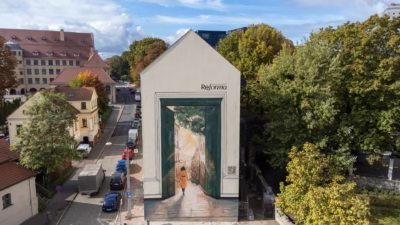
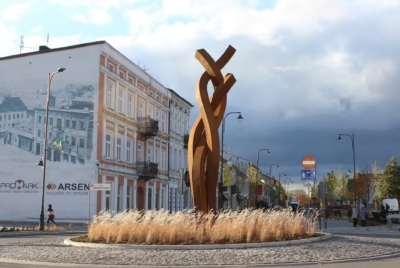
Olbinski’s work is held by museums in the US, Japan and Poland, and two large works of his are installed in public places in Poland.
The bronze bull was unveiled in Katowice in September 2025. It is 4.75 metres long and 2.41 metres high and weighs 1,600 kilograms. It marks the 160th anniversary of Katowice’s town rights, 20 years of Poland in the European Union and 20 years of the In Corpore Foundation, and its design goes back to a cover Olbinski made for Der Spiegel in 2004.
In Poland his work has recently been shown in large museum exhibitions: a monographic show of nearly 300 works at the National Museum in Kielce in 2021, which was then shown at the Castle of the Pomeranian Dukes in Szczecin in 2021–22, and an exhibition of more than 80 works at the Museum of the History of Katowice in 2023.

What awards has Olbinski received?
Olbinski has received more than 150 awards, among them gold and silver medals from the Art Directors Club of New York and from the Society of Illustrators in New York and Los Angeles. In Poland he received the gold Gloria Artis Medal for Merit to Culture in 2005 and the Officer’s Cross of the Order of Polonia Restituta in 2012.
Rafal Olbinski – frequently asked questions
How old is Rafal Olbinski?
Rafal Olbinski was born on 21 February 1943 in Kielce and turned 83 in February 2026.
Where does Rafal Olbinski live now?
He lives and works in Warsaw. He moved back to Poland after 33 years in New York.
Is Rafal Olbinski a surrealist?
He describes his work as ‘poetic surrealism’. Art historian Małgorzata Marszałł argues that he goes beyond surrealism, and her essay on his work presents him as a symbolist.
Has Rafal Olbinski written books?
Yes. He made his literary debut in 2007 with 12 opowiadań (‘12 Stories’) and later published the bilingual Tales of Love and Other Curious Predicaments, the poster album Passion for Posters (2016) and Mój Nowy Jork (‘My New York’, 2024) about his years in the US. In 2018 BOSZ published Olbinski: ars picturae, which pairs his paintings with sonnets by the English poet Ian Lukins.
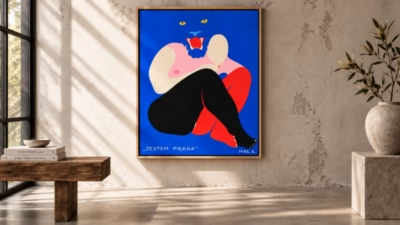
An original painting or a numbered print needs a wall, lighting and furniture chosen around it, and those decisions are made earliest, at the interior design stage. If you are planning a room around a single work or a whole collection, find architects, interior designers and interior photographers in the PLNDesign directory.
See also:
- A wedding gift in Melbourne among 17 stories from a Polish gallery
- Splot honours three cultures in Zduńska Wola, Poland