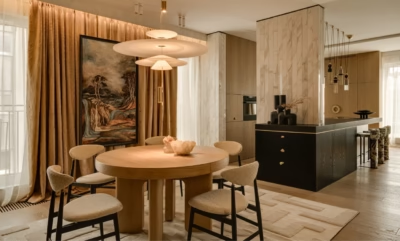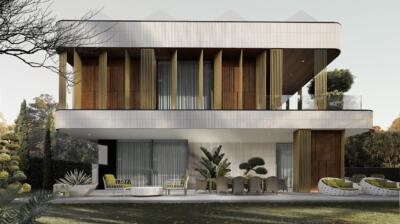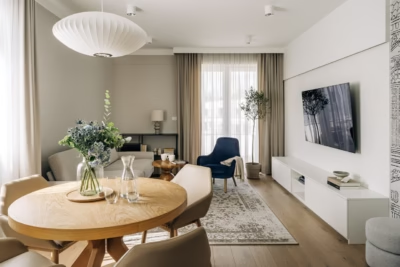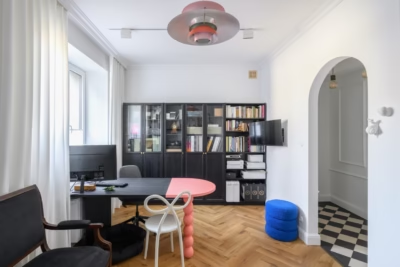


Mid-century modern is the style of architecture, interiors and furniture that took shape in the 1930s and was at its most popular from 1945 to the late 1960s, above all in the United States. It pairs clean lines and open plans with natural materials, and several of its chairs, tables and lamps are still made today. The style also flourished in Scandinavia and Brazil, and post-war Poland produced classics of its own.
Mid-century modern at a glance:
- Rooted in the 1930s, the style grew out of Bauhaus ideas brought to the United States by émigré architects and reached its height in the post-war decades.
- Clean lines, open plans and large windows shape both the houses and the interiors, with wood as the main material alongside moulded plywood, fibreglass and steel.
- White, beige and brown form the base palette, broken up with mustard, olive green, turquoise or orange.
- Low furniture on slim, tapered legs keeps rooms looking light, and a single strong period piece can set the tone of a whole room.
What is mid-century modern?
Mid-century modern is a movement in architecture, interior design and furniture from the middle of the 20th century, based on simple forms, practical layouts and natural materials. ‘Mid-century’ refers to the middle of the century, in practice the 1940s to the 1960s.
The style organises a room around a balance between form and function. Clean geometric lines, very little ornament and a close link with nature are its defining traits, and the same principles run through its houses, interiors and objects.

What are the key features of mid-century modern design?
Clean lines, an open plan, plenty of daylight and natural materials are the clearest signs of mid-century modern. Interiors feel spacious and carry little decoration.
Economy of form comes first. Simple volumes, geometric patterns and a practical approach give every piece of furniture a place and a purpose, which leaves no room for knick-knacks. The open plan matters just as much: the living area runs into the kitchen, rooms share functions and unnecessary walls disappear. Large windows and glazed sections of wall make daylight the main source of light, and furniture is spaced generously.
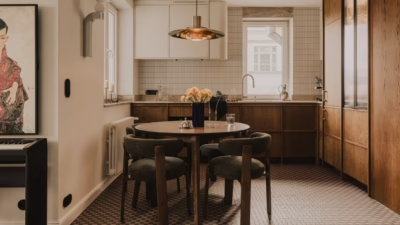
Materials are natural: warm-toned wood with a visible grain, leather, metal, stone and glass. Designers also took up the new materials of the day, from moulded plywood and plastics to vinyl, acrylic and stainless steel, and often paired wood with metal. Rounded forms are another signature, with round, semicircular and oval shapes in furniture, bathroom fittings, accessories and patterns on fabrics and tiles. Sideboards, armchairs and sofas stand on slim, tapered legs, which makes them look smaller and keeps the floor visible.

Which colours define mid-century modern?
A neutral base of white, warm beige, light grey and brown, broken up with mustard yellow, olive green, turquoise or orange, is the classic mid-century modern palette. Black-and-white contrast plays a role of its own.
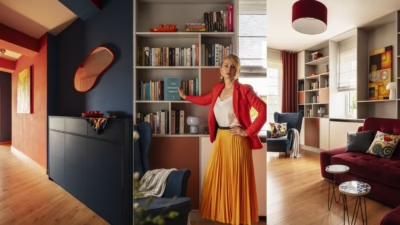
Deeper colours sit against the neutral background: bottle green, olive, rust, copper, navy and cobalt blue, as well as burgundy and chocolate brown. The strongest accents, including mustard, orange, rust red, turquoise and dusty pink, usually appear in curtains and cushions, less often in upholstery, and occasionally on a single feature wall. Contemporary schemes pair period colours with soft whites and beiges for a lighter, calmer room.

Where did mid-century modern come from?
Mid-century modern grew out of the Bauhaus and developed in the United States after the Second World War. Its roots go back to the 1930s, and it was at its most popular from 1945 to the late 1960s.
The Bauhaus, which operated in Germany from 1919 to 1933, held that form should follow function and that an interior could do without superfluous ornament. In 1932 New York’s Museum of Modern Art presented Le Corbusier, Walter Gropius, Ludwig Mies van der Rohe and J.J.P. Oud as leaders of the International Style in Modern Architecture: International Exhibition, curated by Philip Johnson and Henry-Russell Hitchcock. Several Bauhaus figures had moved to the United States before the war. Gropius and Marcel Breuer began teaching at Harvard in 1937, and in 1938 Mies took charge of the architecture department at the Armour Institute of Technology in Chicago, which became the Illinois Institute of Technology in 1940. Alvar Aalto taught at MIT as a visiting professor in the 1940s but never settled in the United States.

After the war, demand for housing rose quickly, and new materials and production methods made it possible to build houses and furniture in large numbers at accessible prices. The Case Study House Program, launched by Arts & Architecture magazine under its editor John Entenza in January 1945, commissioned inexpensive, efficient model homes for the post-war housing boom. It produced 36 designs, 25 of which were built, most of them in and around Los Angeles.
Other traditions fed into the style. Scandinavian modernism contributed natural materials and simple, practical forms, and designers such as Hans Wegner, Finn Juhl and Arne Jacobsen created the Scandinavian side of the mid-century canon. In Brazil, modernism took on organic shapes and bold structures. Brasília, inaugurated in 1960, was planned by Lúcio Costa, and Oscar Niemeyer designed its main buildings.
Which furniture defines mid-century modern?
Mid-century modern furniture has clean lines, a low profile and slim, tapered legs that make it look light. It combines good looks with ergonomics and is usually made of wood, though designers also turned to moulded plywood, fibreglass and plastics.
Case furniture such as tables, sideboards and shelving is straight-lined and built for everyday use. Seating puts comfort first, with seats and backs shaped to the body, mostly in soft, flowing lines without sharp edges. A typical interior has solid-wood shelving and sideboards, low coffee tables, media units on slender legs, and sofas and chairs on wooden legs.

Many pieces from those years became design classics. Charles and Ray Eames introduced the Lounge Chair and ottoman in 1956, built from three moulded plywood shells upholstered in leather. Their moulded fibreglass shell chair of 1950 became the first mass-produced plastic chair, and their Hang-It-All coat rack followed in 1953. Eero Saarinen designed the Womb Chair, released by Knoll in 1948, and the Tulip chair, launched by Knoll in 1957, which stands on a single pedestal instead of four legs. Isamu Noguchi designed his coffee table in 1944: a heavy glass top resting on two identical curved pieces of wood.
Other classics came from George Nelson’s studio, including the Marshmallow Sofa of 1956 and the Ball Clock of 1949. Arne Jacobsen designed the Egg chair in 1958 for the lobby of the SAS Royal Hotel in Copenhagen. Verner Panton conceived the Panton Chair in 1960, and when Vitra put it into production in 1967 it became the first chair made entirely of plastic in a single piece.
Which lighting and accessories suit mid-century modern?
Accessories in a mid-century modern room have simple, geometric forms and a clear period character: design-led lamps, handmade ceramics, vintage posters and abstract prints. Restraint matters, because too many small objects work against the economy of the style.
Lighting does most of the work. Geometric and futuristic shapes, tripod floor lamps and brass wall lights suit the style, as do several lamps that entered design history. George Nelson’s Bubble lamps of 1952 consist of a steel wire frame sprayed with a translucent plastic skin. Isamu Noguchi made his first Akari light sculptures in 1951 in Gifu, with washi paper over a bamboo frame, taking traditional Japanese chōchin lanterns as a model. Max Ingrand designed the Fontana lamp for FontanaArte in 1954. Next to wooden furniture, metal and glass fittings work well.

Ceramics from the middle of the century are another mark of the style: figurines, cups, jugs and teapots with abstract decoration, displayed in glazed cabinets or on open shelves. Many such pieces still turn up at flea markets. On the walls, non-figurative paintings in strong colours and black-and-white abstract or linear prints in thin frames fit well. Textiles rely on linen, wool and cotton, plain or with geometric patterns, and houseplants such as monstera, ficus and palms suit the style. Mirrors make a room feel larger, and bathroom models are usually simple ovals or circles.
What does mid-century modern architecture look like?
Mid-century modern architecture uses simple geometric volumes, open interiors and large areas of glass that open the house to its surroundings. Many of its houses were built in the suburbs, surrounded by greenery.
New materials, more efficient production and better transport helped the style spread. Buildings had clean lines and open spaces, and floor-to-ceiling windows let in as much daylight as possible. Architects dropped ornament in favour of simple, comfortable spaces, and wood, often set against metal, was the dominant material. The connection with nature was central: open plans, panoramic windows and plants inside the house all served the idea of removing the boundary between the home and its setting.
Key examples include the Farnsworth House near Plano, Illinois, a glass pavilion completed by Mies van der Rohe in 1951. Richard Neutra’s Kaufmann Desert House in Palm Springs dates from 1946, and José Antonio Coderch completed Casa Ugalde in Caldes d’Estrac, Catalonia, in 1952. Between 1949 and 1966 Joseph Eichler’s company built more than 11,000 modernist houses in California, designed for middle-class buyers.

What did mid-century modern look like in Poland?
Polish designers adapted modernist and functionalist ideas and created their own classics, including Józef Chierowski’s 366 armchair, Teresa Kruszewska’s Muszelka (‘little shell’) chair and Roman Modzelewski’s RM58 armchair. Furniture systems, ceramics and textiles of the period share the same restrained, geometric forms.
Bent plywood played its part, and the National Museum in Warsaw has set these experiments alongside the work of Alvar Aalto and Charles and Ray Eames. Kruszewska formed the seat of the Muszelka, shown in 1956, from a single sheet of plywood. Modzelewski made the RM58 by hand in 1958 from fibreglass-reinforced polyester laminate, one of the first Polish pieces in that material. The original white model is in the collection of the V&A in London, and the chair has since been reissued by Vzór. The 366 armchair was made in Świebodzice. For a competition held in 1961, Bogusława and Czesław Kowalski designed a modular furniture system for small flats, which stayed in production for more than three decades.

Polish ceramics of the mid-20th century form a chapter of their own. Porcelain figurines came from the Institute of Industrial Design (IWP) in Warsaw, where Henryk Jędrasiak, Mieczysław Naruszewicz, Hanna Orthwein and Lubomir Tomaszewski designed them from the mid-1950s, and the Ćmielów factory took over their production in 1964. Coffee and dinner services from factories in Chodzież, Jaworzyna Śląska and Wałbrzych carried geometric or graphic decoration. The same years produced the woven works of Magdalena Abakanowicz, Jolanta Owidzka and Maria Teresa Chojnacka, and posters by Józef Mroszczak, Henryk Tomaszewski and Jan Lenica of the Polish School of Posters suit interiors in this spirit.
How do you decorate a room in mid-century modern style?
The rules are the same throughout the home: simple wooden furniture on slim legs, an open plan, a muted base palette and a few strong accents. What changes from room to room are the details.
In the living room, start with a strong centrepiece, such as a large design-led sofa or a simple geometric coffee table, with 1950s-style armchairs around it. A low wooden sofa on slim legs, an irregularly shaped rug and a large pendant light all work, and cushions and prints with geometric patterns lift the muted colours. High, loft-like rooms suit the style particularly well.

The kitchen relies on simple geometric forms and natural materials: wood, stainless steel and glass. Cabinet fronts in walnut or teak go with natural-material worktops, geometric tiles and minimal handles. Accents of turquoise, mustard or olive work against the muted base, and retro-styled appliances finish the scheme.
In the bedroom, a wooden bed, plain or with an upholstered headboard, takes centre stage, with low bedside tables and a chest of drawers on slim legs. Linen and cotton bedding stays in calm colours, with geometric patterns on throws and cushions, alongside geometric lamps and 1950s-inspired prints. In the bathroom, wooden vanity units pair with metal accents and geometric tiles, oval or round mirrors, taps with flowing lines and period-style lighting such as wall lights with opal glass shades. The colours stay in warm whites, beige or olive.
How do you mix mid-century modern with a contemporary interior?
Mid-century modern sits well in a contemporary interior as long as it stays in proportion: one strong period piece against simple, current forms is often enough. It also combines with Scandinavian, industrial and boho styles.
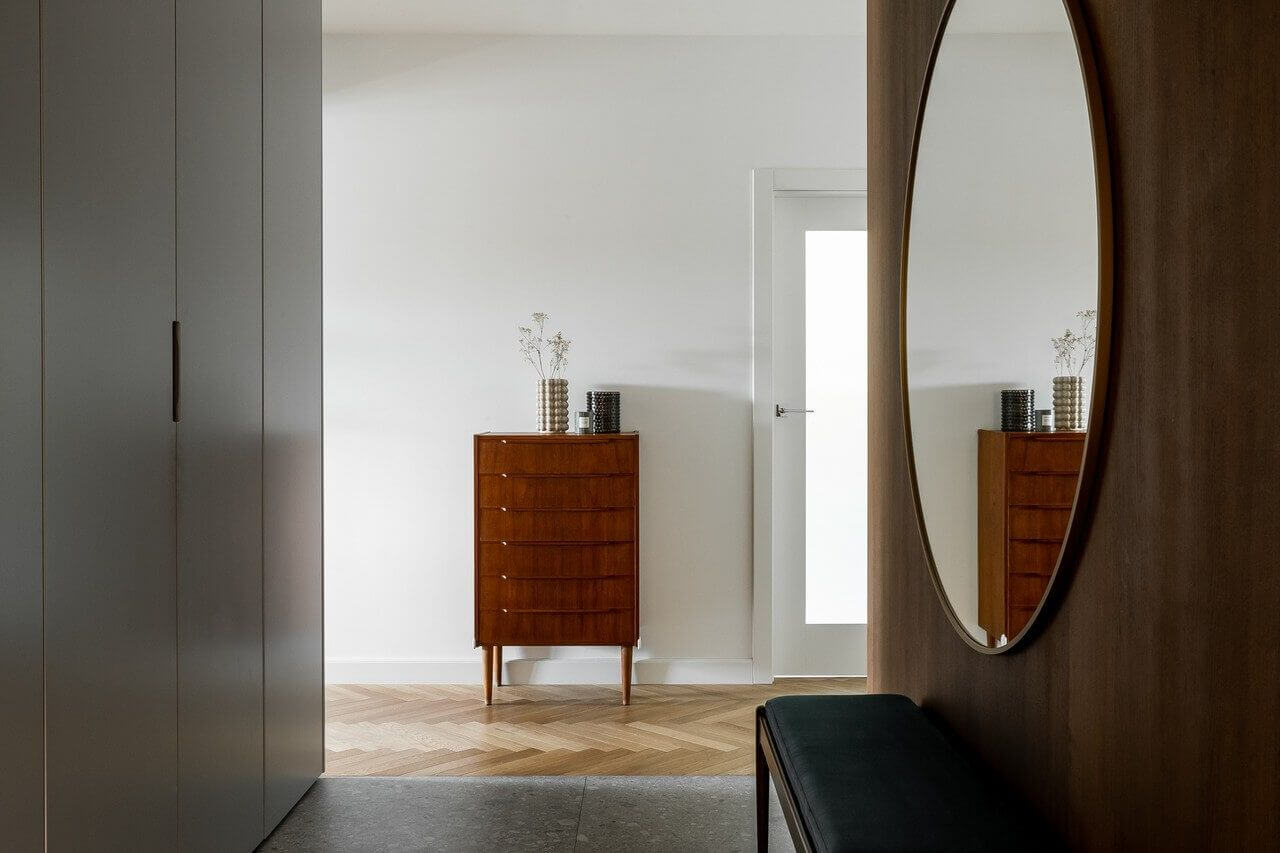
Mixing textures helps, for example a vintage wooden chest of drawers against a concrete wall or next to industrial accessories, as does pairing old with new, such as a classic 1960s armchair beside a contemporary sofa in a muted colour. Keep the palette consistent, with a single strong period accent, and choose furniture with simple, practical forms whatever its age. Modern technology such as smart lighting or audio systems can live alongside classic design if it is hidden or carefully built in.
The contemporary version of the style changes some elements. Plain upholstery replaces patterned fabric, and bold patterns stay in cushions or curtains. Decades-old originals, which can be expensive at auction, are not essential either, since licensed reissues and more affordable interpretations of period designs are available.

What mistakes should you avoid with mid-century modern?
The easiest ways to spoil a mid-century modern interior are furniture that contradicts its principles and buying without a plan.
- Ornamented furniture. Carved legs, routed fronts, deep chesterfield buttoning and gilding clash with the smooth forms of the period, even when the upholstery colour fits a 1950s palette.
- Furniture at the wrong scale. A deep corner sofa sitting flat on the floor or a heavy chest of drawers on a plinth overwhelms low armchairs and tables on slender legs. Pieces in one room should be of a similar height and similar lightness.
- Covered windows. Heavy gathered curtains with a pelmet and tall furniture placed under the window cut the room off from daylight and the view, which the architecture of the movement relied on.
- Impulse buys. An armchair or chest of drawers from an antiques fair, bought only because it dates from the period, may not fit the planned spot or have any role there. Measure the room, alcoves and passages before you buy.
- A replica bought as an original. A chair described as ‘Eames-style’ is a copy or an interpretation, not an Eames chair. Vitra is the sole authorised manufacturer of Eames furniture for Europe and the Middle East, and Herman Miller for all other markets. When buying second-hand, the first check is a label from one of these two manufacturers.

Mid-century modern – frequently asked questions
Who coined the term ‘mid-century modern’?
The phrase appeared in print as early as 1953. Cara Greenberg defined it as a design movement in her 1984 book Mid-Century Modern: Furniture of the 1950s.
Is mid-century modern still in style?
Yes. Interest in the style revived in the late 1990s and has continued since, and some of its classics never left production: Herman Miller has made the Eames Lounge Chair without a break since 1956, and Knoll and Fritz Hansen still produce the Tulip chair and the Egg chair.
Which woods were used in mid-century modern furniture?
Teak, walnut and oak are the woods most associated with the style. Designers also used moulded plywood, alongside new materials such as fibreglass and plastics.
What is the difference between mid-century modern and retro?
Mid-century modern is a specific movement in mid-20th-century design, with its own designers, canon of furniture and architecture, while retro is a broader term for anything that looks back to the past, without being tied to one decade. Eero Saarinen’s Tulip chair belongs to mid-century modern, and a new fridge styled after the 1950s is retro design. Strictly speaking, mid-century modern covers objects from the period and their official reissues, and new furniture in the same spirit is inspired by the style.
How is mid-century modern related to Scandinavian design and the Bauhaus?
All three share functionalism: an object should above all work well, and ornament is unnecessary. The Bauhaus designed with industrial production in mind, while Scandinavian modernism favoured wood, leather and craft. Alvar Aalto used bent plywood and birch instead of tubular steel in his Paimio chair of 1932, and MoMA credits the chair with a strong influence on Charles and Ray Eames and Eero Saarinen.
Does mid-century modern suit a small flat?
Yes. Light colours and furniture raised on slim legs make a small room feel larger, and an open plan helps keep it in order.
Keeping low furniture on slim legs in proportion, deciding where an original piece belongs and making an open plan work in a contemporary home are decisions that benefit from professional advice. Find architects, interior designers and interior photographers in the PLNDesign directory.
See also:
- A Warsaw homeowner swaps minimalism for colour and art
- A guitarist’s first apartment takes its colours from his father’s art