

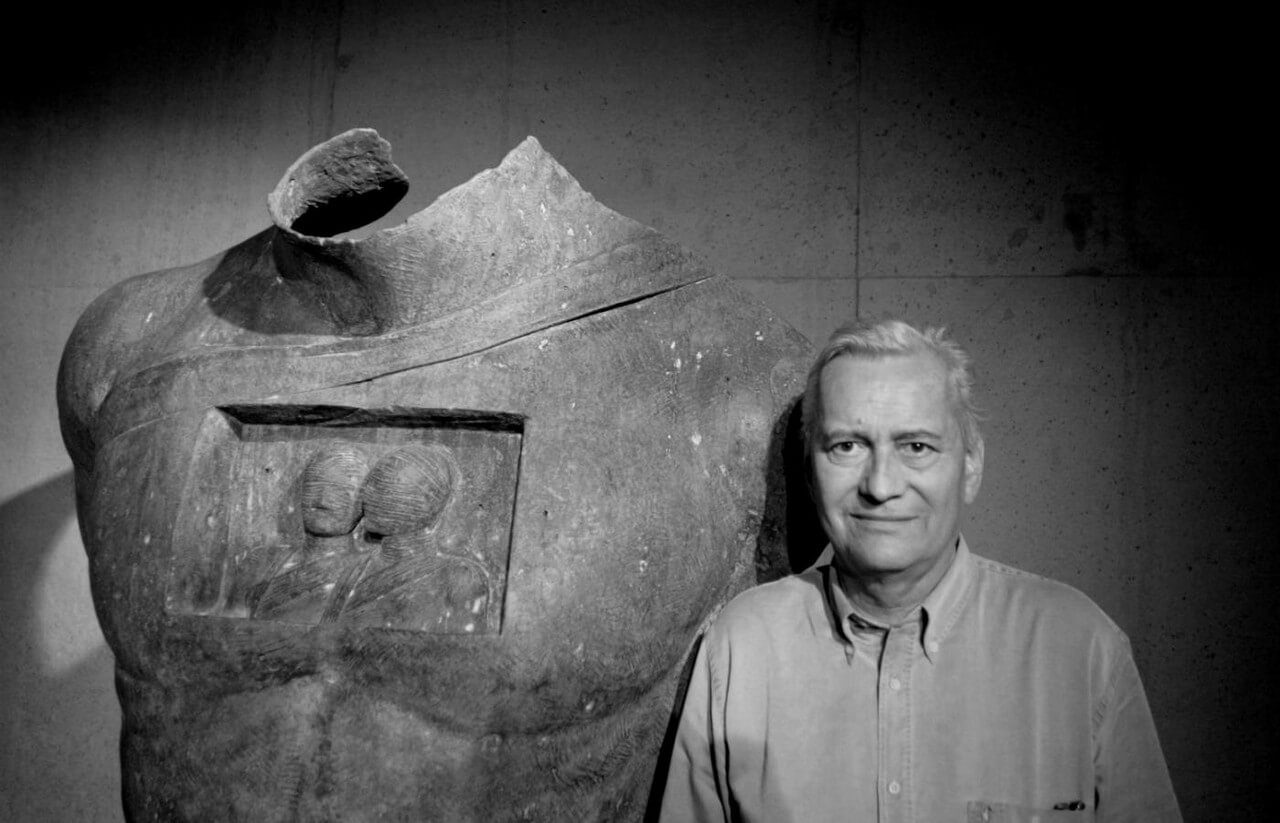
Igor Mitoraj (1944–2014) was a Polish sculptor known for large bronze and marble figures in the classical tradition, deliberately cracked, bandaged or left without limbs. Born in Germany and trained in Kraków and Paris, he worked for three decades in Pietrasanta, the Tuscan marble town that opened a museum devoted to him in June 2026. His sculptures stand in public spaces from Canary Wharf in London to the archaeological sites of Pompeii and Agrigento.
Igor Mitoraj at a glance:
- Born Jerzy Makina in 1944 in Oederan, Germany, to a Polish mother, he grew up in Poland, studied in Kraków and Paris and from 1983 had his studio in Pietrasanta, Italy.
- His sculptures rework Greek and Roman figures as damaged fragments, and he called them works of ‘fantastic archaeology’.
- Permanent public works stand in Rome, Florence, Pompeii, Paris, Lausanne, London, Kraków and Warsaw, among other cities.
- The Mitoraj Museum opened in Pietrasanta on 6 June 2026, in a former covered market completed in 1968.
Who was Igor Mitoraj?
Igor Mitoraj was a Polish sculptor who spent most of his working life in France and Italy and received commissions for large public works in cities including Rome, Paris, London, Atlanta and Tokyo. He was born Jerzy Makina on 26 March 1944 in Oederan, a small town in Saxony. His mother, Zofia Makina, was a Polish forced labourer in wartime Germany, and his father was a French Foreign Legion officer held there as a prisoner of war. The boy was named Jerzy, the Polish equivalent of his father’s first name.

After the war his mother took him back to Poland, where he spent his childhood in his grandparents’ village of Grojec in the south of the country. When she married Czesław Mitoraj, mother and son both took his surname. It happens to join the Polish words for ‘myth’ (mit) and ‘paradise’ (raj), though that was a coincidence of family law rather than an artist’s choice. Jerzy became Igor only after he moved to France.
How did Igor Mitoraj become a sculptor?
Mitoraj trained as a painter and turned to sculpture in the mid-1970s, after a year in Mexico and a successful first solo exhibition in Paris. After secondary art school in Bielsko-Biała, he entered the Jan Matejko Academy of Fine Arts in Kraków in 1963 to study painting under Tadeusz Kantor, the painter and theatre director who later pushed him to leave communist Poland. He first exhibited at Kraków’s Krzysztofory Gallery in 1967.
In 1968 he moved to Paris, partly in the hope of finding his father, whom he never met, and enrolled at the École nationale supérieure des Beaux-Arts. Early in the 1970s he spent a year painting and travelling in Mexico, where Aztec art drew him towards sculpture. Back in Paris, his first solo show, at Galerie La Hune in the Latin Quarter in 1976, was successful enough to convince him to concentrate on sculpture. The same year he won the Prix de la sculpture de Montrouge, which brought him a studio in the Bateau-Lavoir in Montmartre, granted by the French culture minister.

An exhibition for the Artcurial gallery in Paris then took him to Pietrasanta, a Tuscan town of bronze foundries and marble workshops close to the Carrara quarries. He spent a year there making his first bronzes and his first monumental figures in white marble, and the Colombian sculptor Fernando Botero urged him to buy a house in the town. In 1983 Mitoraj set up his studio in Pietrasanta and made it his main home, while continuing to spend time in Paris.
Recognition in Italy followed a major exhibition at Castel Sant’Angelo in Rome in 1985, which led to an invitation to the Venice Biennale in 1986. In 1989 he showed in New York for the first time, at the New York Academy of Art. Pietrasanta made him an honorary citizen in 2001, as did Greve in Chianti and Massa Marittima. In Poland he received the gold Gloria Artis Medal for Merit to Culture in 2005, the Commander’s Cross of the Order of Polonia Restituta in 2012 and an honorary doctorate from the Kraków academy where he had studied.
When did Igor Mitoraj die?
Igor Mitoraj died in Paris on 6 October 2014, aged 70. In the months before his death he opened Traces of Time, his first major solo exhibition in London, at ContiniArtUK on New Bond Street, and his sculptures went on show in Pisa’s Piazza dei Miracoli. He was buried in Pietrasanta, as he had wished.

What makes Igor Mitoraj’s sculptures recognisable?
Mitoraj took the idealised heads and torsos of Greek and Roman sculpture and presented them as damaged fragments, with cracked surfaces, missing limbs and faces wrapped in bandages. He described his own art as an example of ‘mesmerising perfection attached to corrupted imperfection’. The subjects come from myth, and Icarus, centaurs, Eros, Mars and the Gorgon recur throughout his titles. One detail repeats across his heads: the lips are modelled on his own and serve as an informal signature.
He liked to call his sculptures works of ‘fantastic archaeology’, and the Mitoraj Museum presents them as a reworking of ancient and Renaissance forms rather than copies of them. In 2010 the University of Salento gave him an honorary degree in archaeology. Mitoraj rejected the idea that he worked from particular statues. ‘To ancient models I prefer living models,’ he once said, adding that he took something from the people he met in the street. The museum still lists Henry Moore and César among his influences.

He began with terracotta and bronze. After a trip to Carrara in 1979, white Carrara marble became his main material, and in Pietrasanta he worked with the town’s marble workshops and bronze foundries. His work has also been dismissed as kitsch. Magdalena Howorus-Czajka, a cultural historian at the University of Gdańsk, traced that dispute in a 2018 study of how Mitoraj was received in Poland, and noted that it went quiet when he died.
Where can you see Igor Mitoraj’s sculptures today?
Mitoraj’s public works are on permanent view in more than a dozen cities, with the largest group in Italy and others in France, Switzerland, the UK, Poland, Germany, the Netherlands and the United States. Most of them stand outdoors, in squares, parks, gardens and archaeological sites.
Pietrasanta itself became an open-air gallery of his work long before the museum opened. In Rome, his bronze doors open into the Basilica of Santa Maria degli Angeli e dei Martiri and his Dea Roma fountain stands on Piazza Monte Grappa. In Florence, Tindaro Screpolato (‘Cracked Tyndareus’), a bronze head just over four metres high, stands in the Boboli Gardens. Mitoraj gave it to the Uffizi Galleries to mark his 1999 exhibition in the gardens and the city’s National Archaeological Museum.
Showing his work among the ruins of Pompeii was a long-held wish that came true only after his death, in a 2016 exhibition of about 30 bronzes. Two of them stayed for good, given by the artist’s foundation: Daedalus beside the Temple of Venus and Centauro in the Forum. In Agrigento, Icaro Caduto (‘Fallen Icarus’), a broken-winged bronze figure lying on the ground, has remained in front of the Temple of Concordia in the Valley of the Temples since his exhibition there in 2011.
Grand Toscano, his first monumental sculpture, has stood at La Défense, the Paris business district, since 1981, later joined by Ikaria and Icare. The half-torso, half-face figure has an extra head set where its heart would be. In Lausanne, Porta Italica (1997), another bronze fragment of a face, stands in the Olympic Park beside the Olympic Museum, on a free sculpture trail that runs down towards Lake Geneva.
In London, three bronzes stand on the Canary Wharf estate, whose outdoor art is free to see. Testa Addormentata (‘Sleeping Head’, 1983), a bandaged female head lying on its side, is on Bank Street, Centauro (1984) is in Montgomery Square and Centurione I (1987) is in Columbus Courtyard. The British Museum once had a Mitoraj outside its entrance: in 1994 the curator James Putnam invited him to install Tsuki-No-Hikari (‘Moonlight’), a bronze half-head, in the forecourt as part of Time Machine, an exhibition that placed contemporary art beside ancient Egyptian sculpture. It stayed there for years before going into storage to make room for growing visitor numbers. Outside London, Héros de Lumière (‘Hero of Light’, 1986), a nine-tonne figure carved from Carrara marble, belongs to the Yorkshire Sculpture Park near Wakefield, where Mitoraj had a solo exhibition in 1992.
In Kraków, Eros Bendato (‘Eros Bound’), a 1,900-kilogram bronze head lying on the paving of the Main Market Square, was the artist’s gift to the city in 2005, decades after he had studied there. Warsaw has a winged Icarus outside the city’s sports museum, the doors of the Jesuit church in the Old Town and Tindaro, a four-metre head that now stands in front of the Palace of Culture and Science on Plac Centralny.

In Germany, another cast of Centurione I stands on Am Kranen in Bamberg, and in the Netherlands Luci di Nara is on the seafront sculpture boulevard at Scheveningen, in The Hague. In the United States, another version of Eros Bendato is in Citygarden, the sculpture park in downtown St Louis, and the Hirshhorn Museum and Sculpture Garden in Washington DC holds his work in its collection, including Gorgon Hunters (1987).
What is the Mitoraj Museum in Pietrasanta?
The Mitoraj Museum is the first museum devoted to Igor Mitoraj, opened on 6 June 2026 in Pietrasanta, the town where he lived and worked from 1983. It is run by the Fondazione Museo Igor Mitoraj, set up in 2022 by the Italian Ministry of Culture, the Region of Tuscany and the Municipality of Pietrasanta. The foundation grew out of two substantial donations of works from the artist’s heir, Jean-Paul Sabatié, and its director is Frank Boehm.
The museum occupies Pietrasanta’s former covered market, completed in 1968 to a design by the architect Tito Salvatori. Milan-based studio OBR (Open Building Research) converted it, keeping the original three-aisled structure. The ground floor is given over to Mitoraj’s work, with service spaces in the basement and indoor and outdoor areas reserved for temporary exhibitions. The opening exhibition, Mitoraj. Present, shows the foundation’s collection to the public for the first time, with 69 works across his materials, formats and themes.
Mitoraj. Present is on view at the Mitoraj Museum, Viale Oberdan 35, Pietrasanta, until 10 January 2027. From September to May the museum opens on Thursdays from 10:00 to 17:00 and from Friday to Sunday from 10:00 to 19:00. From June to August it opens every day except Friday from 18:00 to 23:00, and on Fridays from 10:00 to 13:00. Last admission is 30 minutes before closing.
How did Mitoraj work with architecture?
Mitoraj made several works as parts of buildings and public spaces, and many of his public sculptures were placed against specific architecture, from Greek temples to office towers. In Rome he made the bronze doors of the Basilica of Santa Maria degli Angeli e dei Martiri, a church Michelangelo designed within the ruins of the Baths of Diocletian. The two doors, the Porta dell’Annunciazione and the Porta della Risurrezione, were unveiled early in 2006 and include an image of John Paul II, who had recently died. In 2009 he completed doors for the Jesuit church in Warsaw’s Old Town.
For Rome he also made Dea Roma (2003), a fountain ten metres high carved in Tivoli travertine, the stone of Bernini’s works and of the city’s bridges. It shows a fragment of a woman’s melancholy face. The defence and aerospace group Finmeccanica, now Leonardo, commissioned it and gave it to the city. It stands in a small garden a few steps from the company’s headquarters.
His exhibitions often used historic architecture as a backdrop: Trajan’s Market in Rome, the Tuileries Gardens in Paris and the Royal Castle in Warsaw in 2004, sites across Venice in 2005, the Valley of the Temples in 2011 and Pisa’s Piazza dei Miracoli in 2014. His permanent works at La Défense and Canary Wharf set the opposite scene, with cracked classical heads among glass office towers.
He also worked for the stage, designing sets and costumes for Puccini’s Manon Lescaut (2002) and Tosca (2006) at the Puccini Festival in Torre del Lago, for Verdi’s Aida in Florence’s Boboli Gardens (2009) and in Doha (2012), and for Verdi’s Messa da Requiem at the Arena di Verona in 2013. His jewellery was the subject of an exhibition at Galleria Contini in Venice in 2018.
Igor Mitoraj – frequently asked questions
Was Igor Mitoraj Polish?
Yes. He was born in Germany in 1944 to a Polish mother, grew up in Poland and studied at the academy in Kraków before leaving for Paris in 1968. He later lived between France and Italy and is buried in Pietrasanta.
Can you see Mitoraj’s sculptures in London for free?
Yes. Three of his bronzes stand outdoors on the Canary Wharf estate, on Bank Street, in Montgomery Square and in Columbus Courtyard, where the public art needs no ticket. The nearest permanent work outside the capital is Héros de Lumière at the Yorkshire Sculpture Park.
What is Igor Mitoraj’s most expensive sculpture?
The record belongs to Tindaro, a four-metre head sold at the Polswiss Art auction house in Warsaw in September 2025 for €1.6 million. The new owner kept it on public display in the city.
Placing a large sculpture in a garden, a courtyard or a lobby means weighing its scale against the space and the architecture around it, a decision worth making with an architect or designer. Find architects, interior designers and interior photographers in the PLNDesign directory.
See also:
- Rafal Olbinski: the Polish poster artist of poetic surrealism
- A wedding gift in Melbourne among 17 stories from a Polish gallery