

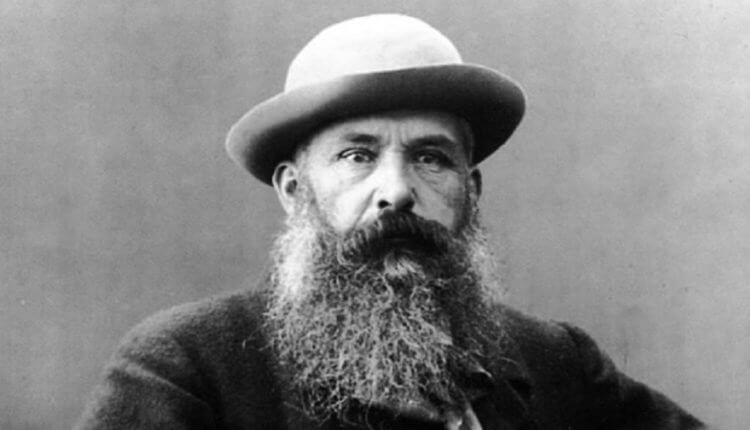
Claude Monet (1840–1926) was a French painter and one of the founders of Impressionism, the movement named after his painting Impression, Sunrise. He is best known for working outdoors and for series that show one subject in changing light: grainstacks, poplars, Rouen Cathedral, the Thames in London and, for the last three decades of his life, the water-lily pond in his own garden at Giverny. His career ran from caricatures sold in a shop window in Le Havre to a $110.7m auction record.
Claude Monet at a glance:
- French painter born in Paris on 14 November 1840, who died at Giverny on 5 December 1926 and helped found Impressionism.
- Impressionism takes its name from Impression, Sunrise (1872), a title the critic Louis Leroy turned against the whole group in 1874.
- Cataracts clouded his sight from around 1908; three operations on his right eye in 1923 and tinted lenses let him go on painting.
- His auction record is $110.7m, paid in May 2019 at Sotheby’s New York for a canvas from the grainstacks series.
Who was Claude Monet?
Claude Monet was a French painter and a founder of Impressionism, the movement that takes its name from one of his canvases. He was born at 45 rue Laffitte in Paris and baptised Oscar-Claude, and he died at Giverny in Normandy at the age of 86.

He built his reputation on painting outdoors and on returning to a single motif again and again to record how light altered it at different hours and seasons. He painted grainstacks in the fields, poplars on a riverbank, the facade of Rouen Cathedral and bridges over the Thames, and from 1899 until his death he painted, above all, the pond he had dug in his own garden.
How did Monet become a painter?
Monet began as a caricaturist. In 1845 his family moved from Paris to the port town of Le Havre, where his father ran a grocery and ship-chandling business and hoped his son would join it, while his mother, a singer, encouraged his drawing. As a teenager Monet sold caricatures through the window of the stationer and framer Gravier, charging 10 to 20 francs apiece, and by his own reckoning earned about 2,000 francs. In an interview in 1900 he said that had he kept going, he would have been a millionaire.
The landscape painter Eugène Boudin noticed the caricatures in the shop and persuaded the young man to try oil paint and work in the open air. Monet later likened the moment to a veil being torn away. His earliest known painting, View from Rouelles, was accepted for an exhibition in Le Havre in August 1858.

His mother had died in January 1857, and his aunt, Marie-Jeanne Lecadre, a widow who painted in her spare time, backed his ambitions. In 1860 he enrolled at the Académie Suisse in Paris, where he met Camille Pissarro. Military service soon interrupted his studies. On 29 April 1861 he enlisted for seven years in the 1st Regiment of Chasseurs d’Afrique and was posted to Algeria. In 1862 he caught typhoid and was sent home to recover, and his family bought him out of the army. He later said that the light and colour of Algeria contained the seeds of his later experiments.
In the summer of 1862, near Le Havre, he met the Dutch landscape painter Johan Barthold Jongkind, to whom he credited ‘the definitive education of my eye’. That December he joined the Paris studio of Charles Gleyre, where he met Pierre-Auguste Renoir, Alfred Sisley and Frédéric Bazille.
What was Monet’s life like before Giverny?
For years Monet lived on the edge of poverty. In 1865 he met Camille Doncieux, seven years his junior, who became his model, his partner and later his wife. She posed for Camille, also known as The Woman in the Green Dress, which Monet showed at the Salon of 1866 and which Émile Zola praised. Their son Jean was born on 8 August 1867, and Monet’s father, who disapproved of the relationship, refused to support them.
Praise at the Salon did not turn into sales. At the start of 1868 Monet wrote to Bazille that nothing had come from home, that he had no money and that he had spent the day almost without a fire while the baby had a bad cold. In another letter he told Bazille that Renoir was bringing them bread from his own home so they would not starve. In June 1868 Monet threw himself into the water; writing to Bazille, he called it a blunder and added that no harm had come of it.

Monet married Camille on 28 June 1870. When the Franco-Prussian War broke out he left for London, where he saw paintings by John Constable and J. M. W. Turner and, through the painter Charles-François Daubigny, met the dealer Paul Durand-Ruel. In December 1871 the family settled in Argenteuil, on the Seine near Paris, and around 1873 Monet bought a boat and fitted it with a small wooden cabin as a floating studio. Their second son, Michel, was born on 17 March 1878. Camille died at Vétheuil on 5 September 1879, aged 32, and Monet painted her on her deathbed in Camille sur son lit de mort (‘Camille on Her Deathbed’), now in the Musée d’Orsay.
Monet then built a second family with Alice Hoschedé, the wife of the department-store owner and collector Ernest Hoschedé, who had bought and commissioned paintings from Monet before going bankrupt in 1877. Alice and her six children shared a home with Monet and his two sons, and in 1883 the household moved to Giverny. Monet and Alice married on 16 July 1892, a year after Ernest’s death.
How did Impressionism get its name?
Impressionism is named after Monet’s Impression, Sunrise (1872), a view of the harbour at Le Havre painted from a hotel window. It was shown at an exhibition that opened on 15 April 1874 in the former studio of the photographer Nadar, at 35 boulevard des Capucines in Paris, which the artists organised themselves, independently of the official Salon.

Critics were scathing. In the satirical paper Le Charivari on 25 April 1874, Louis Leroy used the painting’s title to mock the whole group as ‘impressionists’ and wrote that wallpaper in its embryonic state was more finished than Monet’s seascape. Two years later, reviewing the second exhibition in Le Figaro on 3 April 1876, Albert Wolff dismissed the exhibitors as ‘five or six lunatics, one of whom is a woman’; the woman was Berthe Morisot. The label the critics meant as an insult stuck.
What was Monet’s painting style?
Monet painted out of doors and tried to set down what the eye sees in a particular light at a particular moment. Boudin taught him to watch colour and light, and Jongkind refined that training. Impression, Sunrise was painted in a few hours, with a freedom of handling that the critics of 1874 took for lack of finish. He also learned from Japanese prints: in Garden at Sainte-Adresse (1867), where his father sits in a panama hat, the composition reflects his admiration for them.
From 1890 Monet increasingly worked in series, painting one subject many times over in different weather, seasons and times of day. He was hard on his own work and destroyed canvases he considered failures, a habit he kept into his last years.
Which series did Monet paint?
Monet’s main series are the grainstacks (1890–1891), the poplars (1891), Rouen Cathedral (1892–1894), the Thames in London (from 1899) and the water lilies at Giverny, which he painted from 1899 until his death. Each set follows one motif through shifting light and weather.
In 1891 Durand-Ruel showed 15 grainstack paintings in Paris. The poplars followed the same year: trees along the river Epte near Giverny, which Monet painted from a boat, and 15 of those canvases went on show at Durand-Ruel’s gallery in 1892.
For Rouen Cathedral he worked in two campaigns, from February to April in 1892 and again in 1893, renting rooms opposite the west facade. He finished the canvases at Giverny in 1894, and 20 of the roughly 30 views were exhibited together at Durand-Ruel’s in May 1895. While working on them he wrote that each day he discovered something he had not seen the day before.
London gave him his next long series. During stays in 1899, 1900 and 1901 he painted Waterloo Bridge and Charing Cross Bridge from his room at the Savoy Hotel, and the Houses of Parliament from a terrace of St Thomas’ Hospital across the river. Fog is a constant in these pictures. He produced almost 100 views of the Thames, and 37 of them were shown at Durand-Ruel’s in Paris in May 1904. He already knew the river: during his first stay in London, around 1871, he painted The Thames below Westminster.
The water lilies became the longest series of all. In the summer of 1899 he completed 12 views of the Japanese footbridge over his pond, and he went on painting the pond until his death, about 250 canvases in all. The cycle ended with the large panels he gave to the French state, now in the Musée de l’Orangerie.
Did Monet go blind?
No. Cataracts severely damaged Monet’s sight, and in 1922 his right eye could perceive only light, but he never went completely blind and painted almost to the end of his life.
He had a temporary eye problem as early as 1867. Around 1908 the sight in his right eye began to fail, and in July 1912 a doctor diagnosed cataracts. Monet postponed surgery for years despite the risk of losing his sight. By 1922 his right eye registered only light and his left had about a tenth of normal vision.

The illness altered his colours. Monet complained that colours had lost their intensity and that reds looked muddy, and his canvases grew darker, dominated by browns and reds and painted with broader strokes, as in Le Pont japonais (‘The Japanese Bridge’, 1918–1924) at the Musée Marmottan Monet. To avoid confusing his paints he labelled the tubes and kept the colours in a fixed order on his palette.
In 1923 the ophthalmologist Charles Coutela operated three times on the right eye, twice in January and once in July. Colour remained a problem until he was fitted with tinted Zeiss lenses in 1924 and 1925, and the left eye, still clouded by a cataract, was covered with a black lens. Seeing the true colours of works painted during his illness, he destroyed some and reworked others. In July 1925 he told André Barbier that his sight was much better and that he was working ‘as never before’.
His later years also brought loss: Alice died on 19 May 1911 and his son Jean on 10 February 1914. Monet died at Giverny on 5 December 1926, aged 86, of a lung illness, with his friend Georges Clemenceau, the former French prime minister, at his side.
Where can you see Monet’s most famous paintings today?
Monet’s most famous painting, Impression, Sunrise, hangs in the Musée Marmottan Monet in Paris, and the largest group of Water Lilies fills two rooms at the Musée de l’Orangerie, also in Paris. His other key works are spread across museums in Europe, North America and Japan.
The Orangerie displays eight large compositions, each about two metres high, which together run for nearly 100 metres around two oval rooms laid out to evoke the infinity symbol. Monet signed the gift to the French state on 12 April 1922 and kept working on the panels until his death; the rooms opened on 17 May 1927. In 1952 the painter André Masson called them ‘the Sistine Chapel of Impressionism’.
The Musée Marmottan Monet holds the largest Monet collection in the world, built on the bequest of the painter’s son Michel, who left the museum his father’s works in 1966. Impression, Sunrise arrived separately, as a gift in 1940. In Japan, the Chichu Art Museum on the island of Naoshima, designed by Tadao Ando and opened in 2004, was conceived around three artists: Monet, James Turrell and Walter De Maria. Its Monet room shows five Water Lilies canvases in daylight that changes with the hour and the season.
Water Lilies canvases also hang in the National Gallery in London, the Kunsthaus Zürich and the Musée d’Orsay.
Why was the garden at Giverny so important to Monet?
The garden at Giverny was Monet’s own creation and, for the last three decades of his life, his main subject. He bought the house on 17 November 1890, seven years after moving in; Giverny lies about 80 kilometres west-northwest of Paris.
In February 1893 he bought a plot of marshy land and asked for permission to divert the Ru, a branch of the Epte, to feed a pond. The local council refused in April, as neighbours feared his exotic plants would poison the water and harm their livestock, and the prefect gave his consent on 27 July 1893. Monet stocked the pond with coloured hybrid water lilies from the nurseryman Joseph Bory Latour-Marliac, placing his first order in 1894, and built a footbridge inspired by one of his Japanese prints. In 1901 he bought more land, diverted the river again and tripled the size of the pond. A team of gardeners led by Félix Breuil carried out his instructions.

The house is a pink rendered building. Inside, the dining room has yellow walls and yellow-painted furniture, with blue ceramics in its cabinets, and the kitchen is lined with blue tiles from Rouen and hung with copper pans. Monet collected Japanese woodblock prints, and 211 now hang in the house, including 48 by Hiroshige, 46 by Utamaro and 23 by Hokusai. The salon-studio, where he worked until 1899, is hung with about 60 reproductions of his paintings.
Under Michel Monet’s 1966 bequest the estate passed to the Académie des beaux-arts, which restored the house and gardens and opened them to the public in 1980. Claude Monet’s House and Gardens is open from April to the beginning of November.
How much are Monet’s paintings worth?
Monet’s auction record is $110.7m, paid for Meules (‘Grainstacks’, 1890) at Sotheby’s New York on 14 May 2019. It was the first Impressionist work to sell for more than $100m at auction. A year earlier, on 8 May 2018, Nymphéas en fleur (‘Water Lilies in Bloom’, c. 1914–1917) from the collection of Peggy and David Rockefeller fetched $84.7m at Christie’s New York. In London, Christie’s sold Le Bassin aux nymphéas (‘The Water-Lily Pond’, 1919) for £40.9m on 24 June 2008, then the highest auction price for the artist.
Two sales in 2026 added to the list. On 24 June Nymphéas (‘Water Lilies’, 1907) sold for £40.8m, about $54m, at Sotheby’s London, which called it the most valuable Impressionist work sold at auction in Europe in over a decade. On 22 October Iris (c. 1924–1925) made €50m with fees at Sotheby’s Paris, the highest price paid for a Monet in France.
Facts about Claude Monet
On 27 October 1985 an armed gang raided the Musée Marmottan during opening hours and took Impression, Sunrise with eight other paintings. The works were found in December 1990 in Porto-Vecchio, Corsica, after an investigation that extended to Japan, and Impression, Sunrise went back on display in 1991.
The only Monet in a Polish public collection, The Beach at Pourville (1882) in the National Museum in Poznań, was also stolen. The 60-by-73-centimetre canvas, once owned by Paul Durand-Ruel, was bought in 1906 at an Impressionist exhibition in Poznań organised by Paul Cassirer. On 19 September 2000 staff found that it had been cut from its frame and replaced with a copy. The thief, an admirer of Monet who kept the painting at home, was identified in 2009; the canvas was recovered in January 2010 and returned to display that October. The cut ran through Monet’s signature, which conservators did not reconstruct, and their examination found grains of sand in the paint and the painter’s fingerprint on the back.

Monet travelled for work as long as his health allowed, and his trips produced series of their own. In early 1884 he painted dozens of canvases in Bordighera, Italy; in 1886 he painted the tulip fields of the Netherlands, and in 1895 he spent about two months in Norway. In 1908 he and Alice stayed in Venice from the beginning of October to early December. He finished the Venetian pictures at Giverny, and 29 were shown at Bernheim-Jeune in Paris in 1912; the couple had planned to return, but Alice fell ill and died in 1911. Gwendoline Davies bought San Giorgio Maggiore, Twilight straight from that exhibition.
Monet outlived almost all the painters he had started out with. Berthe Morisot died in 1895, Sisley in 1899, Pissarro in 1903, Paul Cézanne in 1906, Edgar Degas in 1917, Renoir in 1919 and Mary Cassatt in June 1926, six months before him.
Claude Monet – frequently asked questions
Did Van Gogh know Claude Monet?
There is no record that they ever met. The connection ran through Vincent’s brother Theo, a dealer at Boussod, Valadon & Cie, who sold more than 60 Monets between 1887 and 1890, showed ten of his Antibes seascapes in Paris in June 1888 and in 1889 sent around 20 of his paintings to the firm’s London branch for Monet’s first solo show in the city. In April 1890 Theo wrote to Vincent that Monet considered his pictures the best in that year’s Salon des Indépendants.
How many paintings did Monet paint?
Almost 2,000. His catalogue raisonné lists close to that number of paintings, not counting the large Water Lilies decorations.
What did Monet paint most often?
Landscapes, and above all water. Early on he painted the Seine, the Normandy coast and fields of flowers; from 1899 he concentrated on the lily pond in his garden at Giverny, the subject of the largest series of his career.
Who was Monet’s art dealer?
Paul Durand-Ruel, whom Monet met in London during the Franco-Prussian War. In 1872 he bought 29 paintings from Monet for 9,880 francs, and after exhibitions in New York in 1886 he opened a gallery there in 1887, bringing Monet’s work to American collectors.
Where is Claude Monet buried?
In the churchyard at Giverny, the village where he lived from 1883 until his death. His funeral took place on 8 December 1926.
At Giverny Monet bought extra land, won permission to divert a river and directed a team of gardeners to build the garden he wanted to paint. A house, a garden or an interior planned as one whole benefits from a specialist who can take it from first idea to finished space. Find architects, interior designers and interior photographers in the PLNDesign directory.
See also:
- Igor Mitoraj: life, sculptures and where to see them
- Rafal Olbinski: the Polish poster artist of poetic surrealism