

Banksy is an anonymous street artist from Bristol who has painted politically charged stencil graffiti since the 1990s and has never publicly confirmed his identity. His street pieces are regularly painted over, stolen or cut out of walls, while his canvases sell for millions of pounds at auction. In March 2026 Reuters named him as Robin Gunningham, and Banksy has not commented.
Banksy at a glance:
- A pseudonymous street artist from Bristol, active since the 1990s, who claims new works on Instagram and sells new pieces only through his own office, Pest Control.
- A Reuters investigation published in March 2026 identified him as Robin Gunningham, who changed his legal name to David Jones in 2008; his lawyer disputed many of the details.
- His auction record of £18.58 million was paid in 2021 for Love is in the Bin, the canvas that partly shredded itself at Sotheby’s in 2018.
- Rats, apes, police officers, soldiers and children recur in stencils with an anti-war, anti-capitalist and anti-establishment message.
Who is Banksy?
Banksy is the pseudonym of a street artist, political activist and film director based in England, who has worked since the 1990s without publicly confirming who he is. He came out of Bristol’s underground scene, where graffiti writers and musicians worked side by side, and made his name with stencils that pair dark humour with short slogans. His street pieces appear without warning on walls, bridges and buildings, from Bristol and London to the West Bank, New York and Ukraine.
Banksy claims new street pieces by posting them on his Instagram account or his website, and a stencil in his style that he does not post stays unconfirmed. Everything else goes through Pest Control, the office he set up to keep records of his work, answer enquiries and issue certificates of authenticity; it is also the only place that sells new work by him. He directed the documentary Exit Through the Gift Shop, which premiered at the Sundance Film Festival in January 2010 and was nominated for the Academy Award for Best Documentary Feature the following year.

What is Banksy’s real name?
A Reuters investigation published in March 2026 identified Banksy as Robin Gunningham, a graffiti artist from the Bristol area, and found that he changed his legal name to David Jones in 2008. Banksy has not confirmed it, and Pest Control told the reporters that the artist had decided to say nothing.
The central piece of evidence was a signed, handwritten confession from 2000, when Gunningham was arrested in New York for defacing a billboard; Steve Lazarides, Banksy’s former agent, had earlier attributed that arrest to Banksy. The reporters also followed the artist’s trip to Ukraine in 2022. Immigration records show that a David Jones with Gunningham’s date of birth crossed into the country on 28 October 2022 alongside Robert Del Naja of Massive Attack, shortly before new Banksy murals appeared in and around Kyiv.

Gunningham’s name was not new. The Mail on Sunday first linked him to Banksy in 2008, and in 2016 researchers at Queen Mary University of London used geographic profiling to show that the places where Banksy’s works appeared correlated with Gunningham’s known movements. Banksy’s long-time lawyer, Mark Stephens, wrote to Reuters that the artist ‘does not accept that many of the details contained within your enquiry are correct’. He urged the agency not to publish, arguing that naming the artist would violate his privacy, interfere with his art and put him in danger after years of threatening behaviour.
The investigation also dealt with the best-known alternative theory. In 2016 the writer Craig Williams matched the appearance of Banksy murals with Massive Attack tour dates and suggested that Banksy was Robert ‘3D’ Del Naja, a Bristol graffiti artist before he co-founded the band, or a collective led by him. Del Naja denied it, and Reuters described him as Banksy’s painting partner rather than the man behind the name.
Why does Banksy stay anonymous?
Anonymity began as protection from the law. Writing in The Guardian in 2003, Simon Hattenstone noted that it was vital to Banksy because graffiti is illegal, and Lazarides told Reuters that in Bristol, where the authorities took a hard line on graffiti, hiding his identity first served to keep him clear of the police.
Later it also became part of how he presents himself in public. When Time named him among the world’s most influential people in 2010, his portrait showed him with a bag over his head. His lawyer frames anonymity as a matter of free expression: Stephens has argued that working under a pseudonym lets artists criticise those in power without fear of retaliation or censorship. The same anonymity has cost him in court, as the trademark dispute described below shows.

How did Banksy start out?
Banksy began in Bristol in the early 1990s as a freehand graffiti writer in the DryBreadZ Crew, alongside two artists known as Kato and Tes. In those years he met Lazarides, then a Bristol photographer, who began selling his work and later became his agent. His first known large mural, The Mild Mild West (1997), covered the advertising on a former solicitors’ office on Stokes Croft and shows a teddy bear lobbing a Molotov cocktail at three riot police.
By 2000 he had switched to stencils, which took far less time to complete. By his own account, the idea came to him while he was hiding from the police under a rubbish lorry and noticed a stencilled serial number. His first exhibition in Los Angeles, Existencilism, opened at the 33⅓ Gallery in Silver Lake in July 2002. A year later he staged Turf War in a London warehouse and painted on live animals; the RSPCA judged the conditions suitable, but an animal rights activist chained herself to the railings in protest.

In August 2005 he painted nine images on the West Bank barrier, among them a ladder going up and over the wall and children digging a hole through it. In September 2006 his Barely Legal show in Los Angeles featured a live elephant painted in a pink and gold floral wallpaper pattern, an elephant in the room that leaflets at the show linked to world poverty. In June 2009 Banksy versus Bristol Museum filled Bristol City Museum and Art Gallery with more than 100 works, 78 of them new, and drew over 300,000 visits in 12 weeks.
What is Banksy’s style?
Banksy works mainly with stencils and spray paint, pairing a striking image with a short slogan or an unexpected setting. The messages are usually anti-war, anti-capitalist or anti-establishment, and the same cast keeps returning: rats, apes, police officers, soldiers, children and the elderly. The rat has become his calling card, and the word is an anagram of art. Speed is part of the method, and in a 2003 interview he described his street work as quick, with each piece meant to be finished fast. He has also called graffiti a form of revenge for people without power: ‘If you don’t own a train company then you go and paint on one instead.’

The technique has a clear predecessor. The French artist Blek le Rat developed life-size stencils in Paris in the early 1980s and used them for a similar mix of politics and humour. He has praised Banksy’s contribution to urban art, but said that some of his more derivative work makes him angry.
Another strand of his work reworks old paintings. In October 2005 Banksy filled the premises at 100 Westbourne Grove in Notting Hill with Crude Oils, an exhibition of remixed classic paintings with live rats running loose. Edward Hopper’s Nighthawks gained a British football hooligan in Union Jack underwear who has just thrown something through the café window, and Show me the Monet added two shopping trolleys and an orange traffic cone to Monet’s Bridge over a Pond of Water Lilies. Banksy said of these paintings that the real damage to the environment is done by big business, by the same people who hang gilt-framed landscapes on their walls.

What are Banksy’s most famous works?
Girl with Balloon is the image most people know: a girl reaching for a red heart-shaped balloon, first stencilled in London in 2002 and later reproduced in prints and canvases. In a 2017 Samsung poll it was voted the UK’s favourite artwork. Flower Thrower, a protester throwing a bouquet of flowers, later became the subject of his trademark dispute.
Many of his best-known street works answered a particular place and moment. One Nation Under CCTV appeared in London in April 2008, and Westminster City Council painted over it a year later, saying that a famous name gave him no more right to paint graffiti than a child. In October 2013 he spent a month making new work across New York under the title Better Out Than In, with a dedicated website to follow it. In November 2022 he painted murals on bombed buildings in Borodianka, Irpin, Hostomel, Horenka and Kyiv; one in Borodianka shows Vladimir Putin in a judo throw and was later turned into a Ukrainian stamp.
Among the paintings, Devolved Parliament (2009) fills the House of Commons with chimpanzees and, at four metres wide, is his biggest known canvas. Game Changer was given to University Hospital Southampton in May 2020 as a tribute to NHS staff. A number of his works deal with the Israeli-Palestinian conflict, from the 2005 paintings on the barrier to the hotel he opened in Bethlehem in 2017.
Why did Banksy shred Girl with Balloon?
Banksy built a shredder into the painting’s frame a few years before the sale, so that the canvas would destroy itself if it ever went to auction. On 5 October 2018 a framed 2006 version of Girl with Balloon was the last lot of the evening sale at Sotheby’s in London and sold for £1,042,000, equalling his auction record. As the hammer fell, an alarm sounded inside the frame and the canvas began to slide through the blades. The mechanism stopped halfway, leaving only the lower half in strips.

Banksy posted a photograph of the moment captioned ‘Going, going, gone…’, followed by a video of the shredder being fitted into the frame, with a caption he credited to Picasso: ‘The urge to destroy is also a creative urge.’ The line is usually attributed to the anarchist Mikhail Bakunin. A second video showed that the whole picture was meant to be shredded and that the device had worked every time in rehearsals. At Sotheby’s, Alex Branczik, head of contemporary art in Europe, said: ‘It appears we just got Banksy-ed.’ Banksy’s spokeswoman, Jo Brooks, said the auction house had known nothing in advance.
The buyer, an unnamed European woman, went ahead with the purchase. Pest Control authenticated the half-shredded work under a new title, Love is in the Bin, and Sotheby’s presented it as the first artwork created live during an auction. On 14 October 2021 it returned to the same saleroom with an estimate of £4–6 million and, after ten minutes of bidding, sold for £18,582,000, the highest price yet paid for a Banksy.
How much is Banksy’s art worth?
His most expensive works sell for millions of pounds, and his auction record stands at £18.58 million. The highest results so far have all come from London salerooms.
Some of these sales raised money for causes. Game Changer benefited NHS-related organisations and charities, the triptych Mediterranean Sea View 2017 raised £2.2 million for a hospital in Bethlehem in 2020, and Civilian Drone Strike sold for £205,000 in 2017 for Campaign Against Arms Trade and Reprieve. When Devolved Parliament set a record in 2019, Banksy joked on Instagram that it was a shame he no longer owned it.
The rise was steep. In October 2006 a set of six Kate Moss screenprints in the style of Andy Warhol’s Marilyn Monroe pictures fetched £50,400 at Sotheby’s, five times the estimate, and a green Mona Lisa with real paint dripping from her eyes made £57,600 in the same sale. In February 2007 Bombing Middle England sold for more than £102,000 and a canvas of Girl with Balloon for £37,200. Banksy answered with a picture on his website of an auction room bidding on a canvas that calls its buyers morons.
Street pieces form a separate market. They are regularly sold on by cutting out the wall they were painted on, and Pest Control does not certify work made illegally. In 2013 Slave Labour, a child sewing Union Jack bunting, was removed from the side of a Poundland store in Wood Green, north London, and turned up in a Miami auction catalogue; local councillors campaigned for its return, and the auction house withdrew it on the day of the sale.
How do you know if a Banksy is real?
Only Pest Control can confirm it: the office is the sole source of certificates of authenticity for Banksy and the only point of sale for new work. It certifies paintings, prints and sculptures, but not stickers, posters, defaced banknotes or anything that was not made as a work of art, and nothing created illegally, which leaves out street pieces painted without permission. It runs a check-before-you-buy service, and in October 2025 it warned that high-quality fake prints from around 2003 were in circulation. Merchandise needs the same caution, because Banksy makes it only occasionally for specific projects, so a product that looks like Banksy merchandise almost certainly is not.
Exhibitions are another trap. Pest Control states that Banksy is not involved with any of the many shows of his work touring the world, and in October 2025 it said that a new Banksy show in London had nothing to do with him. A chain of venues called the Banksy Museum, with branches in Paris, Amsterdam, New York, Barcelona and Madrid, displays life-size replicas; its founder, Hazis Vardar, has acknowledged that Banksy never agreed to them.
The trademark dispute shows the legal side of anonymity. In October 2019 he opened a pop-up shop, Gross Domestic Product, in Croydon, south London, to show that he was using his trademark in a dispute with the greetings card company Full Colour Black. On 14 September 2020 the European Union Intellectual Property Office ruled his Flower Thrower trademark invalid as filed in bad faith. The panel noted that legal rights could not be attributed to an unidentifiable person and pointed to his own writing dismissing copyright.
What has Banksy designed besides murals?
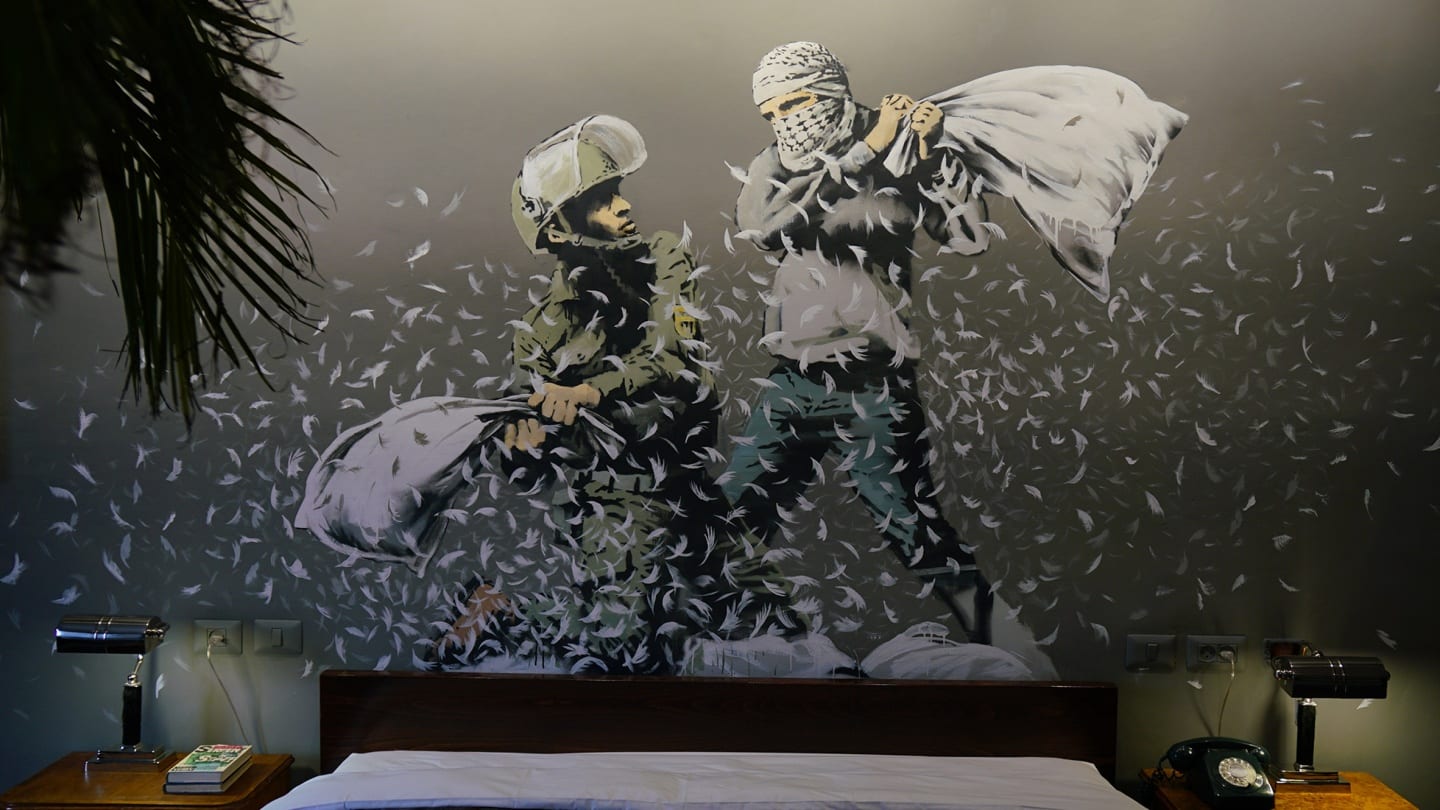
His largest design project is a hotel. In 2017, marking a hundred years since the start of British control of Palestine, Banksy financed the Walled Off Hotel in Bethlehem, opposite the West Bank barrier, with every bedroom facing the wall; the hotel advertises ‘the worst view in the world’. Rooms were designed by Banksy, Sami Musa and Dominique Petrin and range from bunk beds to a presidential suite with a home cinema and a library. The building also holds a museum on the history of the wall and a gallery that the hotel presents as the largest permanent platform for Palestinian artists in Palestine. In December 2019 Banksy added Scar of Bethlehem, a nativity scene set beneath a section of wall punctured by bullet holes, the largest of them shaped like the star over the manger. The hotel closed after the 7 October 2023 attacks and reopened in December 2025 as an independent business, presented by its management as a cultural platform.

In 2015 he went further with Dismaland, a group show modelled on Disneyland and built in Weston-super-Mare, open from 21 August to 27 September. It lampooned the disappointing temporary themed attractions then common in the UK, and the artists taking part included Damien Hirst and Jenny Holzer. Dream Boat, made for the show, was later raffled for the charity Help Refugees through a guess-the-weight competition.
He has also taken on commissions and objects outside the gallery. He designed the cover of Blur’s 2003 album Think Tank, six station idents for Nickelodeon in 2005 and the opening couch gag of the 2010 episode of The Simpsons titled ‘MoneyBart’. He also funded the Louise Michel, a former French Navy boat that rescues refugees in the Mediterranean, painted pink with a girl holding a heart-shaped float; his backing became public in August 2020.
Is Banksy still active?
Yes. Since 2024 he has claimed a steady run of new works, most of them in London. In March 2024 he painted green foliage on a wall behind a heavily pruned tree on Hornsey Road near Finsbury Park, with a stencilled figure holding a pressure washer beside it. Between 5 and 13 August 2024 nine animal works appeared in nine days across London, from a goat near Kew Bridge to a gorilla on a shutter at London Zoo, lifting it to free a sea lion and birds. Several were removed or stolen within hours, the zoo took its shutter away for safekeeping, and a school of piranhas painted on a police sentry box near the Old Bailey went to the London Museum. In May 2025 he painted a lighthouse in Marseille.
On 8 September 2025 a mural on the Royal Courts of Justice in London showed a judge beating a protester with a gavel. It was covered the same day and removed by 10 September, leaving a faint shadow, and removing it cost the Ministry of Justice more than £85,000. In December 2025 he claimed a mural above garages on Queen’s Mews in Bayswater: two children in winter hats and wellington boots lying on their backs, one pointing at the sky. An identical image near the Centre Point tower did not appear on his account.
On 29 April 2026 a statue appeared overnight on Waterloo Place, near the statues of Edward VII and Florence Nightingale and the Crimean War Memorial. A man in a suit marches off the edge of his plinth, his face covered by the flag he carries. Banksy confirmed it the next day with an Instagram video of its night-time installation by crane. Westminster City Council kept it on public view and spent almost £60,000 on barriers and security, and in autumn 2026 it was still deciding the statue’s long-term future; the council acts as custodian of the work, while Banksy keeps the copyright.
Where can you see Banksy’s art?
The most reliable places are Bristol, where several early murals are still on their original walls, and the Walled Off Hotel in Bethlehem, which guests can visit and stay in. Most street pieces do not last: councils paint them over, vandals deface them, and thieves or property owners cut them out to sell. Exhibitions under his name show reproductions, so the table covers originals only.
Migrant Child was painted in May 2019 on the canal-side façade of Palazzo San Pantalon in Venice and shows a child in a life jacket holding a pink flare, feet in the water. By 2025 about a third of the image had deteriorated. Banca Ifis, which owns the building, had it removed in July 2025 and restored, and the work was unveiled at the Arsenale on 7 May 2026, with the bank planning free public projects around it.
Banksy: myths and surprising facts
Banksy has a habit of hanging his own work in major museums. In October 2003 he hung one of his paintings among the 19th-century landscapes at Tate Britain, in 2004 he placed the piece Banksus Militus Ratus in the Natural History Museum in London, and in March 2005 he left altered works in the Museum of Modern Art, the Metropolitan Museum of Art, the American Museum of Natural History and the Brooklyn Museum. In May 2005 Peckham Rock, a lump of concrete painted as a cave drawing of a figure pushing a shopping trolley, went up in the British Museum’s Roman Britain gallery with a museum-style label and went unnoticed for days.
A common mistake is to assume that the British Museum then kept Peckham Rock. It was recorded as lost property and returned to the artist, and the museum borrowed it back in 2018 for its exhibition I object. The first Banksy in its collection arrived in 2019: a Di-faced Tenner, one of the spoof £10 notes printed in August 2004 with Princess Diana in place of the Queen and ‘Banksy of England’ instead of ‘Bank of England’. That year a wad of them was thrown into the crowd at the Notting Hill Carnival, and some people tried to spend them in local shops.
Zoos and shops have been targets too. At London Zoo he climbed into the penguin enclosure and painted, in letters two metres high, that the penguins were bored of fish. In August and September 2006 he slipped up to 500 copies of Paris Hilton’s debut album into 48 UK record shops with his own cover art and remixes by Danger Mouse; some were bought before staff removed them and later resold for up to £750. In September 2006 he placed an inflatable doll dressed as a Guantánamo Bay prisoner, in an orange jumpsuit, black hood and handcuffs, on the Big Thunder Mountain Railroad ride at Disneyland in California.

The public has sometimes taken his side. When Well Hung Lover, a naked man hanging from a bedroom window, appeared on Park Street in Bristol in June 2006, the city council left its fate to the public; 97% of the 500 people surveyed backed it, and it stayed. On 12 October 2013 an elderly man ran a stall near Central Park selling about 25 signed Banksy canvases for $60 each. It took him about four hours to make the first sale, and two of the canvases later fetched $214,000 at auction in July 2014.
Banksy – frequently asked questions
What is the ‘Banksy effect’?
The phrase was coined in December 2006 by the journalist Max Foster to describe how interest in other street artists grew on the back of Banksy’s success.
Can you still see the original Girl with Balloon?
No. The first version was stencilled in 2002 on Waterloo Bridge on London’s South Bank, and others followed around London, including in Shoreditch, but none of these murals survives. The image lives on in prints and canvases, starting with an edition of 25 signed prints in 2003.
Does Banksy show his face in Exit Through the Gift Shop?
No. Banksy tells much of the story himself, but he appears hooded, with his face obscured and his voice altered. The film follows Thierry Guetta, a Los Angeles shop owner who filmed street artists at work and became one himself as Mr Brainwash.
What does ‘Show me the Monet’ mean?
The title plays on the phrase ‘show me the money’. In 2020 the painting was sold at Sotheby’s by Roland and Jane Cowan, the London collectors who had offered Banksy the space at 100 Westbourne Grove for Crude Oils in 2005.
Street art is moving from city walls onto the walls of homes, and a mural indoors involves decisions about scale, colour and placement that are hard to undo with one coat of paint. If you are planning one at home, it pays to work it out with a designer first. Find architects, interior designers and interior photographers in the PLNDesign directory.
See also:
- Igor Mitoraj: life, sculptures and where to see them
- Claude Monet: life, paintings and the garden at Giverny