

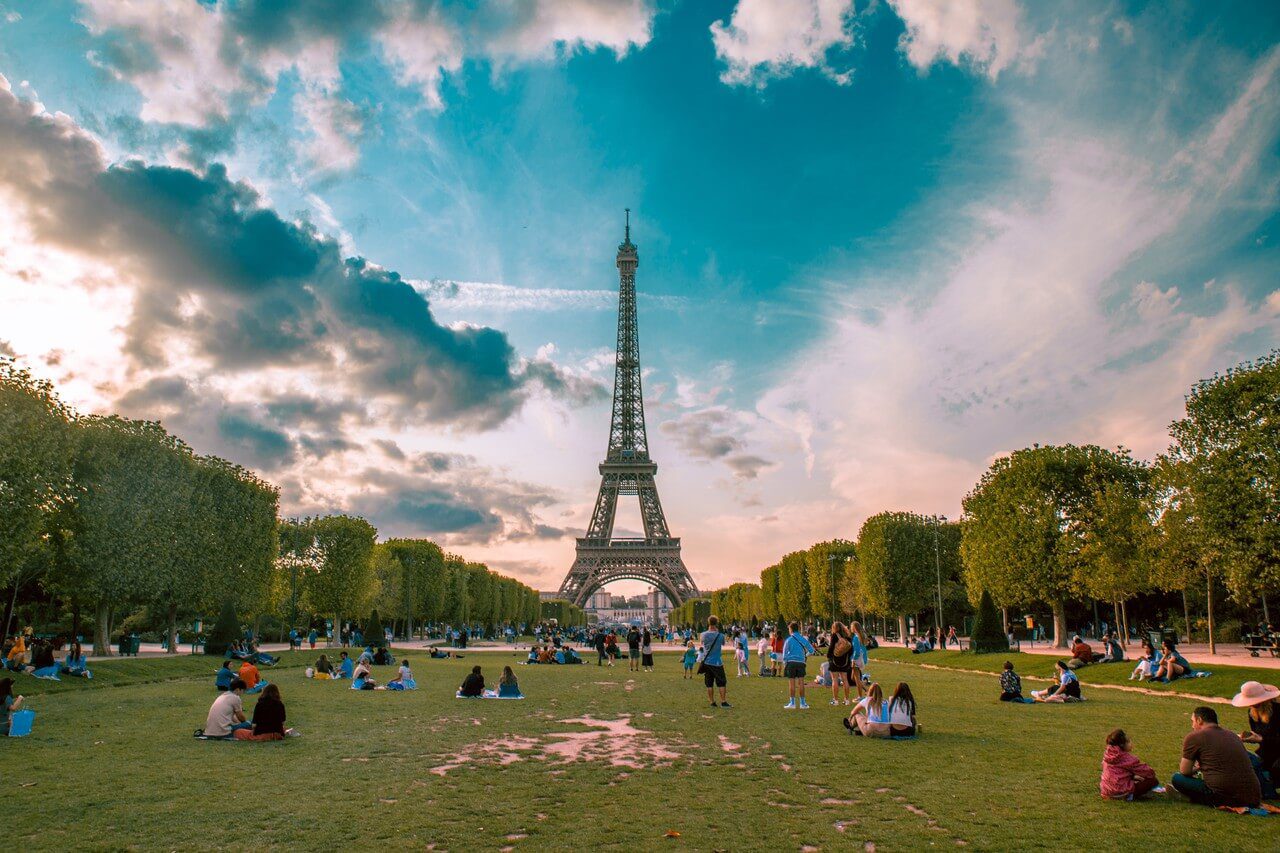
The Eiffel Tower is a 330-metre wrought-iron lattice tower on the Champ de Mars in Paris, built between 1887 and 1889 for the Exposition Universelle. It was meant to be dismantled after 20 years and survived because it proved useful for radio. Today it is the tallest structure in Paris and the most visited paid monument in the world.
Eiffel Tower at a glance:
- 330 metres tall since 15 March 2022, when a digital radio antenna was fitted to the top; in 1889 it measured 312 metres.
- Designed by Maurice Koechlin and Émile Nouguier, two engineers in Gustave Eiffel’s company, who sold him the rights to their patent in December 1884.
- Adult tickets cost €14.80–€36.70, depending on whether you take the stairs or the lift and whether you stop at the second floor or go on to the top.
- Built to stand for 20 years, it was kept once its radio station had proved its value.
What is the Eiffel Tower and why was it built?
The Eiffel Tower is an iron lattice tower on the Champ de Mars, beside the Seine in the 7th arrondissement of Paris. It was built as the centrepiece of the 1889 Exposition Universelle, the world’s fair held to mark the centenary of the French Revolution, and was first called the Tour de 300 mètres, the 300-metre tower. Its local nickname is La Dame de fer, the Iron Lady.

In 2025, more than 6.75 million people went up to its levels and some 10 million walked through the forecourt below, which is free to enter. French visitors made up around 21% of the total, followed by Americans at about 13%. More than 300 million people have visited the tower since 1889.
How tall is the Eiffel Tower?
The Eiffel Tower is 330 metres tall, measured to the tip of its antennas. The iron structure weighs 7,300 tonnes, and the lifts, shops and antennas bring the total to about 10,100 tonnes. The four legs stand on a square base measuring 125 metres on each side.
The height has changed several times, always because of what was fitted to the top:
When it was completed, the tower was the tallest structure in the world. It held that title for 41 years, until the 319-metre Chrysler Building in New York was finished in 1930. Iron expands and contracts with temperature, so the tower is slightly taller in summer than in winter.

Who designed the Eiffel Tower?
The Eiffel Tower was designed by Maurice Koechlin and Émile Nouguier, the two chief engineers of Gustave Eiffel’s company, who came up with the idea in June 1884. Eiffel showed little enthusiasm for their first sketch. The engineers then brought in Stephen Sauvestre, head of the company’s architectural department, who reworked the design and gave it a more decorative finish. This version won Eiffel over.
On 18 September 1884 a patent, number 164364, was filed in the names of Eiffel, Nouguier and Koechlin for a design that allowed metal pylons to rise above 300 metres. On 12 December 1884 Eiffel bought the exclusive rights from the two engineers, who each received 1% of the sums paid for the construction. The tower was built by Eiffel’s company, the Compagnie des Établissements Eiffel, and carries his name.
In 2002 the German journal Deutsche Bauzeitung published an article by Martin Trautz calling Koechlin the real inventor of the Eiffel Tower and crediting him with its structural concept and form. On the first floor, the outdoor walkway between the south and west pillars is now named Rue Maurice Koechlin et Emile Nouguier.
How was the Eiffel Tower built?
The Eiffel Tower took two years, two months and five days to build. Digging for the foundations began on 26 January 1887, and on 31 March 1889 Gustave Eiffel climbed to the top and raised the French flag. The lifts were not yet running, so the party made the ascent on foot.
The legs rest on concrete foundations laid a few metres below ground on a layer of compacted gravel. The two legs nearest the Seine needed more work, with compressed-air caissons driven 22 metres down.
All 18,038 parts were made in advance at Eiffel’s factory in Levallois-Perret, outside Paris, from 5,300 workshop drawings prepared by 50 engineers and draughtsmen. Each part was traced to within a tenth of a millimetre. About 150 people worked in the factory and between 150 and 300 on the site. No drilling or shaping was done on site: a part that did not fit went back to the factory.

The parts were first bolted together, then the bolts were replaced with rivets, 2.5 million in all, a third of them set on site. Each rivet needed a team of four: one man heated it, another held it in place, a third shaped the head and the fourth struck it with a sledgehammer. As the hot rivet cooled, it contracted and pulled the parts tightly together.
Small cranes climbed the tracks of the future lifts to hoist the parts into place. Hydraulic jacks under each leg and sandboxes on the timber scaffolding let the builders adjust the angle of the legs, which were joined at the first floor by the end of March 1888.
The tower is built of puddled iron, a type of wrought iron, from the Forges de Pompey near Nancy. Puddling removed excess carbon from the iron as it was refined. The metal was then rolled into plates and simple L- and I-shaped sections, easy to rivet into frames that were both light and strong.
Why is the Eiffel Tower shaped like that?
The shape of the Eiffel Tower comes from wind calculations. In an interview published in Le Temps on 14 February 1887, Eiffel said wind resistance had been his main concern and that the curve of the four outer edges followed what the calculations dictated. He expected that curve to convey strength and beauty, and asked whether ‘the very conditions which give strength also conform to the hidden rules of harmony’.
The profile is close to an exponential curve, and every part of the structure was overdesigned to resist the wind. The only elements with no structural role are the four decorative arches at the base. Sauvestre added them to make the tower look more substantial and to give the exposition a grander entrance.
Eiffel also had the names of 72 French scientists, engineers and mathematicians engraved on the tower, in recognition of their work and in answer to the artists who had protested against it. The names were painted over at the beginning of the 20th century and restored in 1986 and 1987.
Why was the Eiffel Tower nearly demolished?
The Eiffel Tower was built as a temporary structure. The contract signed on 8 January 1887 gave Eiffel 1.5 million francs from the state towards an estimated cost of 6.5 million, along with the income from the tower during the exposition and for the following 20 years. After that, it was due to be dismantled in 1909, with ownership passing to the City of Paris.

Opposition began early. On 14 February 1887, less than three weeks after work started, Le Temps published a protest by writers, painters, sculptors and architects, among them Charles Garnier, Charles Gounod and Guy de Maupassant. They called the tower ‘useless and monstrous’ and pictured it rising over Paris like a gigantic black factory chimney, crushing Notre-Dame and the city’s other monuments. Eiffel defended the design in the same paper. Some of the protesters changed their minds once the tower was built. A much-repeated anecdote has Maupassant eating lunch in the tower’s restaurant every day, because it was the one place in Paris from which he could not see it.
Visitors took to it immediately. The tower opened to the public on 15 May 1889, before its lifts were ready, and nearly 30,000 people climbed the 1,710 steps to the top before the lifts started running on 26 May. By the end of the exposition it had received 1,896,987 visitors. Construction cost nearly 8 million francs, and the tower had almost paid for itself within its first year.
Science and radio saved it. Eiffel used his apartment at the top for weather observations and experiments on air resistance. On 5 November 1898 Eugène Ducretet made the first radio contact in Morse code between the tower and the Panthéon, four kilometres away, and a transmitting station was installed on the tower for good. Eiffel then offered the tower to the army’s wireless engineers under Captain Gustave Ferrié and offered to pay for the experiments. In 1909 a permanent underground radio centre was built near the south pillar, and it is still there.
When the original concession ran out, the tower was allowed to stay. From 1910 the Paris Observatory sent time signals to ships at sea through it every day. In 1914 its transmitter jammed German radio communications during the advance on Paris, which helped the Allies at the First Battle of the Marne. In 1917 the station intercepted the messages that led to the arrest of Mata Hari.
How much are Eiffel Tower tickets?
Adult tickets cost between €14.80 and €36.70. The price depends on whether you climb or take the lift and whether you stop at the second floor or continue to the top. Prices are the same online and at the ticket offices at the tower.
Prices were checked on the official website on 4 November 2026. Children under four go free but need a free ticket, and the adults with them pay the adult or youth rate.

Lift tickets go on sale online 60 days before the visit and stairs tickets 14 days before, each for a set time slot. Summit tickets for summer dates often sell out quickly, sometimes on the first day of sale. A second-floor ticket cannot be upgraded at the tower, because no supplement to the top is sold. The top and the staircases are not suitable for people with reduced mobility, who cannot go up to the summit.
Your visit starts at the highest level on your ticket and finishes on the first floor on the way down. Opening hours vary through the year, and the top, or even the whole tower, closes when the wind is too strong, so check the calendar on the official website before you go.
What can you see on each level of the Eiffel Tower?
The Eiffel Tower has three levels open to visitors: the first floor at 57 metres, the second floor at 115 metres and the top at 276 metres, the highest public observation deck in the European Union.
The first floor has a glass floor, installed during the 2014 refurbishment, along with touchscreens, display windows and digital albums on events in the tower’s history. It is also home to the Madame Brasserie restaurant. The second floor gives the widest views over the city and houses Le Jules Verne, a Michelin-starred restaurant run by chef Frédéric Anton, with its own lift from the south pillar.

At the top, Gustave Eiffel’s small apartment is open to view, with period furnishings and lifelike figures of Eiffel and some of his guests. He received Thomas Edison there in 1889. The top also has a champagne bar. It can only be reached by lift, with a change of lifts on the second floor.
How do you get to the Eiffel Tower, and when is it least busy?
The nearest metro station is Bir-Hakeim on line 6, less than 10 minutes’ walk from Entrance 1 on Allée des Refuzniks. Trocadéro on line 9 and École Militaire on line 8 are about 15 minutes away on foot, and line C of the RER stops at Champ de Mars-Tour Eiffel.
Every visitor goes through two security checks: one at the entrance to the site and another before entering a pillar to take the lift or the stairs. Large luggage and pets are not allowed, apart from guide dogs, and there is no left-luggage office.
Queues are usually shortest in the morning and the evening. The quietest times are between 9am and 11am and between 8pm and 10.30pm, while the busiest stretch runs from 11am to 5pm.

Can you photograph the Eiffel Tower at night?
Yes. Taking photos of the illuminated tower is allowed, but the lighting and the sparkles are protected by copyright, so professional use of images of the tower at night needs prior permission and may involve a fee. The structure itself has been in the public domain since 1993, 70 years after Eiffel’s death. The copyright applies to the lighting: in 1990 a French court ruled that a special lighting display created for the tower’s centenary in 1989 was an original work, and the Court of Cassation upheld the ruling in 1992.
At nightfall, sensors switch on the golden lighting, which takes less than 10 minutes. At the same time, the beacon at the top starts to turn. It is made of four projectors that each rotate through 90 degrees and switch on and off in turn, which gives the effect of a single beam sweeping the sky. The sparkles, 20,000 flashing bulbs first switched on to welcome the year 2000, run for five minutes at the start of every hour from nightfall until the tower closes. For the best view of them from inside the tower, go to the lower level of the second floor as the hour strikes.

Which towers were inspired by the Eiffel Tower?
The Petřín Lookout Tower in Prague came first. Members of the Czech Tourist Club saw the Eiffel Tower at the 1889 exposition and decided to build something similar at home. Work started on 16 March 1891 and the tower opened on 20 August that year. It is 63.5 metres tall, but because it stands on Petřín Hill, its top is at about the same altitude as the top of the Paris original.
In England, Blackpool’s mayor, Sir John Bickerstaffe, saw the Eiffel Tower at the same exposition and commissioned a tower for his town. Blackpool Tower opened in 1894 and is 158.1 metres tall. Tokyo Tower, built in 1958 as a communications tower, was also inspired by the Eiffel Tower. At 333 metres, it is slightly taller than its Paris model.
What are some interesting facts about the Eiffel Tower?
The Eiffel Tower has been repainted 20 times, on average every seven years, and it has changed colour along the way. The parts were coated in Venetian red at the factory, then the tower turned reddish brown in 1889 and ochre brown in 1892. In 1899 it was painted in five shades, from yellow-orange at the base to light yellow at the top, and in 1907 Gustave Eiffel chose a yellow-brown that stayed for 47 years. A reddish brown followed in 1954, and from 1968 the tower wore Eiffel Tower Brown, applied in three shades with the darkest at the base and the lightest at the top. The 20th painting campaign, which began in 2019, brought back Eiffel’s 1907 yellow-brown, the colour the tower wore for the Paris 2024 Olympic and Paralympic Games. Each campaign uses about 60 tonnes of paint over 250,000 square metres, applied mostly by hand with a round guipon brush.

During the Second World War, the French cut the lift cables when German troops occupied Paris in 1940, and the lifts were not repaired until 1946. German soldiers had to climb to the top to raise their flag, and when Hitler visited Paris he stayed on the ground. In August 1944, as the Allies approached, Hitler ordered the military governor of Paris, General Dietrich von Choltitz, to destroy the tower along with the rest of the city. Von Choltitz did not carry out the order.
In 2012 a study by the Chamber of Commerce of Monza and Brianza in Italy valued the Eiffel Tower at €434 billion, nearly five times the Colosseum’s €91 billion. The study measured image, brand and appeal to visitors, not the value of the structure itself.
Eiffel Tower – frequently asked questions
Does the Eiffel Tower lean or move?
The Eiffel Tower has no permanent lean. On a sunny day the side facing the sun expands more than the other three, so the top moves away from the sun, and over a clear day it traces a rough circle about 15 centimetres across. The wind makes it sway by up to nine centimetres.
Can you still walk up the Eiffel Tower?
Yes, as far as the second floor, which is 674 steps from the ground. The staircase continues to the top, 1,665 steps in all, but that section is closed to visitors, so the last stage is by lift only. You go back down by a different staircase from the one you climbed.
Did anyone die building the Eiffel Tower?
No one was killed or seriously injured during the construction of the Eiffel Tower. Eiffel equipped the site with movable gangways, guardrails and screens.
Is the Eiffel Tower a UNESCO World Heritage Site?
Yes, as part of the Paris, Banks of the Seine site, inscribed on the World Heritage List in 1991. France also listed the tower as a historic monument in 1964.
The Eiffel Tower’s curve was worked out from wind calculations before a single part left the factory. A house extension or a new staircase starts in the same order, with the structure calculated before anyone chooses the finishes. Find architects, interior designers and interior photographers in the PLNDesign directory.
See also:
- Eight-month restoration repairs Sandomierz Royal Castle in Poland
- Camping cooking with a gas stove, one-pot meals and a campfire