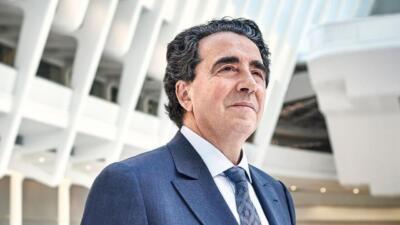


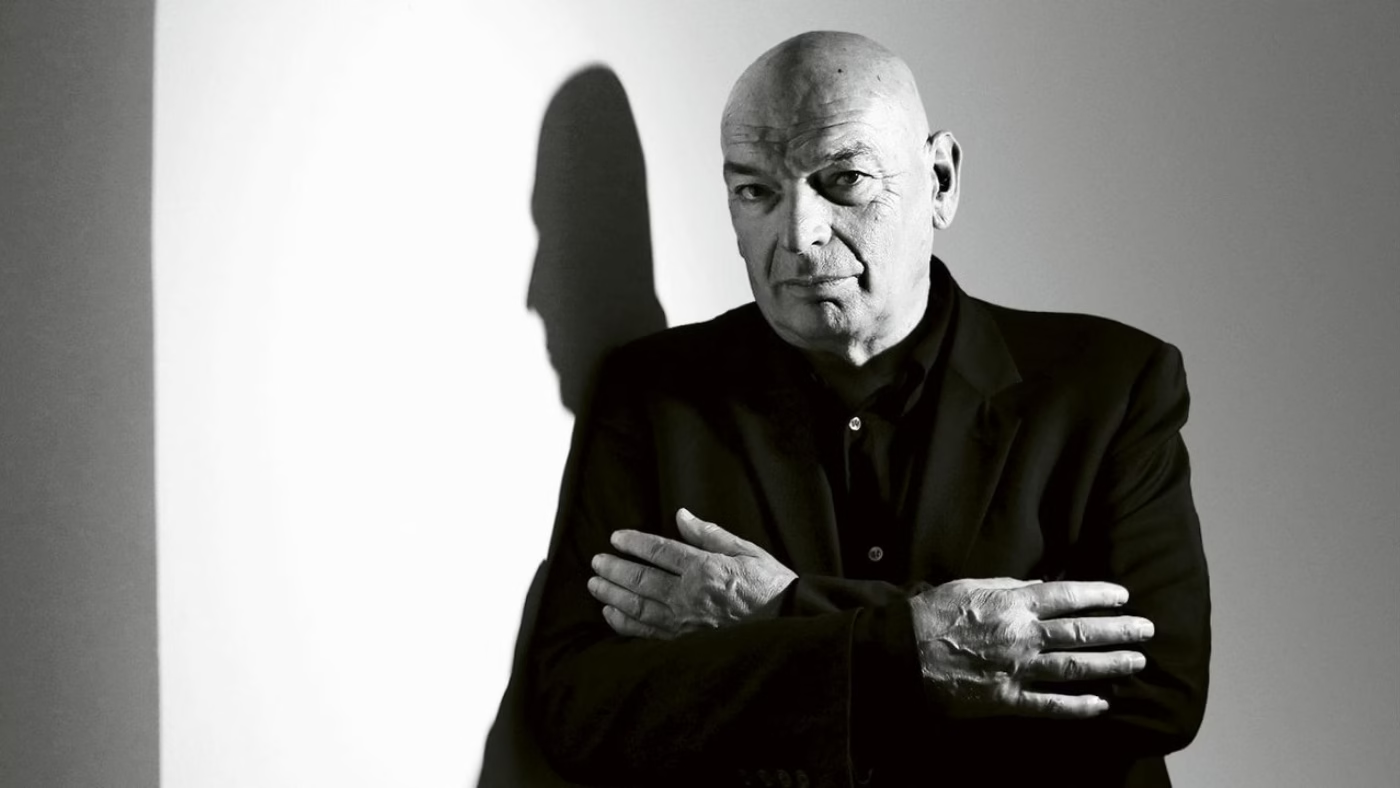
Jean Nouvel is a French architect, born in 1945, who received the Pritzker Prize in 2008 and chairs Ateliers Jean Nouvel, the practice he founded in Paris in 1994. His buildings include the Arab World Institute and the Philharmonie de Paris, the Torre Glòries in Barcelona, the Guthrie Theater in Minneapolis, the Louvre Abu Dhabi and the National Museum of Qatar.
Jean Nouvel at a glance:
- Born on 12 August 1945 in Fumel, in south-west France, he studied at the École nationale supérieure des Beaux-Arts in Paris and opened his first practice in 1970.
- The Arab World Institute in Paris (1987), with its south facade of light-sensitive metal diaphragms, made his name internationally.
- In 2008 he became the second French winner of the Pritzker Prize, after Christian de Portzamparc.
- Ateliers Jean Nouvel works from Paris and Shanghai, and its latest buildings include the Tencent tower in Guangzhou and the new Fondation Cartier at the Palais-Royal in Paris, both completed in 2025.
Who is Jean Nouvel?
Jean Nouvel is a French architect whose buildings stand in Europe, North and South America, the Middle East, Asia and Australia. His work covers museums, concert halls, theatres, office and residential towers, hotels and shopping centres, as well as furniture and objects. By the time he received the Pritzker Prize in 2008 he had worked on more than 200 projects. Now 81, he still chairs Ateliers Jean Nouvel, whose team combines architecture, urban planning, interior design, landscape design, graphic design and 3D visualisation in a single practice.

Where did Jean Nouvel grow up and study?
Nouvel was born on 12 August 1945 in Fumel, in the Lot-et-Garonne department, the son of Renée and Roger Nouvel, both teachers. The family moved often after his father became chief school superintendent for the area. His parents wanted him to concentrate on mathematics and languages, but at 16 a teacher taught him to draw and he set his heart on becoming an artist. Architecture was the family compromise, a profession his parents saw as less risky than art.
He enrolled at the École des Beaux-Arts in Bordeaux and in 1966 entered the École nationale supérieure des Beaux-Arts in Paris, having come first in its national entrance competition. As a student he worked as an assistant to the architect Claude Parent, in the office Parent ran with the urbanist and essayist Paul Virilio, and within a year he was managing the construction of a large housing complex. He graduated in 1971.
How did Ateliers Jean Nouvel begin?
Ateliers Jean Nouvel dates from 1994, but Nouvel had run his own office since 1970, when he went into partnership with François Seigneur. Over the next two decades he changed partners several times. Between 1972 and 1984 he worked with Gilbert Lézénès, Jean-François Guyot and Pierre Soria, and Lézénès and Soria were also part of the team that won the Arab World Institute competition. In 1985 he set up Jean Nouvel et Associés with three younger architects, and from 1988 he ran a firm with Emmanuel Cattani. When that business went into receivership, his long-standing friend Michel Pélissié took over its assets, and in 1994 the two founded Ateliers Jean Nouvel.
Through those years Nouvel was also active in the debate on French architecture. In 1976 he co-founded the Mars 1976 movement, which opposed corporatism in the profession, and soon afterwards the Syndicat de l’Architecture, France’s first trade union for architects. He designed exhibitions for the Biennale de Paris for 15 years, was one of the organisers of a counter-competition for the Les Halles district and in 1980 founded the first Paris architecture biennale.
Today the practice is based at 10 Cité d’Angoulême in the 11th arrondissement of Paris. It has a second atelier in Shanghai and works with partner architects in Barcelona, Madrid, Rome and Geneva. Nouvel is its chairman, and Dominique Alba is chief executive.
What defines Jean Nouvel’s architecture?
Nouvel has no signature style, because each design starts from a particular place, programme and moment. His practice describes his buildings as the outcome of a search for a concept that fits one combination of people, place and time, rather than of a style or an ideology. Nouvel himself puts it in terms of cinema: ‘I’m more akin to a movie-maker who makes movies on completely different subjects.’ A few weeks before the Louvre Abu Dhabi opened in 2017, he called himself a contextual architect and added that ‘buildings must know where they’re from’.

Light and the facade carry much of the idea. At the Arab World Institute the south wall works like a set of camera diaphragms. The Fondation Cartier of 1994 is a glass building set among trees, and under the dome of the Louvre Abu Dhabi daylight falls through a lattice of steel and aluminium. Many of his facades also carry images or text, from views of Paris enamelled on the glass of the Arab World Institute to verses by Prague writers and an angel from a Wim Wenders film on the Golden Angel building in Prague.
What are Jean Nouvel’s most famous buildings?
Nouvel’s best-known buildings include the Arab World Institute, the Fondation Cartier, the musée du quai Branly and the Philharmonie in Paris, the Torre Glòries in Barcelona, the Guthrie Theater in Minneapolis, the Louvre Abu Dhabi and the National Museum of Qatar in Doha.
Arab World Institute, Paris (1987). In 1981 Nouvel, Gilbert Lézénès, Pierre Soria and Architecture-Studio won the competition for the building of the Institut du monde arabe beside the Seine, a cultural foundation set up by France and states of the Arab League. The building, completed in 1987, has nearly 17,000 square metres of usable floor space. Its south facade is made up of 240 moucharabiehs, metal panels fitted with diaphragms that open and close as photoelectric cells respond to the daylight, controlling how much light reaches the interior. Their geometry is based on Arabic latticework, and Nouvel has said the polygons of different sizes recall the Alhambra. On the north facade, which faces the river and the old city, images of the Paris skyline are enamelled onto the glass. The building won the Équerre d’Argent in 1987 and the Aga Khan Award for Architecture in 1989.
Fondation Cartier, Paris (1994). Cartier’s contemporary art foundation moved in 1994 into a building by Nouvel on boulevard Raspail. Glass walls separate the street from a planted garden, and the building itself is glazed, so the trees and the galleries are seen through several layers of glass. In October 2025 the foundation moved again, to a building on the Place du Palais-Royal whose interiors Nouvel also redesigned.
Golden Angel, Prague (2001). Zlatý Anděl, or Golden Angel, is an office and shopping complex in the Smíchov district and the first building of an urban plan for the area that Nouvel had worked on since the early 1990s. Its metal-clad walls carry verses by writers linked with Prague, among them Franz Kafka, Rainer Maria Rilke, Guillaume Apollinaire and Gustav Meyrink. On the glass of its drum-shaped corner, a large angel looks down on the Anděl crossroads. The angel theme comes from the name of the place, and the figure is the angel from Wim Wenders’ film Wings of Desire.
Torre Glòries, Barcelona (2005). Designed with the Barcelona firm b720 Fermín Vázquez Arquitectos, the 144-metre tower was built as the head office of Aigües de Barcelona, the city’s water company, and was formerly known as Torre Agbar. Nouvel likened its rounded form to a geyser rising from the ground, and the shape also draws on the rock pinnacles of Montserrat and the towers of Antoni Gaudí’s Sagrada Família. At night the facade is lit by 4,500 LED lights. Offices were in use from June 2005, and King Juan Carlos I opened the tower officially on 16 September 2005. Since 2022 visitors have been able to go up to the Mirador Torre Glòries observation deck on the 30th floor, 125 metres above the street.
Musée du quai Branly, Paris (2006). The museum opened in 2006 a short walk from the Eiffel Tower. One of its walls is covered by a vertical garden created with the botanist Patrick Blanc, who later worked with Nouvel again on One Central Park in Sydney. When Nouvel won the Pritzker Prize, The New York Times called the building ‘defiant, mysterious, and wildly eccentric’.
Guthrie Theater, Minneapolis (2006). Nouvel’s first completed building in the United States opened on 25 June 2006 beside the Mississippi, near the city’s old mills. Designed with the local firm Architectural Alliance, the 26,500-square-metre theatre has three stages, the largest a thrust stage seating 1,100. Its bulk is clad in dark blue panels, and a cantilevered bridge projects about 54 metres from the building as a viewing deck.

100 Eleventh Avenue, New York (2010). This residential tower in West Chelsea, designed with Beyer Blinder Belle, has a curving south and west facade of 1,647 different panes of glass, each set at its own angle within large steel-framed panels. Nouvel based the pattern on the compound eye of an insect and calls the building ‘a vision machine’. The north and east facades are clad in black brick, a reference to the old industrial buildings of the district.
One Central Park, Sydney (2014). The complex stands on a former brewery site in Chippendale, near the city centre, and consists of two residential towers on a shared retail podium. Plants cover about half of the facade area in a vertical landscape designed with Patrick Blanc, shading the apartments. Near the top of the taller tower, a cantilever carries a motorised heliostat that reflects sunlight down onto the part of the neighbouring park overshadowed by the building. At night the heliostat is lit by the French artist Yann Kersalé. In 2014 the Council on Tall Buildings and Urban Habitat named One Central Park the best tall building in the world.

Philharmonie de Paris (2015). Nouvel won the 2007 competition for the concert hall in the Parc de la Villette, built around a 2,400-seat auditorium. When it opened on 14 January 2015, he stayed away from the ceremony. He later went to court asking for his name to be removed from all references to the building, which he said had been opened unfinished and did not comply with his design.
Louvre Abu Dhabi (2017). The museum on Saadiyat Island opened in November 2017, ten years after France and Abu Dhabi signed the intergovernmental agreement behind it. It is laid out like a medina of 55 low white buildings, 23 of them galleries, surrounded by water, so visitors can arrive by land or by sea. Most of them sit under a dome 180 metres across, weighing about 7,500 tonnes and resting on four supports. Its eight layers of steel and aluminium form a lattice of 7,850 stars that breaks the sunlight into small patches on the buildings and paths below.

National Museum of Qatar, Doha (2019). Opened on 28 March 2019 near the Doha Corniche, the museum tells the history of Qatar. Its form is based on the desert rose, a crystal formation of sand and gypsum found in the region, translated into large interlocking discs that also shade the walls from the sun. Nouvel has described the desert rose as ‘an architecture created by time and the desert itself’. The new building wraps around the restored palace of Sheikh Abdullah bin Jassim Al Thani, where the visitor route ends.
53W53, New York (2019). Originally called Tour de Verre, the 320-metre residential tower on West 53rd Street rises above the Museum of Modern Art and contains new MoMA galleries on its lower floors. A diagrid of crossing concrete members, visible on the facades, tapers towards the top.
Nouvel’s other built work reaches back to the early 1980s, when he remodelled the municipal theatre in Belfort. In France it also includes the Nemausus 1 housing in Nîmes (1987), with 114 apartments, the Onyx cultural centre in Saint-Herblain (1988), the Lyon Opera House, renovated after a competition he won in 1986 and completed in 1993, the law courts in Nantes (2000) and La Marseillaise, a red, white and blue skyscraper in Marseille (2018). Elsewhere in Europe there are the Culture and Convention Centre (KKL) in Lucerne (2000), the conversion of a gasometer in Vienna, the Danmarks Radio concert hall in Copenhagen (2009) and, in Belgium, the Sparkoh! science centre, formerly PASS, in a former coal mine at Frameries, near Mons. In London he designed One New Change (2010), and in the Gulf the Doha Tower (2012).
What is Jean Nouvel working on now?
Nouvel’s practice has completed several large buildings since 2020 and has projects under way in Asia, the Middle East and Europe. In Paris, the Tours Duo were delivered in 2021: two leaning towers, mainly of offices, on the edge of the Périphérique in the 13th arrondissement, the taller of them 180 metres high with 39 storeys. In the same year the Museum of Art Pudong opened in Shanghai. For its fifth anniversary, from June to August 2026, the museum staged Jean Nouvel: Without the Artist, Architecture Disappears, the first solo exhibition Nouvel has held inside a building of his own design, and he wrote and directed a film, Premeditation, shown every evening in the museum’s glass hall.
The Tencent tower in Guangzhou was completed in 2025. On 25 October of the same year the Fondation Cartier opened its new venue at 2 Place du Palais-Royal, opposite the Louvre, in a building from 1855 whose interior volumes Nouvel rebuilt and opened to the surrounding streets with large windows. In 2025 Flammarion also published his book Mes convictions (‘My convictions’).
Current projects include the Shenzhen Opera House, now under construction, the Sharaan resort to be carved into a sandstone hill in the AlUla desert in Saudi Arabia, the transformation of the Galeries Lafayette store Nouvel designed in Berlin, an aviation academy in Singapore and Not a Hotel on the Japanese island of Yakushima.

Where can you see Jean Nouvel’s buildings?
Paris has the largest group of Nouvel buildings open to visitors, from the Arab World Institute to the Philharmonie. Museums, concert halls and theatres by him can also be visited in Abu Dhabi, Doha, Barcelona, Lucerne, Lyon, Copenhagen, Minneapolis and Shanghai, while his residential towers in New York and Sydney can be seen from the street.
| Building | City | Completed | What you can see |
|---|---|---|---|
| Arab World Institute | Paris | 1987 | Museum, library and exhibitions |
| Louvre Abu Dhabi | Abu Dhabi | 2017 | Museum |
| Torre Glòries | Barcelona | 2005 | Mirador observation deck on the 30th floor |
| Philharmonie de Paris | Paris | 2015 | Concert hall |
| Musée du quai Branly | Paris | 2006 | Museum |
| Fondation Cartier, Place du Palais-Royal | Paris | 2025 | Exhibitions |
| National Museum of Qatar | Doha | 2019 | Museum |
| Guthrie Theater | Minneapolis | 2006 | Theatre |
| Culture and Convention Centre (KKL) | Lucerne | 2000 | Concert hall and museum |
| Lyon Opera House | Lyon | 1993 | Opera house |
| Danmarks Radio concert hall | Copenhagen | 2009 | Concert hall |
| Museum of Art Pudong | Shanghai | 2021 | Museum |
| One New Change | London | 2010 | Shops, restaurants and a roof terrace |
| Golden Angel (Zlatý Anděl) | Prague | 2001 | Offices and shops |
| 53W53 | New York | 2019 | Apartments, with MoMA galleries on the lower floors |
| 100 Eleventh Avenue | New York | 2010 | Apartments, facade from the street |
| One Central Park | Sydney | 2014 | Apartments, with shops on the lower floors |
Does Jean Nouvel design furniture?
Yes. Nouvel designs furniture and objects alongside his buildings, and in 1995 he set up a separate company, Jean Nouvel Design, to develop design and interior projects in parallel with the architecture practice. In his view the boundaries between architecture, interior design and furniture design are ‘a total fiction’, which is why at the Arab World Institute he designed the whole museum, including its display cases, seating and display furniture.
His products include cutlery for Georg Jensen (2005), a limited-edition bottle for Yves Saint Laurent’s L’Homme fragrance, the So So collection for the American manufacturer Emeco (2012), furniture for Coalesse and the Reflect kitchen for the Danish brand Reform (2021), whose ridged steel fronts reflect light in different directions. He has also made limited-edition pieces with Gagosian Gallery and Galerie Patrick Seguin, and in 2016 the Musée des Arts Décoratifs in Paris devoted an exhibition to his furniture.
What awards has Jean Nouvel received?
Nouvel received the Pritzker Architecture Prize in 2008, the second French laureate after Christian de Portzamparc in 1994. The jury singled out his ‘insatiable urge for creative experimentation’. His other international awards include the Aga Khan Award for Architecture for the Arab World Institute (1989), the Golden Lion of the Venice Architecture Biennale (2000), the Royal Gold Medal of the Royal Institute of British Architects and the Praemium Imperiale of the Japan Art Association (both 2001) and the Wolf Prize in Arts (2005).
In France he has received the Grand Prix national d’architecture (1987), two Équerres d’Argent, for the Arab World Institute (1987) and the Lyon Opera House (1993), and the Gold Medal of the French Academy of Architecture (1998), and in 2010 he was made an officer of the Legion of Honour. Several of his buildings have their own awards, among them the International Highrise Award for the Torre Glòries (2006) and a CTBUH Award of Excellence for 53W53 (2020).

Jean Nouvel – frequently asked questions
Is Jean Nouvel still working?
Yes. Nouvel turned 81 in August 2026 and still chairs Ateliers Jean Nouvel, whose current projects include the Shenzhen Opera House, the Sharaan resort in AlUla, Saudi Arabia, and Not a Hotel on the Japanese island of Yakushima.
Why is it called the Louvre Abu Dhabi?
The museum was created under an intergovernmental agreement that France and Abu Dhabi signed in 2007. Works lent by the Louvre and other French museums made up about half of the collection shown at its opening in 2017.
Which buildings by Jean Nouvel are in London?
One New Change, an office and retail development facing St Paul’s Cathedral in the City of London, opened in October 2010. In the same year Nouvel designed the temporary Serpentine Gallery Pavilion.
Planning a building and its interior as one, as Nouvel did at the Arab World Institute, works best when the architect and the interior designer are involved from the first sketch. Find architects, interior designers and interior photographers in the PLNDesign directory.
See also:
- Frank Lloyd Wright: life, organic architecture and famous buildings
- Alvar Aalto: buildings, furniture and the UNESCO-listed Aalto Works