

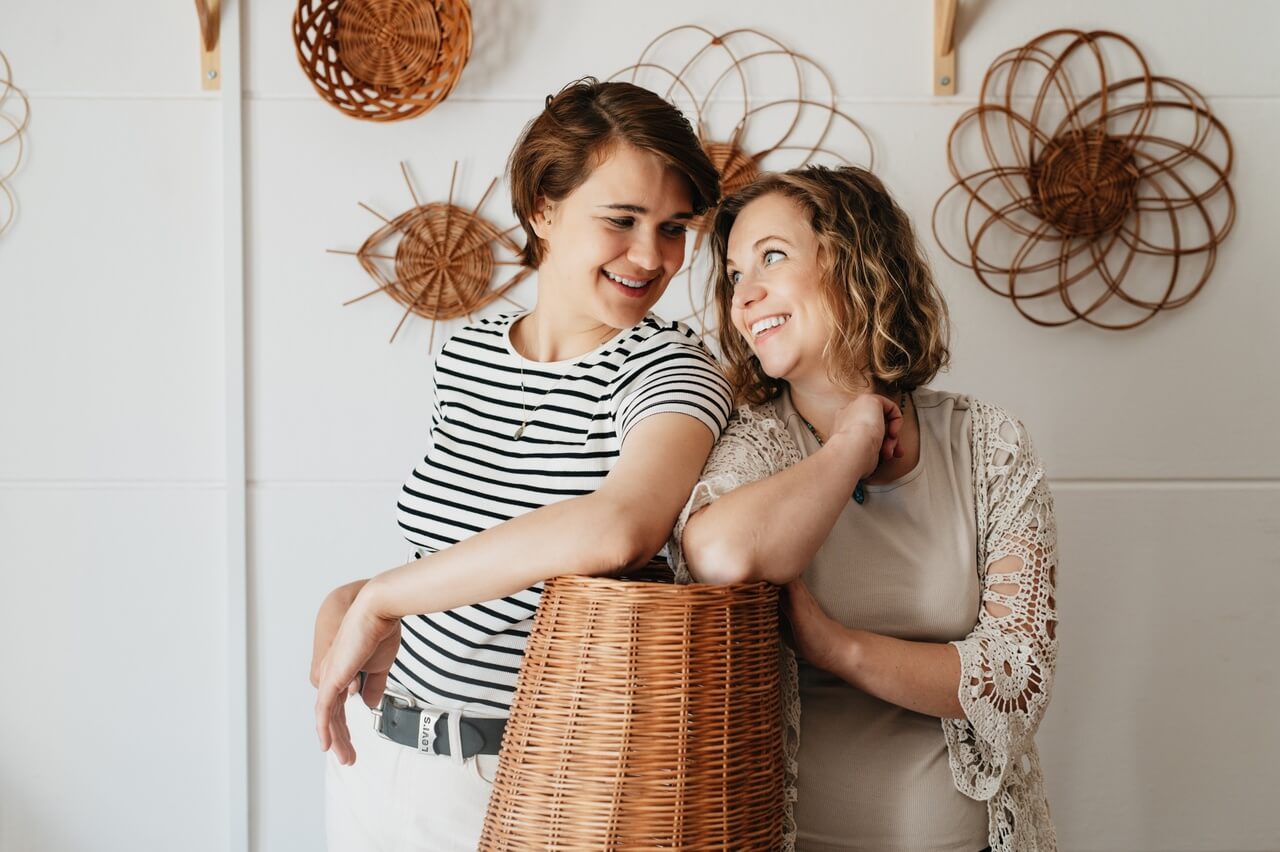
When their grandfather decided to retire, Katarzyna Nejman and Anna Borecka thought his wicker shop in Warsaw’s Praga-Północ district would close for good. Listening to his customers changed their minds. The sisters founded Siostry Plotą, drawing on a family tradition older than the shop itself. In this interview, they recall the smell of their grandfather’s willow, the skills they picked up without realising it and what it takes to pass them on.
Let’s go back to where your story with willow began. What do you remember of your grandfather’s workshop as children? How has it changed, and does he still visit?
Katarzyna Nejman and Anna Borecka: When did it start for us? The day we were born. A little before that, actually. Our grandfather Sylwester ran a wicker shop in Praga-Północ for 30 years, but basketry goes back further than that in our family. It used to flourish all over Poland. It was part of everyday life in so many communities, and most of us knew something about it. Even in the smallest village you could find someone for whom weaving willow into beautiful shapes was second nature.

Grandad’s shop was absolutely full of wicker. Every square centimetre was woven over, from the walls and the floor right up to the ceiling. That strong smell of willow will always take us back there. He’d sit in the middle of it all in a wicker armchair and could talk about willow for hours. We remember how he’d spring out of his chair halfway through a conversation and throw his whole body into the telling. His personality and his love of willow filled the place too. I think that’s what the shop was made of, really. Willow and him. Perhaps that’s why we never gave much thought to taking it over. We loved soaking it all up, but we didn’t have the nerve, or feel the need, to step in.
When Grandad decided to retire, we thought that would be the end of this wonderful story and this place we loved. As the shop was closing, customers told us what it had meant to them, what ties they had to the craft and how conscious they were of it disappearing. We were so moved that we realised we couldn’t let the story end there. We felt we had a part to play in keeping basketry alive.

We moved the business but stayed in Praga-Północ, just 700 metres from the place we’d known as children. We gained a bigger, heated space with a proper back room, a workshop and storage. It’s quite a change, though we like to think our love of willow still fills every corner. At Plac Hallera 5 there’s room for both the things we sell and the workshops where people can get to know the craft for themselves.
Grandad is still very much part of it. He often comes in for a coffee with milk and one teaspoon of sugar, especially since the birth of his third great-granddaughter, Kasia’s little girl. She often comes to work with her mum, so she’s growing up surrounded by willow and Grandad’s wonderful stories. The support he gives us and the faith he has in our work mean the world to us. They make us want to keep learning.
How did you decide to carry on the family tradition? What drew you to it, and do you fit it around other work?
K.N.: One of us is a graphic designer and the other an actor. Both are things we love and can do freelance, and we’re happy to take advantage of that. Our working and family lives are all tangled up together. Ania’s expecting her third child as we speak. We play a kind of “family Tetris” to make the most of our time and what we have between us, and to keep up with everything.

We both love our original professions and very much hope there’s more to come from us in both. Running a business is a huge amount of work. The shop opens six days a week and the online shop is open all the time. During the school year we teach regular groups on weekdays and run weekend classes. We do all the graphics and take most of the photographs for the website ourselves. We work with craftspeople all over the country, do our own weaving and run the social media. In hours alone it’s easily more than two full-time jobs. Sometimes we wonder how we fit it all into a day.
You’ve been around willow since you were born. Where did you learn the craft?
K.N.: That’s true. Willow has always been there. What surprised us was how much we’d picked up just by watching and being around it. There were things about weaving that felt so natural to us we assumed everybody knew them.
Our formal training began at a vocational school in Łowicz, where we gained our professional qualifications. Ania and our dad have also qualified as journeymen. They took the exam in Nowy Tomyśl last year. We seek out master craftspeople in Poland and abroad so we can learn from them in person. It’s an extraordinary journey. Quite often the people we meet are among the last who know a particular technique or pattern.
What does working with willow mean to you? What was it that drew you in?
K.N. and A.B.: There’s probably a whole other book in that. I think there are a few strands to it. We’ll start with the most tangible one, all the wonderful things you can actually use. It’s astonishing what you can make from a single year’s growth of willow. A fine bracelet, baskets, trunks, lampshades, furniture, handbags, toys, a sculpture or even the entire façade of a building. All from shoots that grew in one year. We find that extraordinary.
With so many possibilities, the real challenge is to your imagination. Our artistic sides get to run wild. The act of weaving itself, though it’s often intense and tiring, is incredibly meditative. We joke that willow loves attention and can’t bear it when your mind wanders. You soon hear about it. A rod snaps, it bends where you don’t want it to, or you make a mistake in the weave. It brings you back to the here and now and soaks up some of those thoughts and worries.

It’s a sort of mindfulness for people who resist mindfulness. Our ancestors practised it too. Which brings us to another thing we love about willow, conjuring up ghosts. We still don’t have machines that can do this weaving. The process has barely changed over the years and, strange as that sounds, we can feel it. When you know your hands are going through exactly the same sequence of movements as your grandmothers’ hands, you feel closer to your roots. There’s real strength in that.
Back to the shop. What sorts of wicker treasures can people find there? Do you have particular favourites, or pieces that give you special pleasure to make?
K.N. and A.B.: There’s a lot in the shop. We weave as a family and work with other craftspeople too, so there’s quite a choice of baskets, trays, chests, furniture and children’s toys. For us personally it’s lamps and lampshades. Those are the projects we take on against our better judgement, the ones we’ll make instead of eating or sleeping. Pure infatuation, in other words, and it hasn’t worn off.
Alongside the handmade pieces you sell, you run workshops and art therapy sessions. Who are they for? Do groups meet regularly or come for a single session? What does that time with them mean to you?
K.N. and A.B.: During the school year we run classes for regular groups in month-long blocks, as well as one-off weekend workshops. We work with various institutions, so we get to meet children, young people and people with disabilities. We’re open to private and company events too, whether that’s a hen party, a birthday or a team get-together. We want to share our love of basketry with as many people as possible.

We get so much pleasure from those sessions. Our name, Siostry Plotą, has several meanings in Polish. It can suggest sisters weaving or sisters chattering, which captures the workshops rather well. There’s the energy between us as sisters, but also that creative spirit anyone can share. Everyone is welcome, whatever their gender. There’s passion and chatter and laughter, but also concentration and invention. It feels like a family gathering.
Maybe that sounds like an advert, but we mean every word. People really get involved and enjoy themselves. Many come because the craft interests them and they see the session as time set aside for themselves, a chance to get absorbed in making something and to experience something out of the ordinary.
So teaching is a kind of “positive therapy” for you too?
K.N. and A.B.: Absolutely. There’s something magical about watching people who start off sceptical. Sometimes someone ends up with us almost by accident, brought along as part of a group. At first it’s “This definitely isn’t for me”, “I can’t do this” or “This is going to be boring”. Gradually they get hooked. Then it’s “This is really addictive”, “What, we’re finished already?” or “I know what I’m making next”. Watching that change is what the magic of making is all about for us.

It’s intense for us too. We try to give the people in the room a hundred per cent of our attention and we often forget the outside world and everything we have going on. When we come out of that creative trance we sometimes literally drop to the floor and take a moment to recover. But the satisfaction and the sheer pleasure of spending time with all that creative energy are addictive. We know we’ll keep teaching and build on what we do.
What made you write the book? Who did you write it for, and what will they find in it?
K.N. and A.B.: They say, “Be careful what you wish for, it might come true.” It’s surprisingly apt for Siostry Plotą. The book is a case in point. We’d noticed a gap in the basketry books available. There wasn’t a modern guide for beginners and we wanted to give people an accessible way into weaving.
We put the projects in order of difficulty, with clear instructions, photographs and even QR codes that take you to video demonstrations. We’ve both struggled with instructions in books. We wanted people to be able to weave something by the time they’d worked through ours. There’s nothing better than getting photographs of the things they’ve made with it.

Weaving takes practice, of course. The book is also there as a refresher for people with some experience. The kind words we’ve had from masters of the craft are the greatest accolade we could ask for.
We’re watching this beautiful craft gradually disappear. It used to be so common and now it’s increasingly forgotten and undervalued. We may be one of the last generations with a chance to change that. We just have to get more people to rediscover one of the world’s oldest crafts and fall in love with it again.
How do you work together day to day? Do you have set roles or play it by ear? How do you complement one another, and when do you lean on each other? Writing the book must have been quite an experience. Were there moments of tension or did it all go smoothly?
K.N.: We’ve always got on well and we rarely fall out. Our tastes are similar, we like the same things visually and we see the world in much the same way. Our talents are different, though, which gives both of us scope to be ourselves at work.
Ania is the older sister and the more level-headed one, but she’s also bold about taking on ambitious projects. The way she thinks as an artist shapes a lot of what we do. She studied graphic design at an academy of fine arts and has always been good with her hands. She tried all sorts of materials before losing her heart to willow. Her graphic design skills are what give our branding its own character.

A.B.: Kasia has an energy and a kind of creative chaos that really come through in Siostry Plotą. She inherited Grandad Sylwester’s gift for telling a story with her whole being, with passion and excitement. Words come easily to her, on the page and in conversation. I think she owes that to acting, her first love.
K.N.: Our roles often shift according to what needs doing and which of us has more energy or headspace for the business at that particular moment. Being sisters and colleagues is an interesting combination. We trust each other deeply and what we want to do together comes quite naturally from what matters to us. When things get difficult we remember that we’re sisters first. That bond is the basis of our work together. We care about the business, but each other’s wellbeing always comes first.
Making the book was intense, but we worked well together. The tasks divided up quite naturally. I wrote the text and Ania drew the diagrams and looked after the quality of the photographs. We decided together where the projects were going. Revisions could have been tricky, but some unexpected things in our lives ended up settling who did what. Ania spent time at the computer concentrating on the detail and I took on the more active side of the project.
Where do you find inspiration, in your work and in life? What keeps you going?
A.B.: Everywhere. In everyday life, in other people. Sometimes it’s a tiny gesture or a look between strangers in the street, sometimes a painter’s work or a line in a novel. It could be a throwaway line on a teabag, and above all it’s nature, which is where our work begins. Sometimes one word overheard on a tram lands on such fertile ground that the urge to do something about it becomes almost unbearable. And sometimes someone or something can suck the life out of even the most promising idea.

K.N.: What drives me most? My relationships with people. All the experiences and bits of inspiration I gather build up inside me until there’s a kind of tension. Being with other people, feeling their energy, is what releases it. They’re the spark that gets me making things.
What are your plans for Siostry Plotą?
K.N. and A.B.: Plenty of plans. As for dreams, we couldn’t begin to count them. The best thing about them is that they have this magical knack of coming true.

Getting the business onto a stable financial footing is high on our list. That’s the ground we need under us to take on more ambitious projects. As for those, we want to spend the next few months on education, both our own and other people’s. What lets us get on and do things is having the knowledge and the skills.
Wicker covered every inch of their grandfather’s shop. The sisters decided to keep that family tradition alive in Praga-Północ. Find an interior designer who works with handmade pieces in the PLNDesign directory.
See also:
- Furniture for dogs, cats and their owners, made in Poland
- Southwest upholstery fabrics pair geometric patterns with desert colours