


Karim Rashid is an industrial designer born in Cairo in 1960, raised in Canada and based in New York, best known for curved, brightly coloured plastic objects such as the Garbo waste can and the Oh Chair for Umbra. His work runs from bins and salt shakers to furniture collections and hotel interiors in Athens, Berlin and Tel Aviv, and pink, his favourite colour, has become part of his public image.
Karim Rashid at a glance:
- Industrial designer born in 1960, trained at Carleton University in Ottawa and in Italy, with his own studio in New York since 1993.
- More than 4,000 designs in production, over 400 international awards and work in 20 permanent museum collections, including MoMA and the Centre Pompidou.
- Best known for affordable plastic housewares, above all the Garbo waste can (1996) and the Oh Chair (1999) for Umbra.
- Calls his approach ‘sensual minimalism’: reduced, softly curved forms and colour chosen for its effect on mood.
Who is Karim Rashid?
Karim Rashid is an industrial designer whose New York studio has more than 4,000 designs in production and has completed projects in over 47 countries. His work covers luxury objects and mass-market housewares, furniture, lighting, packaging and brand identity, as well as hotels, restaurants and residential buildings. Clients range from Alessi, Christofle and Swarovski to Umbra, 3M and Method, and from Prada and Issey Miyake to Samsung, Sony and Coca-Cola. In 2001 Time magazine profiled him under the headline ‘The Poet of Plastic’, and the magazine has also called him the Prince of Plastic. Rashid’s own list of self-descriptions includes ‘design pervert’.

Where did Karim Rashid grow up and study?
Rashid was born in Cairo on 18 September 1960 to an English mother and an Egyptian father, a painter who also worked as a set designer for television. The family lived in Rome and London before emigrating to Canada when Karim was five. He has said that he drew buildings and objects with his father from early childhood, and art ran through the family: his brother Hani Rashid is an architect with the practice Asymptote, and his sister Soraya is a painter and musician.
He took a degree in industrial design at Carleton University in Ottawa in 1982, then did graduate studies in Naples under Ettore Sottsass and spent a year in Milan working at the studio of Rodolfo Bonetto. From 1984 he worked for seven years at KAN Industrial Designers in Canada, where his projects included X-ray equipment, a mailbox and a snow shovel, and in the same period he co-founded the Babel Fashion Collection, which he designed from 1985 to 1991. In 1993 he opened his own studio in New York.
What is Karim Rashid’s design style?
Rashid calls his style ‘sensual minimalism’, a label he says he came up with when he was pressed to define his own work. It stands for objects with nothing superfluous, but with soft, organic shapes that digital design tools have made possible, and with colour chosen for its effect on mood. In his view minimalism on its own can feel cold and uncomfortable, and his version keeps the reduction while making things pleasant to use and to look at.

The second constant is accessibility. Rashid argues that for a long time design served a small elite and says he has worked for decades to make it a public subject, which is why mass-produced plastic housewares sit next to silverware and crystal in his portfolio. Plastic is his favourite material, one he has described as the liveliest and most energetic of all, and in a 2001 interview with Time he summed up his view of consumption in one line: ‘Every new object should replace three.’
Why is Karim Rashid associated with pink?
Pink is Rashid’s signature because he treats colour as a way of shaping mood, and pink is the shade he links with energy and optimism. He calls it his super-optimistic version of white and says he has spent more than 20 years trying to make it a colour for men as much as for women. Other colours have their own tasks: he counts lime green among the colours most conducive to dining.
The colour is also part of how he presents himself. For his high-school graduation he wore a pink satin suit he had sewn himself, and today he dresses almost only in white or pink. He gave away his black clothes and has said that he avoids black, while white, in his words, works as a blank canvas.

What are Karim Rashid’s most famous designs?
Rashid’s best-known designs are low-cost, mass-produced objects for the Canadian housewares company Umbra. The Garbo waste can, launched in 1996, is a curved bin of injection-moulded polypropylene, wider at the top than at the base so that rubbish drops in easily. Its name came from a salesperson who compared its outline to Greta Garbo in a strapless gown, and after selling in millions it entered museum collections, including those of MoMA and the Brooklyn Museum.

The Oh Chair followed in 1999. For this stackable chair Rashid reused the curves, openings and translucent polypropylene of the Garbo to make a stylish and inexpensive seat, and SFMOMA holds one in its permanent collection. The Bobble water bottle belongs to the same family of everyday objects: its replaceable carbon filter cleans water as you drink.
At the other end of the price scale are objects for luxury brands. The Kissing salt and pepper shakers for Nambé are two flared pieces of the company’s alloy, shaped so that the pair seem to merge into one when placed together. For Veuve Clicquot he designed the Clicquot Loveseat (2007), the champagne house’s first piece of branded furniture: two petal-shaped seats facing each other around an ice bucket that holds a bottle of Veuve Clicquot Rosé. His perfume bottles for Kenzo and watches and tableware for Alessi sit in the same part of his portfolio.
Which brands make Karim Rashid’s furniture and lighting?
Most of Rashid’s furniture is made by European manufacturers. His first project for the Danish brand BoConcept was the Ottawa collection, created in 2012 and awarded a Red Dot: the dining chair has a leaf-shaped seat and, like the rest of the range, legs that recall tree bark, a reference to the forests of Canada. The collection now also includes a dining table, a sofa and a sideboard.

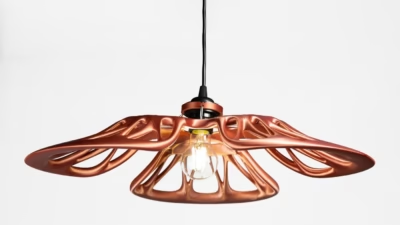
He has also designed furniture for Bonaldo, Tonelli, KARE, MIDJ, Riva 1920 and Natuzzi, and outdoor pieces for Vondom, including the faceted Voxel chair. His lighting is produced by Artemide, Fontana Arte, Kundalini and Martinelli Luce, which makes his Cyborg table lamp.
Which interiors and hotels has Karim Rashid designed?
Rashid designs complete interiors as well as objects, and hotels form a large part of that work. His first hotel was the Semiramis in Athens (2004). The nhow Berlin, a 304-room music hotel on the Spree, followed in 2010 with a lobby, bar, restaurant and rooms designed by his studio. He later reworked its bar and lobby around a blob-shaped cyan bar, a backlit bottle display, custom tiles, acoustic panels and a modular stage for concerts, with 120 seats inside and the same number outdoors.
In Tel Aviv he designed the Poli House, a 40-room hotel that opened in September 2016 in the Polishuk House, a Bauhaus building from 1934 restored by the architect Nitza Szmuk. It was his first project in Israel, and since the facade could not be altered, he kept the yellow, blue, green and white scheme to the inside. His other interiors include the Morimoto restaurant in Philadelphia, the Università metro station in Naples, the makeover of Temptation Resort and Spa in Cancún, announced in 2016, and Switch restaurants in the UAE and Bahrain, where Switch Bahrain won the IDA Interior Design of the Year award for 2020. In New York and Miami he has designed residential buildings for HAP Investments and the Related Group.

What has Karim Rashid designed recently?
Rashid’s recent work includes two launches at Milan Design Week 2025. At Salone del Mobile the German furniture company KARE presented Fluid Realities, a collection of around 60 furniture and lighting designs in white, pink and what Rashid calls techno tones. During the same week he presented a special edition of Zenith, a chaise longue for the Spanish brand Nagami, 3D printed by robotic arms entirely from recycled plastic.
In 2024 he designed Bound, a seating collection for the German brand Kusch+Co.
What awards and honours has Karim Rashid received?
Rashid has won more than 400 international awards. Early recognition included the George Nelson Award in 1999 and Canadian Designer of the Year in 2002, and his prizes since then include multiple Red Dot, iF, IDA and Good Design awards, an IDSA Industrial Design Excellence Award and Pentawards. In 2017 the Fashion Institute of Technology in New York gave him the Lawrence Israel Prize, and in 2020 The Chicago Athenaeum named him laureate of the American Prize for Design for his lifetime achievement.

He holds honorary doctorates from the Corcoran College of Art and Design in Washington (2005), the Ontario College of Art & Design in Toronto (2006), Pratt Institute (2014) and Carleton University (2016). His work is in 20 permanent collections, among them MoMA in New York, the Centre Pompidou in Paris, SFMOMA in San Francisco and the Brooklyn Museum, and he has had retrospectives in São Paulo, Seoul, Milan and Ottawa.
Rashid also judges competitions and speaks at design events. In 2023 he sat on the Lexus Design Award jury with Paola Antonelli of MoMA and Simon Humphries, head of Toyota and Lexus global design, and he is a regular keynote speaker at fairs and design weeks from Milan and Dubai to Auckland.
Karim Rashid – frequently asked questions
What is Karim Rashid’s nationality?
Rashid is Egyptian-born and Canadian-raised: he was born in Cairo in 1960 to an Egyptian father and an English mother, grew up in Canada and has run his studio in New York since 1993.
What did Karim Rashid design for New York City?
In 1999 he won Con Edison’s competition for a commemorative millennium manhole cover for the city’s streets.
Has Karim Rashid worked with Polish brands?
Yes. In 2019 the Polish glassmaker Krosno launched its Krosno D’sign label with Sakred, a glassware collection by Rashid, followed by Luck, a set of wine glasses based on a four-leaf clover. He has also worked with Nowy Styl, Befame, Loope and ILUM, and he has given talks at the Warsaw Home & Contract fair at Ptak Warsaw Expo.
What books has Karim Rashid written?
His books include I Want to Change the World (2001), Digipop (2005) and Design Your Self (2006), a guide to rethinking the way we live, love, work and play. Books devoted to his work include Evolution (2004), KarimSpace (2009), which presents 40 of his projects in a dozen countries, and From the Beginning (2014).
Rashid’s colour rules, pink to lift the mood and lime green for dining, are simple to state and harder to carry through a real home, where a saturated wall or a curved statement chair has to work with daylight, flooring and the proportions of the room. Find architects, interior designers and interior photographers in the PLNDesign directory.
See also:
- Philippe Starck: designer of the Louis Ghost chair and Juicy Salif
- Pininfarina: history, Ferrari years and the design house today