

The Memphis Group, also known as Memphis Milano, was a design collective formed in Milan around the architect and designer Ettore Sottsass in December 1980. Its first collection, shown in September 1981, set loud colour, geometry and plastic laminate against the restraint of modernism, and the group went on to present a new collection every year until 1988. Many of its pieces are still in production, and the style keeps returning in fashion, interiors and graphics.
Memphis Group at a glance:
- An Italian design collective that formed at Ettore Sottsass’s home in Milan on 11 December 1980 and launched with 55 pieces at the Arc ’74 gallery in September 1981, during the Salone del Mobile.
- The name comes from Bob Dylan’s ‘Stuck Inside of Mobile with the Memphis Blues Again’, which was playing during the first meeting.
- Clashing colours, plastic laminate and terrazzo define the style, together with patterns such as Sottsass’s Bacterio; the best-known piece is his Carlton bookcase of 1981.
- Sottsass left in 1985 and the last collection appeared in 1988, but the company behind Memphis still produces the original designs.
What was the Memphis Group?
The Memphis Group was a Milan collective of designers and architects that, between 1981 and 1988, made furniture, lighting, textiles, carpets, ceramics, glass and metal objects in open opposition to modernist good taste. It formed around Ettore Sottsass (1917–2007), who was already in his sixties, and drew in designers from Italy, France, the UK, Austria, Japan, the US and Spain.

For Sottsass and his circle, it was no longer enough for an object to work well. A cabinet or a lamp also had to carry symbolic, poetic and emotional meaning, and to provoke and amuse. Memphis aimed these pieces at small ‘trend markets’, a selected audience of buyers, and kept its distance from the logic of industrial mass production.
Why is it called Memphis?
The group took its name from Bob Dylan’s ‘Stuck Inside of Mobile with the Memphis Blues Again’, which played over and over during the founding meeting in December 1980. The word suited a collective that mixed references from different eras: Memphis is the city in Tennessee where Elvis Presley lived, and it was also the name of a capital of ancient Egypt.

What did Ettore Sottsass design before Memphis?
By 1980 Sottsass had been working with colour, ornament and plastic for more than a decade. For Olivetti he designed the Valentine portable typewriter, introduced in 1969 and completed with the British designer Perry King, and in 1970 he created the Ultrafragola, a wavy illuminated mirror, for the Italian furniture maker Poltronova. In 1978 he drew the Bacterio pattern for the laminate manufacturer Abet Laminati, abstracting the surface of a Buddhist temple in Madurai, India, into a field of black squiggles. Abet’s decorative laminates later became the main palette for Memphis furniture.
Sottsass also designed for Studio Alchimia, an experimental collective founded in Milan in 1976 by Alessandro Guerriero, which worked with Alessandro Mendini, Andrea Branzi and Michele De Lucchi, among others. Branzi, De Lucchi and Mendini later designed for Memphis as well.
History of the Memphis Group, 1980–1988
Memphis began on the evening of 11 December 1980, when Sottsass invited colleagues to the living room of his Milan home to talk about new forms of expression. The six young designers there that night were Martine Bedin, Aldo Cibic, Michele De Lucchi, Nathalie Du Pasquier, Matteo Thun and George J. Sowden. In early 1981 the group met again with more than a hundred drawings of furniture and objects.

The first collection, 55 pieces including furniture, lamps and ceramics, opened at the Arc ’74 gallery in Milan in September 1981, during the Salone del Mobile. Crowds gathered at the entrance on the opening night, and within three months more than 400 periodicals around the world had written about Memphis. Barbara Radice, a journalist who co-founded Memphis with Sottsass, was the group’s artistic director, while Ernesto Gismondi, founder and president of the lighting company Artemide, backed Memphis financially and distributed its collections worldwide. A new collection followed every year.
Sottsass left in 1985 to concentrate on his own practice, Sottsass Associati. ‘Strong ideas are short-lived, and it is not possible to develop them further,’ he said. The group carried on without him until 1988, when it presented its last collection.
What happened to Memphis after 1988?
The company behind Memphis outlived the group. In 1989 and 1991 it released two collections under the name Meta Memphis, this time designed by artists, and since 1997 its new work has appeared under the Post Design brand. The Memphis Milano name stayed with the designs created between 1981 and 1988.
In 1996 Gismondi sold the company to Alberto Bianchi Albrici, who had been its managing director for ten years. At the beginning of 2022 it was acquired by Italian Radical Design, the group founded by Sandra and Charley Vezza that also owns Gufram. As of November 2026, Memphis srl, now based in La Morra in Piedmont, still produces the original designs, including the Carlton bookcase, the Tahiti lamp and the Bel Air armchair.
Who were the members of the Memphis Group?
Ettore Sottsass founded and led Memphis together with Barbara Radice, who was its artistic director. The founding designers were Martine Bedin, Aldo Cibic, Michele De Lucchi, Nathalie Du Pasquier, Matteo Thun and George J. Sowden. Andrea Branzi, Shiro Kuramata, Marco Zanini, Peter Shire, Gerard Taylor and Masanori Umeda joined later, along with architects and designers such as Arquitectonica, Michael Graves, Hans Hollein, Arata Isozaki and Javier Mariscal. Alessandro Mendini designed the Cipriani cocktail cabinet for Memphis in 1981, the group’s first year.
Du Pasquier, born in Bordeaux in 1957 and living in Milan since 1979, designed her first patterns for Sowden’s pieces in that first collection and went on to create many of the group’s textiles. Bedin, who joined in her twenties, was put in charge of Memphis lighting. Shire, a ceramicist from Los Angeles, was the only American who took part in Memphis consistently. Thun designed ceramics, De Lucchi furniture and lamps, and Umeda the Tawaraya ring.
What are the characteristics of Memphis design?
Memphis design is recognisable by bright colours that clash on purpose, geometric and asymmetric forms, and surfaces covered in pattern, from Bacterio squiggles to laminates printed to imitate figured wood or snakeskin. After years in which objects were expected to be functional first, the group brought decoration back as a quality in its own right.

Materials did much of the work. Memphis combined everyday materials such as plastic laminate and terrazzo with precious ones such as briar. The decorative laminates came from Abet Laminati and were decorated by the designers themselves, which is how patterns like Bacterio ended up on cabinets, tables and lamp bases.
The group drew on Art Deco and Pop Art, mixing references from pop culture and high culture. Behind the look lay a rejection of the modernist rule that form follows function and of the conventions of good taste.
Memphis Group designs to know
The table lists key pieces from the Memphis collections, all of which are still in the Memphis Milano catalogue.
| Design | Designer | Year | Type |
|---|---|---|---|
| Carlton | Ettore Sottsass | 1981 | bookcase and room divider |
| Casablanca | Ettore Sottsass | 1981 | cabinet |
| Tahiti | Ettore Sottsass | 1981 | table lamp |
| Super | Martine Bedin | 1981 | floor or table lamp |
| Kristall | Michele De Lucchi | 1981 | coffee table |
| Plaza | Michael Graves | 1981 | dressing table |
| Tawaraya Ring | Masanori Umeda | 1981 | seating platform |
| Bel Air | Peter Shire | 1982 | armchair |
| First | Michele De Lucchi | 1983 | chair |
| Horizon | Michele De Lucchi | 1984 | double bed |
| Big Sur | Peter Shire | 1986 | sofa |
The Carlton bookcase is the piece most often used to sum up Memphis. Sottsass designed it in 1981 in wood covered with decorative laminate; it stands 196 centimetres high and, with its vaguely human outline, can also divide a room. Its shelves form a totem-like stack of triangles, solid blocks and gaps in bright colours. Casablanca, a cabinet from the same year, carries Sottsass’s printed laminate patterns across a tall, expressive form.

Sottsass’s Tahiti table lamp of 1981 looks like a toy bird. A base in black and white Bacterio laminate supports a yellow stem and a round pink head that turns to direct the light from a red beak. Martine Bedin’s Super lamp from the same year is a lacquered semicircle on four rubber wheels, with six coloured cylinders holding the bulbs, and Memphis Milano describes it as a lamp that can be pulled along like a dog on a lead.
Peter Shire’s Bel Air armchair of 1982 has an asymmetric back that takes its cue from shark fins; the maker describes it as a tribute to the American West Coast and surf culture. The V&A, which holds an early example, calls it Shire’s most important contribution to Memphis; according to the museum’s record, Shire estimated that 30 or 40 had been sold in total, at four or five a year in the 1980s.
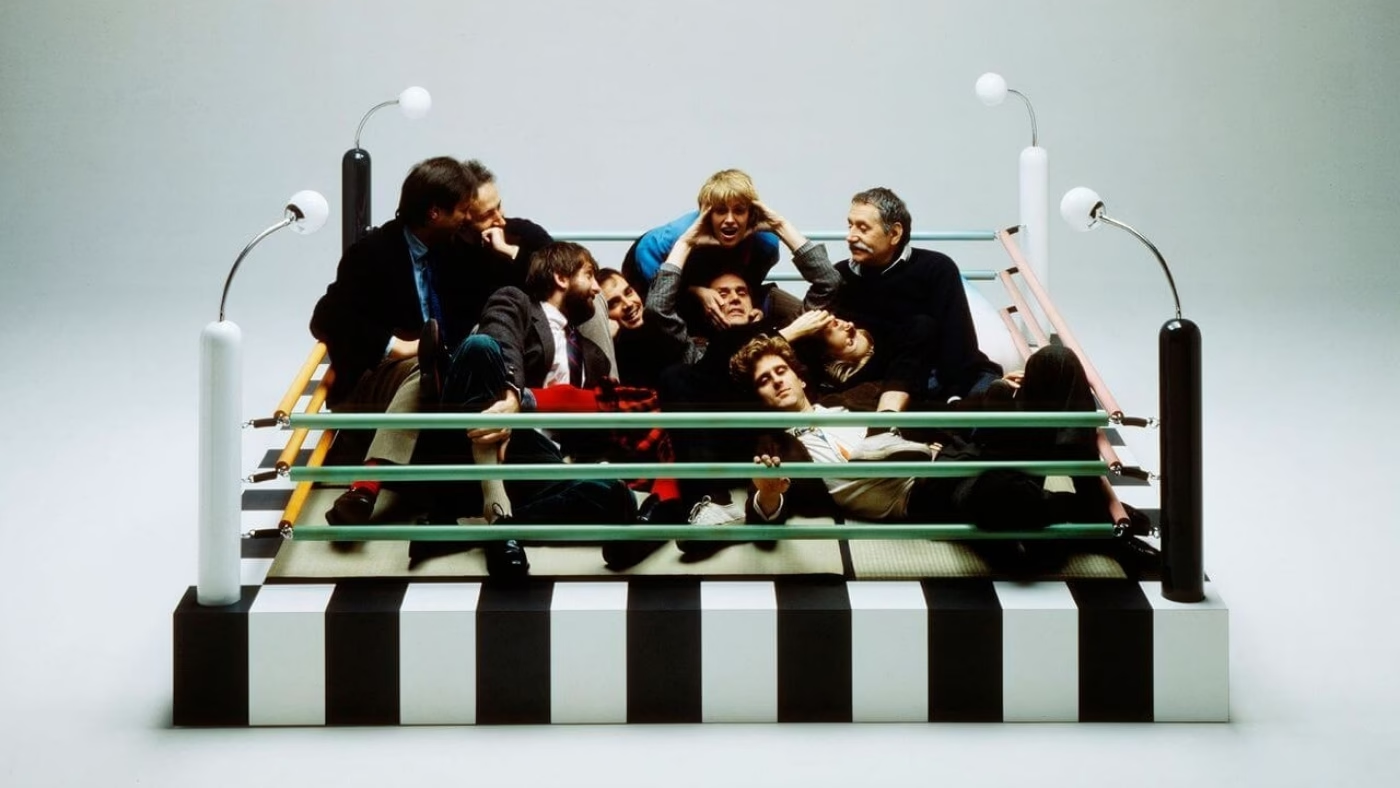
Masanori Umeda’s Tawaraya Ring is a domestic boxing ring lined with traditional tatami mats; it measures four and a half mats, the standard minimum size of a flat in Japan. Umeda wanted a space that would also be a piece of furniture, a ring for intellectual sparring, and the Memphis designers were photographed sitting in it in 1981. Michele De Lucchi’s Kristall coffee table takes its cue from the Apollo 11 lunar module, while Michael Graves’s Plaza dressing table, named after New York’s Plaza Hotel, is an indoor skyscraper with an Art Deco profile.
How did the Memphis Group influence design after the 1980s?
Memphis outlived the group that created it. From the mid-1980s to the mid-1990s its colours and shapes spread through television, shopping malls, household goods and clothes; Nickelodeon based the set of its game show Double Dare on the style. In the 2010s the same palette resurfaced in the vaporwave internet aesthetic.
Fashion has returned to Memphis many times. Dior’s autumn/winter 2011–12 haute couture collection, shown in July 2011, took Sottsass as one of its references. Nathalie Du Pasquier’s patterns appeared in the Wrong for Hay collection launched by the Danish brand HAY in 2013, and in 2014 she designed a 43-piece clothing collection for American Apparel. Missoni drew on Memphis for its autumn/winter 2015 collection, and in 2021, for the group’s 40th anniversary, Anthony Vaccarello showed Memphis furniture in the Saint Laurent Rive Droite stores in Paris and Los Angeles alongside a capsule collection.
The group also had famous collectors. Karl Lagerfeld furnished the Monte Carlo apartment he bought in 1981 with Memphis pieces and sold the collection at Sotheby’s in Monaco in October 1991. David Bowie was a passionate collector of Sottsass and Memphis; in November 2016, after his death, Sotheby’s London sold these pieces in a 100-lot auction that made £1.4m, including a record £77,500 for Peter Shire’s Big Sur sofa.

Memphis Group – frequently asked questions
How is Memphis design different from modernism?
Modernism put function and simplicity first. Memphis gave decoration and form the same weight as function, used cheap laminates alongside precious materials and worked with loud colour and deliberate kitsch.
Where can you see Memphis Group design in museums?
The Carlton bookcase is in the collections of the Musée des Arts Décoratifs in Paris, on long-term loan from France’s Centre national des arts plastiques, and of the Cooper Hewitt in New York, which acquired one in 1986. The V&A in London holds an early Bel Air armchair, kept at V&A East Storehouse.
Is Corporate Memphis the same as the Memphis Group?
No. Corporate Memphis is the nickname for a flat, geometric illustration style in solid colours that became popular with start-ups in the late 2010s. The name refers only to its resemblance to the Memphis style.
An interior in the Memphis spirit, with a loud palette, geometry and a crowd of patterns, needs a good sense of proportion so that the effect does not overwhelm the room. Find architects, interior designers and interior photographers in the PLNDesign directory.
See also:
- Karim Rashid: life, design style and most famous works
- Philippe Starck: designer of the Louis Ghost chair and Juicy Salif