

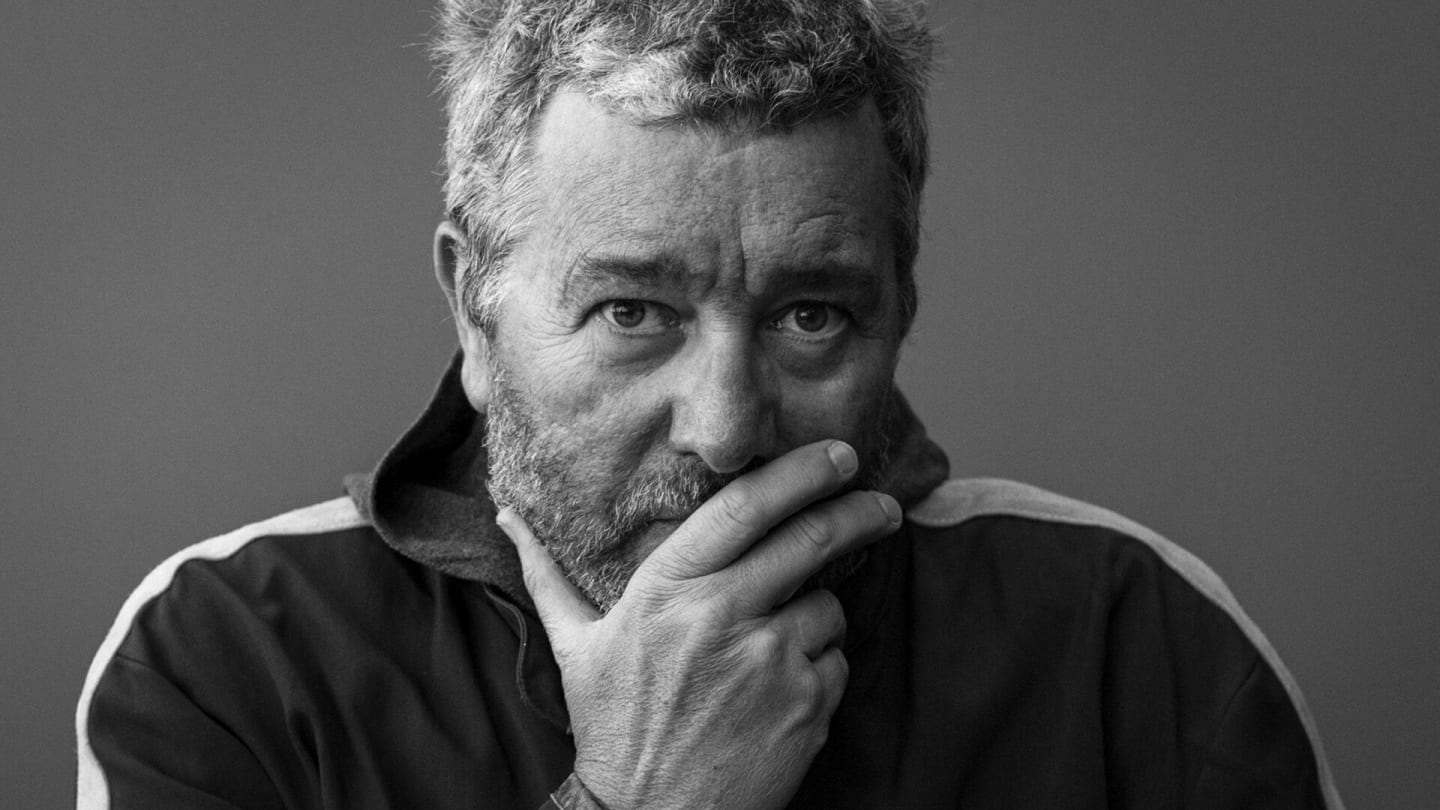
Philippe Starck is a French designer and architect, born in Paris on 18 January 1949, whose work ranges from a lemon squeezer and a plastic chair to hotels, superyachts and the interior of a space station module. By his own count he has worked on more than 10,000 projects, 220 of them in architecture. His best-known objects are the Juicy Salif squeezer for Alessi and the Louis Ghost chair for Kartell.
Philippe Starck at a glance:
- Son of an aeronautical engineer, he studied at the École Nissim de Camondo in Paris and made his name with nightclub interiors in the late 1970s.
- His breakthrough came in 1983, when President François Mitterrand chose him to refurbish the private apartments at the Élysée Palace.
- Juicy Salif (1990) and Louis Ghost (2002) remain his most widely known products, both made in large series by Alessi and Kartell.
- Still designing at 77, he received the DesignEuropa Lifetime Achievement Award from the European Union Intellectual Property Office in 2026.
Who is Philippe Starck?
Philippe Starck is a French product designer, interior designer and architect who has worked at almost every scale of design for more than five decades. He describes his duty as a creator as ‘subversive, ethical, ecological, political, humorous’, and the things he has designed include furniture, lighting, kitchenware, bathroom fittings, toys, motorbikes, wind turbines, yachts and hotels.
He was born in Paris on 18 January 1949. His father, André Starck, was an aeronautical engineer, and Starck has said that this made invention a duty for him. He studied at the École Nissim de Camondo in Paris and in 1968 set up his first company, which made inflatable objects. A period as art director for Pierre Cardin followed before he went back to working for himself.

His first interiors were nightclubs: La Main Bleue in Montreuil (1976) and Les Bains-Douches in Paris (1978). At the end of the 1970s he founded his first industrial design company, Starck Product, later renamed Ubik after the Philip K. Dick novel. The commission that made him widely known came in 1983, when François Mitterrand, on the recommendation of his culture minister Jack Lang, chose Starck to refurbish the president’s private apartments at the Élysée Palace. The work ran until 1984, the year Café Costes opened in Paris.
Café Costes, near the Centre Pompidou, was an immediate success, and people came to see the interior as much as to drink coffee. Its large central staircase and oversized clock became the elements everyone remembered. He gave the café’s chairs three legs so that waiters could move between the tables more easily, and the Costes chair is still produced by Driade. Frame magazine, presenting Starck with its Lifetime Achievement Award in 2019, described the café as the turning point of his career.
What is Philippe Starck’s most famous product?
The two products most closely associated with Philippe Starck are the Juicy Salif lemon squeezer, made by Alessi since 1990, and the Louis Ghost chair, made by Kartell since 2002. Both were designed for large-scale production.
Juicy Salif started on the Italian island of Capraia in 1988. Eating fried squid in a seaside restaurant, Starck began drawing on the paper placemat, and the sketch, now kept in the Alessi museum, turned into a cast aluminium body on three long legs that suggests a squid or a spider. Starck has said the squeezer was meant to start conversations, not to squeeze lemons, and Alberto Alessi has said it gave the standard-bearers of ‘form follows function’ some headaches. It is in the collections of the Museum of Modern Art and the Metropolitan Museum of Art in New York and the V&A in London.

What is the story behind the Louis Ghost chair?
The Louis Ghost chair reworks an 18th-century Louis XVI armchair with an oval medallion back in transparent or coloured polycarbonate, and Kartell has produced it since 2002. The whole chair is injection-moulded in one piece, and the National Gallery of Victoria, which has one in its collection, describes it as one of the most daring examples of single-mould polycarbonate injection in the world. The chair can be stacked.
Starck’s own account is brief: on the chair’s tenth anniversary he said that its success came from a collective Western memory and that it was the natural result of our past, our present and our future. Its success produced a family that includes the Victoria Ghost side chair without arms (2005), the Charles Ghost stool and the small Lou Lou Ghost armchair for children.

What else has Philippe Starck designed?
Beyond those two objects, Starck’s work covers furniture, lighting, kitchen and bathroom products, electronics and transport. For Kartell he designed the Bubble Club sofa and armchair in polyethylene, weather-resistant enough for gardens and terraces. The Masters chair, designed with Eugeni Quitllet, overlays the outlines of Arne Jacobsen’s Series 7, Eero Saarinen’s Tulip Armchair and Charles Eames’s Eiffel Chair, and H.H.H. (Her Highest Highness) is one of his recent chairs for the same brand. For Cassina he designed the Privé sofa, and for Magis the Stanley folding director’s chair.
Hot Bertaa, an aluminium kettle for Alessi designed in 1989, is remembered for other reasons: Alberto Alessi later called it the company’s ‘most beautiful fiasco’. The Guns lamps for Flos (2005) take the form of gold-coloured weapons and were conceived as a condemnation of war, with the gold standing, as Flos describes it, for the collusion between money and war. For Axor he designed Axor Starck V (2014), a crystal-glass mixer that makes the vortex of running water visible.

Technology has its own place in the portfolio. The Parrot Zik headphones (2012) pause the music when they are taken off, the Xiaomi Mi MIX smartphone has a screen covering almost the whole front, and Starck Biotech Paris eyewear uses a hinge called Biolink, modelled on the human collarbone. In 2019 Kartell launched the A.I. chair, developed with Autodesk’s generative design software, and Starck called the result ‘Natural Intelligence’.
Starck has also designed superyachts: Motor Yacht A, a 119-metre yacht with a reverse bow delivered in 2008, which he described as a stealth yacht, and Venus, a 78-metre yacht designed for Steve Jobs and launched in 2012. He created the Virgin Galactic logo with GBH Design in 2005 and in 2018 designed the interior of a habitation module for Axiom Space’s commercial space station. For the 1992 Winter Olympics in Albertville he designed the Olympic cauldron, and in the same year his Histoire de Paris street signs, nicknamed ‘Starck oars’, began to go up in Paris.
What is democratic design?
For Starck, democratic design means raising the quality of everyday objects while bringing their price down, so that good design reaches as many people as possible. In practice he pursued it by producing in larger quantities to cut costs and by selling through mail order: in 1998 he created the Good Goods catalogue with La Redoute, with 170 everyday objects, and he later designed a collection of more than 50 products for the American retailer Target.
The same reasoning shaped his attitude to materials. In an interview with TL Magazine he rejected natural materials outright, saying that wood should stay in the trees and leather on the cow, and argued that plastic could be more ecological than felling trees or killing animals. He later changed course. For Kartell he developed chairs moulded from wood residues, for Andreu World he designed collections in FSC-certified wood from reforested land, and in 2019 he upholstered the Croque la pomme collection for Cassina in a material made from apples instead of leather.
Starck calls the principle behind this dematerialisation: an object should need as little matter as possible. Speaking about his DesignEuropa award in 2026, he summed it up as ‘less materiality means more humanity’.
Which buildings and hotels has Philippe Starck designed?
Starck’s first buildings went up in Japan at the end of the 1980s, and his architecture has since spread to France, Spain and Vietnam. In Tokyo he designed the Nani Nani building (1989) and the Asahi Super Dry Hall next to the Asahi Breweries headquarters on the Sumida River. The black building carries a hollow golden flame weighing 360 tonnes, built by shipbuilders using submarine construction techniques, and many Tokyo residents call it ‘the golden turd’. The Le Baron Vert office complex in Osaka followed in 1992.
In France he designed the 1998 extension of the École Nationale Supérieure des Arts Décoratifs in Paris with Luc Arsène-Henry, as well as the control tower at Bordeaux-Mérignac airport. In Bilbao he turned a former wine and oil warehouse into the Alhóndiga, a culture and leisure centre that opened in 2010, and in Ronda, Andalusia, he designed LA Almazara, an olive oil mill with a museum and restaurant that opened in 2024 and was named one of TIME’s World’s Greatest Places in 2025. Maison Heler in Metz, a Hilton hotel crowned with a traditional Lorraine house, opened in 2025, and in 2026 he presented Nhà Estate, 38 villas on a peninsula at Ho Tram in Vietnam.
Hotels form a large part of his work. His collaboration with the hotelier Ian Schrager began with the Royalton in New York in 1988, where a blue carpet ran the full length of the lobby, and continued with the Paramount (1990) and Hudson (2000) in New York, the Delano in Miami Beach (1995), the Mondrian in West Hollywood and the St Martins Lane and Sanderson hotels in London. Later projects include the Fasano in Rio de Janeiro (2007), Le Royal Monceau (2010) and Brach (2018) in Paris, and Rosewood São Paulo, designed with Jean Nouvel. By his own count, he has designed 43 hotels. His interiors outside hotels include the Eurostar business lounges in Paris and London (2002) and Maison Baccarat, the crystal maker’s Paris house (2003).
What happened to Philippe Starck?
Philippe Starck is still working. In 2008 he told the German weekly Die Zeit that design was dead, that he was ashamed of having been ‘a producer of materiality’ and that he would give up designing within two years. He did not stop, and in 2026 he designed the interiors of Villa Colette, the first five-star hotel on the Cap Ferret peninsula, with 28 rooms and suites.

What awards has Philippe Starck received?
Starck’s distinctions include two Compasso d’Oro awards and two French state honours. The Compasso d’Oro went to the Bubble Club sofa in 2001 and to the H.H.H. chair for Kartell in 2025. France made him a Commandeur of the Ordre des Arts et des Lettres in 1998 and a Chevalier of the Légion d’honneur in 2000. He also received the Harvard Excellence in Design Award in 1997, and in 2023 his Eleganza chair for Kartell won a Red Dot: Best of the Best. In 2026 the European Union Intellectual Property Office gave him the DesignEuropa Lifetime Achievement Award, presented in Ljubljana in September, and the Universidade Católica Portuguesa awarded him an honorary doctorate.
Philippe Starck – frequently asked questions
What inspired Philippe Starck?
Starck names his father, an aeronautical engineer, as his first influence and has said that his father’s profession made invention a duty for him. His individual designs often start from a specific image: a plate of fried squid for Juicy Salif and the Louis XVI medallion chair for Louis Ghost.
Which brands has Philippe Starck designed for?
His partners include Kartell, Alessi, Driade, Cassina, Glas Italia, Andreu World, Magis, Emeco, Duravit, Axor, Flos and Baccarat. For Dior he reinterpreted the Médaillon chair as the Miss Dior chair, and with Louis Roederer he has co-created the Brut Nature champagne since its first vintage, 2006, released in 2014.
Did Philippe Starck design the Paris 2024 Olympic medals?
No. In 2017 he designed a medal concept for Paris’s bid to host the Games: a medal that splits into four parts so that the winner can share it with the people behind the success. The medals awarded in 2024 were designed by Paris 2024 with the jeweller Chaumet and set with a piece of original iron from the Eiffel Tower.
Where can you see Philippe Starck’s work?
His designs are in the collections of the Museum of Modern Art and the Brooklyn Museum in New York, the Centre Pompidou and the Musée des Arts Décoratifs in Paris, the Vitra Design Museum and the Design Museum in London. The Centre Pompidou held a Starck retrospective in 2003, and many of his pieces, from Louis Ghost to Juicy Salif, are still in production.
Polycarbonate and polyethylene furniture looks different in a product photo than in a real room: scale, colour and the pieces around it decide whether a design classic fits in or ends up standing alone. Find architects, interior designers and interior photographers in the PLNDesign directory.
See also:
- Ingo Maurer: the poet of light, his lamps and where to see them
- Branding mistakes that cost architects the clients they want