

Pininfarina is an Italian design house based in Cambiano, near Turin, founded in 1930 by Battista ‘Pinin’ Farina and best known for the Ferraris it designed for more than six decades. It built car bodies and complete cars in large numbers until 2010, and today it designs cars, trains, yachts, products and buildings. Since 2016 it has been controlled by India’s Mahindra Group.
Pininfarina at a glance:
- Founded in Turin on 22 May 1930 by Battista ‘Pinin’ Farina, whose surname was officially changed to Pininfarina in 1961.
- Ferrari’s main design partner from 1951 to 2012, from a first meeting in Tortona to the F12berlinetta; LaFerrari, in 2013, was the first Ferrari designed entirely in-house.
- Series car production in Italy ended in 2010 after a debt crisis in which total debt reached €598 million at the end of November 2008.
- Around 500 employees and €103.6 million of revenue in 2025, with Mahindra’s holding company owning 78.82% and bidding in 2026 to take Pininfarina off the Milan stock exchange.
What is Pininfarina?
Pininfarina S.p.A. is a design and engineering company and a former coachbuilder, with its headquarters in Cambiano, about 13 kilometres south-east of Turin. Its work covers cars, architecture, trains and other transport, yachts and product design. It also runs a full-scale wind tunnel that carmakers hire for aerodynamic and aeroacoustic testing, and the company uses the same facility for architecture and product projects. Alongside design, it offers engineering, show cars, limited series and coachbuilding.

The group employs around 500 people. Besides Cambiano, it has offices in Grugliasco near Turin, Milan, Porto Lotti near La Spezia, Shanghai, Miami, New York and Munich. Over the decades its car clients have included Ferrari, Alfa Romeo, Lancia, Fiat, Peugeot, General Motors and Maserati.
What does the name Pininfarina mean?
The name joins the family surname Farina with ‘Pinin’, a Piedmontese diminutive meaning roughly ‘little one’ and the nickname of the founder, Battista Farina, the tenth of eleven children. For its first three decades the firm traded as Carrozzeria Pinin Farina, in two words. In 1961 the Italian president, Giovanni Gronchi, authorised by decree the change of the family surname to Pininfarina, and the company took the same name. That year Battista, then 68, handed the business to his son Sergio and his son-in-law Renzo Carli.

Who was Battista ‘Pinin’ Farina?
Battista Farina was born in Turin on 2 November 1893 and started work as a boy in Stabilimenti Farina, the coachbuilding firm of his older brother Giovanni. As a teenager he designed the radiator for the Fiat Zero. He stayed in his brother’s firm for decades, learning bodywork and designing his own cars, before leaving in 1930 to set up his own company with financial backing from his wife’s family and support from Vincenzo Lancia.

His honours included the Compasso d’Oro career award in 1957, the French Légion d’honneur and an honorary degree in architecture from the Politecnico di Torino. The last design he worked on was the Alfa Romeo 1600 Spider, later known as the Duetto, developed with Aldo Brovarone and shown at the Geneva Motor Show in March 1966. He died in Lausanne less than a month later, on 3 April 1966.
How did Pininfarina begin?
Carrozzeria Pinin Farina was founded in Turin on 22 May 1930, at Corso Trapani 107. The plant covered 9,250 square metres, employed 150 people and built special bodies for individual customers and small production runs. In the 1930s it bodied cars for Lancia, Alfa Romeo, Isotta Fraschini, Hispano-Suiza, Fiat, Cadillac and Rolls-Royce. Its close ties with Lancia, the pioneer of the monocoque, made it the first coachbuilder to body cars of unitary construction, in the mid-1930s, when others in the trade expected frameless construction to end the independent coachbuilder. By 1939 the company had 400 employees building 150 bodies a month.

During the war the factory made ambulances and searchlight carriages until Allied bombing destroyed it. Italy was barred from the 1946 Paris Motor Show, so Battista and Sergio drove an Alfa Romeo 6C 2500 S and a Lancia Aprilia cabriolet from Turin to Paris and parked them at the entrance to the Grand Palais, a display the press called the Turin coachbuilder’s anti-salon. The Cisitalia 202 coupé, designed at the end of 1945 and built in 170 examples, established the firm’s reputation. In 1951 New York’s Museum of Modern Art showed it in an exhibition of eight cars, and it is now part of the museum’s permanent collection. The exhibition brought Pinin Farina to the attention of Nash-Kelvinator, and from 1952 to 1954 the body of the Nash-Healey sports car was designed and assembled in Turin.
In 1954 and 1955 Pinin Farina bought land in Grugliasco, outside Turin, for a new factory, which opened in 1958 with nearly 1,000 employees. Its first car built in large numbers was the Alfa Romeo Giulietta Spider: 1,025 were made in 1958 and more than 4,000 in 1959. Sergio Pininfarina, born in Turin in 1926 and a mechanical engineering graduate of the Politecnico di Torino, became chairman on his father’s death in 1966, as the company was investing in research. The Studies and Research Centre opened in Grugliasco that year, with 8,000 square metres and 180 technicians producing 25 prototypes a year, and in 1972 a full-scale wind tunnel started work, the first in Italy able to test full-size cars; General Motors opened its own in 1980. In 1986 the company was listed on the Milan stock exchange and opened a plant in San Giorgio Canavese. Sergio was a member of the European Parliament from 1979 to 1988, was made a life senator in 2005 and died in Turin on 2 July 2012.
What happened between Pininfarina and Ferrari?
The partnership ran from 1951 to the F12berlinetta of 2012, the last all-new Ferrari designed with Pininfarina, although the 2014 California T, an update of a Pininfarina design, was still styled in collaboration with the studio. LaFerrari, unveiled in 2013, was the first Ferrari designed entirely in-house. Flavio Manzoni, who has led Ferrari’s own design team since it was set up in 2010, has said that the cars became too complex to fix the technical layout first and then hand it to an outside studio to dress. According to Manzoni, both Pininfarina and the in-house team pitched designs for LaFerrari, and Ferrari’s management chose the in-house proposal. He has also described the separation as very hard for Pininfarina after more than 60 years of collaboration.
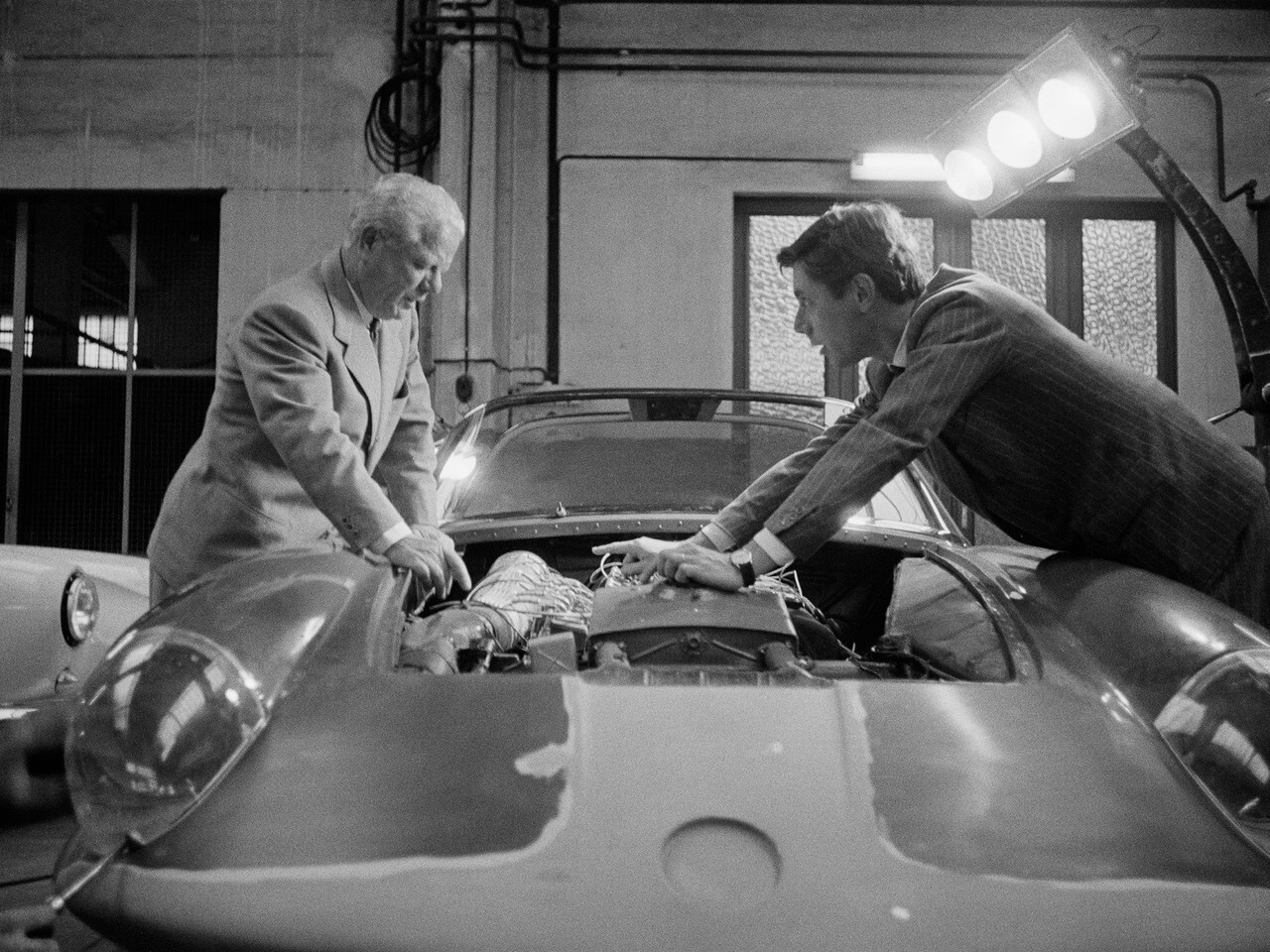
The relationship began in 1951 with a meeting at a restaurant in Tortona, halfway between Turin and Modena, chosen because neither Battista Farina nor Enzo Ferrari wanted to go to the other’s headquarters. Battista put Sergio in charge of the Ferrari work. The ties went beyond design: Pininfarina became a partner in SEFAC, the company that ran Ferrari’s racing team from 1961 to 1989, Battista was a vice-president of Ferrari, and Sergio later sat on its board.

Over those six decades the studio designed the 250 GT SWB, the 250 GT Berlinetta Lusso, the 330 road cars, the Testarossa, F40, F50, 550 Maranello, Enzo and 612 Scaglietti. The only series-production road Ferrari of the period not designed by Pininfarina was the Dino 308 GT4 of 1973, styled by Bertone.
What cars did Pininfarina design?
Beyond Ferrari, Pininfarina designed, and often built, cars for Alfa Romeo, Fiat, Lancia, Peugeot, Cadillac, Rolls-Royce, Maserati and Jaguar, among others. The table lists a selection of its best-known designs, Ferraris included.
| Model | Year | Note |
|---|---|---|
| Cisitalia 202 | 1946 | |
| Alfa Romeo Giulietta Spider | 1955 | About 17,000 made |
| Ferrari 250 GT SWB | 1959 | |
| Alfa Romeo 1600 Spider (Duetto) | 1966 | Battista Farina’s last design; built until 1993, about 124,000 made |
| Fiat 124 Sport Spider | 1966 | Styled by Tom Tjaarda; about 200,000 made |
| Rolls-Royce Camargue | 1975 | Designed by Paolo Martin |
| Ferrari Testarossa | 1984 | |
| Cadillac Allanté | 1986 | Over 21,000 made |
| Ferrari F40 | 1987 | Body designed by Pietro Camardella under Aldo Brovarone |
| Peugeot 406 Coupé | 1996 | Designed and built by Pininfarina; 107,633 made |
| Enzo Ferrari | 2002 | Designed by Ken Okuyama |
| Ferrari F12berlinetta | 2012 | |
| Pininfarina Battista | 2019 | Electric hypercar by Automobili Pininfarina |
The Duetto appeared in the film The Graduate. For Peugeot the studio designed the 404, building the bodies of its coupé and cabriolet, then the 504 coupé and cabriolet, and later the 406 Coupé. The Cadillac Allanté bodies left Turin airport 56 at a time in specially equipped Boeing 747s for final assembly in Detroit. In 1979 Pininfarina restyled the Jaguar XJ for its Series III, and in the 2000s it designed the Maserati Quattroporte and GranTurismo.

Some commissions covered only part of a car or its production. Pininfarina designed the interior of the Fiat Coupé, whose body came from Fiat’s own studio, and the saloon and estate versions of the Daewoo Lacetti. From 1999 it built the European version of the Mitsubishi Pajero Pinin at a plant it had bought in Bairo Canavese, near Turin.
What does Pininfarina design beyond cars?
Since the 1980s Pininfarina has worked on trains, trams, yachts, products and buildings, and in 1986 it set up Pininfarina Extra to take its design work into industrial design, interiors, architecture and graphics. Its rail projects include the Italian ETR 500 high-speed train, the Re 460 locomotive and IC 2000 double-deck coaches for the Swiss Federal Railways, Class 72 trains for Norwegian Railways, the Cobra tram for Zürich, the Sirio tram for Athens and IC4 trains for the Danish railways. It also designed the exterior livery and interiors of Eurostar’s e320 trains, which entered service in 2015. At sea it has worked with yards including Azimut, Princess, Fincantieri, Persico Marine and Rossinavi.

Product commissions range from the Coca-Cola Freestyle drinks dispenser and Cisco’s Catalyst 9000 network switch (2017) to the Metamorphosis bicycle for De Rosa (2018), appliance collections for Gorenje and a watch collection with Bovet. Pininfarina also designed and made the Olympic torch for the 2006 Winter Games in Turin.
In architecture it designed the control tower of Istanbul Airport and worked on the Juventus Stadium in Turin and the international airport in Santiago. It has worked on residential buildings with developers such as Cyrela. For interiors it created the modular Segno furniture system with Reflex in 2016, wooden flooring with Corà Parquet and outdoor furniture with Higold.
Why did Pininfarina stop building cars?
Debt forced the change. After three years of losses totalling €115 million by the end of 2007, total debt stood at €598 million at the end of November 2008, and the restructuring agreed with the banks that December required the family to sell its stake. At its peak in 2006 the group had employed 2,768 people.

In 2009 the Grugliasco factory was sold to Finpiemonte, the Piedmont region’s public finance company, for €14.4 million; the wind tunnel next to it was not part of the sale. Car production in Italy ended in November 2010, when the contract to build the Alfa Romeo Brera and Spider at San Giorgio Canavese came to an end, and on 10 December 2011 the company announced that it would leave car production altogether. The last chapter was in Sweden, where Pininfarina Sverige, owned 60% by Pininfarina and 40% by Volvo, built the second-generation Volvo C70 together with its retractable hard top. The last C70 left the Uddevalla plant on 25 June 2013, and the plant closed.
Who owns Pininfarina now?
India’s Mahindra Group. On 14 December 2015 Tech Mahindra and Mahindra & Mahindra agreed to buy 76.06% of Pininfarina from Pincar, the family holding company, in a deal worth about €168 million, which also included a €20 million investment and a €114.5 million guarantee to creditors. The sale was completed on 30 May 2016. The stake is held by PF Holdings, owned 60% by Tech Mahindra and 40% by Mahindra & Mahindra, which now has 78.82% of the shares. In September 2026 PF Holdings launched a tender offer of €1 a share for the rest, aimed at delisting Pininfarina from Euronext Milan, where it has been listed since 1986; the acceptance period runs from 26 October to 20 November 2026.
The family no longer runs the company. Andrea Pininfarina, the founder’s grandson, who led the company from 2001, was killed in a road accident on 7 August 2008. His brother Paolo, who had run Pininfarina Extra from 1987, succeeded him as chairman and died on 9 April 2024, aged 65. The board is now chaired by Lucia Morselli, and Paolo Dellachà, previously chief executive of Automobili Pininfarina, has been chief executive and general manager since 11 December 2025. In 2025 the group’s revenue was €103.6 million, up from €91.9 million in 2024.
Recent car work includes models for VinFast in Vietnam and Togg in Turkey, and the Midsummer, a barchetta designed with Morgan and limited to 50 cars. In 2023 Pininfarina began designing a three-model range for Izera, a planned Polish electric car brand, but the Izera name has since been dropped, and ElectroMobility Poland now plans to build cars with Foxconn in Jaworzno from 2029.

The name has also returned to a car of its own. Automobili Pininfarina, a separate company launched by Mahindra in 2018, unveiled the Battista, an electric hypercar named after the founder, at the 2019 Geneva Motor Show. It has 1,900 hp and a top speed of 350 km/h, and no more than 150 were to be hand-built in Cambiano. The company set the end of Battista production for the end of 2025 and marked it with the Novantacinque, a one-off made for Pininfarina’s 95th anniversary.
Can you visit the Pininfarina Collection?
Yes, by appointment. The collection at the company’s headquarters, Via Nazionale 30 in Cambiano, follows the firm from its foundation to the present through historic and contemporary cars, among them the Cisitalia, the Giulietta Spider, the Sigma Grand Prix and the Cambiano concept, as well as product designs such as the 2006 Olympic torch. Visits are guided, include a presentation of the design process and are open to groups of 10 to 15 people, Monday to Friday from 9am to 5pm. Admission is €25 per person (November 2026), and visits are booked through the general enquiries form on Pininfarina’s website.
Why does Pininfarina matter to design?
Pininfarina treated aerodynamics as part of a car’s design from the 1930s and later took its studio from car bodies into furniture, transport and buildings. At the 1935 Milan Motor Show he exhibited the Alfa Romeo 6C Pescara Coupé aerodinamico, and the Lancia Aprilia Aerodinamica that followed reached a drag coefficient of 0.40.
Recognition came early from outside the car industry. In 1951 MoMA described the Cisitalia 202 and the other cars in its exhibition as ‘hollow rolling sculpture’, and two generations of the family won the Compasso d’Oro, Battista in 1957 and Sergio in 1995. Pininfarina says its architecture carries on the approach of its car work.

Pininfarina – frequently asked questions
How much did the Pininfarina Battista cost?
When it was unveiled in 2019, the Battista was priced at around €2 million. The starting price later rose to €2.2 million before local taxes.
Does Pininfarina still build cars?
Not in series. Since 2010 it has concentrated on design and engineering, while still building show cars, one-offs and very small series; its services include limited series and coachbuilding.
Pininfarina’s furniture, flooring and residential projects carry car-design thinking into the home. For your own home, the work starts with the layout and the proportions of each room, a stage that is easier with an architect or interior designer. Find architects, interior designers and interior photographers in the PLNDesign directory.
See also:
- Ingo Maurer: the poet of light, his lamps and where to see them
- Verner Panton: the Danish designer behind the Panton Chair