

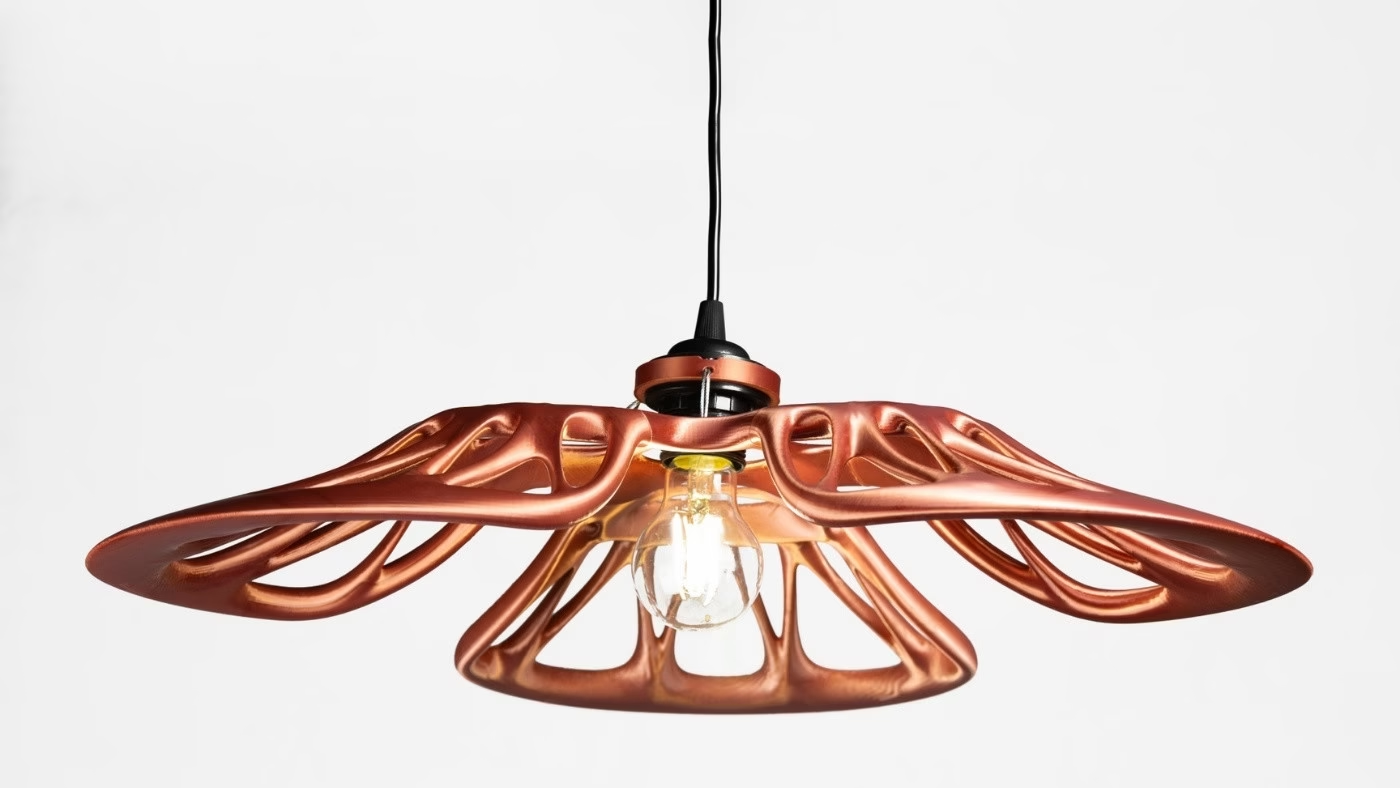
GK-Atelier Grzegorz Kłoda has designed TRIVERA, a collection of 3D-printed lights, as an integral part of a school library in Wejherowo, Poland. The collection comprises a pendant and a wall light, both printed from PLA filament.
A library as a place to learn about design
TRIVERA was conceived for the library at Powiatowy Zespół Szkół nr 4 im. Jakuba Wejhera w Wejherowie (a group of schools named after Jakub Wejher). Rather than being developed as a standalone product, the collection formed part of a wider ambition to give young people daily contact with considered design. Architecture and design rarely form part of an everyday understanding of culture in Polish education. The library aims to change this by allowing pupils to experience well-designed objects as part of their surroundings, rather than learning about them only in theory.

Much of the work on the library involves pupils and school staff, with teachers passing on their knowledge to young people. It is being developed as a shared undertaking, supported by a committed school leadership and a community that sees the investment as a way to build skills for the future.
Clover leaves inform the openwork structure
TRIVERA’s form draws on biomimicry, translating the shape of a three-leaf clover and the branching pattern of leaf veins into the structure of a light fitting. The soft, organic shape is welcoming yet recognisable, giving the library a visual signature. Its openwork construction casts patterns of light and shadow that emphasise the fitting’s jewellery-like quality, particularly in combination with the copper finish.

The collection includes two models: Pendant and Wall. The pendant lights can be arranged in regular grids or informal groups in larger rooms, while the wall lights highlight circulation areas and selected parts of the interior. The design can be scaled without losing its proportions, much as a plant form retains its visual qualities at different sizes.
3D printing on a limited budget
TRIVERA is made from PLA filament using fused filament fabrication (FFF), a form of 3D printing. This allows local production without storing stock or paying for injection moulds. PLA offers fine detail, low shrinkage and low weight, making it suitable for organic forms and easier to install, including on plasterboard ceilings. The modular construction simplifies maintenance: individual components can be reprinted, allowing the fittings to be repaired rather than replaced.

The library is being developed on a limited budget. Instead of choosing the cheapest mass-produced fittings, the project team opted to design its own collection. Each fitting costs between PLN 100 and PLN 400, compared with several thousand złoty for comparable solutions in a typical project. This offers public institutions a way to achieve a high standard of design without substantial expenditure.
Local production and material reuse
TRIVERA’s environmental approach follows from its construction and manufacturing process. The openwork structure uses less material, while production on demand reduces waste and transport. Local manufacture supports a distributed production model. The PLA bodies can be recycled into rPLA, offering the possibility of a closed material loop and, potentially, limited editions made from recovered material. The project also makes clear that PLA biodegrades only under industrial composting conditions.

The lights can be printed by users or clients themselves, giving them an educational role as well. In a library for young people, a light fitting becomes a starting point for discussions about technology, materials and responsible design. TRIVERA proposes a different approach to lighting in public institutions, showing how a school library can set new standards for Polish design.
For public buildings, explore the work of designers and interior architects in Poland. Find architects, interior designers and interior photographers in the PLNDesign directory.
See also:
- ‘We create lamps with their future owners,’ says Uwoodi.pl founder
- The Finally lamp casts warmer light as it dims