

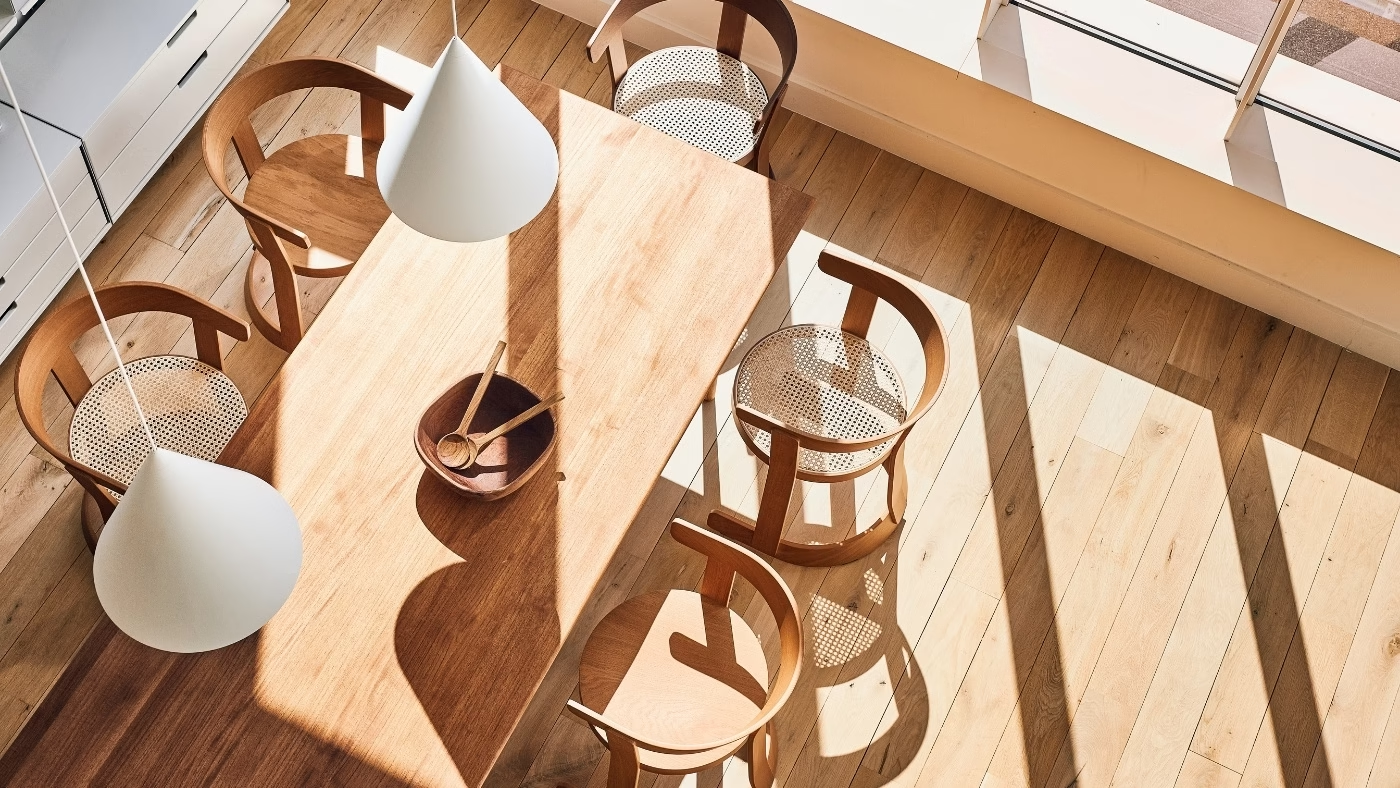
Krystian Kowalski has designed an adult version of Teresa Kruszewska’s reversible children’s chair for 366 Concept, returning to a 1963 design for a children’s hospital in Kraków’s Prokocim district after 63 years. The original offered two seat heights when turned over and was intended for thousands of children, yet reached almost none. Developing the Klepsydra chair involved more than enlarging an archive drawing: body proportions, points of support and the way people sit change with age. The chair joins the 366 Concept range on 10 September 2026.
A chair intended for thousands of children
Teresa Kruszewska, who lived from 1927 to 2014, was one of Poland’s most important 20th-century furniture designers. She studied under Jan Kurzątkowski and worked as his assistant at the Academy of Fine Arts in Warsaw, later taking over his Pracownia Mebla, a furniture design studio within the Faculty of Interior Design. Her 1963 brief was a practical one: chairs for children of different ages at the hospital in Kraków-Prokocim. She solved it through symmetry.

The backrest and base mirrored each other, with the seat positioned to provide a second sitting height when the chair was turned over. The structure was designed around its young users: stable, but light enough for a child to move without help. Kruszewska also kept the engineering simple in anticipation of mass production. It was an early exploration of multifunctionality, which she later perfected in furniture that also served as toys.
The chair never entered production or widespread use, so its appearance never became overly familiar. Kruszewska developed the principles of good design she had established at Spółdzielnia Artystów Ład, an artists’ cooperative, through her own work and passed them on to subsequent generations.
An archive drawing that kept returning to the conversation
Maciej Cypryk, founder of 366 Concept, had wanted to revisit Kruszewska’s work for years. For more than a decade, the brand has returned designs from Poland’s furniture archives to production, including Józef Chierowski’s 366 armchair, Rajmund Teofil Hałas’s 200-190 chair and Henryk Lis’s 300-190 armchairs. Cypryk struggled to decide which of Kruszewska’s designs should come first. Conversations with architects settled the question: when he showed them archive drawings, they repeatedly returned to the reversible hospital chair.

Adapting a child’s chair for an adult was not simply a matter of enlarging the drawing. Changes to body proportions, support points and sitting posture meant an ill-considered adjustment could compromise what mattered most in the original. Cypryk concluded that a new piece was needed, designed with full respect for its predecessor. He approached Kowalski, who accepted the challenge.
Adult ergonomics developed from the beginning
Kowalski graduated from the Faculty of Design at the Academy of Fine Arts in Warsaw and the Royal College of Art in London. He has received the Red Dot Award, German Design Award and iF Design Award, and was named Designer of the Year by the Institute of Industrial Design. Reinterpreting the furniture of a major Polish woman designer has been relatively uncommon in Polish design. ‘When I first saw Teresa Kruszewska’s original chair, I was taken aback by its scale. You could literally put it in a shopping bag. It was quite shocking,’ he recalls.

Kowalski developed the ergonomics for an adult user from the beginning. Kruszewska described this way of thinking as humanism in design: furniture exists because of people and to serve them. ‘I didn’t want to interfere too much with the design or express my own ego as a designer. I wanted the chair to be contemporary in its details, beautiful in its proportions and, above all, comfortable,’ says Kowalski.
Millimetre adjustments and purpose-made moulds
‘Adjusting individual elements by literally millimetres, the relationship between the seat and the backrest in relation to its width, is what determines the final comfort. Composing these elements is like putting together a puzzle that, when assembled correctly, makes the chair comfortable,’ he explains. The thickness of the components changed, as did the backrest’s outline, which is more fluid and less flattened at the top. The principle remained the same: a small number of repeated elements assembled into a single composition. Klepsydra’s silhouette is restrained, but its individual components have complex geometries that determine its appearance, sitting comfort and structural stability.

The backrest and lower part of the base are formed in three dimensions from bent laminated plywood, using moulds made exclusively for the project. Developing the moulds was a separate stage in bringing the chair into production. They had to deliver the correct bending radii and angles, with a high degree of consistency from one component to the next. Once formed, the parts are CNC-machined, as they intersect and meet at precisely defined angles. The construction uses joints in which one component is partially recessed into a milled socket in another, producing the slender appearance apparent at first glance.
Klepsydra occupies a distinct position in the 366 Concept range. While the other pieces return to production in their original form, this is a new chair based on an idea from 1963. The decisive step came before drawing began: treating adult ergonomics as a new design task while preserving Kruszewska’s underlying principle.

The chair can be seen in the Visteria Foundation exhibition Polish Modernism. A Struggle for Beauty at Gawroński Villa in Warsaw until 11 October 2026, and at the 366 Concept showroom at ul. Nowogrodzka 10/2.
Combining pieces from Poland’s design archives with a contemporary interior often calls for someone who knows the market and can coordinate them with other furnishings. Find architects, interior designers and interior photographers in the PLNDesign directory, searchable by specialism, project type and city.
See also:
- Kartell updates Componibili storage units with six colours
- DEKOMA weaves botanical motifs into its Flora chenille fabrics