

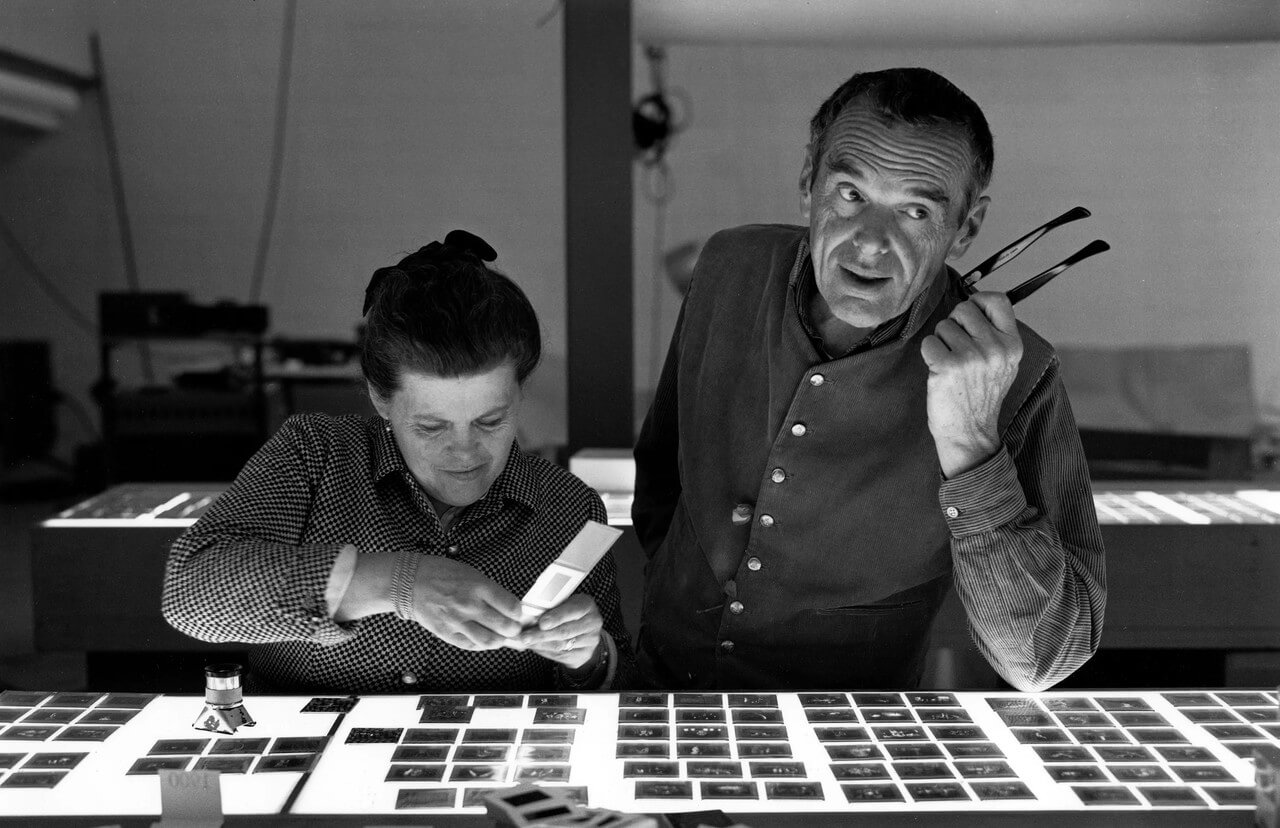
Charles and Ray Eames were an American husband-and-wife design team who worked together from their marriage in 1941 until Charles’s death in 1978. They are known above all for chairs in moulded plywood, plastic and aluminium, for the Lounge Chair and Ottoman, and for the Eames House in Los Angeles. Herman Miller and Vitra still make their furniture, and the house, which came through the 2025 Palisades Fire, is open to visitors.
Charles and Ray Eames at a glance:
- An architect and a painter: Charles Eames (1907–1978) trained as an architect in St Louis and Ray Kaiser (1912–1988) studied painting with Hans Hofmann in New York. They met at Cranbrook Academy of Art in 1940 and married in June 1941.
- Furniture still in production: the LCW plywood chair (1946), the plastic shell chair (1950), the Lounge Chair and Ottoman (1956) and the Aluminium Group (1958) are made today by Herman Miller and Vitra, the only licensed manufacturers.
- The Eames House: their home and studio in Pacific Palisades, completed in 1949 as Case Study House No. 8, survived the January 2025 fire and can be visited by advance booking.
- Films and more: between 1950 and 1982 they made more than 125 short films, including Powers of Ten (1977), as well as toys, exhibitions and products for companies such as IBM and Alcoa.
Who were Charles and Ray Eames?
Charles and Ray Eames were a married couple who designed furniture, a house, films, exhibitions, toys and textiles together for 37 years, from their wedding in June 1941 until Charles died in 1978. They ran their Los Angeles studio, the Eames Office, as a joint practice, and Ray kept it going for another decade after his death.
Charles Ormand Eames Jr was born in St Louis, Missouri, on 17 June 1907 and was interested in architecture and photography from his school years. He studied architecture at Washington University in St Louis, but after two years he was asked to leave because his views were considered too modern. In 1930 he opened an architecture practice in the city with Charles Gray, later joined by Walter Pauley, and with another partner, Robert Walsh, he built two churches in Arkansas and four houses around St Louis.

Ray was born Bearnice Alexandra Kaiser in Sacramento, California, on 15 December 1912. After finishing school in New York state, she moved to Manhattan in 1933 and studied painting with Hans Hofmann until 1939. She was a founding member of American Abstract Artists, a group formed in 1936 after a Museum of Modern Art exhibition of cubist and abstract art had shown only European artists.
How did Charles and Ray Eames meet?
They met in 1940 at Cranbrook Academy of Art in Bloomfield Hills, Michigan, where Charles was teaching and Ray came to attend classes. Charles had moved there in 1938 on a fellowship, invited by the Finnish architect Eliel Saarinen, who had noticed his work, and he became the school’s first head of industrial design.
At Cranbrook he teamed up with Eliel’s son, Eero Saarinen, on moulded plywood furniture for the Museum of Modern Art’s Organic Design in Home Furnishings competition, and Ray helped them prepare the final presentation drawings. When the winners were announced in January 1941, Eames and Saarinen took first prize in two categories, seating and storage furniture. Making the chairs exposed the limits of the technology of the time: industrial presses splintered the plywood when it was forced into compound curves, so every shell needed extensive handwork and the armchairs were covered in upholstery.

Charles divorced his first wife, Catherine Woermann, the mother of his daughter Lucia, in early 1941 and married Ray in June. On their honeymoon they drove to Los Angeles, settled in Richard Neutra’s Strathmore Apartments in Westwood and carried on experimenting with moulded plywood in the spare bedroom.
How did the Eames Office begin?
The Eames Office grew out of war work. From 1942 the couple developed a moulded plywood leg splint, because the metal splints used for wounded servicemen vibrated during transport and caused further injuries. The first plywood splints were ready in 1943, and around 150,000 had been made by the end of the Second World War. With US Navy funding the Eameses also produced stretchers and aircraft parts, and they worked out the moulding process and tooling together with the Molded Plywood Division of Evans Products, which provided financing and a large factory.
In 1943 the studio moved into a former garage in Venice, Los Angeles, which remained the base of the Eames Office for 45 years, until 1988. In 1945 the office turned back to furniture, applying the moulding techniques it had refined during the war.
How did Charles and Ray Eames approach design?
The Eameses summed up their aim as making ‘the best for the most for the least’. They were wary of treating style as a goal, arguing that ‘the extent to which you have a design style is the extent to which you have not solved the design problem’. Their phrase ‘Take your pleasure seriously’ captures the other side of the office, the side that produced toys, films and a house filled with collections.
What furniture did Charles and Ray Eames design?
Their furniture followed new materials: moulded plywood in the 1940s, fibreglass shells and bent wire in the early 1950s, and aluminium from 1958. Most of the key designs have stayed in production for decades.
The LCW, short for Lounge Chair Wood, came straight out of the wartime plywood work. Designed in 1946, it has a separate moulded seat and back joined by a plywood spine, with rubber shock mounts between the parts. Evans Molded Plywood in Venice made the first chairs, and Herman Miller later took over production in Zeeland, Michigan. In its 1999 millennium issue, Time magazine named the LCW the best design of the 20th century.

The plastic shell chair began as an entry to the Museum of Modern Art’s International Competition for Low-Cost Furniture Design in 1948. The first idea was a stamped metal shell, which proved too expensive, so the Eameses turned to fibreglass-reinforced plastic. Herman Miller put the chair on sale in 1950, with shells mass-produced by Zenith Plastics, and it was the first chair with a seat and back formed from a single plastic shell. It came in three colours, greige, elephant-hide grey and parchment, and the same shell could sit on different bases: a rocker on wooden runners and tubular steel legs at first, later a cast aluminium pedestal, a swivel base, the wire ‘Eiffel Tower’ base and wooden dowel legs. Vitra stopped making fibreglass shells in the 1990s, partly for ecological reasons, relaunched the chair in 1998 with a polypropylene shell developed with the Eames family and brought fibreglass back 20 years later. A wire version of the shell followed in 1951 and is still made.
The Lounge Chair and Ottoman, introduced in 1956, was the couple’s first chair for the top end of the market and took the traditional English club chair as its model. Three moulded plywood shells, for the seat, back and headrest, carry leather cushions on an aluminium base. Until the early 1990s the shells were veneered in Brazilian rosewood; later production has used cherry, walnut and palisander. The chair made its debut on NBC’s Home show, presented by Arlene Francis, and Charles said they wanted it to have the ‘warm, receptive look of a well-used first baseman’s mitt’. Herman Miller has made it without a break since 1956, and the chair and ottoman are in the permanent collections of the Museum of Modern Art in New York and the Art Institute of Chicago.

The Aluminium Group started in 1957 as outdoor furniture. Alexander Girard, who was designing the interiors of the house Eero Saarinen built for the industrialist J. Irwin Miller and his wife Xenia in Columbus, Indiana, could not find modern garden furniture to suit it and turned to the Eameses. Their answer, in production within a year, stretches a textile sling between two aluminium side rails held taut by stretcher bars, without glue or screws. Herman Miller first sold it as an indoor-outdoor group, but the light chairs soon moved into offices, and Vitra has made the range in Weil am Rhein since 1959.
La Chaise, a white shell on five chrome-plated steel rods and an oak cross base, was designed in 1948 for the same low-cost furniture competition. Its name is a play on the sculptor Gaston Lachaise, whose Floating Figure inspired the shape. It was too complicated to mass-produce at the time, and Vitra has made it only since 1990. The last piece of furniture from the Eames Office was the Eames Sofa, designed to go with the Soft Pad chairs and completed after Charles’s death; Herman Miller put it into production in 1984.
The main designs, with the year they were introduced and who makes them today:
| Design | Year | What it is | Made today by |
|---|---|---|---|
| LCW (Lounge Chair Wood) | 1946 | moulded plywood lounge chair on shock mounts | Herman Miller, Vitra |
| La Chaise | 1948, in production since 1990 | lacquered shell on steel rods and an oak base | Vitra |
| Plastic and fibreglass shell chairs | 1950 | one-piece shell on interchangeable bases | Herman Miller, Vitra |
| Lounge Chair and Ottoman | 1956 | plywood shells with leather cushions on an aluminium base | Herman Miller, Vitra |
| Aluminium Group | 1958 | textile sling held between aluminium side rails | Herman Miller, Vitra |
| Eames Sofa | 1984 | sofa completed by the Eames Office after Charles’s death | Herman Miller |
What is the Eames House?
The Eames House is the steel-and-glass home and studio the couple built for themselves in Pacific Palisades, Los Angeles, as Case Study House No. 8. It was completed in December 1949, and they moved in on Christmas Eve that year and lived there for the rest of their lives.

The house was part of the Case Study House programme, launched in the mid-1940s by John Entenza, editor and owner of Arts & Architecture magazine, which commissioned homes built with materials and methods developed during the war. The brief was for a married couple working in design and graphic arts whose children had left home. Charles Eames and Eero Saarinen first designed it in 1945 as the Bridge House, a raised box spanning the entrance drive and assembled from parts ordered out of steel fabricators’ catalogues. Post-war shortages meant the steel did not arrive until late 1948, and by then the Eameses wanted a different relationship with the site. They reworked the same off-the-shelf parts, ordering one extra beam, into two buildings set into the slope. Construction began in February 1949, and the foundation and steel frame were in place after 16 hours.
The residence and the studio are two rectangular boxes, each about 5.2 metres high, separated by a courtyard and backed on the hillside by a concrete retaining wall 2.4 metres high and about 60 metres long. The facades are grids of thin black steel filled with clear, translucent and wired glass, grey Cemesto board and plaster panels in off-white, black, blue and red-orange, with a few panels finished in gold leaf. Inside the residence, a double-height living room is overlooked by a mezzanine with two bedrooms. The interior still holds the couple’s collections much as they left them, including folk art and abstract expressionist art, Japanese kokeshi dolls, Native American baskets, an Isamu Noguchi floor lamp, Thonet chairs and Eames prototypes.
The house became a National Historic Landmark in 2006. In January 2025 the Palisades Fire destroyed much of the surrounding neighbourhood, but the house narrowly escaped serious damage. After a five-month restoration to repair smoke damage it reopened in 2025, and the studio was opened to the public for the first time. As of November 2026 the Charles & Ray Eames Foundation runs self-guided visits to the grounds and studio, guided exterior tours and private tours, all booked in advance on its website. A private 60-minute exterior tour costs $1,250 for up to 10 people, and a private 90-minute tour of the residence’s ground floor costs $2,500 for up to four guests. There is no parking at the house, at 203 Chautauqua Boulevard, and wildfire survivors and first responders can ask the foundation about free visits.
What else did Charles and Ray Eames make besides furniture?
Furniture was one part of a wider practice that also took in films, exhibitions, toys and products for other companies. Between 1950 and 1982 Charles and Ray made more than 125 short films on subjects ranging from furniture to mathematics, science and the way people live in other countries.

Powers of Ten (1977) opens on a couple picnicking on the Chicago lakefront, pulls back by powers of ten to a view 100 million light years across, then travels back in through the man’s hand to the quarks inside a carbon atom. The nine-minute film reworked a 1968 sketch version, and the Library of Congress added it to the National Film Registry in 1998.
Exhibitions became another medium. For the American National Exhibition in Moscow in 1959 the Eameses made Glimpses of the USA, projected on seven screens; Mathematica: A World of Numbers… and Beyond (1961) was sponsored by IBM, and they designed IBM’s pavilion at the 1964 New York World’s Fair.
Smaller objects include the Hang-It-All coat rack of 1953, a wire frame studded with coloured balls, and toys such as The Toy (1951), House of Cards (1952) and The Little Toy. The couple also designed radio cabinets for Zenith and Emerson in 1946 and loudspeaker enclosures for Stephens Tru-Sonic in 1957. The Solar Do-Nothing Machine, made in 1957 for the aluminium company Alcoa, focuses sunlight on 24 photovoltaic cells to drive ten spinning displays with no practical function, and was one of the first uses of solar electricity.

What happened to the Eames Office after Charles and Ray died?
Charles Eames died of a heart attack on 21 August 1978 in St Louis, while on a consulting trip. Ray ran the Eames Office for another ten years, wrote an encyclopaedic account of its projects and gave the Library of Congress around 1.5 million items, including 750,000 prints and photographs. She died on 21 August 1988, ten years to the day after Charles, and both are buried in Calvary Cemetery in St Louis.
After Ray’s death the Vitra Design Museum in Weil am Rhein took over a large part of the office’s three-dimensional estate, mainly prototypes, tools and experiments. Charles’s daughter Lucia founded the Eames Foundation in 2004 to look after the house and died in 2014. In 2025 the foundation relaunched as the Charles & Ray Eames Foundation, chaired by the couple’s grandson Eames Demetrios, who also directs the Eames Office, and for the first time its board took in a non-family member, Eckart Maise, formerly Vitra’s chief design officer. The Eames Institute of Infinite Curiosity, whose chief curator is the couple’s granddaughter Llisa Demetrios, opened an archive gallery in Richmond, California, in 2024. In August 2025 it bought a former Birkenstock campus in Novato for a museum designed by Herzog & de Meuron, then expected to open in 2028.
Who makes Eames furniture today and how do you spot an original?
Only two companies are licensed by the Eames family, through the Eames Office, to make Eames furniture: Herman Miller, now part of MillerKnoll, and Vitra. Vitra began producing Eames designs under licence from Herman Miller in 1957 and is now the sole authorised manufacturer for Europe and the Middle East, while Herman Miller makes them in North America.
The Lounge Chair is one of the most counterfeited furniture designs. Plycraft sold copies soon after its launch, and in 1962 the Eameses placed full-page newspaper advertisements warning buyers about imitations. Herman Miller chairs carry a label that has changed over the decades, from the silver and white round medallion of 1956, reading ‘designed by Charles Eames’, to the curved embossed mark used since the 2000s. Details such as the zip colour, the number of screws in the armrests and the glides also changed over time, which helps date a chair.
Where can you see the work of Charles and Ray Eames?
The Eames House in Los Angeles shows the couple’s architecture, furniture and collections in the place they lived and worked. Their prototypes, papers and furniture are also held by museums and archives in the United States and Europe:
| Place | Location | What is there |
|---|---|---|
| Eames House (Case Study House No. 8) | Pacific Palisades, Los Angeles | the couple’s home and studio with their furniture and collections; visits and tours booked in advance |
| Eames Institute of Infinite Curiosity | Richmond, California | an archive of more than 40,000 Eames items with a gallery opened in 2024; a museum in Novato is planned |
| Vitra Schaudepot, Vitra Campus | Weil am Rhein, Germany | Eames Office prototypes, tools and experiments, with Charles Eames’s office reassembled on the lower level |
| Library of Congress | Washington, DC | around 1.5 million items from the Eames Office, including 750,000 prints and photographs |
| Museum of Modern Art | New York | holds the Lounge Chair and Ottoman and the fibreglass armchair, acquired in 1950 |
| Art Institute of Chicago | Chicago | holds the Lounge Chair and Ottoman |
Charles and Ray Eames – frequently asked questions
Who are the furniture design couple known for their chairs?
That is Charles and Ray Eames, who worked from a studio in Venice, Los Angeles, from 1943 to 1988. Their plywood, plastic, wire and aluminium chairs and the Lounge Chair and Ottoman were designed between 1946 and 1958.
Does the Eames House still exist?
Yes. The house and studio at 203 Chautauqua Boulevard in Pacific Palisades came through the January 2025 fire with smoke damage, were restored and reopened in 2025, and can be visited on tickets sold in advance by the Charles & Ray Eames Foundation.
How can you tell if an Eames chair is authentic?
Start with the maker: only Herman Miller and Vitra are licensed to produce Eames designs. On a Lounge Chair, the Herman Miller label also helps date the piece, from the round medallion of 1956 to the embossed mark used since the 2000s.
What did Charles Eames say about details?
‘The details are not details’ comes from the script of a 1961 Eames Office film about the Eames Contract Storage system. Vitra prints the line on an Eames quote poster made with the Eames Office.
What is Powers of Ten?
A nine-minute film by Charles and Ray Eames, released in 1977, that zooms out from a picnic in Chicago to the scale of the universe and back into an atom. It has been on the US National Film Registry since 1998.
An interior designer can help bring furniture, lighting and accessories together. Find architects, interior designers and interior photographers in the PLNDesign directory.
See also:
- Oskar Zięta: the Polish designer who inflates steel
- Janusz Kaniewski: the Polish car designer who worked for Ferrari