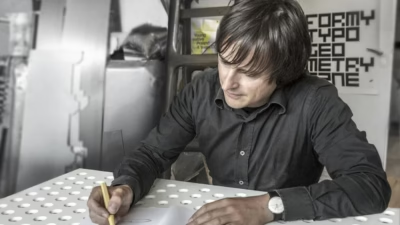


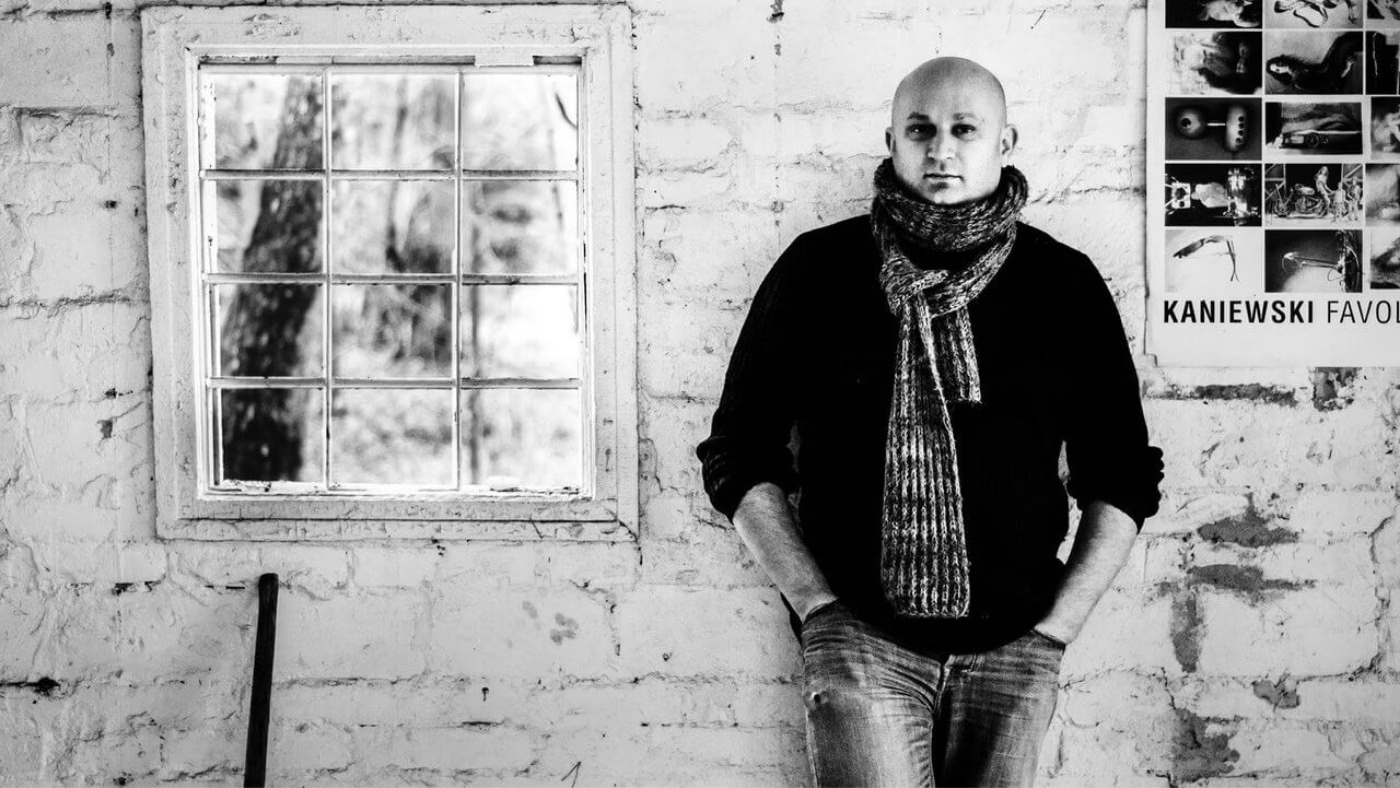
Janusz Kaniewski (1974–2015) was a Polish designer who co-designed the Ferrari California and 458 Italia, was one of the co-authors of the Fiat logo introduced in 2006 and, in Poland, designed everything from an Orlen petrol station in Gdańsk to a Żywiec beer glass. He trained in transportation design in Turin, worked at Pininfarina and later ran his own studio in Warsaw. He died suddenly in May 2015, aged 41.
Janusz Kaniewski at a glance:
- Born in Warsaw on 30 March 1974, he graduated from the Istituto Europeo di Design in Turin in 2000, worked at Pininfarina from 1999 to 2001 and designed for Ferrari from 2003.
- His car work includes the Ferrari California and 458 Italia, the interior of the Ferrari 488 GTB and models for Lancia, Alfa Romeo, Citroën and Suzuki, with a focus on the front end and headlights.
- Beyond cars he designed Lange ski boots, train seats, exhibition vehicles for Koło and Orlen’s first Meeting Point Stop Cafe, which opened in Gdańsk in 2011.
- After his sudden death in 2015, the Gdynia City Museum devoted an exhibition to him, on view from September 2020 to May 2021.
Who was Janusz Kaniewski?
Janusz Kaniewski was a Polish designer who moved between car design, industrial design, graphic design and public space. He is best known for his work for Italian carmakers, but his portfolio also takes in ski boots, train seats, logos, posters and a petrol station. He ran a design studio in Warsaw and taught at the Istituto Europeo di Design (IED) in Turin, where he had studied, and at the Royal College of Art in London.

Where did Janusz Kaniewski grow up and study?
Kaniewski grew up in Stegny, in Warsaw’s Mokotów district, in a family with both technical and artistic leanings. His father, Czesław, was an engineer and designer, and his mother, who had a background in the humanities, came from a musical and artistic family. One grandfather, Kornel, built and patented his own inventions; the other, also called Czesław, made lamps, record players, tables and clocks in his workshop in Lower Mokotów.
Cars filled his drawings from about the age of two, and as a boy he could tell makes apart by their lights and the sound of their engines. Around 1980 his father took him to an exhibition at the Institute of Industrial Design in Warsaw where a model of the Volvo 480 was on show, and Kaniewski later said that this visit decided his future as a car designer. In 2013 he bought a blue Volvo 480 of his own.
He finished secondary school in a humanities class in Wilanów. As a teenager he won a prize for a logo he designed for Transbud, the company where his father worked, and his first job was at the ArtGraph graphic studio, designing labels, banners and billboards. In 1993 he enrolled at the Faculty of Architecture of the Warsaw University of Technology but left after the first year. In 1996 he was admitted to the Faculty of Industrial Design at the Academy of Fine Arts in Warsaw, yet took a job at the Leo Burnett advertising agency instead, and he was admitted again in 1997. By then he knew he would have to study abroad to design cars. He applied to ArtCenter College of Design, in the US and Switzerland, and to the IED in Turin, was accepted by all of them and completed the IED’s transportation design course in 2000.
How did Kaniewski’s career develop?
From 1999 to 2001 Kaniewski worked at Pininfarina’s studio in Cambiano, and he continued to collaborate with the company in later years. From 2003 he designed for Ferrari. After returning to Poland he set up his own studio in Warsaw, which worked as Kaniewski Haute Design, co-founded with the architect Mariusz Filip, and later as Janusz Kaniewski Design. Its clients included the fuel company PKN Orlen and the ceramics maker Koło. With Mazda he ran the first car design workshops in Poland and sat on the jury of the Mazda Design competition.

The main dates of his life and work:
| Year | Event |
|---|---|
| 1974 | Born in Warsaw on 30 March |
| 1993 | Starts architecture at the Warsaw University of Technology and leaves after a year |
| 1999 | Wins the Grand Prix of the Come ti Vorrei / Quattroruote competition in Italy |
| 1999–2001 | Works at Pininfarina’s studio in Cambiano |
| 2000 | Graduates in transportation design from the IED in Turin |
| 2003 | Begins designing for Ferrari |
| 2006 | Fiat announces the new logo he co-authored |
| 2011 | The Orlen Meeting Point Stop Cafe opens in Gdańsk |
| 2012 | Main curator of the Gdynia Design Days festival |
| 2013 | His book is published by Bosz; exhibition at Galeria Miejska bwa in Bydgoszcz |
| 2015 | Dies suddenly on 9 May, aged 41 |
| 2020–2021 | Exhibition about his work at the Gdynia City Museum |
When did Janusz Kaniewski die and how is he remembered?
Janusz Kaniewski died suddenly on 9 May 2015, aged 41. At the time his studio was preparing to present a city bus, a tram, a restaurant car, a new camper van brand, a lamp collection, smart-home switches and a commercial vehicle for a Polish sports brand. The company Kaniewski Design, registered in Warsaw in November 2014, was in liquidation as of November 2026.
In 2020, five years after his death, the Gdynia City Museum made him the subject of the seventh exhibition in its Polish Design Polish Designers series. Curated by Anna Śliwa, it opened in September 2020 and ran until 30 May 2021. It set his public work on vehicles and commercial projects against a more private side of him that helps explain some of his design decisions, and it was accompanied by a Polish-English catalogue.
How did Kaniewski approach design?
Kaniewski treated design as the shaping of a whole process rather than the look of an object: implementation, production, sales, distribution and recycling. He did not want appearance to get in the way of ergonomics, practical use or efficient production, and he took zero waste and intelligent recycling seriously. He wrote that design should be functional and pleasing to the eye, and that if it made someone smile, it was good design. He opposed the use of design in the service of militarism, mindless consumerism or profit at any cost, and he believed a designer should be 15 to 20 years ahead of his time. One of his sayings, ‘The most effective way of predicting the future is to create it’, became the guiding idea of the Gdynia exhibition.

He drew constantly. His sketches, made with felt-tip pens and Karisma pencils as well as 3D software and Photoshop, are soft and light and sit between art and design. From childhood his favourite subject was the front of a car, and in his professional work he concentrated on the same area, above all the headlights. He liked to work slowly and often away from the office, at his plot in Sulejówek outside Warsaw or at Il Bricco di Sciolze near Turin. In a 2014 interview marking his 40th birthday and 25 years of work, he said he wanted to reuse existing objects rather than add new ones, and not to design in any particular style.
Which cars did Janusz Kaniewski work on?
Kaniewski co-designed the Ferrari California and the Ferrari 458 Italia, and he designed the interior of the Ferrari 488 GTB, which succeeded the 458 Italia. He also worked on the Lancia Delta, the Alfa Romeo MiTo and Giulietta, the Citroën C4 Picasso and the Suzuki Kizashi. On these projects he was responsible mainly for the face of the car: the headlights of the Alfa Romeo MiTo and the Citroën C4 Picasso are among the details credited to him.
| Car | Brand | Kaniewski’s contribution |
|---|---|---|
| California | Ferrari | Co-design |
| 458 Italia | Ferrari | Co-design |
| 488 GTB | Ferrari | Interior design |
| Delta | Lancia | Co-design |
| MiTo | Alfa Romeo | Co-design, headlights |
| Giulietta | Alfa Romeo | Co-design |
| C4 Picasso | Citroën | Co-design, headlights |
| Kizashi | Suzuki | Co-design |
His own concept car, Zły (‘Bad’), stayed with him for most of his career. He made the first sketches in 2000, while working at Pininfarina, came back to the idea more than a decade later and was still working on it at the time of his death, though he never built a prototype. The name comes from Leopold Tyrmand’s 1955 novel Zły, published in English as The Man with the White Eyes. The car was meant to have every possible flaw and to sum up the absurdity of the car as a source of fascination, good fortune and trouble. Its counterweight was to be Dobry (‘Good’), a public transport vehicle.
What else did Janusz Kaniewski design?
Beyond cars, Kaniewski worked on sports equipment, packaging, transport interiors and graphic design. He designed ranges of Lange ski boots, including the model in which Hermann Maier won the 2001 World Cup, and sports shoes for Fila while at Pininfarina in 2001. In 2004 he showed shoes made from fruit peel at the Slow Food fair in Turin.
In Poland his work included a beer glass for Żywiec, Marlboro Gold Edge cigarette packaging, train seats made by Taps for several European railways and a camper van for the ski jumper Adam Małysz. For the ceramics maker Koło he designed three exhibition vehicles, one of them a lorry fitted out as a mobile showroom and training room, and for a private client he designed a lorry containing an apartment and a garage for three Ferraris. He also created the DDrome, a prototype musical instrument, logos for the Monopolis complex in Łódź and for Ceramika Paradyż, the main sponsor of Łódź Design, the 2013 poster for the Camerimage film festival, a chain of Pit Stop petrol stations in Ukraine and a United Nations social campaign against child labour.
Which buildings and interiors did Kaniewski design?
In Gdańsk, Kaniewski designed the Orlen Meeting Point Stop Cafe at al. Grunwaldzka 258, the first station of its kind in Poland, which opened in December 2011. It was planned for business travellers, who could have a coffee or hold a meeting while staff refuelled and washed their car. Kaniewski took the design language from motoring: a glazed pavilion, a large neon band that recalls headlights, a facade patterned like carbon fibre and, inside, eco-leather upholstery with characteristic stitching and handmade lamps. The station was designed to draw part of its power from alternative sources. In 2012 it won the premium company-station category of the Stacja Benzynowa Roku (‘Petrol Station of the Year’) competition, and his collaboration with Orlen lasted three years.
His studio also designed the décor of Fiat showrooms, as well as furniture and interiors for private clients.

What role did Kaniewski play in Gdynia and Polish design?
Kaniewski was closely tied to Gdynia. He advised the Mayor of Gdynia on the city’s aesthetics, co-founded the Gdynia Design Days festival and was its main curator in 2012, the fifth edition, held from 7 to 15 July. That year he curated exhibitions including Ładny kraj (‘A Pretty Country’) at the Gdynia City Museum and Made in Poland. He also worked with the City of Warsaw and, in Italy, with the city of Turin on the Olympic village for the 2006 Winter Games.
He sat on the programme board of ARCH, the magazine of the Association of Polish Architects (SARP), and on the juries of the Arena Design competition at the Poznań International Fair and of an architectural competition for a public toilet organised by Koło. In 2013 the Galeria Miejska bwa in Bydgoszcz showed his sketches and work in progress in the exhibition Janusz Kaniewski. Design: Illustration, organised with the Camerimage festival and open from 17 November 2013 to 12 January 2014.
His awards include an Award of Excellence in the CorelDraw Design Contest in Canada (1993), the Grand Prix of the Come ti Vorrei / Quattroruote competition in Italy (1999), a Motor Trend award in the US (2001), an award from the Mayor of Osaka (2003) and a lifetime achievement award from Machina Design (2008). In 2011 Forbes placed him second in its ranking of Poland’s most innovative entrepreneurs, and Brief listed him among the 50 most creative people in Poland.

Janusz Kaniewski – frequently asked questions
Was Janusz Kaniewski an architect?
No. He left architecture after one year at the Warsaw University of Technology and trained as a transportation designer in Turin. Even so, he became the first non-architect member of the Association of Polish Architects (SARP).
Did Janusz Kaniewski design the Fiat logo?
He was one of its co-authors. The badge, announced in October 2006, is a ruby-red shield with tall lettering in a chrome frame, based on the shield that Fiat cars carried from 1931 to 1968. It made its debut on the new Fiat Bravo and was developed by the Fiat Style Centre with the agency RobilantAssociati.
Is there a book about Janusz Kaniewski’s work?
Yes. In 2013 the Bosz publishing house released Design. Wykłady i rozmowy o projektowaniu przyszłości (‘Design: lectures and conversations on designing the future’), an illustrated Polish-language book by Kaniewski that combines project histories, interviews, articles and his own reflections.
Kaniewski’s Orlen station in Gdańsk was designed as one piece, from the glazed pavilion and its facade to the upholstery and lamps inside. A shop, café or showroom gains from the same approach, with one team responsible for the building, the interior and the details. Find architects, interior designers and interior photographers in the PLNDesign directory.
See also:
- Karim Rashid: life, design style and most famous works
- Philippe Starck: designer of the Louis Ghost chair and Juicy Salif