

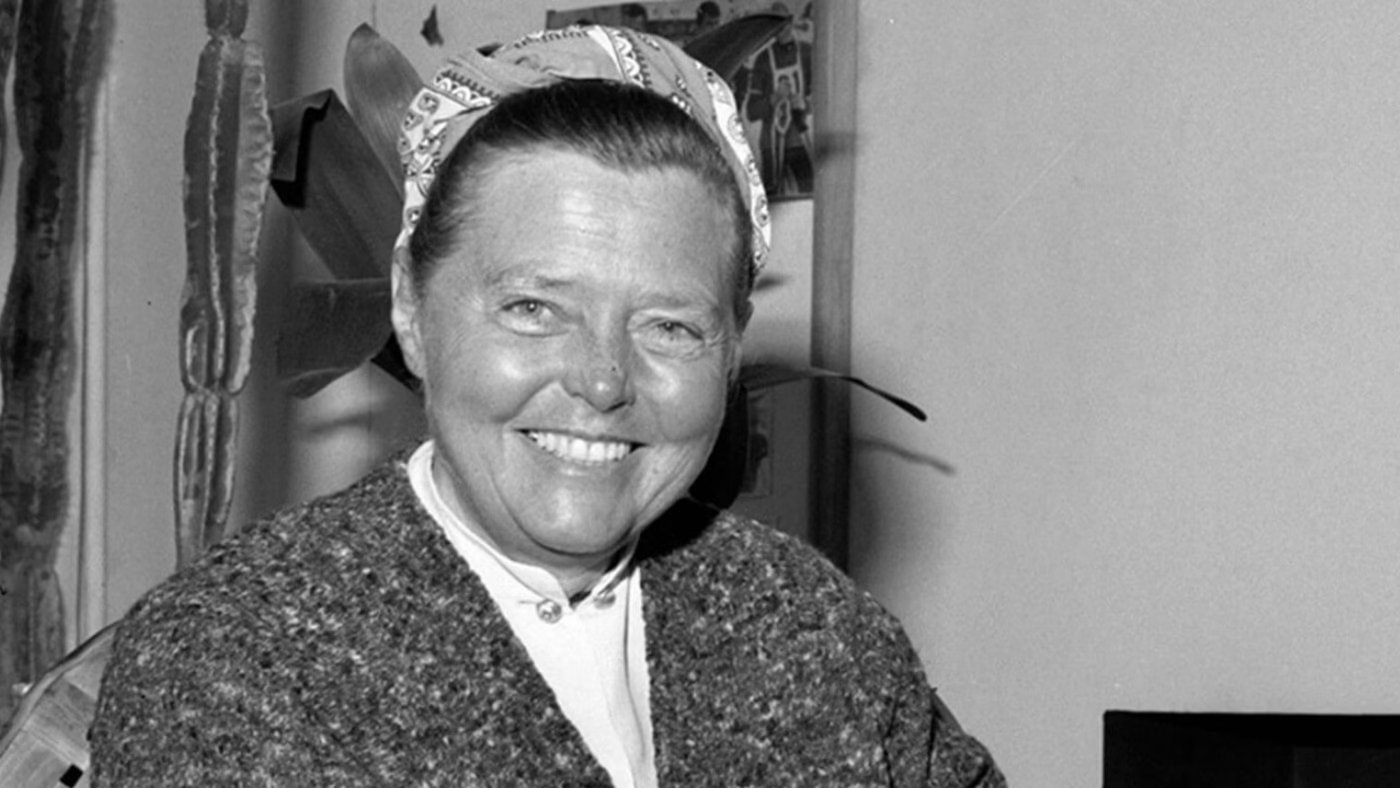
Charlotte Perriand (1903–1999) was a French architect and designer who spent ten years in Le Corbusier’s studio, where she developed the LC chairs and chaise longue, and later designed kitchens, student rooms and the Les Arcs ski resort in the French Alps. Her work moved from tubular steel in the late 1920s to wood, bamboo and prefabricated bathrooms, shaped by the war years she spent in Japan and Indochina.
Charlotte Perriand at a glance:
- Born in Paris on 24 October 1903, she trained in furniture design at the École de l’Union Centrale des Arts Décoratifs and made her name in 1927 with a bar installation in aluminium, glass and chrome.
- From 1927 to 1937 she worked in Le Corbusier’s studio, where she, Le Corbusier and Pierre Jeanneret designed the tubular-steel chairs and chaise longue that Cassina has produced since 1965.
- Japan and Indochina, where she lived from 1940 to 1946, turned her towards bamboo, wood and Japanese ideas about storage and space.
- From 1967 until the late 1980s she shaped Les Arcs, a ski resort in Savoie; she died in Paris on 27 October 1999, aged 96.
Who was Charlotte Perriand?
Charlotte Perriand was a French architect and designer whose work ranged from single chairs to apartment interiors, student halls and a whole ski resort. She believed that design should improve everyday life for as many people as possible, and she switched between industrial materials and craft techniques depending on what a project needed. In her 1981 essay L’Art de Vivre she wrote that ‘the extension of the art of dwelling is the art of living’.
She never treated furniture as a separate discipline. For decades the furniture she developed in Le Corbusier’s studio was known mainly under his name; today Cassina, which has made it since 1965, credits it to him, Pierre Jeanneret and Perriand together.

Where did Perriand train and how did her career start?
Perriand was born in Paris to a tailor and a seamstress. Her school art teacher noticed her talent for drawing, and from 1920 to 1925 she studied furniture design at the École de l’Union Centrale des Arts Décoratifs, where one of her teachers was the Art Deco interior designer Henri Rapin. She also attended lectures by Maurice Dufrêne of the La Maîtrise workshop, who displayed her wall hangings at the Galeries Lafayette department store. In 1925 her student work was selected for the Exposition Internationale des Arts Décoratifs et Industriels Modernes in Paris.

Reading Le Corbusier’s books turned her away from the Art Deco she had been taught. In 1926 she married Percy Kilner Scholefield, and the couple converted their attic apartment on Place Saint-Sulpice into a machine-age interior. Perriand recreated part of it as the Bar sous le Toit (‘Bar under the Roof’) at the 1927 Salon d’Automne: a built-in bar of aluminium, glass and chrome, with nickel-plated surfaces, leather cushions and glass shelves. The press praised the installation, and at 24 she became a designer to watch.
How did Perriand come to work with Le Corbusier?
In October 1927 Perriand took her drawings to Le Corbusier’s studio at 35 Rue de Sèvres and was turned away with the remark ‘We don’t embroider cushions here.’ She invited him to the Salon d’Automne. Once he had seen the bar, he offered her a job designing furniture and interiors for the studio.

She stayed at Rue de Sèvres for ten years, in charge of interior fittings and of presenting the studio’s furniture at exhibitions. Perriand described her work with Le Corbusier and his cousin Pierre Jeanneret as ‘three fingers on one hand’. In 1929 she was among the founders of the Union des Artistes Modernes.
Which furniture did Perriand design with Le Corbusier and Pierre Jeanneret?
The best-known pieces date from 1928 and follow Le Corbusier’s idea of the chair as a ‘machine for sitting’, with a different seat for each activity: the B301 chair with a tilting back for conversation, the LC2 Grand Confort armchair for relaxing and the B306 chaise longue for resting, long sold as the LC4. Its authors called the chaise longue a machine for rest. The frames were tubular steel, painted on the prototypes and nickel- or chrome-plated in production, and Perriand covered the chaise longue in pony skin.
In 1929 the three designers presented Équipement intérieur d’une habitation (‘Interior Equipment for a Dwelling’) at the Salon d’Automne, a model apartment in glass and tubular steel that included a bedroom and a bathroom. The furniture on show included a swivel armchair that Perriand had designed in 1927 for her own studio on Place Saint-Sulpice. The chair, partly inspired by an office swivel chair, is now in the collection of the Museum of Modern Art in New York, and Cassina makes it as the 7 Fauteuil tournant, long known as the LC7.
Thonet produced the tubular-steel range in the early 1930s. The Italian company Cassina has held an exclusive licence for the collection since 1964 and has produced it since 1965; today it sells it as the work of Le Corbusier, Pierre Jeanneret and Charlotte Perriand. Perriand also oversaw the prototypes, and Oliver Wainwright, architecture critic of the Guardian, has described her as the furniture’s true author, since Le Corbusier had no time for such details.

How did her work change after she left Le Corbusier’s studio?
In the 1930s Perriand’s politics moved to the left and her design became more egalitarian. She was involved with left-wing groups such as the Association des Écrivains et Artistes Révolutionnaires, and she replaced costly chrome with wood and cane, which ordinary households could afford. Many designs from this period drew on the vernacular furniture of Savoie, where her paternal grandparents lived. For the 1935 Brussels International Exposition she worked on the Maison du jeune homme (‘House for a Young Man’), a living space that combined a home gym, with a rowing machine, rings and weights, and a study.

She left Rue de Sèvres in 1937 and worked with the painter Fernand Léger on a pavilion for that year’s Paris Exposition. When the Second World War began in 1939, she joined Jean Prouvé and Pierre Jeanneret on prefabricated buildings, including military barracks and furniture for temporary housing.
How did Japan and Indochina shape Perriand’s work?
In 1940 Japan’s Ministry of Commerce and Industry invited Perriand to advise on industrial design and furniture production for export. She sailed from Marseille on one of the last ships to leave before the German army arrived, and in Japan she studied traditional crafts and building methods and worked with local artisans. She began to make her tubular-steel designs in bamboo, and in 1941 she staged an exhibition in Tokyo that brought her furniture together with Japanese craftsmanship.

Japanese architecture gave her ideas she returned to for years. In one of the imperial residences in Kyoto she saw shelves arranged on the wall in the shape of a cloud, which she later developed into her Nuage (‘cloud’) bookcases. She also read Kakuzō Okakura’s The Book of Tea, which she referred to for the rest of her career.
After Pearl Harbor she could no longer return to France via the United States as planned. In 1942 she had to leave Japan and, held back by the naval blockade, spent the rest of the war in Indochina, now Vietnam. There she married her second husband, Jacques Martin, and in 1944 gave birth to their daughter, Pernette. She studied woodwork and weaving before returning to France in 1946. Perriand went back to Japan in 1953–54, and in 1955 she staged a second Tokyo exhibition, Proposal for a Synthesis of the Arts, with Le Corbusier and Léger; the plywood chair she designed for it is produced today by Cassina as Ombra Tokyo.
What did Perriand design after the war?
Back in Paris, Perriand worked as an independent designer and resumed her collaboration with Jean Prouvé, who produced several of her designs between 1951 and 1953. In 1950 she designed a prototype kitchen for Le Corbusier’s Unité d’Habitation in Marseille, and she went on to design the kitchens and fitted furniture of its apartments. With Prouvé she fitted out the Air France building in Brazzaville (1950–52) and the Hôtel de France in Conakry (1953).

The Cité internationale universitaire de Paris gave her several commissions. In 1952 she designed a modular bookcase for its Maison du Mexique and, with Prouvé, the Tunisie bookcase for the Maison de la Tunisie. In 1959 she worked with Le Corbusier and the Brazilian architect Lúcio Costa on the Maison du Brésil, developing a modular scheme for its 95 student rooms that combined aluminium, Formica and brightly coloured plastics with wood. Her commercial clients included Air France, whose offices in London, Paris and Tokyo she remodelled, and in 1960 she worked with Ernő Goldfinger on the French Tourist Office in Piccadilly, London.
The mountains stayed central to her work. In 1939 she drew up a study for a mountain hotel in Méribel, and from 1946 she was part of the team that developed the resort. In 1960–61 she built her own chalet in Méribel-Les Allues, which was listed as a French historic monument in 2016.
What did Perriand design at Les Arcs?
Les Arcs, a ski resort above Bourg-Saint-Maurice in Savoie, was Perriand’s largest project. From 1967 she worked with Roger Godino, who founded the resort with the ski guide Robert Blanc, and a team of architects including Gaston Regairaz, Guy Rey-Millet and Bernard Taillefer, and she stayed with the project until the end of the 1980s. Of the resort’s four villages, she shaped three: Arc 1600, which opened at Christmas 1968, Arc 1800 and Arc 2000.
The resort was planned for guests who would spend most of the day outdoors, so Perriand kept the apartments small and sparsely furnished, with large windows and terraces facing the mountains. The stepped blocks follow the slope, and the old summer pasture huts were kept as part of the plan rather than demolished. At Arc 1600 she worked on the La Cascade residence (1967–69), and she designed much of the furniture.
Short construction deadlines led her to standardise kitchens and bathrooms. For Arc 1800 she developed complete bathroom and kitchen units moulded in polyester reinforced with fibreglass, assembled in a workshop and lifted into the buildings by crane; examples from 1975–78 are now in the collection of the Art Institute of Chicago. The resort also served as the setting of Ruben Östlund’s 2014 film Force Majeure.
What did Perriand do in her final years?
From 1978 Perriand worked directly with Cassina on reissues of the furniture she had designed with Le Corbusier and Jeanneret. In 1985 the Musée des Arts Décoratifs in Paris held a large retrospective, Charlotte Perriand: Un Art de Vivre. In 1993 she designed a tea house in the garden of UNESCO’s Paris headquarters for a festival of Japanese culture, and in 1996 the Design Museum in London showed her work.
In 1998 she published her autobiography, Une vie de création, later translated into English as A Life of Creation. Charlotte Perriand died in Paris on 27 October 1999, three days after her 96th birthday.
Where can you see Charlotte Perriand’s work today?
Les Arcs is the largest group of Perriand’s buildings that can still be visited and used, while in Marseille and Paris some of her interiors survive in the buildings they were designed for. Museum pieces are held in permanent collections, so it is worth checking whether they are on display before a visit.
| Work | Place | How to see it |
|---|---|---|
| Arc 1600, Arc 1800 and Arc 2000 | Les Arcs, Bourg-Saint-Maurice, Savoie, France | Open in the winter and summer seasons; the tourist office runs guided architecture tours |
| Kitchens and fitted furniture of the Unité d’Habitation | 280 Boulevard Michelet, Marseille, France | The Marseille tourist office runs guided tours of the building, booking required |
| Student rooms of the Maison du Brésil | Cité internationale universitaire de Paris, 7L Boulevard Jourdan, Paris, France | Student residence on the university campus, listed historic monument |
| Kitchen-bar from the Unité d’Habitation (1952) | Musée des Arts Décoratifs, Paris, France | Museum collection |
| Revolving armchair and a shower door from the Maison du Brésil | Museum of Modern Art, New York, United States | Museum collection |
| Prefabricated bathroom and kitchen units from Arc 1800 (1975–78) | Art Institute of Chicago, United States | Museum collection |
What is Charlotte Perriand’s legacy?
Perriand’s furniture is still in production. Cassina has made the LC collection since 1965 and is now the only company authorised to produce her designs, working with her daughter and sole heir, Pernette Perriand-Barsac, who worked alongside her mother for many years. The range includes the Nuage bookcases, reissued in 2012, and pieces from the Maison du Brésil student rooms.

Major exhibitions have since presented her as an author in her own right. In 2019–2020 the Fondation Louis Vuitton in Paris gave its entire Frank Gehry building to Charlotte Perriand: Inventing a New World, the first time it had devoted the whole building to a single designer, with reconstructions ranging from her Place Saint-Sulpice studio to the UNESCO tea house. In 2021 the Design Museum in London followed with Charlotte Perriand: The Modern Life, organised with the Perriand family and the Fondation Louis Vuitton. Flavien Gaillard, a design specialist at Christie’s, points out that no other woman worked with all the leading designers of the period: Prouvé, Le Corbusier and Jeanneret.
Charlotte Perriand – frequently asked questions
Who was Charlotte Perriand married to?
Perriand married twice. She married Percy Kilner Scholefield in 1926 and separated from him in 1930; during the war she married Jacques Martin in Indochina, and their daughter, Pernette, was born in 1944.
What is Charlotte Perriand best known for?
For the tubular-steel chairs and chaise longue developed in Le Corbusier’s studio in 1928, and for Les Arcs, the Alpine ski resort she worked on for some two decades.
Did Charlotte Perriand design the LC4 chaise longue?
Yes, together with Le Corbusier and Pierre Jeanneret. The chaise longue dates from 1928, Perriand oversaw its prototype, and Cassina, which began production in 1965, now credits all three designers.
Is Charlotte Perriand’s furniture still made?
Yes. Cassina produces the LC collection designed with Le Corbusier and Jeanneret, as well as pieces Perriand designed herself, such as the Nuage bookcases and the LC7 swivel armchair.
Where did Charlotte Perriand study?
At the École de l’Union Centrale des Arts Décoratifs in Paris, where she studied furniture design from 1920 to 1925.
Perriand planned her Les Arcs apartments and Paris student rooms around built-in storage and compact kitchens, so that a small space could hold everything its occupants needed. The same questions come up when you plan a small apartment or a holiday home, and an architect or interior designer can help answer them. Find architects, interior designers and interior photographers in the PLNDesign directory.
See also:
- Zaha Hadid: life, famous buildings and legacy
- Arne Jacobsen: architect of the Egg chair and the SAS Royal Hotel