

Hydrangea care starts with knowing which type you grow. Most hydrangeas do best in light shade, sheltered from cold, drying winds, in fertile soil that stays moist but drains freely. When to prune them, and how much protection they need in winter, depends on whether a shrub flowers on stems that grew the previous year or on new growth made in the same season. Soil acidity matters mainly for colour, turning the flowers of mophead and lacecap hydrangeas blue or pink.
Hydrangeas at a glance:
- Mophead and lacecap hydrangeas flower on last year’s stems, so they are pruned only lightly, in spring, and their faded flower heads stay on over winter to protect the buds below.
- Panicle and smooth hydrangeas flower on new growth and can be cut back in early spring without losing that summer’s flowers.
- Blue flowers need acid soil: mophead, lacecap and mountain hydrangeas are blue below about pH 5.5 and pink in neutral to alkaline soil.
- Hydrangeas are harmful to dogs and cats if eaten, and the leaves can irritate sensitive skin.
Which type of hydrangea do you have?
Hydrangeas are shrubs, small trees and climbers from East Asia and the Americas, and the ones grown in gardens differ above all in where their flowers form. Mophead, lacecap, mountain, oakleaf and climbing hydrangeas flower on stems that grew the previous year, while panicle and smooth hydrangeas flower on shoots produced in the same season. That one difference decides when to prune and how much a hard winter can cost you.
| Hydrangea | Botanical name | Flowers on | When to prune | Colour changes with soil pH |
|---|---|---|---|---|
| Mophead and lacecap (bigleaf) | Hydrangea macrophylla | Last year’s stems | Spring, lightly | Yes |
| Mountain | Hydrangea serrata | Mainly last year’s stems | Spring, as mopheads | Yes |
| Oakleaf | Hydrangea quercifolia | Last year’s stems | Spring, minimal | No |
| Climbing | Hydrangea anomala subsp. petiolaris | Last year’s shoots | Straight after flowering | No |
| Panicle | Hydrangea paniculata | New growth | Early spring | No |
| Smooth | Hydrangea arborescens | New growth | Early spring | No |
The bigleaf hydrangea, Hydrangea macrophylla, grows 1.5–2.5 m tall, although compact cultivars such as ‘Pia’ stay below 1 m. Mopheads have rounded flower heads and lacecaps flat ones, in white, pink, mauve or blue. Its flower buds for the following year form in late summer and early autumn and spend the winter on the stems, which is why frost and autumn pruning so often cost it a season’s flowers. The mountain hydrangea, Hydrangea serrata, is a smaller relative, usually 1–1.5 m high, with flat lacecap heads in blue, pink or red, depending on the soil, and leaves that often colour well in autumn. It prefers partial shade and a sheltered spot.
Panicle hydrangea, Hydrangea paniculata, has cone-shaped flower heads, usually white or cream, that turn pink as they age. ‘Limelight’, one of the best-known cultivars, opens pale lime green, then turns creamy white and gradually flushes pink. Panicle hydrangeas are hardy in most of the UK even in severe winters and tolerate full sun as long as the soil stays moist. Nurseries also sell them as standards, trained as small trees on a single stem.
Smooth hydrangea, Hydrangea arborescens, is a very cold-hardy shrub with rounded white flower heads. Its best-known cultivar, ‘Annabelle’, has large white heads on weak stems that tend to flop, while ‘Strong Annabelle’, also sold as Incrediball, holds heads up to 30 cm across on strong stems.
Oakleaf hydrangea, Hydrangea quercifolia, is grown as much for its foliage as for its flowers. Its lobed leaves, shaped like those of an oak, turn red, bronze and purple in autumn. The cone-shaped flower heads open creamy white, turn pink as they age and dry to a papery, rusty brown through autumn and winter.
Climbing hydrangea, Hydrangea anomala subsp. petiolaris, clings to walls, fences and tree trunks with aerial roots, although young plants need wires or a trellis until they take hold. Its flat, lacy heads of fragrant white flowers open in early to midsummer. It grows well in shade and is often slow to get going: young plants can take three to five years to flower.

How do you prune mophead and lacecap hydrangeas?
Mophead and lacecap hydrangeas need only light pruning. Next summer’s flower buds form in late summer and early autumn, so cutting the stems back in autumn, or hard in spring, removes them and the shrub will not flower that year. Leave the faded mophead flower heads on over winter, as they protect the tender buds beneath from frost, and in spring cut each old head back to the first or second strong pair of buds below it. Lacecaps can be deadheaded straight after flowering, while mophead flowers should be removed then only in mild areas.
Each spring, one or two of the oldest stems can also be cut out at the base to encourage strong replacement shoots. An overgrown shrub can be renovated by cutting all its stems to the base, at the cost of that summer’s flowers, as the new stems bloom the following year. Shoots damaged by frost are cut back in spring to the first undamaged pair of buds. Mountain hydrangeas are pruned in the same way. Some reblooming cultivars, such as the Endless Summer series, flower on both old and new stems, so they bloom whether they are pruned or not.
How do you prune panicle and smooth hydrangeas?
Panicle and smooth hydrangeas flower on shoots that grow in the same season, so they are pruned in early spring, before new growth starts, without any loss of flowers. Pruning is not essential, but cutting last year’s stems back each spring gives larger and more numerous flower heads. For the biggest heads, cut to the lowest healthy pair of buds, leaving a framework no more than about 25 cm high, or cut to about 60 cm for a taller shrub. Neglected plants respond well to harder pruning, and up to a third of the stems of an established smooth hydrangea can be removed at the base to keep it compact.
Heavy flower heads are the smooth hydrangea’s weak point. ‘Annabelle’ in particular tends to collapse after rain, so it needs support, such as metal hoops put in place in spring before the leaves come out, or a fence or low wall for the stems to lean on. ‘Strong Annabelle’ has stiffer stems that hold its heads upright.
How do you prune oakleaf and climbing hydrangeas?
Oakleaf hydrangeas, like Hydrangea aspera, need only minimal pruning in spring to remove dead and over-long stems. Climbing hydrangea is pruned in summer, straight after flowering, by shortening over-long shoots. Pruning it later in the year removes the buds that would flower the following summer, and because most flowers form near the top of the plant, as much of the top growth as possible should be left in place.
Where should you plant a hydrangea?
Light shade suits most hydrangeas best. A spot with morning sun and shade in the afternoon lets them flower well without scorching, and full sun is fine only where the soil never dries out in summer, which panicle hydrangeas tolerate best. Choose a position sheltered from cold, drying winds, for example by a house wall, a fence or taller shrubs, and avoid frost pockets and exposed sites, where late frosts can damage new growth. Climbing hydrangea does best on a north- or east-facing wall.
What soil do hydrangeas need?
Hydrangeas are not fussy about soil type. They grow in clay, loam or sand, whether acid, neutral or alkaline, as long as the soil is fertile and evenly moist without being waterlogged. Acid soil matters only for keeping the flowers of mophead, lacecap and mountain hydrangeas blue. On very chalky ground, too much lime can turn new leaves yellow from a lack of iron, and climbing hydrangea dislikes chalky or waterlogged soil altogether. Heavy, poorly drained ground is worth improving before planting, and light, sandy soil, which dries out fast, benefits from plenty of garden compost.
A mulch at least 5 cm deep of garden compost, leafmould or well-rotted manure, spread between late autumn and late winter, helps keep the soil moist. Leave a gap of 10–15 cm around the stems.
How do you change the colour of hydrangea flowers?
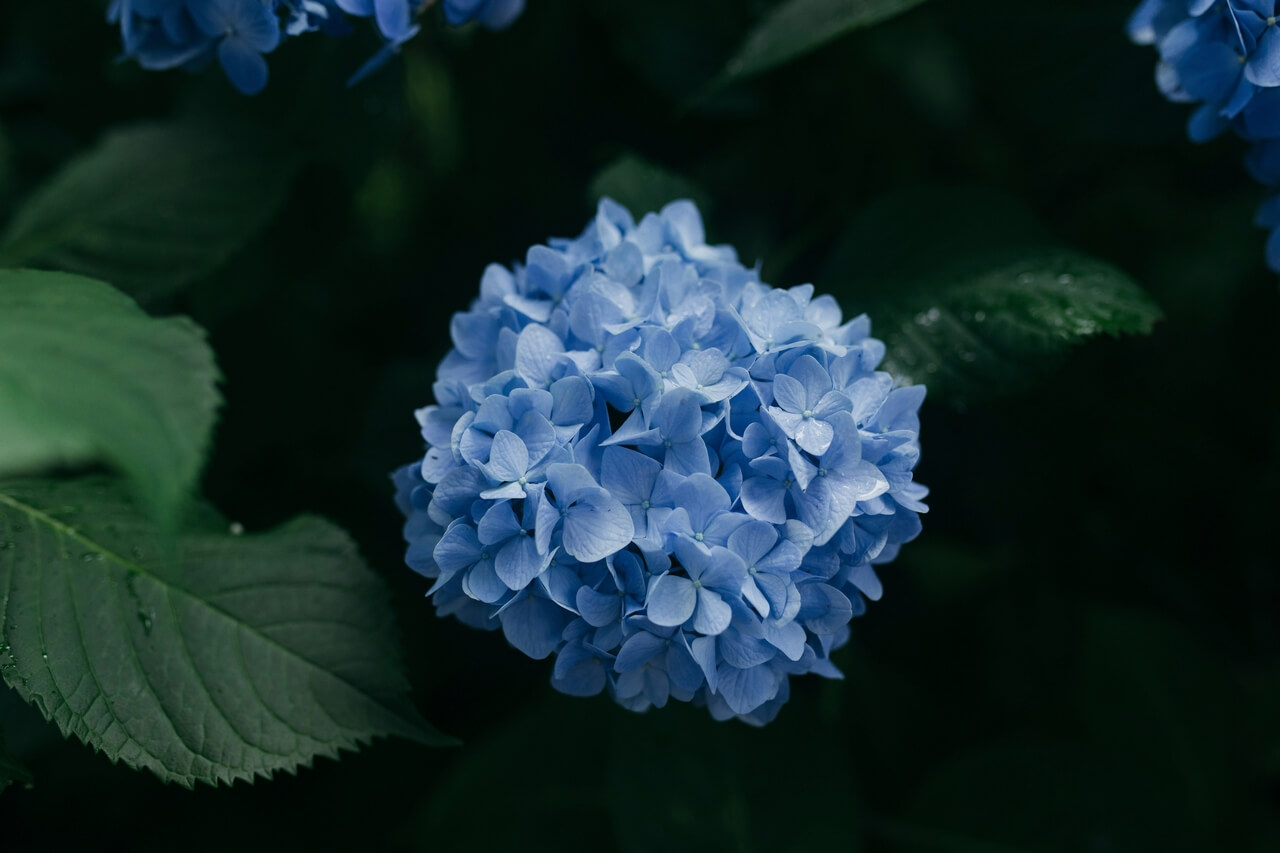
Only mophead and lacecap hydrangeas and mountain hydrangeas change colour with the soil. Their blue comes from aluminium, which the roots can take up only from acid soil. Below about pH 5.5 the flowers are blue, in neutral to alkaline soil they are pink, and in between they turn mauve or purple, sometimes with blue and pink flowers on the same plant. White, red and green cultivars keep their colour whatever the soil.
To make the flowers bluer, dissolve 1 tablespoon of aluminium sulphate in about 4 litres of water and pour it over the soil around the shrub in spring, keeping it off the leaves. The treatment is meant for plants at least two to three years old and can be repeated through the growing season, but too much aluminium sulphate damages the plant, so follow the dose on the label. Fertilisers rich in phosphorus, such as superphosphate and bonemeal, lock up aluminium in the soil and work against blue flowers. On very alkaline or chalky soil, blueing products do not work, and blue hydrangeas are then best grown in pots of ericaceous compost. Hard tap water and lime leaching from concrete foundations and paths both push the soil pH up, which is why blue-flowered hydrangeas are watered with rainwater where possible.
For pink or red flowers, raise the pH by applying ground limestone or chalk at 75–100 g per square metre in winter. Too much lime does harm, as it turns new growth yellow.

How should you water hydrangeas?
Hydrangeas need evenly moist soil, and a shrub short of water wilts and flowers poorly. In its first growing season, water a newly planted hydrangea whenever a week to ten days pass without significant rain, especially in spring and summer. Established shrubs need watering during hot, dry spells, and a thick mulch reduces how often that is. Rainwater is best for blue-flowered cultivars, although tap water is better than letting the plant dry out. Water the soil around the roots rather than the leaves and flowers.
Do hydrangeas need feeding?
Hydrangeas that have been in the ground for two or three years generally do not need regular feeding. Too much fertiliser produces soft, leafy growth with fewer flower buds, which is also more easily damaged by frost, and an excess of nitrogen in particular gives leaves at the expense of flowers. A shrub struggling on light, sandy soil can be given a general fertiliser in spring, although on such soils a mulch to keep the roots moist often helps more. Blue-flowered cultivars are fed once in spring with a fertiliser for acid-loving plants that is low in phosphorus.
How do you plant a hydrangea?
Plant hydrangeas in spring or autumn. Container-grown plants can go in at any time of year, as long as the soil is not frozen, waterlogged or very dry.
- Water the plant well in its pot before planting.
- Dig a hole as deep as the root ball and three times as wide.
- Set the plant at the same depth as it grew in the pot, with the top of the compost level with the surrounding soil.
- Refill the hole, firm the soil gently with your heel and water thoroughly.
- Spread a mulch around the shrub, leaving a gap around the stems.
How do you protect hydrangeas in winter?
Most hydrangeas are hardy throughout the UK, and the main winter risk is to the flower buds of mophead and lacecap hydrangeas, which hard frost in winter or late frosts in spring can kill. Leave their faded flower heads on until spring and mulch the soil between late autumn and late winter. In regions with colder winters, bigleaf hydrangeas need more protection: surround the shrub with hessian or chicken wire fixed to stakes and fill the enclosure with dry leaves, then remove the cover only once the risk of frost has passed in spring. Panicle and smooth hydrangeas flower on new growth, so even a hard winter does not cost them their flowers.
Hydrangeas in pots are more vulnerable, because the whole root ball can freeze. Wrapping the pot does not insulate it enough to prevent that in an average winter, so move containers into a cold greenhouse or against a sheltered, sunny wall, raise them on pot feet and check that the compost does not dry out during dry spells.

Can you grow hydrangeas in pots?
Hydrangeas grow well in containers, but they need more attention than in the ground, because the compost dries out quickly. Choose a compact cultivar, such as ‘Red Hot Violet’ or ‘Altona’, and a pot with drainage holes. Fill it with two parts peat-free John Innes No. 3 to one part peat-free multipurpose compost, or with ericaceous compost for blue flowers. Check the compost regularly and move the pot into shade during hot weather.
Hydrangeas sold in flower as gift plants are florist cultivars. Indoors they need bright, indirect light, a cool room at about 15–18°C and compost kept evenly moist, watered as soon as the surface feels dry, with no water left standing in the decorative pot cover. After flowering they can be planted in the garden, although florist cultivars are not reliably hardy in cold regions and do not always flower again.
How do you propagate hydrangeas?
Hydrangeas root easily from cuttings. Softwood cuttings are taken from mid-spring to early summer, semi-ripe cuttings from late spring to midsummer and hardwood cuttings in winter. For a softwood cutting, choose a shoot that has not flowered that year and cut a piece 13–15 cm long. Remove the leaves from the lowest two leaf joints and cut the largest remaining leaves in half. Dip the base in rooting hormone if you wish, insert the cutting into damp vermiculite or sterile cutting compost and cover the pot with clear plastic, held off the leaves with small sticks. Keep it in bright shade, never in direct sun. Roots usually form within two to three weeks, and plants raised from cuttings take two to three years to flower.
Layering needs even less equipment. Bend a low stem down to the ground, peg it in place and cover it with soil, then, once roots have formed, cut it from the parent plant and replant it.
Why is my hydrangea not flowering?
A mophead or lacecap hydrangea that does not flower has usually lost its buds, either to frost in winter and spring or to pruning at the wrong time. Other common causes are too much shade, dry soil and too much nitrogen fertiliser, which produces lush leaves and few flowers. A lack of fertiliser is rarely the reason. Young plants may also need time: hydrangeas raised from cuttings take two to three years to flower, and climbing hydrangea can take three to five. A hydrangea that wilts is almost always short of water, and newly planted shrubs are most at risk in dry weather, so water it thoroughly and mulch the soil to hold the moisture in.
How can you use hydrangeas in garden design?
A single hydrangea works as a specimen shrub on a lawn or beside a front door, while a group stands out against dark conifers or among ornamental grasses and perennials such as hostas, heucheras, astilbes and peonies. Climbing hydrangea can cover a shady north- or east-facing wall or climb into a large tree, and a panicle hydrangea grown as a standard suits a border or a large pot on a terrace. Hydrangeas also hold interest beyond summer: faded flower heads left on the plant give structure through winter, ‘Limelight’ changes from green to white to pink as it ages, and oakleaf hydrangea adds red, bronze and purple autumn foliage.
Hydrangea care through the year
| Season | What to do |
|---|---|
| Late winter and early spring | Prune panicle and smooth hydrangeas before new growth starts. Apply lime for pink flowers in winter. |
| Spring | Cut old mophead flower heads back to the first or second strong pair of buds and remove one or two of the oldest stems. Plant new shrubs, feed struggling shrubs on light soil, start blueing treatments and trim oakleaf hydrangeas lightly. |
| Mid-spring to early summer | Take softwood cuttings. |
| Summer | Water during dry spells, deadhead lacecaps after flowering, prune climbing hydrangea straight after flowering and take semi-ripe cuttings. |
| Autumn | Plant new shrubs. Leave faded mophead heads in place and do not shorten the stems of mopheads and lacecaps. |
| Late autumn and winter | Mulch, protect bigleaf hydrangeas in cold regions, move pots to a cold greenhouse or a sheltered wall and take hardwood cuttings. |
Hydrangea care – frequently asked questions
Are hydrangeas poisonous to dogs and cats?
Yes. The ASPCA lists hydrangea as toxic to dogs, cats and horses, and the RHS rates hydrangeas as harmful to dogs and cats if eaten. The plant contains a cyanogenic glycoside, and eating it usually causes vomiting, diarrhoea and lethargy, while cyanide poisoning is rare. If a pet has eaten part of a hydrangea, contact a vet. In people, all parts of the plant may cause a mild stomach upset if swallowed, and the leaves can aggravate skin allergies, so it is worth wearing gloves when pruning.
Do you deadhead hydrangeas?
Yes, but the timing depends on the type. Lacecap hydrangeas can be deadheaded straight after flowering. On mopheads, leave the faded heads over winter, as they protect the buds below from frost, and cut them off in spring just above the first or second strong pair of buds. Mopheads can be deadheaded after flowering only in mild areas. Panicle and smooth hydrangeas can keep their dry flower heads until they are pruned in early spring.
What month should you cut back hydrangeas in the UK?
It depends on the type. Mophead and lacecap hydrangeas are pruned in spring, usually in March or April, once the worst frosts are over. Panicle and smooth hydrangeas are cut back in late winter or early spring, before new growth begins, and climbing hydrangea in summer, as soon as it has finished flowering. Avoid cutting back mopheads and lacecaps in autumn, as that removes next year’s flower buds.
What pests attack hydrangeas?
Aphids, two-spotted spider mites and vine weevil can all attack hydrangeas. Hydrangea scale shows as flat, white, waxy blobs on the stems and leaves, most noticeable in early summer. If treatment is needed, use only products approved for garden use and follow the label.
Why do hydrangea flowers turn green?
The colour of many hydrangeas changes as the flowers age. By late summer, the blue and pink heads of mophead and lacecap hydrangeas fade to mixtures of green and pink or red, and white flowers often turn pink. The panicle hydrangea ‘Limelight’ opens pale lime green, turns creamy white and then flushes pink, ending as a mix of pink and green.
When do hydrangeas flower?
From early summer into autumn, depending on the type. Climbing hydrangea flowers in early to midsummer, mophead, lacecap and mountain hydrangeas from mid to late summer, and panicle hydrangeas from summer into autumn.
How fast do hydrangeas grow?
Bigleaf hydrangea grows quickly into a multi-stemmed shrub and reaches its full size in five to ten years. Its final size depends on the cultivar, and compact ones stay at around 1 m.
When can you move a mature hydrangea?
Move it while it is dormant and leafless, between late October and mid-March. Younger shrubs transplant more easily: a plant that has grown in one place for more than five years has a large root system and is much less likely to survive the move. Water it thoroughly after replanting and during dry spells.
How well a hydrangea grows and flowers depends on where it is planted: in light shade with morning sun, sheltered from wind, in soil that stays moist. Around a house, sun and shelter are largely set by how the building, terrace and garden are laid out, so they are easiest to get right at the design stage. Find architects, interior designers and interior photographers in the PLNDesign directory.
See also:
- Philodendron care: light, watering, compost and toxicity
- Houseplant care in winter: light, watering, heat and pests