


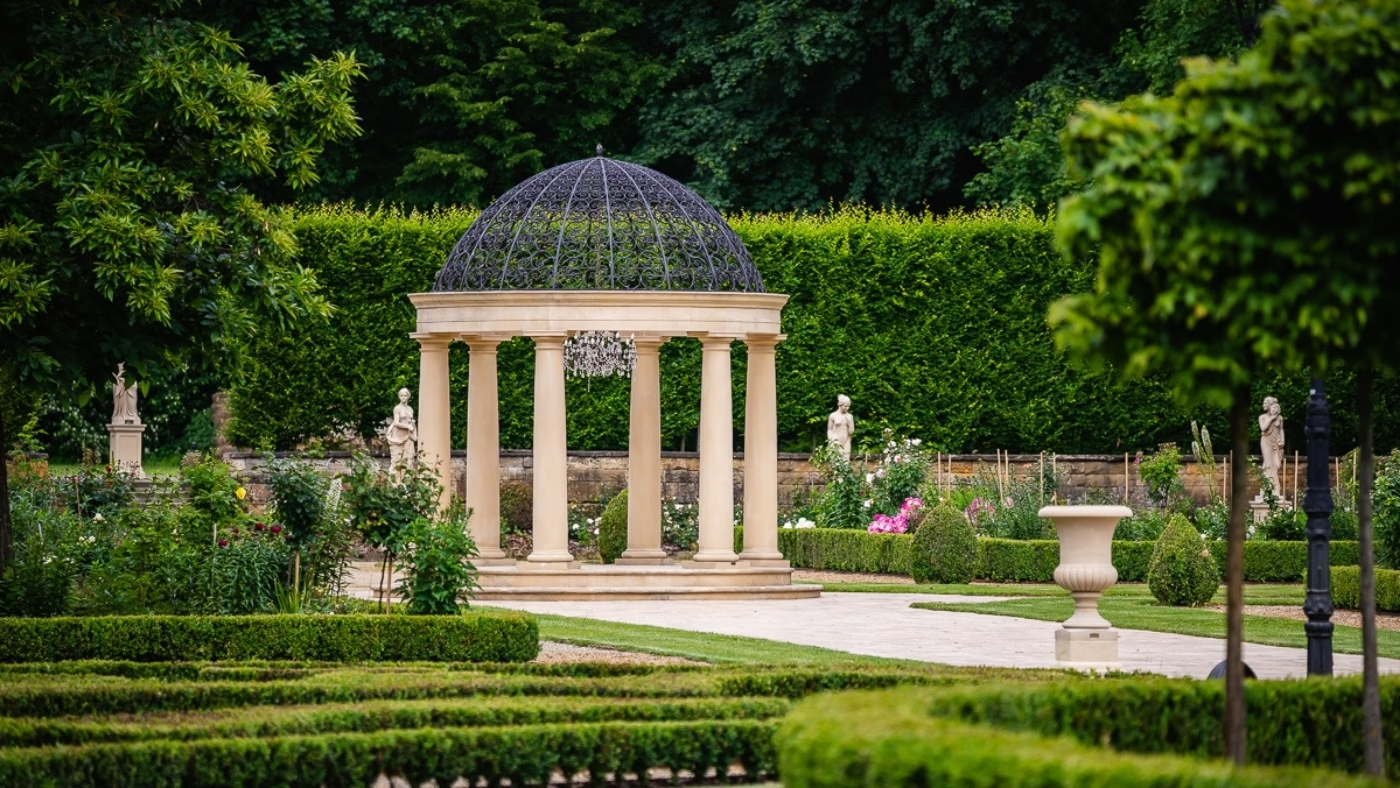
Polish brand Chronos draws on Italian, French and English garden traditions in its outdoor designs. The history of European gardens is often framed as a simple contrast: French gardens impose geometry on nature, while English gardens restore its freedom. This familiar distinction overlooks the fact that both grew out of the Italian Renaissance tradition. That tradition, in turn, drew together classical precedents, engineering techniques from Islamic states, the medieval enclosed garden (hortus conclusus) and early modern architectural theory based on geometric forms.
The Italian Renaissance garden
The Renaissance villa was more than a place of leisure. It had its origins in the farm, and humanists who read Roman authors regarded farming as an exercise in character-building. Sculptures from classical antiquity were placed in the garden to assert continuity with the traditions of Rome and legitimise the owner’s status. The garden was understood as a ‘third nature’, alongside the ‘first nature’ of the wilderness and the ‘second nature’ of cultivated land. It was meant to demonstrate how art and nature could work together. Chronos’s Amfora Włoska and Donica Meridiana draw on this tradition, taking their inspiration from terracotta vessels in Tuscan citrus gardens.

The geometry of the French garden
France adopted much of the Italian approach to garden design and decoration but changed its meaning. Where the Italians sought to reveal nature’s underlying order, the French aimed to improve it through art and bring it under their control. Nature was no longer meant to shape the owner’s character, but to demonstrate the extent of their power. André Le Nôtre, the principal designer of the gardens at Versailles, therefore devised a layout that reflected the hierarchy of court and state. On the main axis, Apollo, the central figure in Louis XIV’s solar imagery, rose from the water in his chariot, turning the garden’s ordered layout into an allegory of royal power.

The engineering involved conveyed the same message. Vast earthworks, complex hydraulic systems and flowers and fruit grown out of season were intended to prove that the monarch could command nature itself. There was not enough water to run all the fountains at once, so they were switched on just before the king or important guests passed, sustaining a carefully constructed illusion.
Today, the same French geometric order serves a different purpose. In the Fountain Garden at Mała Wieś Palace, Chronos designed a symmetrical space enclosed by a hornbeam hedge. It contains five fountains operating in synchrony, a pavilion, pergolas, an obelisk at the end of the main avenue and timber and cast-iron planters modelled on those at Versailles. Here, the classical layout organises a space for relaxation rather than displaying power.
The English landscape garden
In the 18th century, the English developed a style they presented as a native invention, the opposite of French geometry and an expression of national freedom. In fact, it drew on medieval hunting parks, themselves an earlier symbol of feudal power, while early landscape gardens continued to borrow from French, Italian and Dutch models. Control over nature had not been abandoned; only the means of concealing it had changed.

Sunken barriers known as ha-has hid the boundary from view, allowing the eye to travel uninterrupted from the house to the horizon. Clipped parterres and hedges close to the house had to be abandoned, as cattle grazing a short distance away would have disrupted their formal order. The garden was composed to resemble the pastoral landscapes of paintings, with a deliberately cultivated wildness. Its decorative language also changed: formal fountains with precisely orchestrated water displays gave way to artificial lakes, ponds and streams.
From the Industrial Revolution to contemporary design
In the 19th century, the Industrial Revolution and the wider distribution of wealth opened up garden ownership to the emerging middle class, bringing mass production into conflict with workshop traditions for the first time. Modernism in the 20th century went further, rejecting the ornament of the past. Function became the overriding concern, and swimming pools, terraces and barbecues replaced elaborate symbolic schemes. The 21st-century garden, however, rejects this austere reduction. It is no longer simply a practical extension of the home, but a space in which architectural details once again play a central role in the composition.

Chronos’s designs restore this artistic dimension to the garden. They include classical urns and planters made from reconstituted sandstone, British garden furniture in hot-dip galvanised steel with a hand-applied patina, and both contemporary and classical sculptures and fountains. These pieces show how a carefully chosen object can bring structure and a sense of proportion to the stark forms of a contemporary residence or the grounds of a traditional manor house.
Planning a home and garden together starts with considering the relationship between the building and its surroundings. Find architects, interior designers and interior photographers in the PLNDesign directory.
See also:
- Klangor Studio frames forest views at gabled house near Warsaw
- Former fire station gains a new tower and community rooms in Brno


