

Boston fern care comes down to bright light without direct sun, compost that stays moist but never soggy, humid air and a steady 18–24°C. Most of what goes wrong with Nephrolepis exaltata ‘Bostoniensis’, from crisp brown tips to shed leaflets, traces back to dry air or uneven watering.
Boston fern at a glance:
- Light: a north- or east-facing window gives the bright, indirect light it needs, while a south- or west-facing one calls for a sheer curtain or a spot further back. Direct sun scorches the fronds.
- Water: keep the compost evenly moist in spring and summer and let the top few centimetres dry out in autumn and winter, using soft water where possible.
- Air and warmth: the fronds start to suffer when humidity drops towards 30% and do better at 40–50%, with daytime temperatures of 18–24°C.
- Feeding: a balanced liquid fertiliser at half strength once a month in spring and summer, and little or none in winter.
What is a Boston fern?
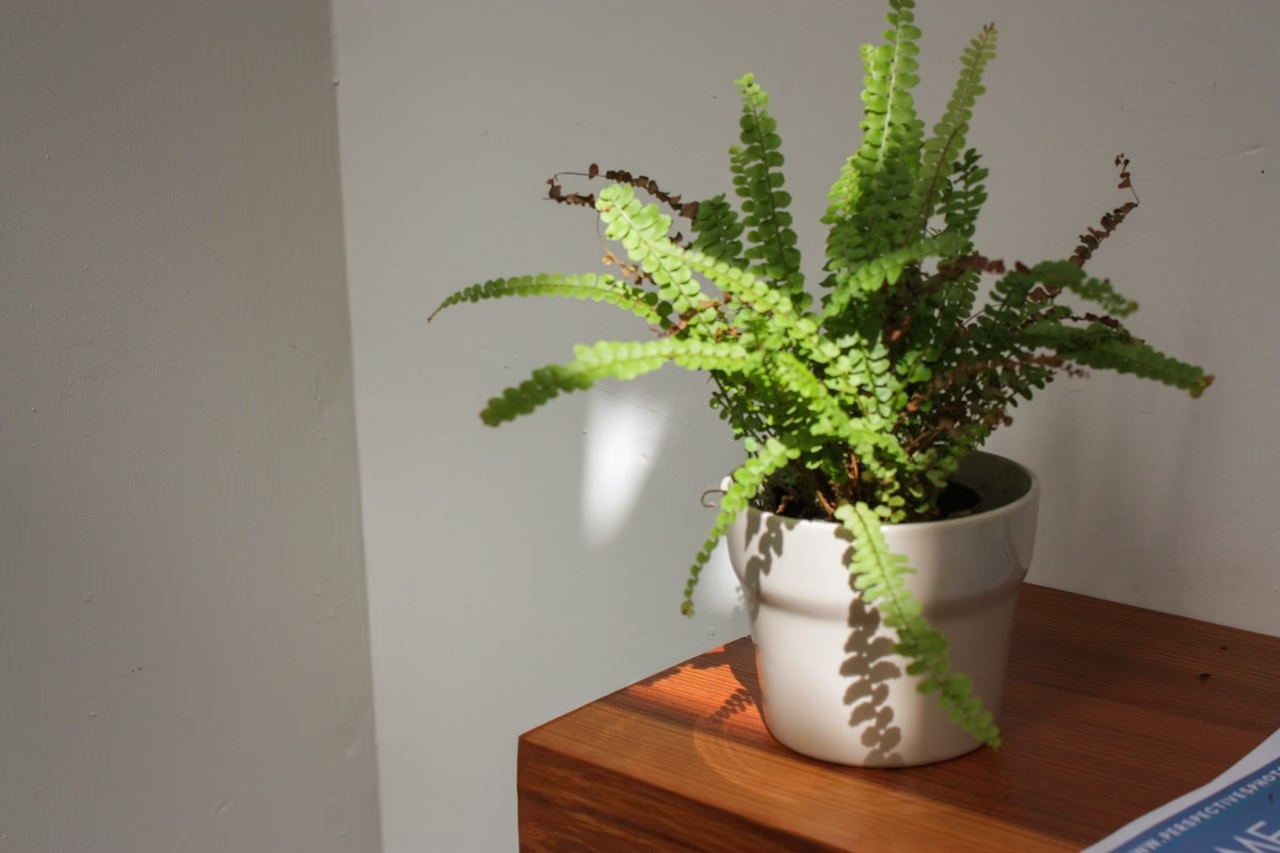
The Boston fern is Nephrolepis exaltata ‘Bostoniensis’, a natural variant of the sword fern. The wild species grows in humid forests from northern South America through Mexico and Florida to the West Indies, and holds its fronds upright. The Boston form arches them outwards until they hang. It turned up in 1894 in a large shipment of ferns sent from Philadelphia to Boston, which gave it its name, was already a popular houseplant in Victorian times and is the source of most of the cultivars sold today. The plant is frost-tender, so in a cool climate it is grown indoors.
Where should you put a Boston fern?
Put a Boston fern in bright, indirect light where the sun does not fall on it directly. A north- or east-facing window works well. In a room facing south or west, set the plant behind a sheer curtain or far enough from the glass that no sun reaches it, because strong direct light dries out and scorches the fronds. A bathroom with a window is one of the best places for it, since it offers filtered light and the steamy air the fern likes. Wherever it stands, keep it away from radiators and draughts.

What temperature does a Boston fern need?
A Boston fern is comfortable at ordinary room temperatures of about 18–24°C during the day, with nights around 5°C cooler. In a warm room the compost dries out faster and needs checking more often, and air that is both too warm and too dry can turn the fronds yellow.
Can a Boston fern live outside?
It can, but in a cool climate only in summer. The RHS gives it a hardiness rating of H1b, for plants that can grow outdoors in summer as long as temperatures stay above about 10–15°C, so in Britain it can move to a sheltered, shaded patio or balcony during the warm months and should come back indoors before the nights turn colder than that. Choose a spot in full or partial shade and out of the wind, and check the compost often, as pots outdoors can dry out quickly in hot weather. Only in frost-free climates, roughly USDA zones 9 to 11, can a Boston fern stay outside all year.

How often should you water a Boston fern?
Water often enough to keep the compost evenly moist through spring and summer, but never so much that it becomes soggy. In autumn and winter, when growth slows, wait until the top few centimetres of compost feel dry before watering again. A finger pushed into the compost is a better guide than a fixed timetable, since the warmth of the room, the size of the pot and the season all change how fast it dries. Pour the water onto the compost rather than over the crown and fronds, empty the saucer once the pot has drained and use soft water where you can. A Boston fern copes with an occasional dry spell better than most cultivated ferns, but both too much and too little water make it shed leaflets.
How do you keep a Boston fern humid enough?
Fern fronds start to suffer when relative humidity falls towards 30%, and 40–50% suits them much better, while heating dries indoor air in winter. A room humidifier placed near the fern is the most direct fix. Grouping plants together raises the humidity around them, and so does a tray of wet pebbles under the pot, provided the base of the pot sits above the water line, because a pot standing in water invites root rot. Misting with room-temperature water adds moisture only briefly, and fronds that stay wet for long can rot, so the fern also needs good ventilation.

How do you pot and repot a Boston fern?
A Boston fern needs compost that drains freely but holds moisture, with an acid or neutral pH. A peat-free multipurpose compost suits it, or a mix of one part loam, two parts sharp sand and three parts leaf mould. Use a pot with a drainage hole and leave out the layer of stones or crocks at the bottom: rather than helping drainage, it leaves the roots sitting in waterlogged compost. The roots are shallow, so a pot with about 2.5 cm of space around the root ball is enough. Repot every couple of years in spring, once the clump has filled its pot, moving it into a slightly larger one.
How should you feed a Boston fern?
Feed a Boston fern once a month in spring and summer with a balanced liquid fertiliser diluted to half strength, and cut feeding right back in winter. Too much fertiliser scorches the foliage, and the fronds then brown and dry out from the tips. After repotting or dividing, leave the plant unfed for about six months.
Should you cut back a Boston fern?
A Boston fern does not need cutting back. It is evergreen, so the job comes down to removing dead or yellowing fronds at the base with clean scissors or snips, taking care not to damage the young fronds unfurling in the centre. A few browning fronds at the bottom of the clump are normal, as older growth dies back naturally, and cutting them off at soil level makes room for new ones. Handle the plant as little as possible, because fronds that are touched or brushed against repeatedly tend to turn brown.

How do you propagate a Boston fern?
The two easy methods are runners and division. A Boston fern sends out long, thin runners (stolons) that root wherever they touch the compost, and rooted runners can be separated and potted up in late winter or early spring. A large plant can be divided in spring: take the clump out of its pot, cut the root ball vertically into halves or quarters with a sharp knife, keeping as many fronds as possible on each piece, then pot up the divisions and keep them evenly moist and humid for the first few weeks. Spores are a slower and trickier route. They are sown at about 21°C, and named cultivars do not come true from spores.
Why is my Boston fern turning brown or losing leaves?
Most problems with a Boston fern come from dry air or watering rather than from pests. The common symptoms and their usual causes:
- Brown, crisp tips and edges: air too dry, compost allowed to dry out, or too much fertiliser.
- Yellowing fronds and leaflets dropping from the centre of the clump: humidity too low or the room too warm.
- Leaflets shedding all over the plant: watering that swings between too much and too little.
- Pale fronds: the plant needs watering or feeding, or its spot is too bright.
- Rotting crown or fronds: waterlogged compost or foliage that stays wet for too long.
- Round white balls on the roots: nodules that store water, which are harmless.
Pests are few. Indoors, look out for scale insects, which show as small shell-like bumps on the stems and the undersides of the fronds, mealybugs, which hide under fluffy white wax in sheltered spots, and spider mites. Scale is easy to confuse with the spore cases (sori): on a Boston fern these form two neat rows of round dots near the edges of the leaflets, start pale and darken as they ripen, and are a normal sign of a mature frond. Pick pests off by hand, dislodge them with a firm spray of warm water or wipe them away with cotton wool dipped in rubbing alcohol, and cut off badly infested fronds. Avoid pesticides where you can, as they can damage the foliage.

Is a Boston fern safe for cats and dogs?
Yes. The ASPCA, which runs an animal poison control centre in the US, lists the Boston fern as non-toxic to both dogs and cats. The plant to watch is the asparagus fern (Asparagus densiflorus), which is sold as a fern but belongs to a different plant family. The ASPCA classes it as toxic to dogs and cats: repeated contact with the foliage can cause allergic dermatitis, and eating the berries can lead to vomiting, abdominal pain or diarrhoea. If a pet has eaten a plant you cannot identify, contact a vet.
How can you display a Boston fern at home?
The arching fronds look best with room to hang, so a hanging basket, a raised container or a plant stand suits a Boston fern best. A Boston fern can also stand in its own pot inside a larger decorative container lined with damp sphagnum moss, which keeps the compost moist for longer and the air around the fronds more humid. To water a fern in a hanging pot, take it down, water it in the sink and let it drain fully before hanging it back up.
Boston fern care – frequently asked questions
How do I make my Boston fern happy?
Give it steady conditions: a bright spot out of direct sun, an even, warm temperature away from draughts, compost that never dries out completely in the growing season and air that is not too dry.
How big does a Boston fern get?
Indoors it reaches up to about 90 cm in height and spread, usually within two to five years. Compact cultivars stay smaller, and ‘Compacta’ has fronds about 38–46 cm long.
Can a Boston fern grow in low light?
It grows best in medium to bright indirect light near a window. For a darker room, the small cultivar ‘Dallas’ copes with lower light and lower humidity than the standard Boston fern.
A bathroom with a window gives a Boston fern the light and humidity it needs, so space for plants is worth planning when a bathroom is redesigned, from the position of the window to shelving and a ceiling hook for a hanging basket. Find architects, interior designers and interior photographers in the PLNDesign directory.
See also:
- Philodendron care: light, watering, compost and toxicity
- Pond plants: what to grow in each zone and how to plant them