

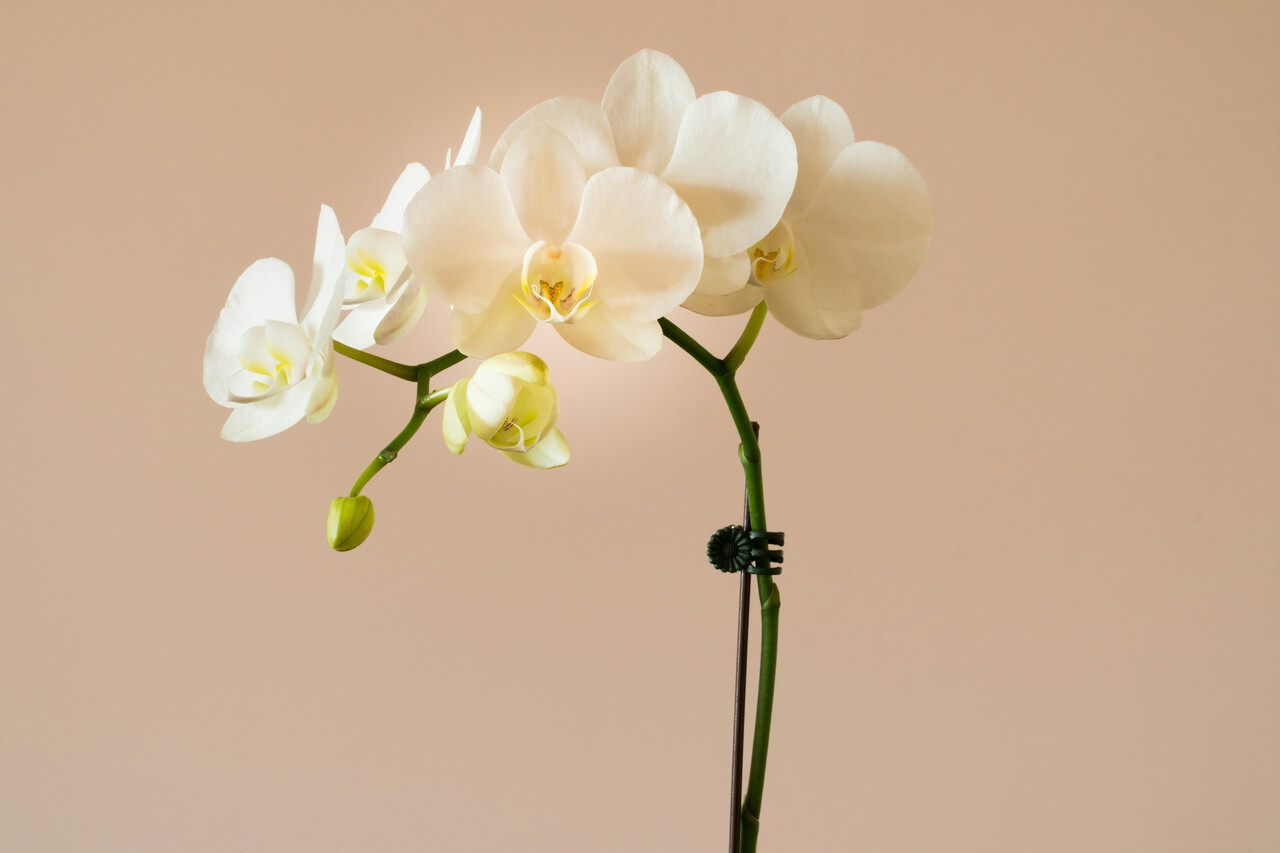
Orchid care at home comes down to a bright spot out of direct sun, a loose bark compost instead of soil and water only once the compost has dried. The moth orchid (Phalaenopsis) is the easiest orchid to grow indoors and the main subject of this guide, while cymbidiums, dendrobiums and vandas need their own temperatures and seasons.
Orchid care at a glance:
- Position: an east- or north-facing windowsill gives bright light without direct sun. A south- or west-facing one needs a sheer curtain, especially in summer.
- Watering: about once a week from spring to autumn, when the pot feels light and the roots have turned silvery. Let the pot drain completely, because roots left standing in water rot.
- Feeding: an orchid fertiliser at half strength every other watering while the plant is growing, and little or none in winter.
- Reflowering: a green stem cut just above a node often flowers again within a few months. A mature plant that will not flower needs more light or a month somewhere about 5°C cooler.
Which orchid is easiest to grow at home?
The moth orchid (Phalaenopsis) is the easiest and most popular orchid for a home. It suits centrally heated rooms, copes with medium to low light and flowers regularly with little attention, often for months at a time. In the wild it is an epiphyte that grows on tree trunks and branches rather than in soil. Plants in shops usually come in clear plastic pots filled with chopped bark. When buying, choose one with large, healthy leaves rather than limp ones, and check the label for its eventual size, as standard varieties can grow very large.
Temperature narrows the choice among other orchids. Oncidiums need at least 13°C to flower, while cymbidiums, dendrobium hybrids and miltonias prefer a cool, well-lit room through the winter, with a minimum of 11°C.
Where should you put an orchid?
Most indoor orchids want bright light but no direct sun, so an east- or north-facing windowsill suits a moth orchid well. A south- or west-facing window works if a sheer curtain filters the light, because direct summer sun scorches the leaves. In winter, a brighter position such as an east- or west-facing windowsill helps the plant flower, and artificial light is another option. The leaves show whether the light is right: on a moth orchid they should be olive green, darker leaves point to too little light and a reddish tinge to too much.
A moth orchid is comfortable at 19–30°C during the day and 16–19°C at night, and should not be kept below 16°C. Keep it away from radiators, heaters and draughts. Cold draughts and sudden swings in temperature can make the flower buds drop.

How should you water an orchid?
Water a moth orchid when the compost has dried and the pot feels light, which from spring to autumn usually means about once a week. In winter it needs a little less. The roots should not dry out completely, and the pot must never stand in water, because roots left sitting in water rot.
A clear pot shows when it is time. Orchid roots are covered in velamen, a spongy layer of dead cells that soaks up water quickly. When wet, the velamen turns translucent and the roots look green; as they dry, they turn silvery grey. A firm, plump silver root is healthy and means the next watering is close. Wrinkled, shrivelled roots in very dry bark show that the plant has gone too long without water.
Orchids can be watered from the top or from below. Pour tepid water over the bark and tip away what collects in the saucer, hold the pot under a gently running tap for about 30 seconds, or stand it in a bowl of water. Whichever method you use, let the pot drain completely before it goes back into its saucer or cover. Water in the morning and keep water out of the crown, the centre of the plant where the leaves join. Water left there can cause crown rot, so blot it with a paper towel.
Rainwater is the best choice, especially in hard-water areas, and tap water that has been boiled and cooled is the alternative. Avoid water from a water softener and distilled water. Slipper orchids (Paphiopedilum) should dry out only a little between waterings, and never completely in winter. Most orchids also like fairly humid air. Stand the pot on a tray of damp gravel or pebbles, with its base above the water, or use a humidifier.
How do you feed an orchid?
Feed an orchid only while it is actively growing, which shows as new roots or a new flower stem. A fertiliser made for orchids, at half strength every other watering, is enough for a moth orchid. Feeding at every watering lets salts build up in the compost, so the plain waterings in between keep it clean. In winter feed sparingly or stop altogether, and stick to the dose on the label, because overfeeding harms the plant. Cymbidiums and dendrobiums change their feed with the seasons, as described in their section below.
What do you do with an orchid after the flowers drop?
Once the last flowers of a moth orchid have dropped, look at the stem. If it has turned pale and dry, cut it off at the base. A stem that is still green can flower again, and there are three ways to handle it:
- Cut it back to a node. Nodes are the small joints along the stem. Cutting just above the second or third node from the base usually produces a side shoot with new flowers, often within 8–12 weeks.
- Leave it. Cut the stem just below the lowest faded flower, and a new flowering stem usually grows from one of the remaining nodes.
- Cut it off at the base. The next flowers take longer, up to a year, but the new stem is stronger and the flowers larger.
Keep watering and feeding as usual while you wait. For most other orchids, remove each flower as it fades and, once they are all over, cut the stem cleanly about 3 cm from its base. Leave the pseudobulbs, the thickened stems of cymbidiums, dendrobiums and cattleyas, in place. They store water and nutrients, and only those that are completely shrivelled and dead should be removed.
How do you get an orchid to flower again?
A healthy moth orchid that will not flower needs more light, a cooler spell, or both. Flowering is triggered by a drop in temperature, and ordinary winter temperatures in a house often provide it. If the room stays warm all winter, move a mature plant somewhere about 5°C cooler for around a month, after which a new flower stem should appear. A plant that keeps refusing to flower also needs a brighter position, especially in winter. For cymbidiums and cool-growing dendrobiums, a summer outdoors, with nights clearly cooler than the days, helps trigger the flower buds.

How and when should you repot an orchid?
Repot a moth orchid about every two years, or sooner if it has outgrown its pot or the compost has broken down. The best time is after flowering, when the roots are active and have green tips. Never use multipurpose or loam-based compost: orchids need a bark-based orchid compost.
Choose the smallest pot the roots will fit into, ideally the same one. Too much compost stays wet for too long and leads to root rot, and cymbidiums flower best when their roots are tight in the pot. A clear plastic pot lets you check the moisture and the roots, and because some orchid roots photosynthesise, they benefit from the light. Black or terracotta pots also work.
- Take the plant out of its pot and shake or tease off the old compost.
- Check the roots. Firm roots, green or silver, are alive. Roots that are brown or black and soft, mushy or slimy, that are hollow and papery, or whose outer layer slides off are dead. Cut them off with clean, sterilised scissors and shorten long healthy roots to about 12 cm.
- Set the plant at the same level as before and fill around the roots with moist bark, firming it gently. Aerial roots that grow outside the pot stay outside: do not bury them or force them in. A short cane steadies a wobbly plant.
- Water thoroughly and let the pot drain completely.
How do you propagate orchids?
Moth orchids and dendrobiums sometimes produce keikis, small plantlets that form at the nodes, on a moth orchid usually on the flower stem. Leave a keiki on the parent until it has several good roots, then cut it off, pot it in orchid compost and water it sparingly at first. A young dendrobium is ready when it reaches about a third of the size of its parent, and it may take a year or two to flower.
Orchids with pseudobulbs are divided when a large plant is repotted. Each piece of a cymbidium needs at least five pseudobulbs and takes two to three years to flower. A cattleya should have at least six mature pseudobulbs before it is divided, and each division three to five. Slipper orchids are divided after flowering by separating an offshoot with a good root system from the edge of the clump.
What pests and diseases affect orchids?
Moth orchids are fairly resistant to pests, although mealybugs and scale insects appear from time to time. The main disease risk is root rot, caused by overwatering or by a pot that is too large.
Mealybugs are soft-bodied insects up to 4 mm long, coated in white wax, that look like specks of cotton wool. They cluster in sheltered spots such as leaf joints and sheaths and feed on sap, leaving sticky honeydew on which black sooty mould grows. Scale insects show as similar specks on the leaves. Both have become resistant to commercial insecticides, so wash them off under the tap instead. If that does not help, use only a product approved for amateur gardeners and apply it exactly as the label says. Keep any new orchid apart from the others for at least a month before it joins them.
Fungus gnats, small dark flies 3–4 mm long that run over the compost, breed in compost that stays wet. The adults are harmless and their larvae feed mainly on decaying matter, so letting the compost dry out between waterings reduces them, and yellow sticky traps catch the adults. Outdoors in summer, slugs and snails can damage orchids.
Bacterial rot starts as small, water-soaked spots, often with a yellow halo, that spread fast, can turn brown and may smell foul. Orchids that grow from a central crown, such as moth and slipper orchids, are the most vulnerable. Cut out the affected tissue together with at least 2.5 cm of healthy tissue, using a blade sterilised between cuts. From then on, water early in the day, keep the air moving and remove any water that gathers in the crown.
Fusarium wilt blocks the flow of water through the plant. The roots die, the leaves yellow, wrinkle and wilt, and a cut through the rhizome of a cattleya shows a purple or pinkish-purple ring. The fungus enters through cut surfaces, which is another reason to sterilise tools before every cut.
Viruses show as irregular yellow or dead patches on the leaves, yellow streaks or rings, and on moth orchids sometimes as leaves curling downwards. The flowers can show streaks of broken colour. Similar marks can have other causes, and an infected plant may show none at all. There is no cure: an infected plant should be thrown away or kept completely apart from the rest. Viruses travel on hands and cutting tools during repotting and dividing, so sterilise tools between plants.
Botrytis, or grey mould, marks the flowers with small brown, black or grey spots, sometimes with a pale pink edge, which grow and merge. It spreads in cool, damp, still air. Moving air, watering early so that the flowers are dry by nightfall, and removing spotted and fallen flowers keep it in check.
How do you care for cymbidiums, dendrobiums and vandas?
Cymbidiums are cool-growing orchids that spend the summer outdoors. From June to mid-September they stand in a warm, sheltered spot in light shade, after being hardened off gradually so that the leaves do not scorch. Nights of 10–12°C in late summer and early autumn trigger the flower spikes. While the spikes develop, the plant should stay below 15°C, otherwise the buds can drop, and once in flower it does best at around 21°C. In winter it needs a cool room at 10–14°C with good light. Water regularly in spring and summer, letting the compost dry a little in between, and every week or two in winter, using rainwater or filtered water. Cymbidiums take a high-nitrogen feed while they grow and a high-potassium one from late summer.
Cool-growing dendrobiums, such as Dendrobium nobile hybrids, need a clear split between growth and rest. In spring and summer they want bright light without strong direct sun, water whenever the compost needs it and regular feeding, and they can go outside for the summer. In autumn and winter they need bright, cool and drier conditions, with watering cut back to about once every 10–12 days in winter. Without a fall in night temperatures they do not flower reliably, and a plant watered too much in autumn may produce keikis instead of flowers. Switch to a high-potassium feed in autumn and avoid high-nitrogen fertiliser after midsummer.
Vandas need very bright light, indoors ideally at a south-facing window, with days of 21–29°C and nights of 16–21°C. Humidity should be 70–80% and never below 65%. The air around them must move, because stagnant air harms them as much as cold draughts. Vandas are often grown in baskets or hung with their roots bare, without any compost. Bare roots may need watering every day if the air circulates well, always in the morning and with tepid water.
Which orchids can you grow in the garden?
Hardy orchids grow in the ground, mostly in light or partial shade. The Chinese ground orchid (Bletilla striata) is hardy through most of the UK, down to about -5 to -10°C, and likes moist but well-drained soil in a sheltered spot. Calanthe striata grows in semi-shade in well-drained soil enriched with organic matter, and lady’s slipper orchids (Cypripedium) need light shade and soil that neither dries out in summer nor gets waterlogged in winter. Pleione is grown in a cool greenhouse, on a windowsill or in a sheltered rock garden.
Garden orchids should come from a nursery, never from the wild. In Great Britain it is an offence to uproot any wild plant without the permission of the owner or occupier of the land, and rare species listed in Schedule 8 of the Wildlife and Countryside Act 1981, may not be picked, uprooted, destroyed or sold. Among them are the military, monkey, lizard and ghost orchids. International trade in orchids is regulated under CITES, the Convention on International Trade in Endangered Species, which lists the whole orchid family.

Orchid care – frequently asked questions
What should you not do with an orchid?
Do not plant an orchid in multipurpose or loam-based compost, leave it standing in water or move it into a pot much larger than its roots, because wet compost around the roots makes them rot. Keep it out of direct summer sun, away from radiators and draughts, and do not water it with softened or distilled water.
Why are my orchid’s leaves turning yellow?
Yellow leaves are most often a sign of overwatering or poor drainage, so check the roots for rot. Old leaves also fade with age and can be removed once they do. If the watering is right, look for the diseases described above, such as Fusarium wilt or a virus.
Are orchids poisonous to cats?
Moth orchids are not poisonous to cats. The ASPCA lists the moth orchid as non-toxic to cats, and Cats Protection includes orchids, among them moth orchids, cymbidiums, dendrobiums, oncidiums and vandas, on its list of plants that are safe for cats. Safe means that no toxins are known to affect cats, although eating any plant can still upset a cat’s stomach.
How long do orchid flowers last?
Moth orchids can stay in flower for several months. Slipper orchids, which usually flower between November and March, keep their flowers for up to three months.
What is the white crust on orchid bark?
A white crust on the bark or the pot is a build-up of salts from fertiliser or of minerals from hard water. Run plenty of plain water through the pot to wash them out, switch to rainwater, and replace the compost if the deposit is heavy or the bark has broken down.
Can orchids go outside in summer?
Cymbidiums and cool-growing dendrobiums can, and the cooler nights outdoors help them form flower buds. Harden them off first, choose a sheltered spot in light shade and watch for slugs and snails.
Orchids do well in bright rooms with humid air, such as a bathroom with a window or a garden room. If you are planning a space like this and want room for plants built in from the start, find architects, interior designers and interior photographers in the PLNDesign directory.
See also:
- ZZ plant care: light, watering, repotting and common problems
- Kalanchoe care: light, watering, reflowering and propagation