

ZZ plant care rests on three conditions: bright, indirect light, compost that dries out completely between waterings and a room that never gets colder than 10°C. Zamioculcas zamiifolia tolerates shade, dry indoor air and long gaps between waterings, and most of the problems it develops start with too much water.
ZZ plant at a glance:
- Light: bright, indirect light within about 2 m of a window gives the fastest growth. The plant tolerates shade, but strong direct sun scorches its leaves.
- Water: only once the compost has dried out completely, which usually means every couple of weeks in summer and about once a month in winter.
- Warmth: it grows at 15–38°C and should not stand anywhere colder than 10°C.
- Safety: every part is harmful if eaten and the sap irritates skin and eyes, so keep the plant away from children and pets and wear gloves when handling it.
What is a ZZ plant?
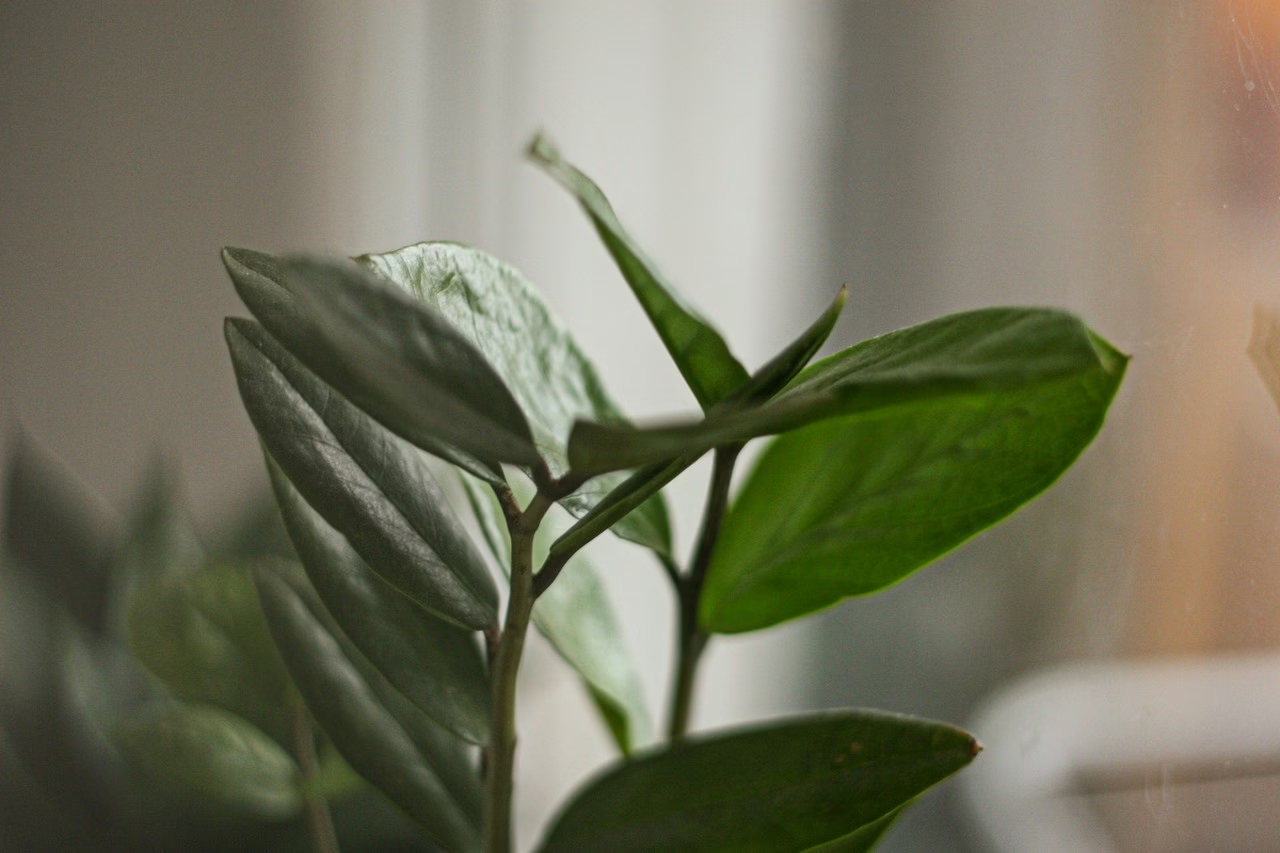
The ZZ plant is Zamioculcas zamiifolia, an evergreen perennial from the arum family (Araceae), also sold as Zanzibar gem or eternity plant. It grows wild in eastern Africa, from Kenya to north-eastern South Africa, in dry, open savannah woodland and on rocky, half-shaded ground. What look like stems are single compound leaves. Each one rises straight from a thick underground rhizome on a swollen, succulent stalk carrying six to eight pairs of glossy, dark green leaflets, and indoors the plant usually reaches 40–80 cm, with large specimens approaching a metre.
The rhizome and the fleshy base of each leaf stalk store water. In a drought the plant sheds its leaflets and keeps the swollen stalk bases as a reserve, and in trials indoors under low light, plants went four months without water and not a single leaf wilted or turned yellow. The species was first described in 1829 by Loddiges as Caladium zamiifolium, and the genus name refers to the resemblance of its foliage to the cycad Zamia. It became a mainstream houseplant only after Dutch nurseries began propagating it on a large scale around 1996, and it now holds the RHS Award of Garden Merit.

How much light does a ZZ plant need?
A ZZ plant grows best in bright, indirect light, and standing it within about 2 m of a window speeds up its naturally slow growth. It also copes with shade and grows by a window of any aspect, which is why it works in a hallway or a room with a north-facing window. Strong direct sun is the thing to avoid, especially in the afternoon: it scalds the leaflets and leaves brown patches on them. In a spot that is too dark the plant grows more slowly and makes smaller leaflets, and in very poor light it stretches, turns yellow and drops leaflets. If that happens, move it closer to a window.

How often should you water a ZZ plant?
Water a ZZ plant only when the compost has dried out completely, all the way down rather than just on the surface. In summer that usually works out at every couple of weeks and in winter at about once a month, but the state of the compost matters more than the calendar, so push a finger a few centimetres in and wait if it still feels damp. When you do water, soak the compost until water runs out of the drainage holes, let the pot drain for about ten minutes and empty the saucer.
Overwatering is the usual way to lose a ZZ plant. Compost that stays wet for long periods, particularly a dense mix with little air in it, leads to root and rhizome rot, and several stems yellowing at the same time is the typical warning. If you see it, stop watering, take the plant out of its pot and check the rhizomes and roots for rot.
Why does a ZZ plant have water droplets on its leaves?
Droplets at the tips of the leaves, usually seen in the morning, are guttation. When the compost is wet and the air is humid and cooler than the compost, typically at night, the roots keep pushing water up while the leaves release little vapour, and the excess escapes through pores called hydathodes at the edges and tips of the leaves. ZZ plants are among the houseplants that do this. Guttation is usually harmless to the plant, but it shows that the compost is holding a lot of water, so let it dry out properly before the next watering. The droplets carry mineral salts, sugars and amino acids, which is why they can dry to white spots on the leaves.
What temperature and humidity does a ZZ plant need?
A ZZ plant grows at 15–38°C and does best at 18–32°C, so an ordinary heated room suits it all year. Below about 15°C it stops growing, and it should never stand anywhere colder than 10°C, where the leaves can suffer chilling injury. In winter, keep it away from cold draughts. Average indoor humidity is fine, so there is no need to mist the leaves.

In summer a ZZ plant can go outside. The RHS rates it H1b, hardy enough to spend the summer outdoors provided temperatures stay above 10–15°C, so a sheltered, shaded balcony or patio suits it during the warm months. Bring it back indoors before night temperatures fall below about 15°C, and keep it out of direct sun outside as well.
What compost and pot does a ZZ plant need?
A ZZ plant needs a free-draining mix. A peat-free cactus and succulent compost works well, or a coir-based potting compost opened up with perlite and sand, roughly two parts compost to one part each of perlite and sand. General houseplant compost is made for moisture-loving tropical plants and stays too wet for a ZZ plant. Whatever the mix, the pot must have drainage holes, so that water never collects around the rhizomes.
How often should you feed a ZZ plant?
A ZZ plant has low nutrient needs and does not require regular feeding. To encourage growth, give it a balanced liquid houseplant fertiliser diluted to half strength a few times between spring and late summer, and none in winter.
When should you repot a ZZ plant?
A ZZ plant grows slowly and does well in a snug pot, so it needs repotting only about every two years, in spring or summer. The signs are rhizomes pressing against the sides of the pot, roots coming out of the drainage holes and growth that has stalled. Left too long, the rhizomes can push a pot out of shape and even crack it. Move the plant into a pot just one size larger, because a much bigger one keeps the compost wet for longer and puts the rhizomes at risk of rot. Ease the root ball out carefully, shake off the loose old compost and set the plant at the same depth as before.
How do you propagate a ZZ plant?
Division is the quickest way to get a second plant. When repotting, separate the rhizomes into two or more clumps, each with at least one stem and its own roots, and pot them up separately. Leaf cuttings take much longer. Pull or cut single leaflets from a healthy stem, push the base of each into moist, free-draining compost and keep them warm, in bright, indirect light. Rooting powder is not needed. Under nursery conditions a leaflet forms a small rhizome in about four weeks and puts up its first leaf about a month later, while on a windowsill the roots can take up to four months to appear and a new leaf six months or more. Whole leaf stalks can be rooted too, but they are slower than single leaflets.
What are the most common ZZ plant problems?
Most problems with a ZZ plant come from water or light rather than pests or disease:
- One older stem turning yellow: normal ageing.
- Several stems yellowing at once: usually overwatering, so check the rhizomes and roots for rot.
- Brown, scorched patches: too much direct sun. Move the plant further from the window.
- Stretched growth, yellowing and dropped leaflets: not enough light.
- Dark spots on the stems: a normal feature of the plant, not a disease.
- No new growth: normal in winter and in rooms below about 15°C. In summer, check the light and whether the rhizomes have filled the pot.
- Small black flies over the compost: fungus gnats, which breed in moist compost and disappear once you water less.
Pests are rare. Now and then scale insects or mealybugs turn up indoors, so look over the stems and the undersides of the leaflets when you water.

Is a ZZ plant poisonous?
Yes. All parts of the plant are poisonous, and the RHS classes it as harmful if eaten and as a skin and eye irritant, advising gloves when handling it. The sap contains insoluble calcium oxalate crystals shaped like fine needles. The Queensland Poisons Information Centre warns that chewing or swallowing any part causes immediate pain or a burning sensation and swelling of the lips, mouth, tongue and throat, and that contact dermatitis can develop in sensitive people. Swollen lips or tongue, or difficulty breathing or swallowing, need urgent medical attention.
The ASPCA lists the ZZ plant among the houseplants containing insoluble calcium oxalates. In cats and dogs, chewing the leaves typically causes drooling, retching, vomiting, diarrhoea and loss of appetite, and the animal may shake its head or paw at its mouth. A larger amount can cause significant stomach pain or swelling at the back of the throat that makes breathing difficult, and then the pet needs a vet straight away. Keep the plant out of reach of children and pets, and wash your hands after pruning or repotting.
Does a ZZ plant purify the air?
Only to a degree that makes no practical difference in a home. In sealed laboratory chambers, ZZ plants have absorbed volatile organic compounds including benzene, toluene, ethylbenzene and xylene. Real rooms are another matter: a 2019 review by Michael Waring and Bryan Cummings of Drexel University, covering 30 years of studies, calculated that matching the air exchange of a building’s ventilation system or a couple of open windows would take between 10 and 1,000 plants per square metre of floor. Ventilation clears volatile compounds from indoor air far faster than plants can.

Which ZZ plant varieties are there?
Two named varieties are easy to tell apart from the green species. Raven (cultivar name ‘Dowon’) has leaves that open lime green and soon turn a deep purple-black. It comes from the South Korean breeder Hyuk Jin Lee, who patented it in the United States in 2018, and it needs the same care as the species. Zenzi is a dwarf form with smaller dark green leaflets that grows to about 25–30 cm.

ZZ plant care – frequently asked questions
Why is it illegal to propagate ZZ plants?
Propagating an ordinary ZZ plant is not illegal. The restriction concerns protected varieties such as Raven and Zenzi, which are sold under plant breeders’ rights (marked PBR), and these rights let the holder stop others from reproducing the variety without permission. In the UK, plant breeders’ rights do not extend to anything done for private and non-commercial purposes.
Do ZZ plants flower?
Mature plants occasionally flower in summer, though rarely indoors. The flower is a small arum-like spathe, green or green and white and about 7 cm long, wrapped around a short spadix, and it appears low down among the leaf bases. The plant is grown for its leaves, and a faded flower can be removed at soil level.
What are the downsides of having a ZZ plant?
It is harmful if eaten and its sap irritates skin and eyes, so it needs a place out of reach of children and pets. It also grows slowly, taking two to five years to reach full size, so a small plant stays small for a long time, and it is easily killed by overwatering.
A ZZ plant copes with the shade of a hallway or a north-facing room, so when a darker part of a home is being redesigned, it is worth planning a spot for plants along with the lighting and furniture. Find architects, interior designers and interior photographers in the PLNDesign directory.
See also:
- Philodendron care: light, watering, compost and toxicity
- Houseplant care in winter: light, watering, heat and pests