

To grow pelargoniums well, give them full sun and a free-draining compost, water only when the top of the compost has dried, switch to a high-potash feed once they flower and deadhead them regularly. Pelargoniums are tender perennials from southern Africa that tolerate heat and drought but not frost, so in a cool climate they go outside after the last frost and come back under cover in autumn, where they can be kept for the following year.
Pelargoniums at a glance:
- Tender perennials from southern Africa, pelargoniums survive heat and drought but not frost, so where winters are cold they are either overwintered under cover or replaced each spring.
- The main groups are zonal, ivy-leaved, regal and scented-leaved pelargoniums, alongside smaller groups such as stellar, angel, unique and species types.
- Planting out waits until frosts are over, which in most of the UK means the end of May, after a couple of weeks of hardening off.
- For more flowers, give them full sun, a high-potash feed every fortnight once buds appear, water only when the compost is dry on top and remove faded flowers.
What is a pelargonium?
A pelargonium is a plant from Pelargonium, a genus of about 280 species of evergreen perennials, succulents and shrubs in the geranium family, Geraniaceae. Around 90 per cent of the species grow wild in southern Africa, and the rest are spread from East Africa, Madagascar, Yemen, Iraq and Asia Minor to southern Australia and the north of New Zealand. Most of the pelargoniums sold for gardens, balconies and windowsills belong to hybrid groups, though some wild species are grown as well.
The name comes from the Greek pelargós, meaning stork. After flowering, the fruit splits into five segments, each holding one seed and ending in a long awn, and the seed head they form looks like a stork’s bill. The leaves of many species are aromatic because they contain essential oils: Pelargonium graveolens is grown and distilled for the perfume industry, and rose-scented forms are the most important commercially.
Pelargoniums have been grown in Europe since the early 17th century. Pelargonium triste was the first species in cultivation, and in 1631 John Tradescant the elder introduced it to England from seed bought in Paris. A pelargonium already appears in the 1648 catalogue of plants grown at the Oxford Botanic Garden. In the 19th century, breeders crossed the species to produce hundreds of cultivars, and the zonal pelargoniums grown today come from that work.

What is the difference between a geranium and a pelargonium?
Pelargoniums are the plants most people call geraniums, but botanically they belong to a separate genus. Geranium is the hardy geranium, or cranesbill, a garden perennial that stays outdoors all year, while pelargoniums are tender and need protection from frost. The shared name goes back to Linnaeus, who in 1753 placed pelargoniums, geraniums and storksbills (Erodium) in a single genus, Geranium. Johann Jacob Dillenius had proposed the name Pelargonium in 1732, but the two genera were formally separated only in 1789, by Charles L’Héritier. The flowers show the difference: in a pelargonium the two upper petals differ from the three lower ones, while a geranium flower is symmetrical all round.
Are pelargoniums perennial?
Yes. Pelargoniums are evergreen perennials and shrubs that can live for many years, but they do not survive frost. Where winters are cold, they are either grown as summer bedding and replaced each spring or brought under cover before the first frost and kept for the following season, and most will not survive a British winter outdoors without protection. An overwintered plant can be grown on for several years. Stems that become leggy are cut back in spring to make the plant branch, and cuttings taken in late summer give you young plants for the next season.
What types of pelargonium are there?
Pelargoniums are divided into groups that differ in habit, leaves and flowers. Their care is broadly the same, but the groups suit different places on a balcony, patio or windowsill:
- Zonal pelargoniums (P. × hortorum) are the familiar bedding and patio plants, bred mainly from P. inquinans and P. zonale. They grow upright and bushy, with rounded leaves that often carry a darker purple or maroon zone, and clusters of single or double flowers in red, salmon, pink or white on long stalks. Some are grown as much for their leaves: ‘Mrs Pollock’ has green leaves edged with purple and cream, and bright red flowers.
- Stellar pelargoniums are zonal types with star-shaped flowers, first bred in Australia in the 1970s. Their flowers are tough and long-lasting and stand up to strong sun; the Fireworks and Quantum series belong here.
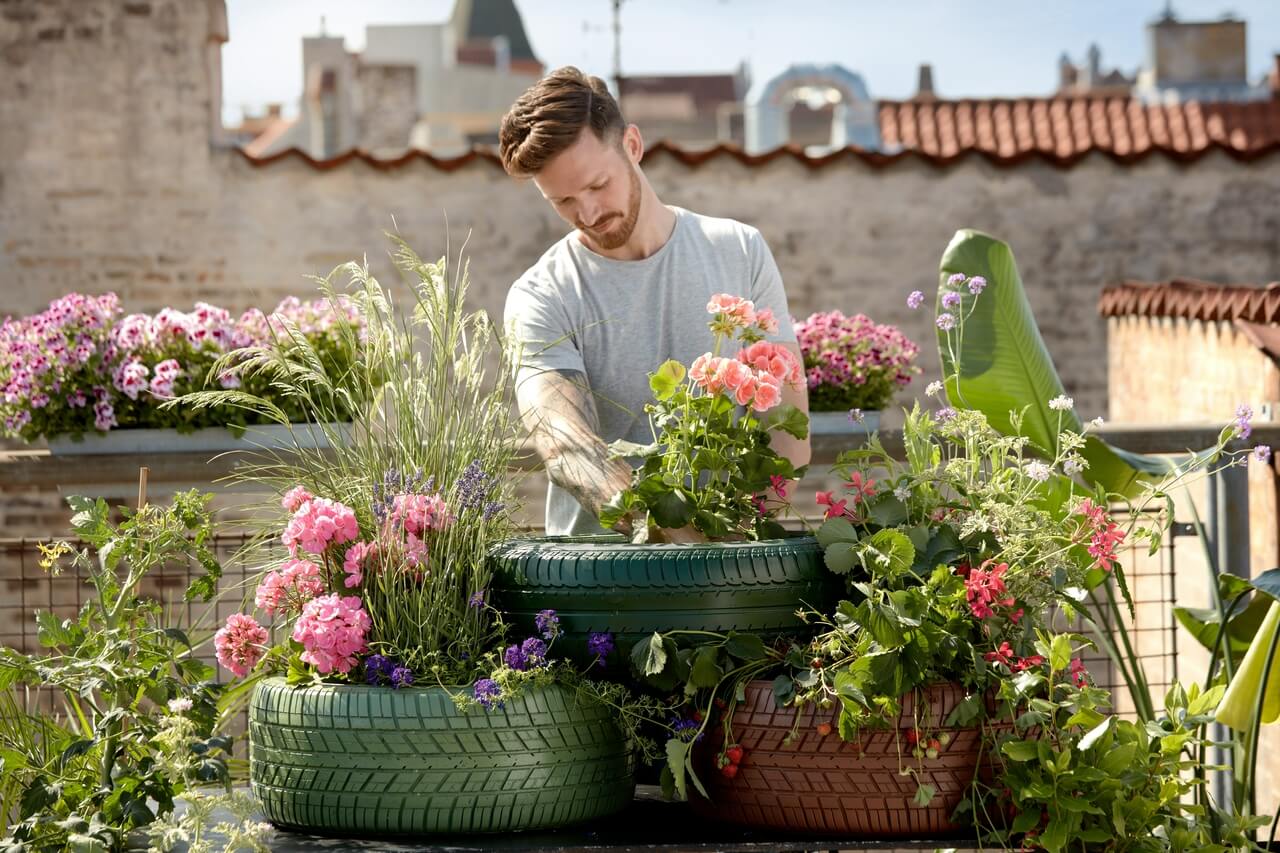
- Ivy-leaved pelargoniums come from P. peltatum. Their long stems trail over the edge of a container, and their smooth, glossy, thick leaves help them hold water in dry spells. They flower over a long season in red, purple, pink or white, which suits them to hanging baskets, window boxes and balcony troughs. ‘Ville de Paris’, also sold as ‘Balcon Rose’ and ‘Pink Cascade’, is a trailing balcony variety.
- Regal pelargoniums (P. × domesticum), derived largely from P. cucullatum, have coarsely toothed leaves and large, velvety, ruffled flowers in mauve, pink, purple or white, often with darker blotches. They flower slightly earlier than zonals and prefer cooler conditions and some shade, so they do best in a conservatory or a sheltered spot outdoors. ‘Lord Bute’ and ‘Dark Secret’ are regals.
- Angel pelargoniums look like small regals, with round leaves and pansy-like flowers marked darker on the upper petals. They stay compact and suit pots indoors or out.
- Scented-leaved pelargoniums are grown mainly for their foliage, which can smell of rose, lemon, lime, peppermint, pineapple or nutmeg. The group takes in species as well as hybrids: Pelargonium tomentosum has velvety, peppermint-scented leaves and tiny white flowers, and ‘Attar of Roses’ has rose-scented leaves. Most have small flowers.
- Unique pelargoniums resemble the scented-leaved types, with pungent foliage, but have showier flowers. Many of them date from the early 19th century.
- Species pelargoniums are the wild forms from southern Africa. Some have tuberous roots, and many go dormant in summer or winter.

When should you plant pelargoniums outside?
Plant pelargoniums outside once frosts have passed. In most of the UK that is not before the end of May, and in Scotland it is early to mid June. Before planting out, harden the plants off over a couple of weeks so they get used to outdoor conditions gradually. Plug plants bought in spring are potted into 9cm pots and grown on in a bright, warm place at 7–21°C until it is safe to plant them out.
Every pot, trough and window box needs drainage holes. A layer of crocks or gravel at the bottom does not improve drainage, because it interrupts the way water moves through the compost and takes up room the roots could use; one crock over the hole is enough to stop compost washing out. Give the plants space as well, since grey mould and rust spread quickly in damp, crowded conditions with little air movement.
What is the best compost for pelargoniums?
Pelargoniums need a free-draining compost that never stays wet. In containers, use a peat-free multipurpose compost or a soil-based compost such as John Innes No 2; multipurpose compost is lighter, so it is the better choice for hanging baskets. Adding perlite or horticultural grit opens up the mix and helps excess water drain away, and a slow-release fertiliser mixed in at planting gives the plants a steady supply of nutrients. In a border, pelargoniums grow best in fertile soil that is neutral to alkaline, so they do not need acid conditions. Heavy soil and fine composts that pack down hold water around the roots and are best avoided.
Do pelargoniums like full sun?
Yes. Most pelargoniums flower best in full sun and cope well with heat and drought, which makes them a good choice for south-facing balconies and patios. Zonals tolerate some shade, and regals prefer partial shade and cooler conditions, so they are the better choice for a spot that gets sun for only part of the day. Plants grown in a conservatory, a greenhouse or on a windowsill need full light but should be shaded from scorching midday sun. All pelargoniums do best in a sheltered position with good air movement, which helps keep grey mould away, and ivy-leaved types should be kept out of heavy rain.
How often should you water pelargoniums?
Water pelargoniums when the top 2.5cm or so of compost feels dry, then water thoroughly. They tolerate being a little too dry far better than being too wet, and ivy-leaved types store water in their thick, waxy leaves. Compost that stays wet makes the plants wilt and their leaves turn yellow. In a hot spell, containers in full sun may need watering every day or two, while in winter pelargoniums need only a little water, with the compost allowed to dry out between waterings.
Water the compost, not the plant. Wet leaves and flowers encourage rust, grey mould and other fungal problems, and watering in the morning means the compost does not stay wet overnight. Empty any water that collects in the saucer, so the pot is never left standing in it.
How and when should you feed pelargoniums?
Feed pelargoniums every 10–14 days in spring with a balanced liquid fertiliser. Once flower buds form, switch to a high-potassium feed such as tomato feed and use it every fortnight for the rest of the summer, following the dose on the packet. Potassium encourages flower buds, while too much nitrogen produces soft growth that is more vulnerable to pests and diseases. In autumn and winter, feed once a month, and stop altogether for plants that are dried off for the winter.

How do you deadhead and pinch out pelargoniums?
Remove faded flowers regularly throughout the season, so the plant puts its energy into new buds rather than seed. You do not need secateurs: snap each spent flower stalk off where it joins the stem. Deadhead more often in wet weather, because decaying petals are where grey mould takes hold, and remove yellowing leaves at the same time.
Pinch out the shoot tips in spring or early summer to make the plants branch and grow bushier, which works on young ivy-leaved plants too. Tall, strong-growing varieties can be trained up a cane, and plants kept growing all year round are pruned hard in spring. Keep pruning tools clean, because pelargonium viruses are spread in sap, including on blades.
Why is my pelargonium not flowering?
Common reasons are too little sun, a feed with too much nitrogen and not enough potassium, and spent flowers left on the plant. A pelargonium in shade flowers less, so move it to the sunniest spot you have, switch to a high-potash feed and deadhead regularly. Plants also flower less when they are weakened by rust, grey mould or pests, or when their roots sit in cold, wet compost. On young plug plants, removing the first flower buds lets them put their energy into roots and leaves first.
What diseases affect pelargoniums?
The two diseases to watch for are grey mould and pelargonium rust, and both are favoured by damp air, wet leaves and poor air circulation. Giving plants space, watering the compost rather than the foliage and clearing up dead leaves and flowers promptly are the main ways to prevent them.
Grey mould (Botrytis) shows as fuzzy grey-brown mould on decaying buds, leaves and flowers, which then shrivel and die. It usually gets in through damaged tissue or attacks plants that are already stressed, and it spreads fast in humid conditions. Remove affected parts straight away, ideally dropping them into a bag as you go so the spores do not scatter, and improve ventilation.
Pelargonium rust (Puccinia pelargonii-zonalis) attacks zonal pelargoniums; ivy-leaved types are not affected. It starts as small yellow spots on the upper surface of the leaf, with whitish blisters beneath that turn into brown, powdery masses of spores, often arranged in rings. Badly affected leaves yellow and fall, weakening the plant. Infected leaves can look healthy for about two weeks, so keep new plants apart from the rest for at least that long. Pick off diseased leaves and fallen debris, avoid wetting the foliage and do not take cuttings from infected plants, because the disease travels with them. A heavily infected plant is best thrown away.
Oedema is a disorder rather than a disease. It appears when the roots take up more water than the leaves can lose and the excess bursts cells on the underside of the leaves: watery spots turn into raised bumps that become brown and corky, and badly affected leaves can yellow and drop. Ivy-leaved pelargoniums are especially prone, usually when wet compost meets cool, humid, overcast weather. Leave the marked leaves on the plant, because removing them makes the problem worse, then water less, check that the compost drains freely and give the plants more air.
Leaf colour is another clue. Yellow leaves usually point to overwatering, rust or grey mould, while leaves that turn red show stress from cold, too much water or a shortage of nutrients. Pelargoniums can also be affected by viruses and by leafy gall, which produces dense clusters of distorted shoots at soil level.
In the UK, no fungicides are approved for home gardeners against grey mould, and good hygiene and airflow are the main defence against rust as well. If you decide to treat rust, use only a fungicide legally available to home gardeners and follow the label exactly. Homemade remedies are unregulated and usually untested.
What pests attack pelargoniums?
Whitefly, red spider mite and aphids are the pests to look out for on pelargoniums, while fungus gnats appear in compost that stays wet and vine weevil grubs can damage the roots of plants in containers. Check the undersides of the leaves regularly, because that is where whitefly and red spider mite live.
Glasshouse whitefly are tiny white-winged insects, about 1.5mm long, that fly up in a cloud when the plant is disturbed. They feed on the undersides of the leaves and excrete sticky honeydew, on which black sooty mould grows. They are mainly a problem indoors and under glass, though they can spread to plants outside in a warm summer. Under glass, the parasitic wasp Encarsia formosa attacks the young stages, and yellow sticky traps show how many adults are about.
Red spider mites are less than 1mm long and hard to see without a hand lens. The first sign is a fine, pale mottling on the upper surface of the leaves; in a heavy attack, fine webbing appears and the leaves lose most of their colour, dry up and fall. The mites thrive in warm, dry conditions, especially under glass, and outdoors in hot summers. The predatory mite Phytoseiulus persimilis is the most commonly used biological control, and badly infested plants are best removed.
Fungus gnats, also called sciarid flies, are dark greyish-brown flies 3–4mm long. Their larvae live in damp compost and feed mainly on dead roots and decaying plant matter, although some can damage the roots of seedlings and the base of soft cuttings; established plants are rarely harmed. Let the compost dry out between waterings, or repot into fresh compost. Yellow sticky traps catch the adults, along with other insects, and the nematode Steinernema feltiae can be added to the compost as a biological control.
How do you overwinter pelargoniums?
Bring pelargoniums under cover before the first autumn frost and keep them in a light, airy, frost-free place, ideally at 7–10°C. At that temperature they may carry on growing and even flowering. Keep them away from radiators and fires, and avoid a humid bathroom. There are three ways to keep them until spring:
- As potted plants. Lift plants from the border and pot them up in John Innes No 1, or bring containers indoors. If space is short, cut the plants back to about 10cm. Cut-back plants need very little water until spring, while plants still in growth should be checked weekly and watered when dry. In mid-spring, repot into fresh compost, either John Innes No 2 or peat-free multipurpose, and put the plants outside only after the last frost.
- As cuttings. Take softwood cuttings in late summer and keep them on a bright windowsill indoors, watering sparingly. Pinch out the tips in late winter and pot the young plants into 9cm pots in mid-spring.
- Bare-root. This works only for tough, woody-stemmed varieties and is the least reliable method. Before the frosts, lift the plants, shake off the soil and dry them in a frost-free place, then hang them up or wrap them. In early spring, soak the roots for a few hours, cut the stems back to about 10cm and grow the plants on somewhere warm and bright, such as a greenhouse.
How do you take pelargonium cuttings?
Pelargoniums root from softwood cuttings taken at any time from spring to autumn, and late summer is ideal. Choose a healthy, non-flowering shoot and cut it just below a leaf joint, 5–10cm long. Remove the lower leaves and any flower buds, then leave the cut end to dry for a few hours, which reduces the risk of rot. Insert the cutting into a gritty, free-draining compost, for example around the edge of a pot, and water it lightly. Keep it warm and in good light but out of direct sun, with the compost just moist, never wet. Rooting hormone is optional. Roots usually form within two to four weeks, and new growth at the tip and roots showing at the bottom of the pot mean the cutting has taken.
Pelargoniums – frequently asked questions
Are pelargoniums poisonous to cats and dogs?
Yes. Pelargoniums are toxic to dogs, cats and horses: they contain geraniol and linalool, which can cause vomiting, loss of appetite, lethargy and skin irritation. Scented-leaved types mainly cause stomach upset, but a larger amount can lead to unsteadiness, muscle weakness and low body temperature, and cats are the most sensitive. If your pet has eaten part of a plant, contact your vet straight away.
Do pelargoniums do better in the ground or in pots?
Both work. Zonals are bedding plants that do well in a border with fertile, neutral to alkaline soil, but containers make it easy to move plants under cover in autumn. Regal pelargoniums are happiest in a conservatory or a sheltered spot, and ivy-leaved types should be kept out of heavy rain.
Can you root pelargonium cuttings in water?
It can work, but cuttings standing in water tend to rot, and pelargoniums root more reliably in a gritty, free-draining compost. Letting the cut end dry for a few hours before inserting it lowers the risk of rot further.
What do pelargoniums dislike?
Frost, shade and wet roots. Frost kills them, shade cuts flowering, and cold, wet compost damages the roots. Water on the leaves encourages fungal disease, so misting does more harm than good.
Which pelargoniums suit a balcony depends on how much sun it gets and how sheltered it is: zonals and stellars for full sun, ivy-leaved types to trail from window boxes and troughs, regals where they get some shade and shelter. If you are planning a balcony or terrace from scratch, find architects, interior designers and interior photographers in the PLNDesign directory.
See also:
- Plants poisonous to cats: lilies, houseplants and garden plants to avoid
- Orchid care: how to water, feed and rebloom a moth orchid