

How to grow honeysuckle comes down to four things: soil that is moist but well-drained, shade for the roots and light for the stems, a sturdy support fixed before planting, and pruning timed to when the plant flowers. Honeysuckles (Lonicera) are twining climbers and shrubs grown for tubular, often strongly scented flowers that, depending on the species, open from spring to late autumn. Most climbing kinds are hardy and need little more than a yearly prune, a good soak in dry spells and an annual mulch.
Honeysuckle at a glance:
- The genus Lonicera has about 180 species of climbers and shrubs from the northern hemisphere, and common honeysuckle (L. periclymenum) is native to the UK and much of Europe.
- Dappled or partial shade suits it best. In deep shade it will not flower, and on a south-facing wall the leaves can scorch.
- Pruning follows the flowering habit: honeysuckles that flower on last year’s growth are cut back after flowering, and those that flower on new growth are tidied in spring without hard cutting.
- The berries of ornamental honeysuckles are not for eating. Only honeyberry (Lonicera caerulea) is grown for edible fruit.
What is honeysuckle?
Honeysuckle is the common name for Lonicera, a genus of about 180 species in the family Caprifoliaceae, native to northern latitudes of Eurasia and North America. The name honours Adam Lonicer, a Renaissance botanist. The genus includes twining climbers, the subject of this guide, and shrubs such as winter-flowering L. fragrantissima and the small-leaved evergreen L. pileata, which is used for hedging and topiary.
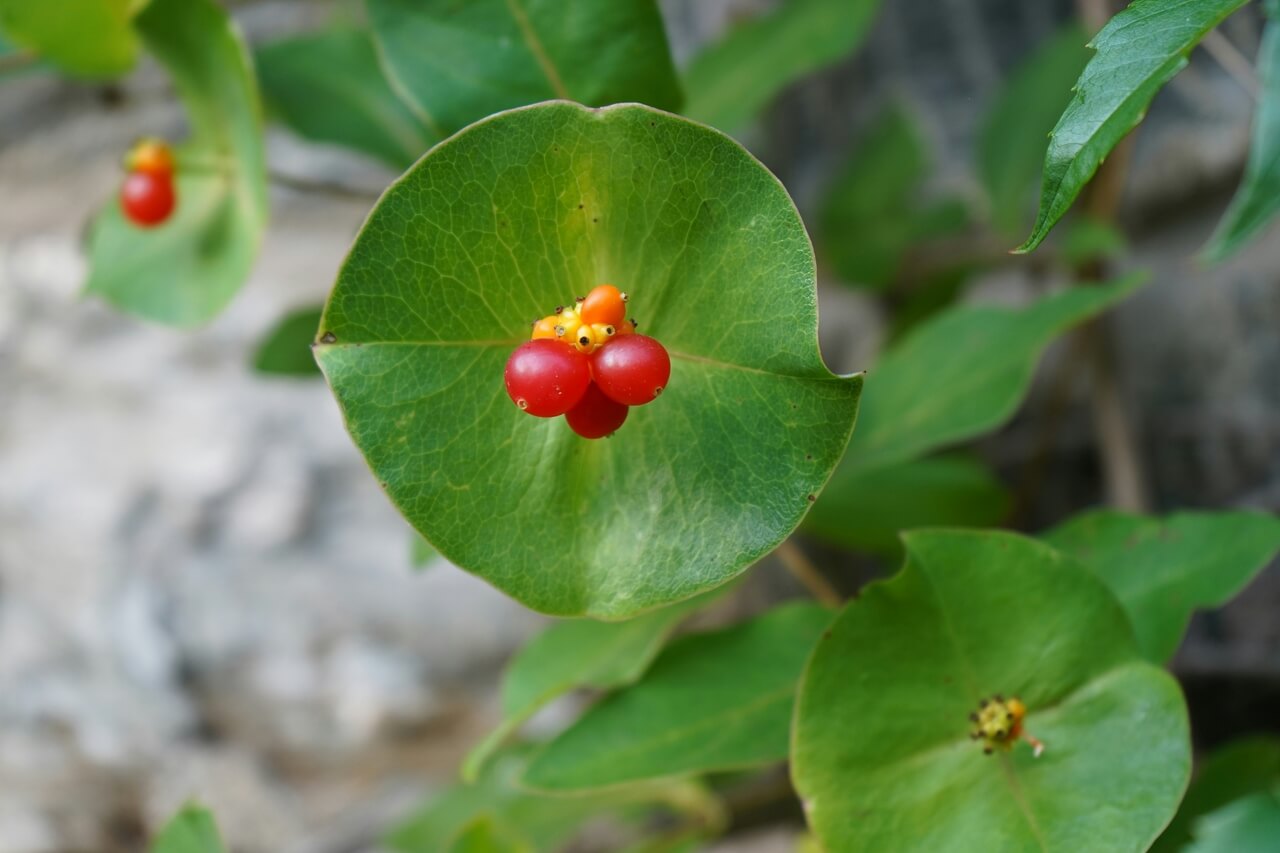
Climbing honeysuckles carry their leaves in opposite pairs. In Italian honeysuckle (L. caprifolium) the uppermost pairs are fused around the stem, so the stem seems to pass through a single leaf. In common honeysuckle the leaves are never joined. Common honeysuckle, also known as woodbine, grows wild across much of Europe, North Africa, Turkey and the Caucasus, and in the UK it is a native plant of woodland and hedgerows, where it climbs through shrubs and trees.

Which honeysuckle should you grow?
Choose by what you want from the plant: common honeysuckle and its cultivars for scent, Japanese or Henry’s honeysuckle for evergreen cover, and hybrids such as Tellmann’s honeysuckle or ‘Dropmore Scarlet’ for orange and scarlet flowers. Hardiness in the table is the RHS rating: H6 plants survive winters down to between −20 and −15 °C, H5 plants down to between −15 and −10 °C.
| Honeysuckle | Flowers | Foliage | RHS hardiness |
|---|---|---|---|
| Common honeysuckle (L. periclymenum) | Creamy white or yellowish, flushed pink or red outside, mid to late summer | Deciduous | H6 |
| Italian honeysuckle (L. caprifolium) | Scented, creamy white, in clusters at the shoot tips | Deciduous | H6 |
| Japanese honeysuckle (L. japonica) | Fragrant, white fading to yellow, spring to late summer | Evergreen to semi-evergreen | H5 |
| Henry’s honeysuckle (L. henryi) | Dull yellow and red, summer | Evergreen | H5 |
| L. × heckrottii | Fragrant, deep pink outside and yellow-orange inside, late summer | Deciduous or semi-evergreen | H5 |
| Tellmann’s honeysuckle (L. × tellmanniana) | Orange, often tinted red, late spring and summer | Deciduous | H5 |
| ‘Dropmore Scarlet’ (L. × brownii) | Narrow, bright scarlet trumpets, midsummer to late autumn | Semi-evergreen | H5 |
Common honeysuckle has several garden cultivars. ‘Graham Thomas’ carries fragrant white flowers that soon turn buff-yellow over a long season. It is named after the English horticulturist Graham Stuart Thomas, who found it in a Warwickshire hedgerow around 1960. ‘Serotina’, known as late Dutch honeysuckle, has fragrant flowers that are deep red-purple outside and yellow within, and both cultivars hold the RHS Award of Garden Merit. ‘Chojnów’, a Polish cultivar introduced in 2006 and sold as Fragrant Cloud, has very fragrant, rich crimson flowers with white and cream throats in mid and late summer.
Japanese honeysuckle, native to China, Manchuria, Japan and Korea, is a vigorous climber that can reach about 10 metres. Its cultivar ‘Halliana’ is evergreen, with highly fragrant white flowers that soon turn buff-yellow, while ‘Aureoreticulata’ has semi-evergreen leaves finely veined in yellow. Henry’s honeysuckle, an evergreen that grows to about eight metres, is now listed by botanists as a synonym of L. acuminata.
The three hybrids in the table all have L. sempervirens as a parent. Tellmann’s honeysuckle, a cross with L. tragophylla, was raised at the Royal Hungarian Horticultural School in Budapest and put on the market by the Berlin nursery Späth in 1927. It grows best in partial shade. ‘Dropmore Scarlet’, a cross with L. hirsuta, was bred by Frank Skinner in Manitoba, Canada, and introduced in the 1950s.
Which honeysuckles are scented?
Common honeysuckle and its cultivars, Italian honeysuckle, Japanese honeysuckle and L. × heckrottii all have fragrant flowers. Not every honeysuckle is scented: Tellmann’s honeysuckle has little or no fragrance, so if scent matters, check the plant label before buying.
The fragrance is strongest in the evening and at night, when it draws the moths that pollinate the flowers. Common honeysuckle smells far less by day than after dark, and warm weather and moist soil help the scent along.
Where should you plant honeysuckle?
Plant climbing honeysuckle in partial or dappled shade, which gives the healthiest plant and the best show of flowers, with the roots in shade and the stems able to reach sunlight. A south-facing wall gets sun all day and encourages flowering, but the leaves may scorch, and hot, dry conditions make powdery mildew more likely.
The soil should be moist but well-drained. Heavy, wet ground and dry sites both produce a sickly plant, and waterlogging is common where heavy soil is poorly drained or compacted. Common honeysuckle grows in chalk, clay, loam and sand, and in acid, neutral or alkaline soil. Leave room for growth: common, Italian, Japanese and Henry’s honeysuckle can all reach 4–8 m.
When is the best time to plant honeysuckle?
Container-grown honeysuckles can be planted at any time of year, as long as the ground is not frozen or waterlogged and the summer heat is not at its peak. Deciduous kinds establish best when planted in winter, ideally late winter, and evergreens such as Japanese and Henry’s honeysuckle in spring or autumn.
How do you plant honeysuckle and give it support?
Fix the support before planting. On a wall or fence, run horizontal wires about 45 cm apart, add vertical wires at the same spacing and leave a gap of at least 5 cm between the wires or trellis and the wall. A pergola, a fence or a tree can also carry a honeysuckle, as long as it is given wires or mesh to twine around.
Once the plant is in the ground, cut its existing shoots back by two-thirds. This encourages strong new shoots from the base, which can then be tied in to the support as they grow. Water regularly through the first spring and summer so that the roots establish.
How do you water and feed honeysuckle?
Established honeysuckles need only an occasional soak in hot summers. Walls and fences cast a rain shadow, so check the soil at their base even after light rain and water well if it is dry.
A spring feed with a general-purpose fertiliser, applied as the pack directs, is optional. A yearly mulch of garden compost or well-rotted manure, spread in spring, keeps moisture in the soil. Leave the faded flowers on the plant: they turn into berries that give winter interest and feed birds.
Is honeysuckle hardy?
Most climbing honeysuckles are hardy and need no winter protection. Common and Italian honeysuckle are rated H6, hardy across the UK and northern Europe. Japanese and Henry’s honeysuckle, L. × heckrottii, Tellmann’s honeysuckle and ‘Dropmore Scarlet’ are rated H5, hardy in most of the UK even in severe winters. Henry’s honeysuckle is evergreen, Japanese honeysuckle keeps all or part of its foliage, ‘Dropmore Scarlet’ is semi-evergreen, and common honeysuckle is deciduous, though it occasionally holds on to its old leaves over winter.
How and when should you prune honeysuckle?
Prune climbing honeysuckle every year, at a time set by how it flowers. Honeysuckles that bloom on short sideshoots grown the previous year are pruned after flowering: in late summer, cut the flowered shoots back by about a third. Common honeysuckle and its cultivars, Italian honeysuckle and Tellmann’s honeysuckle are all pruned after flowering.
Honeysuckles that flower on the current season’s growth, usually the later-flowering kinds, are pruned in spring. Start by removing weak and damaged shoots, then shorten wayward stems and thin congested growth, but avoid hard pruning, which reduces flowering. Japanese honeysuckle belongs to this group: prune it in early spring and, if needed, lightly trim untidy shoots after flowering. On posts and in tight spaces, side shoots can be cut back to short spurs of two or three buds.
A neglected plant that has become a tangle, bare at the base, can be renovated in late winter. Cut all the stems back to 60 cm, then choose the strongest, best-placed new shoots to build a fresh framework on the support. Before any pruning, check for nesting birds, and in a wildlife garden leave the plant a little untidy for them.
Why is my honeysuckle not flowering?
Check the light and the pruning first. In too much shade a honeysuckle produces leaves but few or no flowers. Pruning can also take the flowers away: cutting a plant that flowers on last year’s growth in spring removes the sideshoots that would have bloomed, and pruning a late-flowering honeysuckle hard reduces its display. Drought adds stress, so water during dry spells.
Are honeysuckle berries poisonous?
The berries of ornamental honeysuckles should not be eaten. The Royal Horticultural Society lists common, Japanese, Henry’s and Tellmann’s honeysuckle as potentially harmful, describes their fruit as ornamental and not for eating, and advises wearing gloves when handling several species. It also warns that honeysuckle berries other than honeyberry are toxic if eaten in large quantities.
Berry colour depends on the species: glossy red on common honeysuckle, orange-red on Italian honeysuckle, blue-black on Japanese honeysuckle and black on Henry’s honeysuckle. On common honeysuckle the berries ripen in late summer and autumn.
Honeyberry (Lonicera caerulea) is the honeysuckle grown for food. Its oblong, blue-black berries have a white bloom on the skin and are blueberry-like. Plant at least two shrubs together for good pollination and a crop, in fertile, free-draining soil in sun or light shade, as in shade it will not flower and fruit reliably. Eat only berries from plants you know to be honeyberry.
How do you propagate honeysuckle?
The long, flexible stems of climbing honeysuckle are well suited to layering. In spring, bend a stem down to the ground or into a pot, peg it in place and cover it with a little soil. The buried section roots and becomes a new plant.
Cuttings work too. Take softwood cuttings from spring to summer, or semi-ripe cuttings from July to September from healthy stems grown that season, with a firm base and a still-soft tip. Keep them no longer than 10 cm and choose stems with leaf nodes close together, because longer cuttings tend to dry out and fail.
Honeysuckle can also be raised from seed. Collect ripe berries in autumn, remove the flesh and dry the seeds, then give them 4–12 weeks of cold, either over winter in a cold frame or in slightly damp compost in a sealed bag in the fridge. Sow them on compost in a seed tray and germinate them at 13–18 °C.
What pests and diseases affect honeysuckle?
Honeysuckles are relatively trouble-free, and the two problems to watch for are powdery mildew and aphids. Powdery mildew is most likely in hot, dry weather and on plants with dry roots, so water in summer and mulch the base with garden compost in spring rather than reaching for a fungicide.
Aphids go for the young shoots in spring. The honeysuckle aphid causes curled, distorted leaves and sticky honeydew, on which sooty mould grows. Small colonies can be rubbed off and squashed by hand and badly affected shoots pruned out, with an organic insecticide kept as a last resort. Honeysuckles can also suffer from thrips, glasshouse whitefly, fungal leaf spot, silver leaf and, rarely, honey fungus.
Is honeysuckle good for wildlife?
Yes. Honeysuckle flowers feed bees and butterflies by day and moths at night, and birds eat the berries. On common honeysuckle, bumblebees visit the flowers, the night scent draws pollinating moths, and the declining white admiral butterfly depends on the plant. Dormice build summer nests for their young from its bark and feed on the nectar-rich flowers, while thrushes, warblers and bullfinches eat the berries.
Honeysuckle – frequently asked questions
How long does honeysuckle take to flower?
A honeysuckle raised by layering usually flowers within three years.
Is honeysuckle easy to grow?
Yes. Climbing honeysuckles are hardy, cope with most soils that are neither waterlogged nor dry, and need little more than a yearly prune, watering in dry spells and an annual mulch.
How fast does honeysuckle grow?
Common honeysuckle reaches 4–8 m and takes 5–10 years to reach its full size, and Japanese honeysuckle can climb to about 10 metres. Where Japanese honeysuckle has become invasive in the United States, its runners can grow more than three metres in a year.
Can honeysuckle grow in a pot?
It can, but climbing honeysuckles have deep roots and need soil that stays moist, so they do better in the ground. In a container, use a large pot with good drainage holes, fit a trellis or wires for the stems to climb and give a liquid feed every fortnight during the growing season. Low, non-climbing varieties such as ‘Strawberries and Cream’ are better suited to pots.
Is honeysuckle invasive?
Japanese honeysuckle can be. It is an aggressive invasive vine across much of the United States, where birds and small mammals spread its seeds and it also spreads by underground rhizomes and runners, smothering trees and other plants. In Northern Ireland it is listed in Schedule 9 of the Wildlife (Northern Ireland) Order 1985: it is not banned from sale, but planting it or allowing it to grow in the wild is an offence. Common honeysuckle is a native plant in the UK and much of Europe.
A pergola, trellis or planted wall by a terrace has to carry a mature climber for many years and suit the rest of the garden. Find architects, interior designers and interior photographers in the PLNDesign directory.
See also:
- Plants poisonous to dogs: garden plants and houseplants to avoid
- Kalanchoe care: light, watering, reflowering and propagation