

To grow lavender, plant it in full sun and free-draining soil that is neutral to slightly alkaline, water it sparingly once it has rooted and trim it every year so it stays compact. English lavender is the hardiest type for gardens with cold winters, while French lavender is better kept in a pot that can be moved under cover.
Lavender at a glance:
- Hardiness: English lavender and lavandin overwinter in the ground. French lavender needs a frost-free place in winter.
- Sun and soil: full sun and free-draining soil with a pH of 6.5–7.5 are the two conditions lavender cannot do without.
- Pruning: trimming once or twice a year keeps the plant compact and brings a second, lighter flush of flowers. Cut into leafy growth only, never into bare old wood.
- Water: too much does more harm than drought, rotting the roots and making frost damage in winter more likely.
Which types of lavender come back every year?
Lavender is a perennial, but how reliably it returns depends on the species. English lavender and lavandin are the hardiest and can usually stay in the ground all winter if the soil drains freely. French lavender and other tender species are short-lived and do best in containers kept frost-free over winter, and in regions with cold winters French lavender is usually treated as an annual.
English lavender (Lavandula angustifolia) is the hardiest species and one of the most widely grown, both in gardens and on commercial plantations. Its narrow, silvery-green leaves are covered in fine hairs, and the flower spikes are most often purple, less often violet-blue, white or pink. Proven cultivars include ‘Hidcote’, with dark violet flowers and a compact habit, and ‘Munstead’, which suits both borders and pots.
Lavandin (Lavandula × intermedia) is a hybrid between English lavender and broad-leaved lavender (Lavandula latifolia). It is hardy, though slightly less so than English lavender, grows larger and is cultivated mainly on plantations for its oil. Of its cultivars, ‘Grosso’ has long stems and a strong scent, while ‘Provence’ needs more protection from frost.
French lavender (Lavandula stoechas), sold in some countries as Spanish lavender, is recognisable by the tuft of coloured bracts at the top of each flower head, often in a different shade from the flowers below. It reaches 40–60 cm and keeps a compact shape.

When and where should you plant lavender?
The safest time to plant lavender is spring, in April or May, because young plants left in cold, wet soil over winter can rot. Pot-grown plants can also go in through summer and into early autumn, as long as they have around two months of mild weather to root before winter. An established plant that needs moving is best lifted in early spring, so it has the whole season to settle.
Choose a position in full sun that is warm and airy but sheltered from cold winds. Avoid hollows and spots beside downpipes or ponds, where water collects. For a low hedge, space plants about 30 cm apart, or 45 cm for larger cultivars, while plants grown in groups need about 90 cm between them.
When moving an older lavender, lift it with as large a root ball as possible, without tearing the woody stems, and replant it at the same depth as before. Watering it the day before helps the root ball hold together. Avoid transplanting in heat or drought, in full flower and late in autumn.
What soil does lavender need?
Lavender needs light, free-draining soil that is neutral to slightly alkaline, with a pH of 6.5–7.5, and it does well on chalk. In the wild it grows on dry, sunny hillsides, which is why sandy soil suits it best in a garden, while heavy clay and waterlogged ground are what it tolerates least.
Check acidity with a soil pH test kit. The pH of acidic soil can be raised with ground chalk or dolomite lime, applied before planting or during the season and repeated if needed. Open up heavy soil with sand or grit. On clay, plant lavender on a mound or ridge 20–30 cm high or in a raised bed, or dig a deep planting hole and part-fill it with drainage material such as expanded clay pellets, stones or broken pots to carry water away from the roots. Planting holes and pots can also be filled with ready-made lavender compost or a cactus and succulent mix.
How often should you water and feed lavender?
Water newly planted lavender regularly through its first summer. Once established in the ground it is drought tolerant and rarely needs watering, and it copes with a slight shortage of water far better than with too much. How often a garden plant needs water depends on the weather and on how dry the soil has become, so check the soil before reaching for the watering can.
Lavender has low nutrient needs and generally does not need feeding. Too much fertiliser produces leaves at the expense of flowers and leaves plants more prone to disease and cold damage. If you feed at all, use a low-nitrogen fertiliser with more phosphorus and potassium, or spread a thin layer of compost around the plant in spring.
What does lavender not like?
Lavender struggles wherever it lacks sun or its roots sit in water. The main problems are:
- shade, where it flowers poorly and its stems grow long and leggy
- wet, heavy soil that holds water around the roots
- acidic soil
- nitrogen-rich fertiliser, which can hold back flowering
- meltwater, because lavender overwinters worse where water from thawing snow collects
- crowded planting, which encourages fungal disease

When and how should you prune lavender?
Prune lavender at least once a year, and ideally twice, to keep it compact and flowering well. Cut only into green, leafy growth. Lavender regrows from bare old wood very slowly, so cutting hard into it is a last resort for rejuvenating a neglected plant, and even then it may not recover.
The main trim comes straight after flowering in late summer: remove the spent flower stalks along with about 2.5 cm of leafy growth. Lavender starts to flower in June, and cutting off fading spikes together with the bare section of stem between June and August encourages a second flush. The plant then puts its energy into new shoots instead of seed, although the second flowering is lighter than the first. Finish any shaping by mid-September at the latest, because later cuts push out soft new growth just before winter. If a plant is still reflowering, leave it until spring.
In spring, before growth starts in late March or April, cut frost-damaged shoots back to live tissue and tidy any straggly growth. In regions with hard winters, the main shaping can be left until this spring cut: the remaining shoots are shortened by half and the plant is clipped into a dome, which lets air and light reach every stem. Cut a young plant back by half in its first year after planting so it branches from the base and thickens up quickly. Prune on a dry day to reduce the risk of fungal disease.
How do you protect lavender in winter?
English lavender and lavandin can stay outside over winter, but frost is not the only threat: in heavy, waterlogged soil the risk of rot and frost damage rises. Young plants in their first winter after planting or moving can be given a loose layer of dry leaves, straw or conifer branches around the base in autumn. Keep the covering airy, because trapped damp can do more harm than cold. French lavender and other tender types need to spend the winter somewhere frost-free, such as a greenhouse.

How do you grow lavender in a pot?
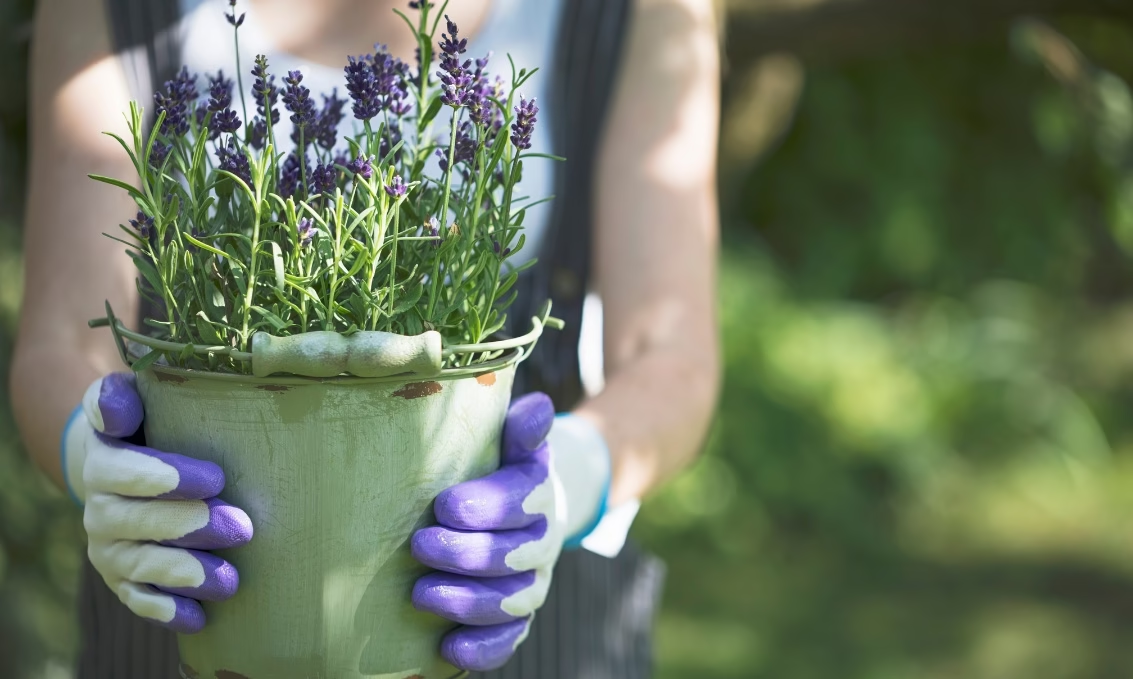
Lavender roots deeply, so it needs a deep container holding at least 10 litres, around 30–40 cm across, with large drainage holes and a layer of coarse gravel in the base. Fill it with peat-free multipurpose or loam-based compost, such as John Innes No 2, mixed with up to 25% coarse grit by volume, or with ready-made lavender compost. Low-growing cultivars of English lavender and French lavender are the best choices for pots.
Stand the pot in full sun, ideally facing south or west, where the air moves freely. Containers dry out faster than garden soil, so in hot weather water once or twice a week when the compost starts to dry, and empty any water that collects in the saucer.
Lavender in a pot needs more warmth than lavender in the ground and has to be protected over winter. Containers left outside should be kept fairly dry and sheltered, at the foot of a wall, in a cold frame or in a greenhouse, because wet compost encourages root rot. English lavender can spend the winter on a balcony: after a final watering in early October, stand the pot out of the wind on a thick layer of cardboard or polystyrene and wrap the pot and plant in a straw mat or thick horticultural fleece. Take the wrapping off in early April and water the plant then. The alternative is to bring the pot into a bright, cool room at 5–10°C in October and keep the compost moderately moist. Plants that spent the winter indoors need hardening off for 10–14 days from late April or early May, starting with three hours outside a day and gradually extending the time, before they go out for good once the risk of frost has passed.
How do you propagate lavender?
The simplest ways to propagate lavender are cuttings and layering. Cuttings give new plants faster than seed, and the plants are identical to the parent. Take softwood cuttings in early to midsummer, semi-ripe cuttings in midsummer or hardwood cuttings after flowering in late autumn, choosing healthy shoots without flowers. Cut below a leaf joint, strip the lowest three or four leaves, dip the end in rooting hormone and insert the cutting into light, free-draining compost kept moist and warm. Roots form in about 30–40 days.
For layering, bend a long, flexible stem down into a trench about 10 cm deep in spring, strip the leaves from the section that will be buried, cover it with soil and pin it down with wire. Once it has rooted, cut it from the parent plant and replant it.
Seed is the slowest method. Lavender seed needs a cold period: sown outdoors in autumn it gets one naturally, while for spring sowing it is mixed with sand and kept in the fridge for two to three weeks first. Prick out the seedlings once they have a few leaves and plant them out in May. Plants raised from seed usually flower in their second season and may not resemble the parent.
When should you harvest and dry lavender?
Cut lavender for drying when the whole spike has coloured but only the first one or two flowers have opened. Fully open flowers dry brown and can drop off the stem, while stems cut too early tend to wilt, although hanging them upside down to dry can save them. Harvest in the morning once the dew has dried, tie the stems in bunches and hang them in a dark, dust-free place. Dried flowers in a linen bag will scent a bedroom or living room, and a drop of lavender oil refreshes them once the smell fades.
Why is my lavender dying?
Root rot is the most common reason lavender dies, caused by watering too often or by soil that stays waterlogged. A plant short of sun also starts to dry out. In a pot the problem can be the reverse: a small volume of compost dries quickly, so lavender in a container needs watering a little more often than lavender in the ground.
Lavender that looks dry after winter is not necessarily dead. Wait until spring, check whether the stems are alive and cut out the dead parts, and if the plant is shooting from the base, give it time to recover. Pests rarely do serious harm: rosemary beetle, sage and Ligurian leafhoppers and cuckoo spit cause mostly cosmetic damage that seldom needs treatment. Lavender is, however, one of the high-risk host plants for Xylella fastidiosa, a bacterial disease, so take care when buying imported plants.
How do you use lavender in garden design?
Lavender suits sunny borders, rock gardens, banks and the edges of paths, and it can be clipped into a low hedge. The best companions are plants with similar needs that do not need frequent watering and will not shade it: roses, calendula and herbs such as thyme, savory, hyssop and yarrow, as well as Salvia nemorosa, daylilies and sedums. Planted in front of a rose, lavender hides the bare lower part of the shrub. Its flowers attract bees, bumblebees and butterflies, and late in the season a few seed heads can be left on the plant for goldfinches.
How to grow lavender – frequently asked questions
Does lavender do better in pots or in the ground?
Hardy English lavender and lavandin do best in the ground in free-draining soil, where they can stay out all year and seldom need watering once established. Pots are the better choice for French lavender and other tender types, which have to move somewhere frost-free for winter, and for gardens with heavy, wet soil where lavender would rot.
How long does a lavender plant live?
Lavender can grow in one place for many years, but it gradually turns woody in the centre and flowers less. After five or six years it usually loses its shape and needs a hard cut or replacing, and cuttings taken from young shoots beforehand provide new plants.
Where does lavender come from?
Wild lavender grows from the Canary Islands and Madeira across the Mediterranean and North Africa to the Arabian Peninsula and India, mostly on dry, sunny hillsides. The name most likely comes from the Latin lavare, ‘to wash’.
What is lavender used for?
Lavender oil is distilled with steam from the flowering tops of English lavender and is used in soaps, shampoos and bath products. The European Medicines Agency (EMA) lists the flower and the oil as traditional herbal medicines for the relief of mild symptoms of mental stress and exhaustion and to aid sleep, an assessment based on long-standing use because clinical trial evidence is insufficient. The EMA does not recommend them for children under 12 or during pregnancy and breastfeeding.
Is lavender poisonous to dogs and cats?
The American Society for the Prevention of Cruelty to Animals (ASPCA), which runs an animal poison control centre, lists English lavender as toxic to dogs, cats and horses because of linalool and linalyl acetate. Signs include nausea and loss of appetite, and in dogs and cats also vomiting. If you suspect a pet has eaten the plant, contact a vet.
Whether lavender takes depends largely on where it is planted: full sun, free-draining soil and a spot where water never collects. When a garden, terrace or balcony is being laid out from scratch with plants like this in mind, those conditions are easiest to build in at the start. Find architects, interior designers and interior photographers in the PLNDesign directory.
See also:
- How to grow pelargoniums: planting, care and overwintering
- Plants poisonous to cats: lilies, houseplants and garden plants to avoid