

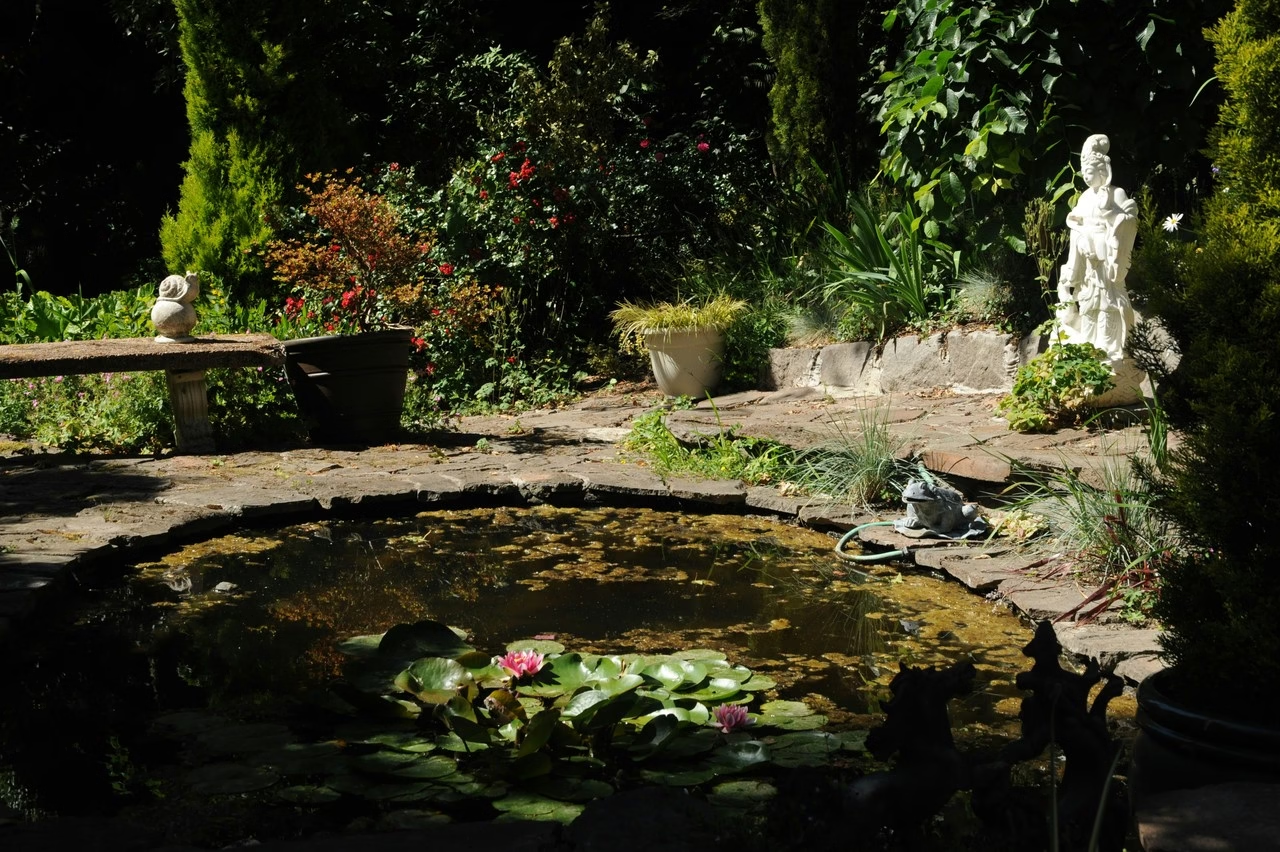
Pond plants are chosen by zone: marginal plants for the wet edge and shallow shelves, water lilies for the deepest water, oxygenators below the surface and floating plants on top. Together they add oxygen, shade the water and give wildlife shelter, and the aim is to have about half of the surface covered by leaves. Several once-popular species, including water hyacinth and parrot’s feather, can no longer be sold in Great Britain or anywhere in the European Union.
Pond plants at a glance:
- Planting by depth: marginals grow on the wet edge and on shelves up to about 30 cm deep, while water lilies need 30–120 cm of water, depending on the size of the variety.
- Clear water: oxygenators, floating plants and marginals work best together, with leaves covering about half of the surface.
- Planting in baskets: most pond plants go into lined aquatic baskets of heavy, fertiliser-free soil topped with gravel, ideally between mid-spring and early summer.
- Plants to avoid: water hyacinth, giant salvinia and parrot’s feather may not be kept or sold in Great Britain, and in England and Wales it is an offence to plant water lettuce or any Elodea, Canadian pondweed included, in the wild.
Which pond plants go in each zone?
Each part of a pond suits a different group of plants, and each plant has a water depth at which it grows best, so the depth given on the label is the first thing to check before buying. The basic division looks like this:
| Zone | Water depth | Example plants |
|---|---|---|
| Pond edge (bog zone) | wet mud or up to about 10 cm of water | marsh marigold, water forget-me-not, bog arum, purple loosestrife, water mint |
| Shallow water | up to about 30 cm | yellow flag iris, sweet flag, arrowhead, miniature reedmace |
| Deep water | 30–120 cm, depending on the variety | water lilies, yellow water lily |
| Submerged | below the surface, free-floating or in baskets | hornwort, spiked water-milfoil, water violet, mare’s tail, pondweeds |
| Surface | floating on the water | frogbit, water soldier |
The pond edge has soil that stays wet and is either exposed or covered by a thin layer of water. Marsh marigold (Caltha palustris) is the classic plant here: its large golden flowers open as early as March and give bees and hoverflies early pollen. Water forget-me-not (Myosotis scorpioides) follows with sky-blue flowers from May, and newts lay their eggs on its leaves. Water mint (Mentha aquatica) flowers from July to October and draws butterflies such as the small tortoiseshell, peacock and comma.

Shallow water suits upright marginals with strong rhizomes. Yellow flag iris (Iris pseudacorus) has yellow flowers and can reach about 1.5 metres, so it may need support, and emerging froglets shelter among its rhizomes. In a small pond, however, it can become too invasive. Arrowhead is named after its arrow-shaped leaves. Buy the native Sagittaria sagittifolia, not duck potato (Sagittaria latifolia), which is listed on Schedule 9 of the Wildlife and Countryside Act in England and Wales. Reedmace needs the same care. Typha angustifolia grows to 1.2 metres and can become too invasive for a small pool, while miniature reedmace (Typha minima) stays at 30–45 cm.
The deepest part of the pond belongs to water lilies (Nymphaea). They need full sun to flower well, with at least six hours a day for most varieties, and calm water away from fountains, pumps and cascades. Planting depth depends on vigour: dwarf varieties need 30–45 cm of water, medium ones 45–75 cm and large ones 75–120 cm, and the largest can spread to 2.4 metres. The native white water lily (Nymphaea alba) can be too vigorous for smaller ponds. The native yellow water lily (Nuphar lutea) has leathery leaves up to 40 cm across and scented yellow flowers from early summer to early autumn. It grows in full sun or partial shade but can become a nuisance if it is not kept in check, which makes it a plant for large ponds.
Floating plants are not planted at all. They sit on the surface without being rooted in soil, and one plant per square metre is enough to start with. Frogbit (Hydrocharis morsus-ranae) has small white flowers and rounded leaves under which tadpoles, fish and dragonfly larvae hide. Water soldier (Stratiotes aloides) forms a rosette of spiky, aloe-like leaves that floats just below the surface in summer. Both sink to the bottom for the winter, and water soldier can become a nuisance in a small pool.
Which plants keep pond water clear?
Clear water comes from a mix of plant types rather than from a single species. Submerged oxygenators add oxygen, floating leaves shade the surface and keep the water cooler, which discourages algae, and marginals add cover at the edges. Aim to have about half of the surface covered by leaves: a pond overgrown from edge to edge lets too little light reach the bottom, while one with open water everywhere warms up in the sun.
Hornwort (Ceratophyllum demersum) is the easiest oxygenator to start with. It needs no soil, floats freely and copes with deep water, it suits small ponds, and fish use its leaves for spawning. It also makes a good alternative to the invasive Canadian pondweed. Spiked water-milfoil (Myriophyllum spicatum) carries small reddish flowers in June and July, and dragonflies and damselflies lay their eggs on its stems. Water violet (Hottonia palustris), a member of the primrose family, has lilac flowers and should not be moved or planted in summer. Plant four to five bunches of three to four stems per square metre. Too many oxygenators can use up the oxygen at night in summer and kill fish.
Keeping the water clear also means removing whatever decays. Take off yellowing water lily leaves and faded flowers before they sink, because rotting leaves feed algae and use up oxygen, and thin out oxygenators and floating plants when they start to cover more than half of the surface. Duckweed is not worth introducing, as it grows fast in warm weather and can cover a whole pond. Garden soil used for planting should be free of fertiliser and herbicide, and a pond with a thriving fish population will usually need a filter as well as plants.
Which native pond plants are best for wildlife?
For a wildlife pond, native plants are the safest choice, although native, non-native and cultivated plants can all become invasive. Most of the plants described above are native to Britain, including hornwort, spiked water-milfoil, water violet, frogbit, marsh marigold, water forget-me-not, water mint, yellow flag iris and yellow water lily. Plants at the edge also give frogs, newts and insects shelter and a way in and out of the water.
Other native species extend the flowering season. Common water-crowfoot (Ranunculus aquatilis) forms floating mats of white, buttercup-like flowers with yellow centres that feed bees and butterflies. Bogbean (Menyanthes trifoliata) has starry white flowers in spring and spreads into floating mats where dragonflies lay their eggs. Brooklime (Veronica beccabunga) flowers blue from May to September, stays in leaf all year and is easy to keep in check, which makes it useful in small ponds, as does lesser spearwort (Ranunculus flammula).
Which pond plants should you avoid?
Invasive non-native plants should never go into a garden pond. Once they reach rivers, lakes and ditches they spread fast, crowd out native species and upset the balance of the water, and even tiny fragments can cause problems.
In Great Britain the worst of them are listed as species of special concern, which may not be imported, kept, transported, sold or grown. The aquatic plants on the list include water hyacinth (Eichhornia crassipes), giant salvinia (Salvinia molesta), parrot’s feather (Myriophyllum aquaticum), broadleaf water-milfoil (Myriophyllum heterophyllum), floating pennywort (Hydrocotyle ranunculoides), water primrose (Ludwigia grandiflora), floating primrose-willow (Ludwigia peploides), curly waterweed (Lagarosiphon major), Nuttall’s waterweed (Elodea nuttallii) and fanwort (Cabomba caroliniana). When buying water-milfoil, check the Latin name on the label: the native spiked water-milfoil is fine, the two listed species are not. Breaking these rules can lead to fines and, for the most serious offences, up to two years in prison.
England also bans the sale of water fern (Azolla filiculoides) and Australian swamp stonecrop (Crassula helmsii), a ban in force since 6 April 2014. In England and Wales, Schedule 9 of the Wildlife and Countryside Act 1981 makes it an offence to plant, or otherwise cause to grow in the wild, a list of species that includes water lettuce (Pistia stratiotes), water fern, Australian swamp stonecrop and all species of Elodea, Canadian pondweed among them. Water lettuce is not on the British list of species of special concern, but no part of it should reach a stream, ditch or natural pond. Across the European Union, water hyacinth, water lettuce and giant salvinia are on the list of invasive alien species of Union concern, so they cannot be kept, sold or brought into the EU, with the restrictions on water lettuce in force since 2 August 2024.
Never dig plants out of the wild, as it can be illegal and may harm the environment. Buy from a nursery instead and wash each new plant in a bucket before it goes into the pond to rinse off seeds and stray plant fragments. It is worth keeping new plants apart for a few weeks first, as Australian swamp stonecrop often arrives as a contaminant on new plants, and making sure nothing can escape from the pond into the wild, for example via a nearby stream.
How do you plant pond plants?
Most pond plants go into aquatic baskets set at the right depth on a shelf or on the pond floor. The lattice sides let water and air reach the roots, and a basket can be lifted out whenever the plant needs dividing or moving. Planting takes five steps:
- Line the basket with hessian or polypropylene fabric, unless the mesh is very fine, so the soil does not wash out.
- Fill it with a medium to heavy loam. Garden soil works if it is free of fertiliser and herbicide; otherwise use a peat-free aquatic compost.
- Plant at the same depth as in the original pot, with any rhizomes sitting just above the soil surface.
- Cover the soil with a thin layer of grit or fine gravel so fish cannot stir it up.
- Lower the basket into the water slowly. Stand deep-water plants on bricks at first and lower them in stages as the leaves reach the surface, until the basket sits at its final depth. A newly planted water lily should start with 15–25 cm of water above its crown.
Oxygenators go into baskets as bunches and need to be anchored firmly, while hornwort can be dropped straight into the water. Floating plants are placed gently on the surface after any clumps have been separated.
The best time to plant is from mid-spring to early summer, and water lilies can go in from late spring to late summer. Tender plants that have spent the winter indoors return to the pond only once the risk of frost has passed in late spring.

What are the best plants for a small pond?
A small pond needs compact plants that are easy to control. Good choices include a dwarf water lily such as Nymphaea ‘Pygmaea Helvola’, golden club (Orontium aquaticum), lesser spearwort, the arum lily Zantedeschia aethiopica (the form ‘Crowborough’ is the hardiest) and water forget-me-not. Other small water lilies include Nymphaea tetragona and Nymphaea ‘Pygmaea Rubra’. A dwarf water lily can grow even in a large container, as long as the water is at least 30 cm deep, and in a small pool marginals are best planted separately, in 15 cm containers.
Some common pond plants can become too invasive for a small pond: yellow flag iris, Typha angustifolia, variegated reed sweet-grass (Glyceria maxima var. variegata), water plantain (Alisma plantago-aquatica), Houttuynia cordata and the variegated sweet flag Acorus calamus ‘Argenteostriatus’. Water soldier and some pondweeds can become a nuisance as well, and so can the native white water lily. A simple scheme works best in a small pond: one main plant, such as a dwarf water lily, one or two marginals, one oxygenator and one floating plant, with floating leaves kept well short of covering the whole surface.
Which pond plants suit sun, shade and fish?
Most flowering pond plants need sun. Water lilies need full sun to flower well, so a pond that sits in shade for much of the day is a poor place for them. Yellow water lily copes with partial shade, and hornwort grows in sun or partial shade. Many large-leaved bog plants around the pond also tolerate some shade.
Fish disturb pond plants, so in a fish pond everything should sit firmly in baskets topped with gravel. Koi are the hardest on plants: browsing along the bottom, they uproot plants in the deeper areas. A barrier of sturdy rocks at the front of marginal shelves helps, and water lilies in deeper water can be grown in koi-resistant containers, under sinking net protectors or on floating plant islands. Their leaves then give the fish shade on sunny days.
What should you plant around a pond?
Around the pond, plants for damp soil carry the planting beyond the water. A bog garden suits ground that is always damp but not permanently waterlogged; where water stands for long periods, marginals are the better choice. Native meadowsweet (Filipendula ulmaria) and purple loosestrife (Lythrum salicaria) do well here, along with Siberian iris, hostas, primulas such as Primula florindae and Primula japonica, the umbrella plant (Darmera peltata), rodgersias, ferns such as the royal fern and the ostrich fern, and sedges and rushes.
Globeflower (Trollius europaeus) flowers later than marsh marigold and extends the season at the damp edge. Spring is the best time to plant bog plants, which do well in soil rich in organic matter.
How do you prepare pond plants for winter?
In autumn, remove fading leaves and stems as the plants die back, cut off the fading foliage of water lilies and stretch a net over the pond to catch falling leaves. Leave whatever you take out on the side of the pond for 48 hours, so that pond creatures can return to the water, before composting it. Marginal plants that are still standing can wait: cutting them back in late winter leaves shelter for invertebrates.
Hardy water lilies need no winter protection. Frogbit and water soldier sink to the bottom for the winter, and most hornwort drops down too and survives as dormant buds. Tender plants should be lifted and kept somewhere frost-free, such as a conservatory or greenhouse, in containers of deep mud, damp sand or water until late spring. Tropical water lilies need water of at least 10°C over winter, or their tubers can be stored in damp sand at the same minimum temperature.

Pond plants – frequently asked questions
What are the best plants to put in a pond?
The best mix combines all four groups: a water lily for the deep water, a few marginals for the edge, oxygenators below the surface and one or two floating plants. For a wildlife pond, native species such as hornwort, water forget-me-not, marsh marigold and frogbit are a reliable start.
What are some good all-year-round pond plants?
Brooklime stays in leaf all year. For colour through the seasons, combine plants that flower at different times: marsh marigold in March, water forget-me-not in May, spiked water-milfoil in June and July and water mint from July to October.
Do water lilies help keep a pond clean?
Yes, mainly by shading the water. Their floating leaves cut the amount of sunlight reaching the water and keep it cooler, which discourages algae, as long as yellowing leaves are removed before they sink and rot.
Do you still need a filter in a planted pond?
If the pond holds fish, most likely yes. A thriving fish population usually needs a filter as well as plants.
What should you do with excess pond plants?
Leave removed plants on the edge of the pond for a while so that small creatures can return to the water, then compost them or use them as a mulch in dry borders away from ponds, streams and drains. Pour waste pond water onto the lawn, not into a watercourse. Nothing from a garden pond should end up in the wild, and dumping listed invasive plants there can be an offence.
Zone layout, plant choice and the position of a pond in relation to the sun decide how much work it will need in the seasons that follow, so a new pond is worth planning with a specialist. Find architects, interior designers and interior photographers in the PLNDesign directory.
See also:
- How to grow lavender: planting, pruning and winter care
- Orchid care: how to water, feed and rebloom a moth orchid