

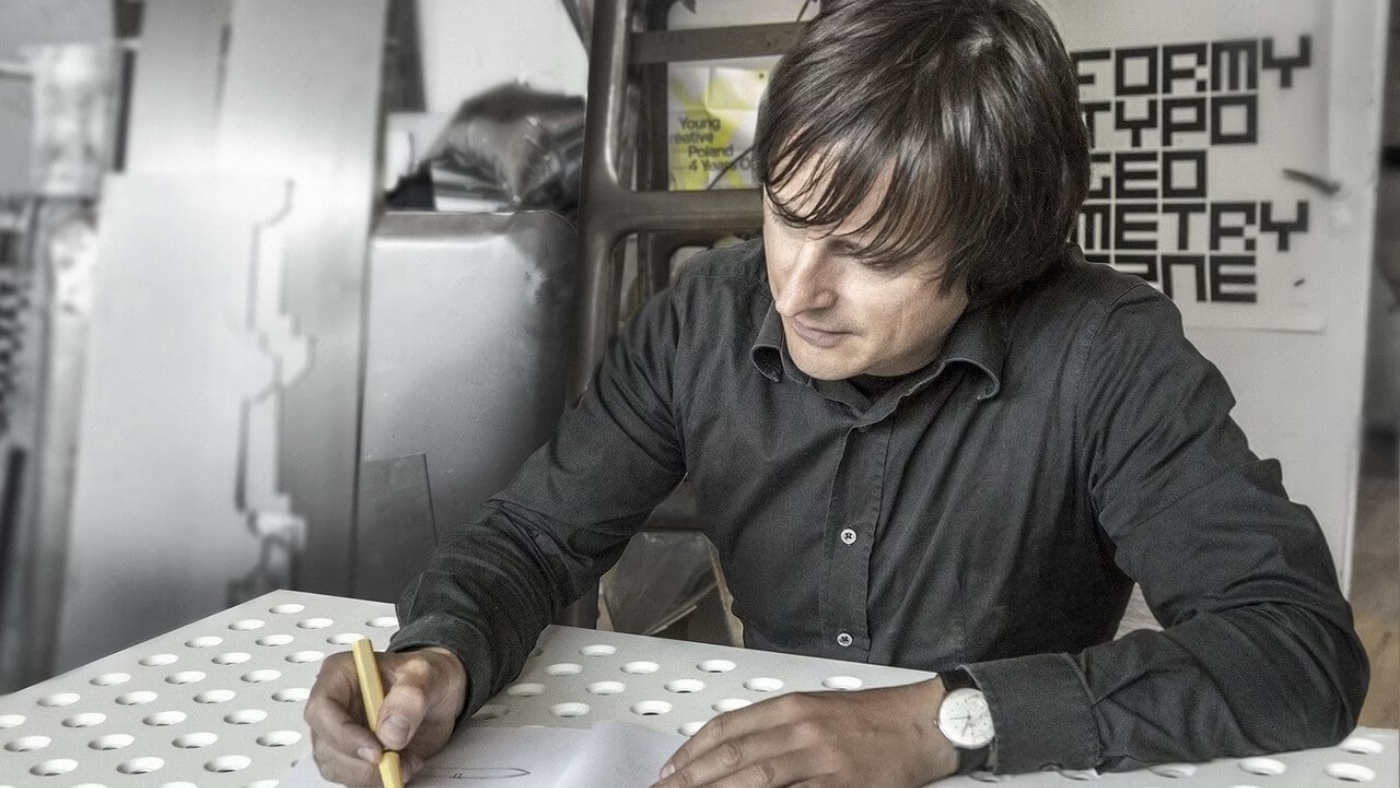
Oskar Zięta is a Polish architect, designer and artist who shapes steel by inflating it. At ETH Zurich he developed FiDU, a method that turns two welded sheets of metal into a three-dimensional form with internal pressure, and he has used it for the PLOPP stool, chairs, mirrors and public sculptures. He runs Zieta Studio in Wrocław.
Oskar Zięta at a glance:
- Born in Zielona Góra in 1975, he studied architecture in Szczecin and completed a doctorate at ETH Zurich.
- FiDU, developed in 2004, welds two flat steel sheets along their edges and inflates them, so no two pieces deform in exactly the same way.
- The PLOPP stool, in serial production since 2008, is in the collection of the Centre Pompidou in Paris.
- Zieta Studio, registered in Wrocław in 2010, makes furniture, mirrors and large works such as the NAWA sculpture on Daliowa Island.
Who is Oskar Zięta?
Oskar Zięta is an architect by training who describes himself as an architect, process designer and artist. He was born in Zielona Góra, in western Poland, in 1975, and as a child spent hours in his grandfather’s blacksmith’s workshop, watching metal being forged. As a teenager he ran middle distances and competed in modern pentathlon, and he seriously considered a sports university until an injury ended that plan. Architecture came second, he says, because he could draw well. He graduated from the architecture faculty of Szczecin University of Technology in 2000.
A two-year scholarship then took him to ETH Zurich. From 2003 he worked there as a research and teaching assistant in the Computer Aided Architectural Design (CAAD) chair, studying how thin steel sheets could be made stable enough to serve as structural elements. He wrote his doctoral thesis under Professor Ludger Hovestadt and taught at ETH until 2017. He has also taught at School of Form, the design school of SWPS University.

How does the FiDU technology work?
FiDU stands for Freie Innendruck Umformung, German for free inner pressure forming. Zięta developed the method at ETH in 2004. Two laser-cut steel sheets are welded together along their edges and inflated, and the flat outline finds its three-dimensional shape on its own. The first prototype was filled with water through a vent; later pieces are blown up with compressed air. Because sheet metal never buckles in exactly the same way, objects made in series still differ slightly from one another.
The starting point was something engineers treat as a fault. The German standard DIN 8580 describes waviness of the material during forming as a production error, and Zięta set out to make a product from it. He calls his way of working ‘controlled loss of control’. Inflated thin steel also proved far stronger than expected. Zięta was told the PLOPP stool would bear 60 kilograms at most; it carries 2.5 tonnes. In 2012 he tested a FiDU footbridge in Zurich, made from 1-millimetre sheet metal. It spanned six metres and weighed 174 kilograms. The engineers expected it to carry 500 kilograms, and in a stress test it held 1,850.
Beyond furniture, the technology has potential uses in architecture, transport and energy. ‘Metals are a rewarding material, but of course they also demand a great deal of professionalism. It takes many years of continuous work in this material, improving the quality of detail, skill and craft,’ Zięta says.

What is the PLOPP stool?
PLOPP is the inflated steel stool with which Zięta entered the furniture market. Its name is a Polish acronym for Polski Ludowy Obiekt Pompowany Powietrzem, roughly ‘Polish folk object pumped with air’, and its form draws on the traditional Polish folk stool. Zięta made the first version in 2005. It originally had four legs, but it wobbled, so the stool now stands on three.
PLOPP made its debut at SaloneSatellite in Milan in 2007, after a stand became free at the last minute. Several hundred orders followed the fair. Zięta bought his first machines in Switzerland, his father rented a production hall, and in 2008 serial production began in Zielona Góra. The same year PLOPP received a Red Dot Design Award.
A standard stainless-steel PLOPP weighs six kilograms. Uninflated, 200 stools fit into a package 20 centimetres high, and because each stool is made of a single material it can be recycled. The Centre Pompidou in Paris holds PLOPP in its collection as one of 12 chairs that changed contemporary design, and the stool is also in the Vitra Design Museum and in the Gallery of Polish Design at the National Museum in Warsaw.

Which furniture and mirrors has Oskar Zięta designed?
Chippensteel, a limited-series chair from 2008, followed PLOPP. Its name and outline refer to the Chippendale chair, a model fashionable in the third quarter of the 18th century and named after the English cabinetmaker Thomas Chippendale. The chair starts as a flat shape cut from sheet metal, which is welded and inflated into three dimensions. The perforated, puffed-up steel of the back imitates irregularly gathered upholstery, and every chair ends up with its own folds and creases.
Ultraleggera applies the same thinking to aluminium. The thin-walled chair weighs 1,660 grams, and in load tests the studio took it to 1,200 kilograms. It won the Materialica Design + Technology Award in 2020 and a Red Dot award in 2021.
Mirrors form the other large family. Tafla mirrors are made of stainless steel polished to a high gloss rather than of glass. The Tafla O series takes organic outlines based on drops of liquid, while other models are geometric, and because every convexity on the surface comes out differently, each mirror bends its reflection in its own way. The round Rondo mirror, launched in 2012, comes in diameters of 75 to 150 centimetres. Today’s collection also covers lighting, tables, consoles, storage, wall pieces and accessories, in polished or lacquered steel, copper and aluminium.

Which large-scale works has Oskar Zięta made?
Blow & Roll (2010) brought FiDU to the scale of a garden. Commissioned by the London Design Festival and supported by the Polish Cultural Institute, the installation set steel profiles of different lengths, up to 20 metres, into the pond of the John Madejski Garden at the Victoria and Albert Museum. The elements travelled to London flat, packed in wooden boxes, and were rolled out into the pond and inflated with water on site. Blow & Roll used the world’s first rolled steel profile. Individual profiles were also shown at the Phillips de Pury space at the Saatchi Gallery, where visitors could inflate them with a bicycle pump.

NAWA (‘nave’) stands on Daliowa Island, the smallest of the islands in central Wrocław. Unveiled in June 2017, it was part of Wrocław’s European Capital of Culture 2016 programme and of a plan to turn the neglected island into a public space for meetings and concerts. The sculpture is a passage of 35 bionic arches in mirror-polished stainless steel, the tallest more than seven metres high and the lowest more than three. Their outline follows the shape of the island and echoes the historic buildings of nearby Ostrów Tumski, while the polished steel reflects the river, the Ossolineum and the University of Wrocław. The arches were fabricated in a shipyard in north-east Wrocław and brought to the island by water. Architektura-Murator named NAWA the most innovative Polish architectural project of 2017, and the work was nominated for the 2019 EU Mies van der Rohe Award.
In Warsaw, WIR (‘whirl’, 2017) stands at the centre of the Galeria Północna shopping centre. Its five wavy steel profiles wind around a central form like streams of water.
What has Oskar Zięta made recently?
Since 2018 Zięta has been developing Crystals, tall forms in mirror-polished steel that reflect and frame their surroundings. Urban Crystals stood in the garden of the Royal Palace in Wrocław during a City Museum of Wrocław exhibition in 2020 and was later shown in Times Square in New York and at Art Dubai. In 2024 Zięta returned to the London Design Festival with Through Process to Progress, and in 2025 he made a walk-in Crystals Pavilion for the Copernicus Science Centre in Warsaw, to accompany the exhibition Mirrors. Between Illusion and Reality.
His home town has a public work too. Generations (Generacje) was unveiled in September 2023 in Park Tysiąclecia in Zielona Góra, during the city’s Winobranie wine festival; the steel sculpture translates into three dimensions a relief by Marian Szpakowski on the facade of the BWA gallery building. In October 2024 a helicopter carried Hempel from the studio to the Apartamenty przy Parku Szczytnickim development in Wrocław. The mirror-polished sculpture is a homage to the Spire (Iglica), the 106-metre steel needle designed by Stanisław Hempel in 1948, and reworks its structural vocabulary. In 2025 the Henryk Tomaszewski Theatre Museum in Wrocław showed Interferences, a kinetic exhibition of steel objects about form, sound and metal.
What is Zieta Studio?
Zieta Studio is the brand of Zieta Prozessdesign, the company Zięta registered in Wrocław in 2010. The original name reflects his approach, which he sums up as ‘the final form follows the process of production’. The studio and its experimental workshop are in Wrocław, and the production line is in Zielona Góra. The team, made up of architects, designers, engineers and technologists, works with robots, machines and lasers, and scans finished pieces to compare them with their digital models.
Zięta’s awards include a Red Dot Design Award and the Schweizer Design Preis (both 2008), a German Design Council award and the Forum AID Award (2009), the Audi Mentor Prize (2011), the Materialica Design + Technology Award (2020) and a second Red Dot (2021).

Where can you see Oskar Zięta’s work?
His public sculptures stand in Polish cities, and his furniture and objects are in the collections of design and art museums in Europe and the United States.
| Work | What it is | Where | Year |
|---|---|---|---|
| NAWA | 35 mirror-polished steel arches | Daliowa Island, Wrocław | 2017 |
| WIR | five intertwined steel profiles | Galeria Północna, Warsaw | 2017 |
| Generations (Generacje) | mirror-steel sculpture | Park Tysiąclecia, Zielona Góra | 2023 |
| Hempel | steel sculpture referencing the Wrocław Spire | grounds of Apartamenty przy Parku Szczytnickim, aleja Ludomira Różyckiego 1C, Wrocław | 2024 |
| Museum collection | City | Since |
|---|---|---|
| Badisches Landesmuseum | Karlsruhe | 2010 |
| Victoria and Albert Museum | London | 2010 |
| Centre Pompidou | Paris | 2011 |
| Pinakothek der Moderne | Munich | 2011 |
| Museum für Gestaltung | Zurich | 2013 |
| Denver Art Museum | Denver | 2015 |
| Vitra Design Museum | Weil am Rhein | 2016 |
| Museum of Copper | Legnica | 2016 |
| National Museum in Warsaw | Warsaw | 2017 |
| National Museum in Kraków | Kraków | 2018 |
| City Museum of Wrocław | Wrocław | 2020 |
A place in a collection does not mean a piece is on permanent display. In Warsaw, PLOPP belongs to the Gallery of Polish Design at the National Museum.
Oskar Zięta – frequently asked questions
What does PLOPP stand for?
PLOPP is an acronym of the Polish words Polski Ludowy Obiekt Pompowany Powietrzem, roughly ‘Polish folk object pumped with air’.
How much weight can a PLOPP stool hold?
A standard steel PLOPP weighs six kilograms and carries a load of 2.5 tonnes.
Where is Zieta Studio based?
In Wrocław, where the studio and its experimental workshop are. Production runs in Zielona Góra.
Is Oskar Zięta an architect?
Yes. He graduated in architecture from Szczecin University of Technology in 2000 and describes himself as an architect, process designer and artist.
A steel stool or a large polished mirror is easier to place well when someone plans the whole room around it. Find architects, interior designers and interior photographers in the PLNDesign directory.
See also:
- Karim Rashid: life, design style and most famous works
- Philippe Starck: designer of the Louis Ghost chair and Juicy Salif