

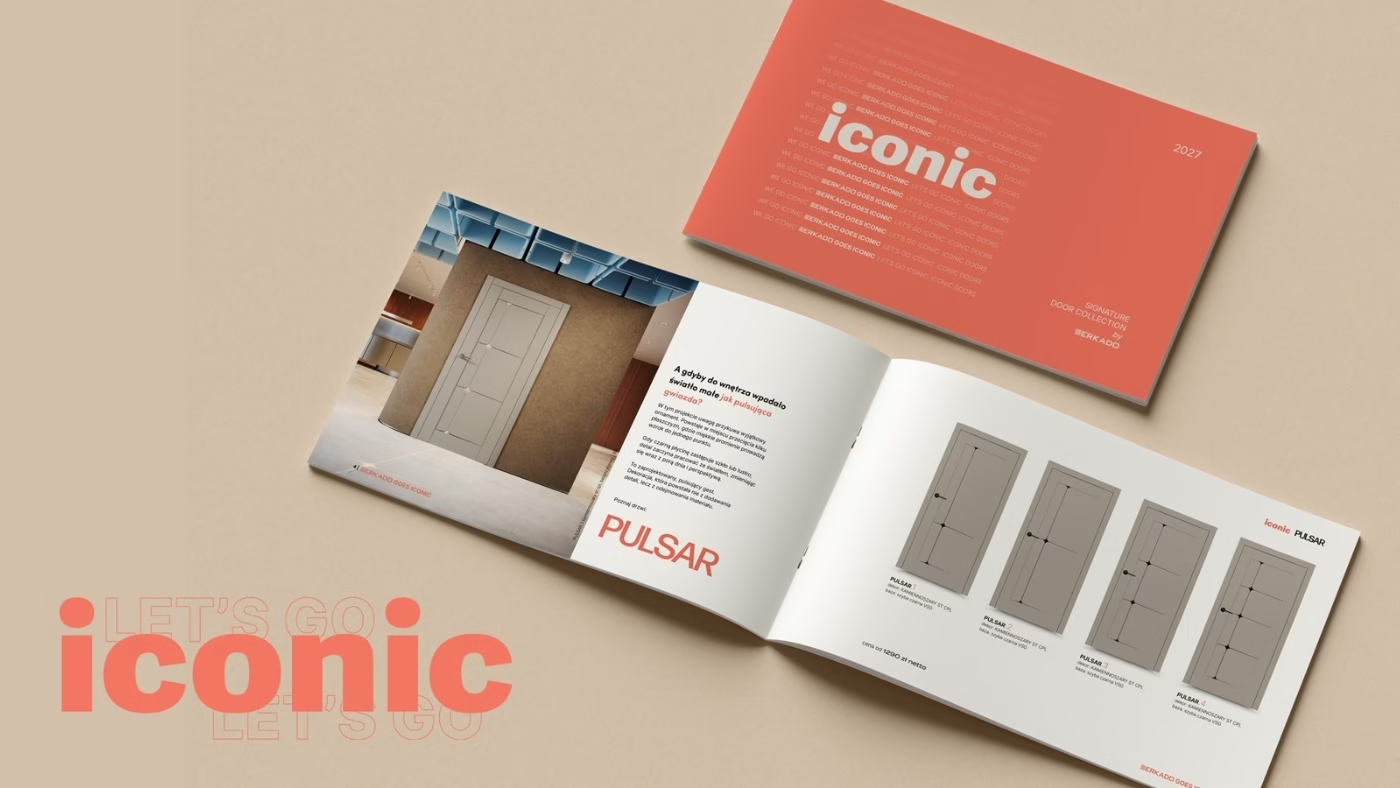
“We have designed doors that we want to be copied. Because that is how icons are born.” ERKADO opens the catalogue for its new internal door collection with these words. ICONIC grew out of the belief that doors can be designed with the same ambition as furniture, lighting or architecture. The brand describes the collection as its manifesto.
Form follows construction
The starting point was the observation that doors remain part of an interior for years. They should therefore contribute to the space without competing with it or dominating it. The collection moves away from passing trends and showy effects in favour of enduring qualities: form and proportion.
The entire collection follows the modernist principle that form arises from construction. Its designers focused on three concepts that have informed design for centuries: rhythm, proportion and coherence. In practice, ornament on ICONIC doors is rarely an added element. It emerges from removing material, spacing panels apart, introducing a precise gap or rounding an edge. Light plays a central role, defining contours, giving depth and changing the doors’ appearance throughout the day.
Each model has a keyword: Pulsar is associated with ornament, Kumiko with rhythm, Slit with shadow and Blur with interpenetration. Navat stands for division, Flask for a point, Grid for depth and Aura for a frame. The collection also encourages a playful approach: the catalogue’s introduction ends by inviting readers to discover which doors best suit them, “not necessarily your interior”.
Three interior architects represent the collection
Three interior architects are the faces of ICONIC. All have many years of design experience and are involved in education. They also share the belief that a well-designed detail can improve quality of life.
Monika Staniec has designed interiors for 17 years, always putting people at the centre of her work. A graduate of the Eugeniusz Geppert Academy of Art and Design in Wrocław, she combines an understanding of emotions with knowledge of neuroarchitecture and treats design as a means of improving quality of life. She founded Let’s Archi!, a platform that connects architects with businesses. As an educator and speaker, she initiates industry projects and encourages dialogue between designers and manufacturers.

Monika Sałata is from Szczecin and has a particular affection for the character of city-centre apartment buildings. More recently, she has developed ties with Kraków’s artistic community. She graduated from Wyższa Szkoła Sztuki Użytkowej in Szczecin (a higher education institution specialising in applied arts) and the School of Art and Design in Łódź. She runs her own studio and is a guest lecturer in interior design at WSH TWP in Szczecin (a higher education institution specialising in the humanities). Her signature work is commercial interiors that combine ergonomics with a strong visual identity and support the growth of brands.

Aleksandra Lepka holds a doctorate in art, lectures at the Eugeniusz Geppert Academy of Art and Design in Wrocław and has three design patents to her name. Her work combines design practice and research. She has received scholarships from Poland’s Minister of Culture and National Heritage on several occasions and is a member of PRO Stowarzyszenie Architektów Wnętrz (an association of interior architects). She has run ALL DESIGN INSIDE since 2010. Her portfolio encompasses several hundred completed projects, including hotels, banqueting halls, office buildings, spas, restaurants and shops.

Seven models and a family of door-frame additions
The collection comprises seven door models, each in four variants, alongside the Aura family of additions to the door frame. ICONIC doors are available in scratch- and fingerprint-resistant ST CPL laminate in eight super-matt colours. Some models also come in CPL laminates and wood-effect PREMIUM finishes. Rebated, non-rebated and reverse-rebated versions are offered in the standard height or a 2,112-millimetre height format. Intermediate widths are available at no extra cost, making installation in older buildings easier without cutting into walls.
BLUR connects rooms by filtering light and views through glazing with rounded edges. The design references Streamline Moderne and the interiors of historic ocean liners. Five types of glass offer different levels of privacy.

PULSAR expresses the collection’s idea most fully: its ornament is formed by removing material rather than adding it. Replacing the black panel with glass or a mirror allows the detail to interact with light. It changes throughout the day, like the flashing star that gives the model its name.

KUMIKO was inspired by furniture fronts that seem to have no right angles despite their rectangular construction. Rounded panels of different sizes establish a quiet vertical rhythm. A black backing emphasises this rhythm, while a backing in the same colour as the door leaf turns it into a subtle relief.

The panels of SLIT are separated by just five millimetres. This narrow black gap outlines the door and responds to the return of wall panelling and slatted finishes in interiors. The model looks best in wood-effect finishes.

NAVAT draws on the work of Carlo Scarpa, a master of combining materials. Four spaced-apart sections and black routed grooves lead the eye towards an inlay that unifies the composition. The effect is both minimalist and graphic.

Two small circles give FLASK its character. Circular inlays mark the centre of the composition and look the same across every variant. This allows different versions of FLASK to be used in successive rooms while retaining a consistent design.

GRID has a flat door leaf that appears three-dimensional. Rounded frames and a recessed black gap form a shadow line revealed by the light. It is a new interpretation of the classic panelled door, traditional in wood finishes and strongly architectural in colour.

Aura changes the door surround
Aura is an addition to the frame, rather than a door leaf. It consists of three profiles designed to fit a standard ERKADO frame. These change the appearance of the entire doorway without replacing the door itself.
- Aura.1 makes the room feel taller through a softly rounded architrave
- Aura.2 widens the doorway with a double curve inspired by Mid-Century Modern
- Aura.3 makes the door resemble a piece of furniture standing on the floor and references Art Deco

Viewing ICONIC in person
The ICONIC collection is best experienced in person. Photographs cannot fully convey the qualities central to these doors: light falling across rounded edges, the depth of black gaps, reflections in mirrored ornaments and the tactile super-matt finish. ERKADO therefore invites visitors to selected showrooms, where they can see the models close up, compare finishes and decorative backings, from black glass to mirror, and see how their appearance changes with the viewing angle and lighting.
Showroom advisers can help match a model to an interior’s style. They can also demonstrate how Aura frame additions change the appearance of the entire doorway. Full details of the collection, including the colour palette, variants, dimensions and installation options, are available on the ERKADO website and at selected showrooms.
More about the collection: ERKADO ICONIC
Find architects, interior designers and interior photographers for your interior project in the PLNDesign directory.
See also:
- ERKADO introduces ICONIC door collection at Warsaw Home 2026
- Chronos draws on European garden traditions for its outdoor designs