

Liz MacPhail had known her clients’ 1920 house in Austin, Texas, USA, for years. She lived just across the street. Renovating it was a particularly personal commission, and the owner brought a designer’s eye of her own, along with a library of reference books, family antiques and portraits of her ancestors. Photography is by Stephen Karlisch.
A brief assembled from books and magazine cuttings
The owner’s passion for design and attention to detail would have challenged many an experienced interior designer. She had spent years gathering references and considering paint colours and flooring. At meetings she would bring well-worn pages from books and piles of magazine cuttings. Her private design library could have held its own against that of a professional studio.
MacPhail recalled that her client preferred those physical references to images from Instagram or Pinterest. They suggested a certain fondness for the past and for a more traditional interior. Although MacPhail also values spare, modern design, she found particular satisfaction in working with someone who shared her interest in the history and memories attached to a room.

An English table, French pieces and family portraits
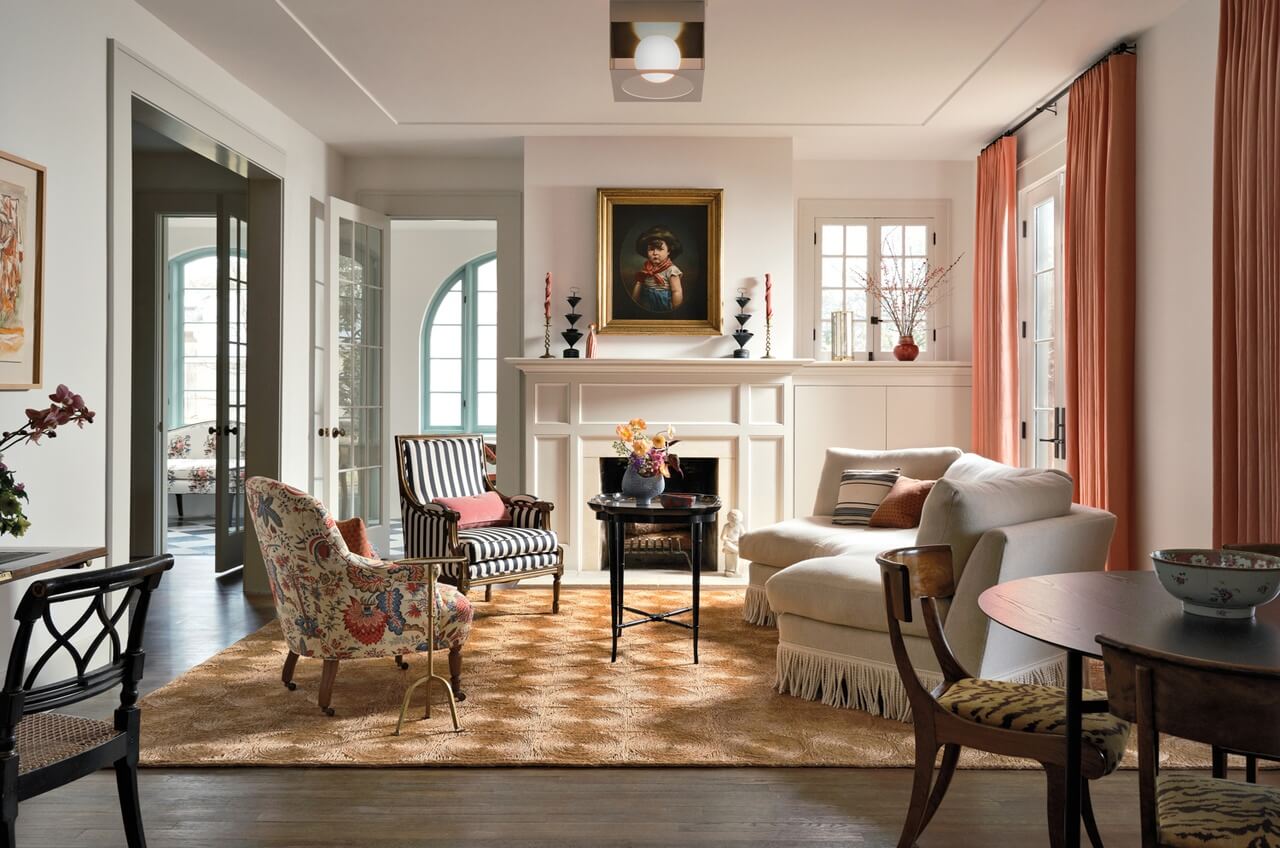
The owners’ collection of antiques and ancestral portraits set the direction. Alongside the inherited furnishings were 19th-century English tables, storage furniture in burr wood, and French fauteuils and bergères with painted and polychrome finishes.

White walls and dark floors quieten the mix. Rattan chairs, bamboo shades and handwoven rugs sit alongside Italian brass mirrors, chairs with tiger-patterned seats and ruffled pink curtains that reach from floor to ceiling. MacPhail replaced the ceiling lights in the entrance and living room with cubist designs that give a contemporary edge to the vintage pieces.
The combinations change from room to room. Crimson fringe, flowers, checks and stripes lend some of the textiles an old-fashioned elegance. Strong colours and exaggerated changes of scale have a more contemporary effect.

Putting the fabrics together piece by piece
MacPhail likens choosing the fabrics to assembling an enormous puzzle. Once the framework was in place, she added one piece at a time until the whole picture emerged. It was a lengthy process, but an enjoyable one that she felt repaid the time.

For all the detail, the furniture layouts are economical. Each piece serves a clear purpose and leaves an easy route through the room. Clear stretches of tabletop, chest tops and shelves give individual objects space, an unexpected instance of restraint amid so much colour and pattern. What holds the rooms together is the owners’ attachment to the things in them, including pieces that an exact match of style or period would have ruled out.
For building and interior commissions, find architects, interior designers and photographers in the PLNDesign directory.
See also:
- A Melbourne family recalls life in Japan in an Australian country retreat
- Two entrepreneurs choose a quiet, minimal home in Poland’s Podlasie region