

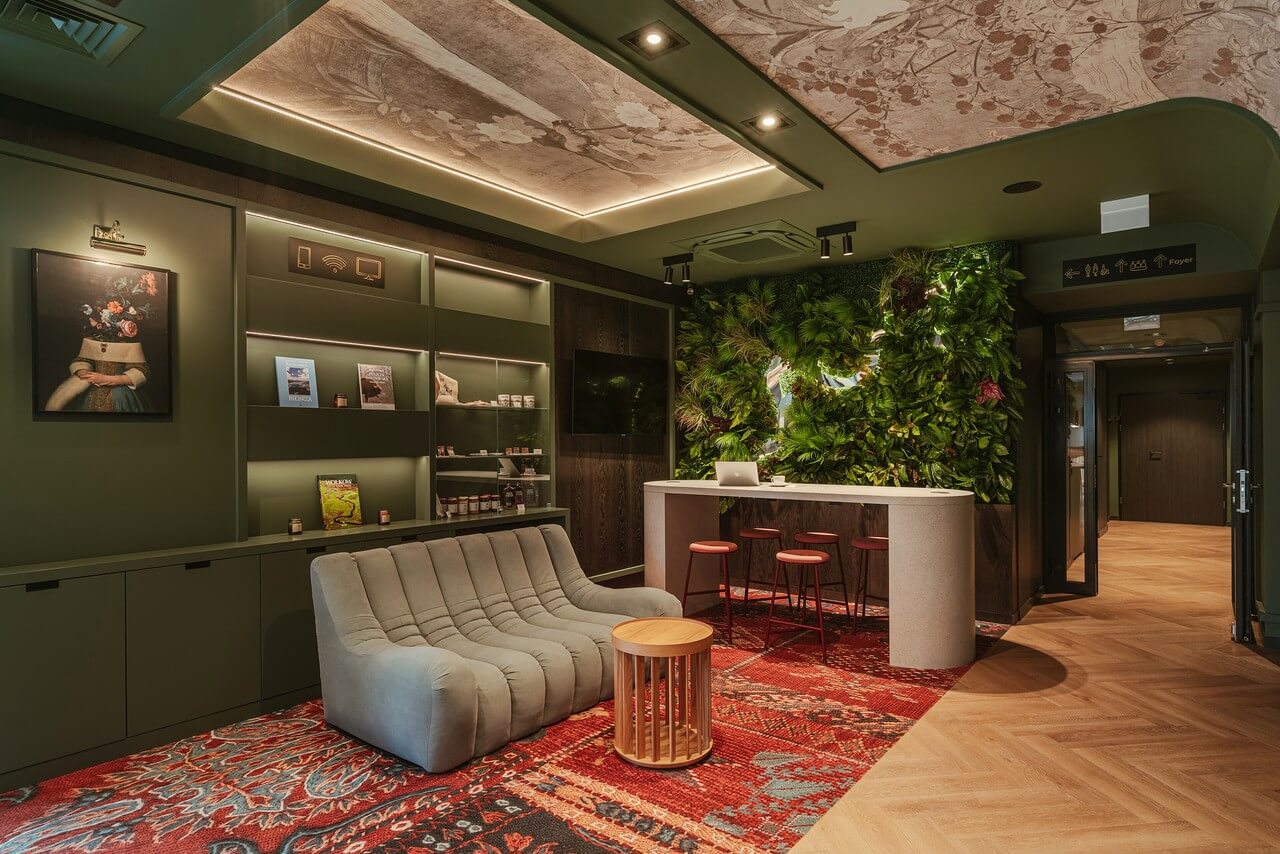
An irregular mirror set among plants traces the meanders of the Biebrza, while an upside-down bison hangs from a restaurant ceiling. MIXD designed these shared spaces for Mercure Białystok in Białystok, Poland, after studying the landscapes, buildings and traditions of Podlasie. The photographs are by Mood Authors.
An introduction to Podlasie
The primeval Białowieża Forest, wetlands, rivers, nature reserves and rare species gave the designers a wealth of material. Podlasie’s different nationalities and faiths have also shaped its architecture, folk art and food. The Baroque Branicki Palace, the synagogue and castle in Tykocin, the fortress at Goniądz and the mosque in Bohoniki sit alongside Catholic and Orthodox churches, the sanctuary on Mount Grabarka and Wierszalin, once home to a mystical religious community in the forest.

“Mercure places a strong emphasis on what is specific to a place, its history, culture, events and surroundings,” said Piotr Kalinowski, MIXD’s chief executive and creative director. “It’s particularly through the interiors that a guest is introduced to a place, through the materials, colours, furnishings, decorations and details. In keeping with that, from reception and the lobby onwards we filled the spaces with references to Podlasie, so that visitors would be intrigued from the moment they arrived and drawn into the story of the region.”
Małgorzata Miernik, Accor’s franchise projects director for Poland and the Baltic states, said: “We’re very pleased that for the first Mercure project in Białystok we could work with an experienced studio that understands the brand and can propose ideas that delight guests and stay with them. That was important to us, and it’s borne out both by visitors’ comments and by the LIV Hospitality Design Award the project won in 2022.”

A river, a bouquet and a greeting in Esperanto
To the left of the entrance, the mirror winding through a wall of planting resembles an aerial view of the Biebrza crossing marshes, peat bogs and meadows. The area supports some 250 bird species, and the spring mating season draws birdwatchers from around the world. The hotel library includes books of nature photography by Wiktor Wołkow, known for his images of Podlasie.

Martyna Berger’s portrait of a woman in an elaborate dress leaves her identity a mystery. The suggestion is that she may be a member of the Branicki family, whose palace became known as the Versailles of Podlasie. A bouquet conceals her face, its flowers suggestive of the palace’s French Baroque garden, painstakingly reconstructed by archaeologists, historians and gardeners.
Behind reception glows the word “Saluton!”, a greeting in Esperanto. Białystok-born physician Ludwik Zamenhof devised the international language in the hope that easier communication between nations might help avert disputes and conflict.
Forest light and a bison above the tables
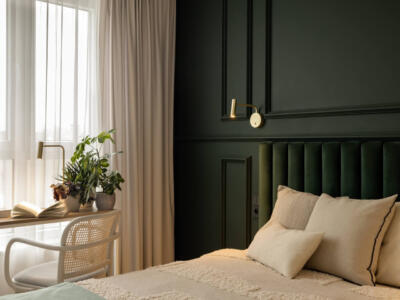
Deep green walls recall dense forest. Wallpaper in the restaurant and conference room suggests mist over woodland marshes. Hanging upside down overhead, the restaurant’s bison has more in common with the cheerful character in a local beer advertisement than with a close encounter with the powerful animal in the wild.

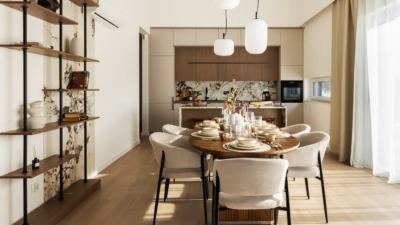
“Light, both artificial and natural, plays an enormous role in the interiors,” said Marta Jakubas, a hospitality associate at MIXD. “The restaurant windows face east. Coming down to breakfast, guests can feel as though they’re in a forest early in the morning, when the trees cast long shadows and the branches and leaves filter the sunlight. The light also picks out the colours of the glass inserts in the ornamental metal screen around the buffet. That detail takes its cue from local timber architecture, particularly the fretwork on houses in the Land of Open Shutters.”
“The atmosphere of the light changes after dark,” she added. “The Stone Wall sconces by Tom Dixon give a soft, subdued light, as do the pendants with woven basket shades above the restaurant tables.”

Anna Żelazko of Mercure Białystok described the response: “Our hotel guests are delighted by the interiors inspired by the nature of Podlasie, and event organisers appreciate them too. The references to local animals and plants let you catch your breath even here in the city and feel as though you’re deep in the Białowieża Forest. The biggest surprise is always the bison greeting people in the restaurant. Putting it there, and upside down at that, worked wonderfully. It became the mascot of Bona Me and took pride of place on Instagram and other social media.”
Folk patterns from floor to ceiling
The interiors were conceived as mysterious, intimate and elegant, with folk references that extend into haute couture. French fashion designer Christian Lacroix designed the patterned carpet, whose colours and motifs recall both Belarusian embroidery and Oriental rugs.

“We originally wanted carpets to continue up the walls, in a nod to the Eastern-influenced tradition that survives in eastern Poland,” Jakubas said. “When fire safety requirements ruled that out, we treated the wallpaper in a similar way, even taking it across the ceiling. The pattern, reminiscent of old engravings, suited the interior and brought out the unusual curved junction between the walls and ceiling.”
MIXD’s design team comprised Piotr Kalinowski, Marta Jakubas, Paweł Panek, Joanna Mazurek, Martina Mirecki, Jolanta Cioroch and Joanna Paterska. In the gym, floral wallpaper recalls the work of self-taught painter Iłarion Daniluk of Hajnówka. Flowers were a favourite subject in both his paintings and his murals, many of which survive in houses in his home town.

Products used in the project
- Stone Wall lights by Tom Dixon
- Patterned carpet designed by Christian Lacroix
For commercial interiors, find designers, architects and interior photographers in the PLNDesign directory.
See also:
- Two hotel identities share restaurants and bars at Oslo Airport
- A blue spiral stair links the guest rooms of a seaside resort near Shenzhen