

Landscape architect Gabriela Kijewicz began planting trees while her house was still under construction. She and Tomasz Kijewicz had acquired 5,000 square metres of drained farmland in rural Mazovia, Poland, where a single crop had grown for years. She developed the design herself through her practice, GK Architektura Krajobrazu, gradually turning the land into a garden shared with birds, insects and amphibians.
A path through grasses and perennials
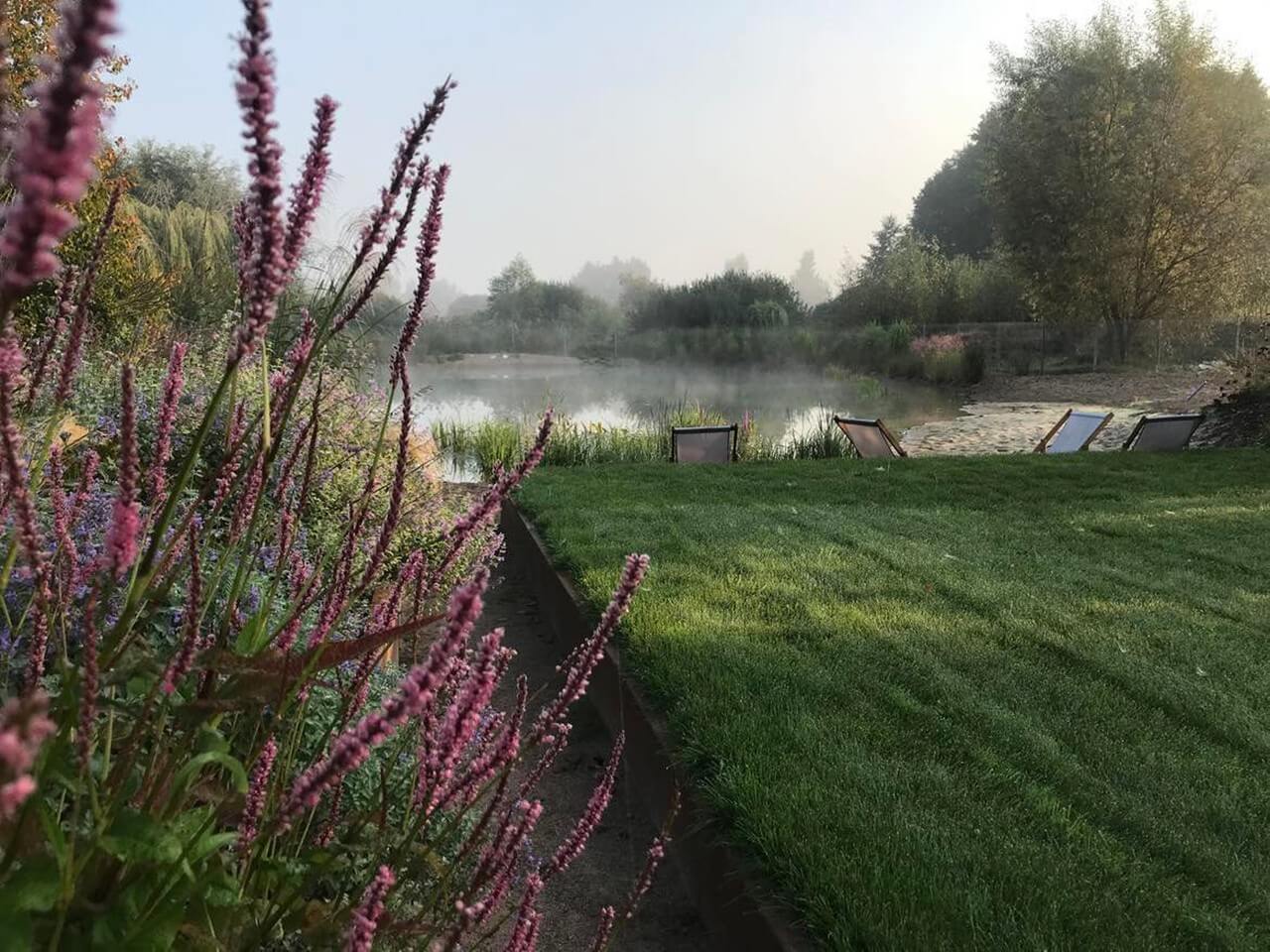
Kijewicz planted native limes, hornbeams, beeches, field maples and oaks, alongside Himalayan birches and plane trees. She chose the rest of the planting to change through the growing season. A path establishes the main view, its course picked out by grasses and flowering perennials.

Catmint, sage, lavender, hardy geraniums, lupins, persicarias, coneflowers, anemones, verbena, agastache and mint recur across the garden. Feather reed grass, miscanthus, fountain grass, tufted hair grass and switchgrass grow among them, with varieties of viburnum, winged spindle, hydrangeas and peonies. Simple pergolas, weathering-steel elements, gabion walls and concrete slabs give structure to the loose planting.
A pond and a sandy beach
The pond was the last element to be built. Along it runs a broad sandy beach where the family can sit in hot weather. Groundwater and rain feed the pond. Planted wetland filtration and a second mineral-and-plant filter keep the water clear, much as they would in a natural swimming pool or swimming pond. Plants for the banks and filters came from nearby field ponds, ditches and meadows.

The pond helps retain water locally, improves the microclimate and has brought greater biodiversity. Amphibians, which can indicate water quality, include European fire-bellied toads, green frogs and common frogs. Grass snakes have also settled nearby. Herons, swallows and ducks come to the water.
A garden that extends the landscape beyond it
The planting provides food and shelter for pollinators and birds. More than 50 nest boxes have been installed. Tree sparrows, wagtails, greenfinches, tits, starlings, blackbirds, pheasants and bullfinches are among the birds recorded in the garden. Monitoring has also identified golden orioles, hoopoes and woodpeckers. Insects and small rodents live in the gabion walls, which are filled with local sandstone.

To the north lie wet meadows, former fishponds and field ponds. Kijewicz matched her planting to the vegetation beyond the boundary, making it easy to forget that the E7 road between Warsaw and Kraków is only 500 metres away. For the owners the change from exhausted farmland to a diverse garden is an ongoing project, with the planting continuing to develop from year to year.
For country houses and retreats, find architects, interior designers and photographers in the PLNDesign directory.
See also:
- A carp pond shapes a minimal garden in Janki, Poland
- How to clean houseplant leaves: what to use and what to avoid