

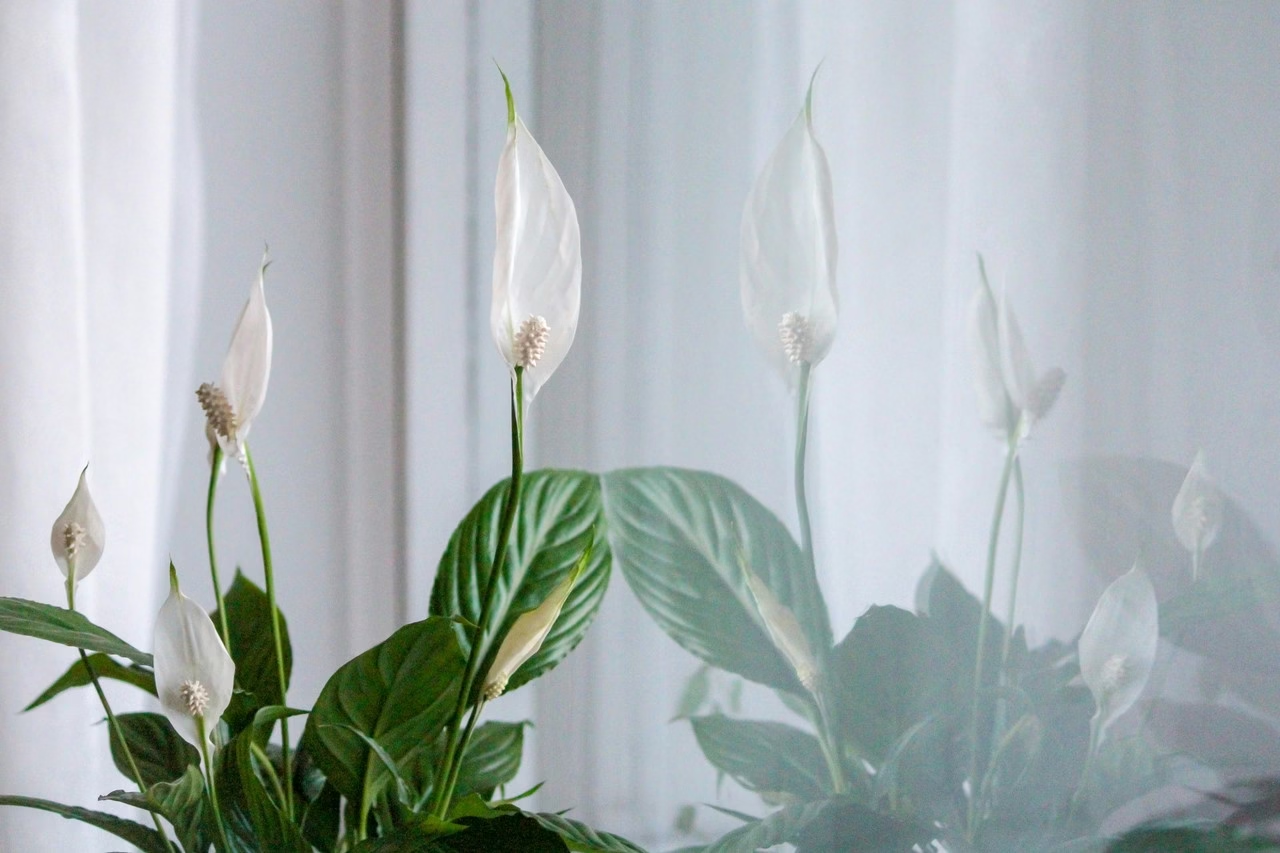
Peace lily care rests on bright, indirect light, compost that stays lightly moist without ever becoming waterlogged, and moderate humidity. The peace lily (Spathiphyllum) is an evergreen tropical perennial from the arum family, grown for its glossy dark green leaves and white spathes, and it is easy to keep indoors. Its leaves, stems and flowers contain calcium oxalate crystals, so it is poisonous to cats, dogs and people.
Peace lily at a glance:
- Light: bright, indirect light near a window. Direct summer sun scorches the leaves, while in deep shade the plant grows slowly and rarely flowers.
- Water: once the top few centimetres of compost have dried, ideally with rainwater or filtered water. The pot should never stand in water, and the plant needs slightly less in winter.
- Compost and pot: free-draining, peat-free compost in a pot with drainage holes, only a few centimetres larger than the old one when you repot in spring.
- Safety: chewing the plant irritates the mouth of a pet or a child, so keep it out of their reach and wear gloves when you handle it.
What is a peace lily?
Peace lilies make up the genus Spathiphyllum, evergreen perennials from the arum family (Araceae). They grow wild from Mexico through tropical Central and South America to south-east Asia and the islands of the western Pacific, on the floor of humid tropical forests, in shady, moist or wet places along rivers and streams. Warmth, moisture and light filtered through a forest canopy are also what the plant needs indoors.
The plant forms a clump of elliptical or lance-shaped, glossy dark green leaves on long stalks, and Spathiphyllum wallisii, a popular houseplant species, grows 30–60 cm tall. What looks like a white petal is a spathe, a modified leaf wrapped around a cream-coloured spike, the spadix, which carries the tiny true flowers. The whole structure resembles the flower of an anthurium, another member of the arum family.

Where should you put a peace lily?
A peace lily does best in bright, indirect light, near a window but out of direct summer sun. Strong sun scorches the leaves and too much light bleaches them pale, while in deeper shade the plant survives but grows very slowly and seldom flowers. By an east- or west-facing window it can stand close to the glass. In a room with a south-facing window, keep it back from the window in summer, out of reach of direct sun, and move it closer in winter, when the sun is weaker. By a north-facing window it does best on the sill or right next to it. A bright bathroom suits it too, because the air there is more humid.
Average room temperatures of 12–24°C are fine. Hot, cold or draughty spots damage the plant, so keep it away from radiators, cold draughts and heating or air-conditioning vents that blow straight onto the leaves.
How often should you water a peace lily?
Water a peace lily once the top few centimetres of compost have dried out. Through spring and summer the compost should stay lightly moist, but the pot must never sit in a saucer of water, because waterlogged roots rot. How often that works out depends on the warmth and light in the room, the compost and the size of the pot, and in a bright, warm room the plant drinks more. In winter, when growth slows, water slightly less.
Use water at room temperature, ideally rainwater or filtered water. Peace lilies are sensitive to the fluoride in tap water, which damages the leaves.
The plant shows clearly when it is thirsty: the leaves lose their firmness and droop, sometimes alarmingly, then lift again soon after watering. A plant watered promptly recovers without lasting harm, but repeated wilting holds back its growth, so it is better not to let it happen often.
Does a peace lily need humidity?
A peace lily prefers moderate humidity, and in dry air its leaves turn brown at the edges. The most effective help is a tray of damp gravel: stand the pot on it so that the base sits above the water rather than in it. A humidifier near the plant works too. Misting the leaves does no harm, but it raises humidity only briefly, because the water quickly evaporates. Dry air is most common in the heating season, and houseplant care in winter covers the other adjustments that time of year calls for.
What compost and pot does a peace lily need?
A peace lily needs free-draining compost that holds moisture without staying waterlogged, in a pot with drainage holes. Peat-free multi-purpose compost with perlite added for drainage, about three parts compost to one part perlite, does the job, and the mix should be slightly acidic.
The plant likes to be slightly pot-bound. A newly bought peace lily can usually stay in its original pot for a year or two, and it needs repotting only once its roots are densely packed or start growing out of the drainage holes. The new pot should be only a few centimetres larger than the old one, because too large a pot keeps the compost wet for too long and puts the roots at risk of rot.

How do you feed a peace lily?
Feed a peace lily with a general liquid fertiliser every few weeks during the growing season, from spring to autumn, and little or not at all in winter. A general fertiliser supports both leaf growth and flowering. The plant needs very little feed, so keep the dose low and follow the instructions on the label.
Too much fertiliser burns the roots and turns the leaf tips and edges brown. Pale green leaves, on the other hand, more often mean that the plant is getting too much light than too little food.
How do you get a peace lily to flower?
Light is the main factor, and a peace lily that does not flower is most often standing too far from a window. Plants less than a year old often do not flower yet, and regular feeding in the growing season helps. The flowers appear mainly in spring and summer and last for several months. Once one has faded, cut it off at the base of its stem with a clean, sharp tool, and remove fading leaves the same way.
Peace lily flowers turn green mostly because they are ageing: the white spathe fades to green and gradually blends in with the leaves. Some varieties also have greenish spathes.
How do you repot and divide a peace lily?
Repot in spring, when the roots fill the pot or grow out of it. Ease the plant out carefully, loosen the root ball gently, shake off excess old compost and cut away any rotten or damaged roots. Set the plant in the new pot, fill around it with fresh compost and water it in.
Repotting is also the moment to divide a large plant, which is the easiest way to propagate a peace lily. Cut or pull the root ball apart into several smaller plants, each with plenty of roots and several strong stems, and pot each one separately in free-draining, peat-free compost. Wear gloves, because the sap can irritate skin.
Why is my peace lily drooping, yellowing or turning brown?
Most leaf problems on a peace lily come from watering, dry air or the wrong position rather than from disease:
- Drooping leaves, dry compost: the plant is thirsty and recovers soon after watering.
- Drooping leaves, wet compost: the roots are waterlogged. Take the plant out of its pot, remove soft and rotten roots, repot it in fresh, free-draining compost and water sparingly.
- Brown leaf tips and edges: usually dry air or tap water, and sometimes too much fertiliser or compost left to dry out for too long.
- Yellow leaves: overwatering, compost that has dried out completely, cold draughts or too much sun. A single older leaf turning yellow now and then is normal.
- Blackened leaves: too much water or cold.
Root and stem rots are the most common diseases of peace lilies, and overwatering is usually behind them. The lower leaves turn yellow while the roots go black and mushy.
Pests mostly attack plants that are already weakened. Mealybugs are the most common indoors, and spider mites, aphids and scale insects also turn up, while fungus gnats can appear in the compost. Spider mites thrive in warm, dry air, so higher humidity reduces the risk of an attack. Wiping the leaves with a damp cloth removes the odd pest, and cutting off badly infested parts helps in the short term, but the lasting fix is to put right the conditions that weakened the plant.
Can a peace lily go outside in summer?
Yes, once nights are consistently warmer than 13°C. Outdoors it needs a sheltered, shady spot out of direct sun. Bring it back in before night temperatures are forecast to drop below 10°C. Centrally heated rooms are much drier than the air outside, so a tray of damp gravel or a humidifier helps the plant readjust.
Is a peace lily poisonous to cats, dogs and children?
Yes. The flowers, leaves and stems contain insoluble calcium oxalate crystals, and the ASPCA lists the peace lily as toxic to cats and dogs. When a pet chews the leaves, the crystals cause pain, burning and swelling of the mouth, tongue and lips, heavy drooling, vomiting and difficulty swallowing. Cats may also paw at their face and have diarrhoea. Swelling of the mouth and airways severe enough to affect breathing is uncommon.
The peace lily is not one of the true lilies that are so dangerous to cats (see plants poisonous to cats), but the UK’s Animal PoisonLine has recorded kidney failure in a small number of cats after they ate it. If a cat or dog has chewed the plant, call a vet straight away. Other garden plants and houseplants to keep away from a dog are listed in plants poisonous to dogs.
In people, including children, chewing or swallowing a piece of the plant causes immediate irritation of the mouth and throat, drooling, swollen lips, nausea and vomiting. Poison Control, the US National Capital Poison Center, advises gently wiping out the mouth and having the child rinse and spit with water. For further advice, contact a doctor or a poison centre. The safest place for a peace lily is out of reach of children and pets.
Do peace lilies purify the air?
In a laboratory they do, but in a home the effect is negligible. In a NASA study published in 1989, Spathiphyllum ‘Mauna Loa’ removed benzene, trichloroethylene and formaldehyde from the air, but the tests took place in sealed chambers. In 2019 Bryan Cummings and Michael Waring of Drexel University reviewed a dozen studies spanning 30 years and converted their results to the conditions of an ordinary building. The air exchange that comes with normal ventilation removes volatile organic compounds far faster than plants do, and matching it would take between 10 and 1,000 plants per square metre of floor.
Which peace lily varieties are there?
Peace lily varieties differ above all in size and in the colour of their leaves. ‘Sensation’ is the largest commercially grown peace lily and matures at about 1.8 metres tall and wide. ‘Chopin’ reaches about 60 cm and has white flowers, while compact ‘Bellini’ grows to about 45 cm and ‘Pearl Cupido’ stays under half a metre. ‘Domino’ stands out for its foliage, with glossy dark green leaves speckled with white streaks. ‘Mauna Loa’, the variety from the NASA study, holds the RHS Award of Garden Merit.

Peace lily care – frequently asked questions
Is a peace lily a true lily?
No. Despite its common name, the peace lily belongs to the arum family (Araceae), not to the lily family (Liliaceae).
What does a peace lily dislike?
Harsh sun, cold and draughts, hot radiators, dry air and water standing in the pot.
How often should you clean peace lily leaves?
Regularly. Dust settles easily on the large leaves, so wipe them with a damp cloth whenever they look dull.
A peace lily needs diffused light and moist air, so where it will thrive depends on the layout of windows and rooms. When you plan a new interior, it pays to decide on places for plants from the start and to talk the design through with a professional. Find architects, interior designers and interior photographers in the PLNDesign directory.
See also:
- Succulent care: light, watering, compost and popular types
- Hydrangea care: pruning, planting, flower colour and winter care