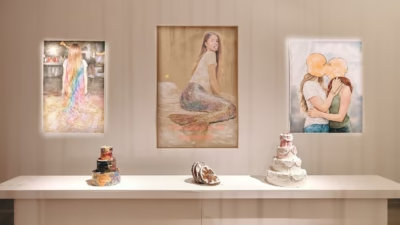


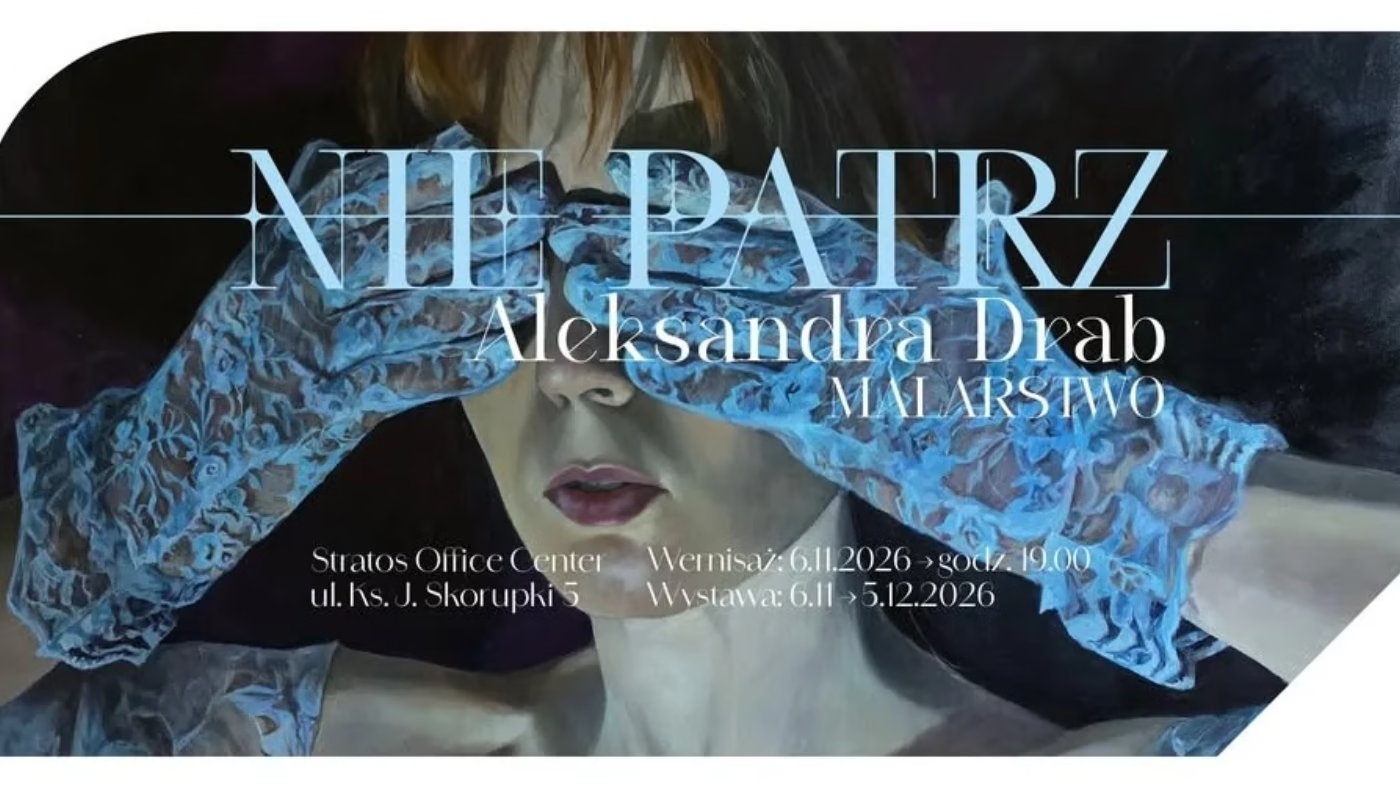
A white wedding dress provides a way to question ideas of innocence, submission and freedom in Aleksandra Drab’s latest painting series, Nie patrz (Polish for “Don’t look”). The artist, represented by Zofia Weiss Gallery, is exhibiting the works at Stratos Art Project in Warsaw. The title painting depicts an attractive young woman in a white lace dress, painted with close attention to the smallest details. She covers her eyes with hands in openwork gloves and does not look. Her mother’s wedding dress from the 1990s was the starting point for the exhibition. Drab’s paintings explore female identity, the body and social expectations passed down through generations. The exhibition opened on 6 November 2026 at Skorupki 5 and runs until 5 December 2026.
The many meanings of white
The title Nie patrz sounds like a prohibition, yet playfully invites viewers to look. It directs attention to the female body, desires that carry a sense of shame, and the social expectations and cultural conventions that have shaped ideas of femininity for centuries. Drab approaches these subjects through a distinctive visual language that juxtaposes fragments of the female figure with meticulously rendered fabrics. Lace, folds, gathers and the whiteness of the cloth carry meanings beyond their decorative role.
The inspiration for the latest series was a family heirloom: the dress Drab’s mother wore at her wedding in the 1990s. It had been kept, just as her grandmother’s dress had been before it. This object, tied to a personal history, prompts a broader reflection on tradition, female identity and social expectations. White, traditionally associated with purity, innocence and a new beginning, can also signify sacrifice, submission and the need to conform.

“White fascinates me because it has so many meanings. It symbolises innocence and a new beginning, but also submission and sacrifice. On the one hand, it is the purest of colours; on the other, it can conceal what is imperfect and ‘dirty’. It is this tension between purity and what lies beneath the surface that interests me most,” Drab says in conversation with Kama Zboralska.
In Drab’s paintings, fabric both covers the body and draws attention to it. It can protect but also restrict, conceal and expose. This paradox is central to the exhibition’s examination of the boundaries between social expectations and the right to define one’s own identity.
Nie patrz is on view at Stratos Art Project, Skorupki 5, Warsaw, until 5 December 2026.
Reclaiming a voice through painting
Drab is a graduate of the Faculty of Painting at the Jan Matejko Academy of Fine Arts in Kraków. In 2025, she completed her diploma with distinction in Professor Witold Stelmachniewicz’s studio, presenting the series Oto ciało moje (meaning “This is my body”). During her studies, she was already addressing fear, the body and difficult emotional experiences, gradually developing a visual language that connects a personal perspective with universal questions of identity.
Technical precision is important to her work, particularly in her handling of fabric textures, light and skin tones. Drab reduces her compositions to two striking, recurring motifs: tightly cropped fragments of the female figure and the almost phosphorescent whiteness of cloth. This deliberate reduction heightens the tension. Exposed skin contrasts with dazzlingly white, almost sacred fabric, producing a charged atmosphere that shifts between eroticism, shame, provocation and emancipation.

Drab’s paintings are deeply autobiographical, yet also have a universal resonance. She uses her own body as both subject and object, uncompromisingly confronting social expectations surrounding femininity, virginity and bodily autonomy. The fabrics evoke bridal veils and shrouds associated with death and the afterlife, protecting and exposing the body while concealing and revealing the mysteries of femininity. Although she uses her own image in many works, Drab stresses that she does not consider them conventional self-portraits. For her, the body is a medium through which to tell stories about the broader experience of womanhood.
Drab’s work has already gained recognition on the Polish art scene. In 2024, she won first prize at the seventh Zimowy Salon Młodych z Akademii (a winter salon for young artists from the academy), organised by Zofia Weiss Gallery in Kraków. She placed 18th in 2024 and 20th in 2025 in Kompas Młodej Sztuki (a ranking of young artists). In 2026, she was a finalist in the New Image / New Look competition, organised by Magdalena Abakanowicz University of the Arts Poznań.
Nie patrz marks a further stage in her artistic exploration. From personal experiences of how she perceives her own body, Drab moves towards intergenerational memory, tradition and the right to define femininity on her own terms. The exhibition invites viewers to consider the many meanings that apparently simple symbols can hold, and how these change with the experience of successive generations.
An architect or interior designer can help you choose where to hang paintings and how to light them at home. Find architects, interior designers and interior photographers in the PLNDesign directory.
See also:
- Lower Town, Present! maps how Gdańsk’s tenement streets shape daily life
- Biuro Kreacja shapes Gdynia centenary exhibition with waves of fabric