

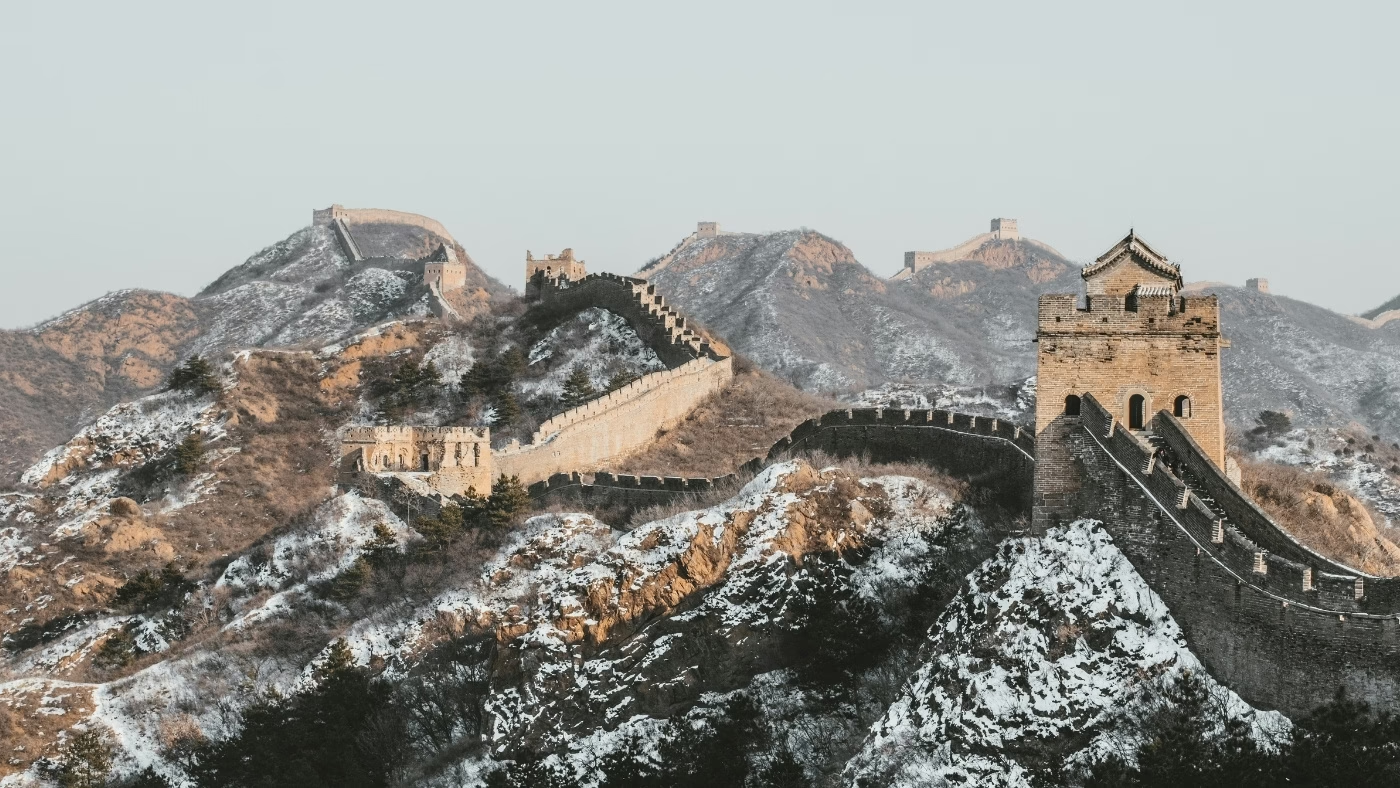
The Great Wall of China is a system of fortifications built across northern China over more than two thousand years: walls of rammed earth, stone and brick, trenches, watchtowers, passes and natural barriers such as ridges and rivers. A national survey published in 2012 put its total length at 21,196.18 km, and the brick-and-stone stretches most visitors know near Beijing date from the Ming dynasty (1368–1644). The wall has been on the UNESCO World Heritage List since 1987.
Great Wall of China at a glance:
- Begun almost 3,000 years ago as the border walls of rival states, it was joined into one northern line by the First Emperor after he unified China in 221 BC.
- The Ming wall measures 8,851.8 km, and 22 per cent of it has already disappeared.
- Most of the wall is rammed earth made from local material; the Ming rebuilt key sections in brick and stone bonded with sticky rice and lime mortar.
- It cannot be seen from the Moon with the naked eye, and NASA says it is barely visible even from low Earth orbit.
What is the Great Wall of China?
The Great Wall of China is a network of fortifications built by successive Chinese states and dynasties along the historical northern frontier, as protection against nomadic peoples from the Eurasian steppe. It combines walls, trenches, watchtowers, barracks, fortresses and passes, and in many places hills and rivers form part of the defensive line. Taken together, the fortifications reach from Liaodong in the east to Lop Lake in the west.

UNESCO inscribed the Great Wall on the World Heritage List in 1987, with three sites as components of the listing: Badaling near Beijing, Shanhaiguan (Shanhai Pass) on the Bohai coast and Jiayuguan (Jiayu Pass) in Gansu. UNESCO describes the wall of the Ming period as the world’s largest military structure. In 2007 the Great Wall was voted one of the New 7 Wonders of the World.
The Chinese name Wànlǐ Chángchéng means ‘ten-thousand-li long wall’. A li was a traditional unit of distance, usually around 540 metres, but ‘ten thousand’ is used figuratively here, in the sense of ‘countless’. The English name grew out of early modern European travellers’ accounts of ‘the Chinese wall’, and by the 19th century ‘the Great Wall of China’ had become standard in English and French.
How long is the Great Wall of China?
The Great Wall of China is 21,196.18 km long, counting the surviving walls and trenches of every dynasty. The figure comes from a national survey by China’s State Administration of Cultural Heritage (today’s National Cultural Heritage Administration) and the national mapping bureau, which began in 2007 and was published in 2012. It recorded 43,721 sites linked to the wall in 15 provinces, autonomous regions and municipalities, about half of them in Inner Mongolia and Hebei.

The Ming wall, which includes the best-known sections near Beijing, measures 8,851.8 km, a figure published in April 2009. It is made up of 6,259 km of built wall, 359 km of trenches and 2,232 km of natural barriers such as hills and rivers. The border fortifications of the Jin dynasty (1115–1234) add about 4,010 km. The 2012 total is almost 2.4 times the Ming figure, which had long been quoted as the length of the whole wall.
Much of that length no longer stands as a wall. The 2012 findings showed that only 8.2 per cent of the Ming wall remained intact and that 22 per cent of it, 1,961 km, had disappeared. The heritage administration’s 2016 report on the protection of the wall notes that, apart from some brick-and-stone sections, the wall was mostly built of rammed earth from local material, and that natural erosion and human activity have left most of it collapsed or damaged. Many western sections are made of mud rather than brick and stone, and in places their height has dropped from more than five metres to less than two. Local people have also taken stone from the wall to build houses and roads.
When was the Great Wall of China built?
The Great Wall of China was built in stages over more than two thousand years, from the border walls of the first millennium BC to the Ming dynasty, which ruled until 1644. Dynasties built in different places and with different materials, so the wall seen today is a collection of walls from different periods.

Chinese states were already familiar with wall-building in the Spring and Autumn period, between the 8th and 5th centuries BC. During that period and the Warring States period that followed, Qi, Chu, Qin, Wei, Zhao, Yan and other states fortified their borders with stone or with earth and gravel stamped between board frames. Excavations by the Shandong Provincial Institute of Cultural Relics and Archaeology between May and December 2024 dated the oldest part of the Qi wall, near Jinan, to the late Western Zhou dynasty (1046–771 BC), around 300 years earlier than previously thought.
After the state of Qin unified China in 221 BC, its ruler, now the First Emperor, had the walls between the former states pulled down and ordered new walls to link the remaining fortifications on the northern frontier. Little of the Qin wall survives. The Han dynasty repaired and expanded the system, and its westernmost fortifications start at the Yumen and Yang passes south-west of Dunhuang in Gansu. The Northern dynasties and the Sui later rebuilt sections, while the Tang and Song made no significant effort. Dynasties founded by non-Han peoples, among them the Northern Wei, Liao, Jin and Western Xia, built walls of their own further north, reaching into present-day Mongolia.
The Ming dynasty gave the wall its best-known form. After their defeat by the Oirats at the Battle of Tumu, the Ming made wall-building their strategy against the Mongols and built in brick and stone instead of rammed earth. Up to 25,000 watchtowers are estimated to have been built on the Ming wall. Between 1567 and 1570, under the supervision of General Qi Jiguang, 1,200 of them went up between Shanhaiguan and Changping, and earthen sections were faced with brick. The sections near the Ming capital, Beijing, were made especially strong.
Why was the Great Wall of China built?
The Great Wall was built to protect Chinese states and empires from nomadic peoples of the northern steppe: the Xiongnu in the time of the Qin and, centuries later, the Mongols. It worked as a defensive system, with watchtowers, barracks and garrison stations along the line and signal towers on hilltops that passed warnings by smoke or fire. The wall also served as a transport corridor and a border control: it regulated who crossed and allowed duties to be charged on goods carried along the Silk Road.
At the end of the Ming dynasty the wall faced the Manchus. Even after losing Liaodong, the Ming army held the heavily fortified pass at Shanhaiguan and kept them out of the Chinese heartland. In 1644 Beijing fell to the rebel Li Zicheng. On 25 May the Ming general Wu Sangui opened the gates at Shanhaiguan and allied with the Manchus, hoping to drive the rebels out of the capital. The Manchus took Beijing for themselves and went on to establish Qing rule over the whole of China. Once Mongolia became part of the Qing empire, China’s borders lay beyond the wall, and work on it as a defence line stopped.
How was the Great Wall of China built?
The builders used what each stretch of terrain offered: stone in the mountains, rammed earth on the plains and, under the Ming, brick. Moving large quantities of material over long distances was difficult, so local resources came first. Under the Qin the guiding rule was ‘build and move on’, which shows that the builders did not see the wall as a permanently fixed border.
During the Ming, bricks were used across many areas of the wall, together with tiles, lime and stone. Bricks were easier to handle than earth or stone, which sped up construction, and they carried more weight and lasted better than rammed earth. Rectangular cut stone went into the foundations, the inner and outer edges of the wall and the gateways. The bricks were bonded with sticky rice mortar, a mixture of soup made from sticky rice and slaked lime.
Battlements line the top of most of the wall, with openings a little over 30 cm tall and about 23 cm wide, and from the parapets guards could watch the surrounding land. Barracks, stables and armouries stood close to the wall’s inner face. Height and width vary from one section to the next: at Jinshanling the wall is five to eight metres high, six metres wide at the base and five metres across the top, while at Juyongguan it rises to 7.8 metres and is five metres wide.

Can you see the Great Wall of China from space?
You cannot see the Great Wall from the Moon, and from low Earth orbit it is hard to see without help. NASA says the wall generally cannot be made out with the naked eye from low orbit, is barely visible even in near-perfect conditions and is no more conspicuous than many other human-made objects. It is too narrow, and its materials are close in colour and texture to the surrounding land. Seen from the Moon, at an average distance of 384,399 km, the wall would look as wide as a human hair viewed from three kilometres away.
Gene Cernan and Ed Lu said they could see the wall from orbit, while Yang Liwei, China’s first astronaut, said he could not. Leroy Chiao photographed it from the International Space Station, but the image was so indistinct that he was not sure he had captured the wall. An image released by the European Space Agency as a view of the wall turned out to show a river in Beijing.
The myth is older than spaceflight. In a letter of 1754 the English antiquary William Stukeley wrote that the Chinese wall ‘may be discerned at the Moon’. Henry Norman repeated the claim in 1895, and Ripley’s Believe It or Not! carried it in 1932.
Great Wall of China: facts and myths
The story that labourers who died on site were sealed inside the Great Wall is an urban legend. No human bones or other remains have been found in the wall or in its mortar, although many workers did die building it.
The wall near Beijing is not the wall of the First Emperor. European accounts long repeated the claim that the Ming walls were the ones built in the 3rd century BC, yet little of the Qin wall remains and most of the existing wall dates from the Ming.
Marco Polo never mentioned the wall. Neither did the other Europeans who reached China or Mongolia in the 13th and 14th centuries, among them Giovanni da Pian del Carpine and William of Rubruck, and his silence has been used to argue that Marco Polo never went to China at all. John Man, author of a history of the Great Wall, takes the opposite view and holds that Marco Polo did see it.

The wall became a national symbol only in modern times. After the fall of the Ming it was largely abandoned. The historian Arthur Waldron argues that it was turned into a Chinese national symbol only in the early 20th century, when its history was retold as myth, and the Communist government later revived it as an emblem of patriotism and of standing up to pressure from abroad.
The wall is still being damaged today. Inscribed bricks taken from it have been sold for up to CNY 50, a stretch on the border of Liaoning and Hebei was repaired with concrete in 2014 and drew wide criticism, and in 2023 construction workers in Shanxi widened a gap in the Ming wall to make a shortcut for an excavator.
Which sections of the Great Wall can you visit?
The most visited sections lie north of Beijing, where the Ming built the wall strongest and where it has been restored most often. Shanhaiguan on the coast and Jiayuguan in Gansu, both part of the UNESCO listing, are also open to visitors.
| Section | Location | What you find there |
|---|---|---|
| Badaling | Yanqing District, north-west of Beijing | First section opened to tourists, in 1957; extensively restored; cable car and barrier-free access; almost 10 million visitors in 2018 and a daily limit of 65,000 introduced in 2019 |
| Mutianyu | Huairou District, north-east of Beijing | Ming wall, among the first sections restored after the Cultural Revolution; cable car to tower 14, chairlift and toboggan; evening openings in summer |
| Jinshanling | Luanping County, Hebei | 11 km of Ming wall climbing steep slopes, with 67 watchtowers |
| Simatai | Miyun District, Beijing | Entered through Gubei Water Town; open for night visits |
| Jiankou | north of Beijing, next to Mutianyu | Unrestored wall with its original bricks and stone; a demanding hike |
| Juyongguan | south of Badaling | Fortified pass whose garrison defended the capital |
| Shanhaiguan | Qinhuangdao, Hebei | The ‘First Pass Under Heaven’ and Old Dragon Head, the section that runs into the sea |
| Jiayuguan | Gansu | Pass fortress where the Portuguese Jesuit Bento de Góis arrived from India in 1605 |

How do you visit the Great Wall from Beijing?
Badaling has a direct rail connection, while the other sections are usually reached by organised tour, hired car with driver or taxi. Since 30 December 2019 high-speed trains on the line from Beijing to Zhangjiakou have stopped at Badaling Great Wall station, built underground beneath the wall and the deepest high-speed rail station in China. The journey takes about 20 minutes from Qinghe station and about 30 minutes from Beijing North. Bus 877 runs to Badaling directly from Deshengmen, and public bus 916 from Dongzhimen serves the route towards Mutianyu.
Each section sets its own prices. At Mutianyu in 2026, adult admission is CNY 40, or CNY 45 with a postcard. The shuttle bus between the service area and the wall costs CNY 15 return, and the enclosed cable car to tower 14 costs CNY 100 one way or CNY 140 return. The chairlift and the toboggan are run by a different company and sold separately. Simatai admission is CNY 40; visitors who only want to see the wall need to book ahead, because the way in is through Gubei Water Town.

A visit to one section near Beijing usually takes half a day to a full day, including the journey. Crowds peak during the Labour Day holiday in early May, during National Day week from 1 October and during the summer holidays in July and August. At Mutianyu, tour groups arrive from about 10am, so the first hours after opening are the quietest. Opening hours change with the season, so check them for your date before you set off.
Great Wall of China – frequently asked questions
Where does the Great Wall of China start and end?
The Ming wall runs from Jiayuguan in Gansu in the west to Shanhaiguan on the Bohai Gulf, its traditional eastern end, where the wall meets the sea. Beyond Shanhaiguan the Ming line continues into Liaoning, where its last eastern watchtower stands at Hushan near Dandong.
Is the Great Wall of China one continuous wall?
No. The 2012 survey counted 10,051 wall sections, 1,764 ramparts or trenches, 29,510 individual buildings and 2,211 fortresses or passes, built by different dynasties in different places. Between built sections, ridges and rivers often complete the line.
How long does it take to walk the Great Wall of China?
Dong Yaohui and two companions walked the Ming wall from Shanhaiguan to Jiayuguan in 508 days, between 4 May 1984 and 24 September 1985. In 1987 William Lindesay covered 2,470 km of the wall on foot, from Jiayuguan to Old Dragon Head, in 78 days.
Did Genghis Khan build part of the Great Wall?
No. Some wall sections in the southern Gobi Desert and on the Mongolian steppe are known as the ‘Wall of Genghis Khan’, but Genghis Khan built no walls or permanent defence lines himself.
The builders of the Great Wall matched each stretch to its site: stone on mountain ridges, rammed earth on the plains and, under the Ming, brick. Fitting structure and materials to a particular plot is still where an architect starts, whether the project is a house on a slope or a city flat. Find architects, interior designers and interior photographers in the PLNDesign directory.
See also:
- Buckingham Palace: history, architecture and how to visit
- Big Ben: history, facts and visiting the Elizabeth Tower