

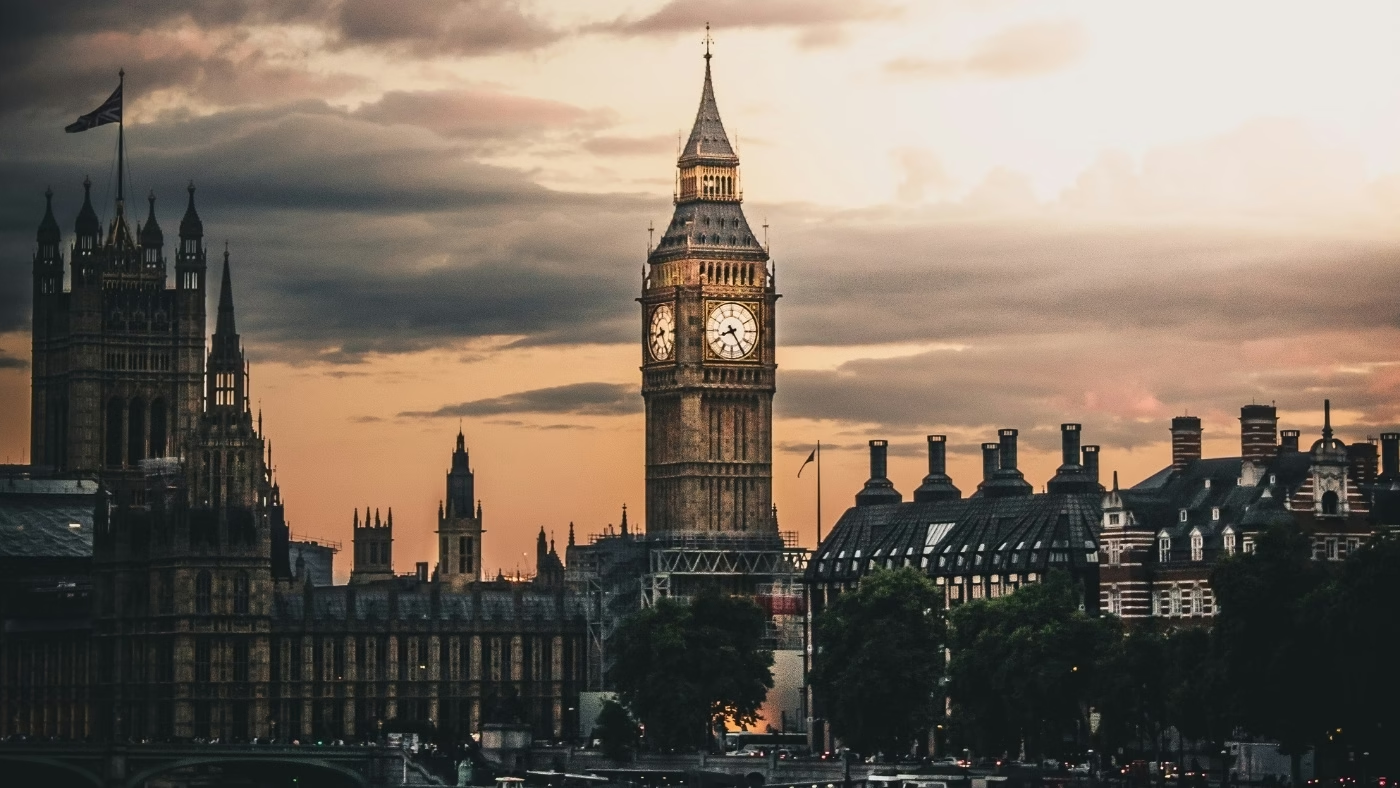
Big Ben is the Great Bell that strikes the hours in the clock tower at the north end of the Palace of Westminster in London, and the name most people use for the whole tower. Officially the Elizabeth Tower since 2012, the 96-metre tower was designed by Charles Barry and Augustus Pugin and completed in 1859. Its clock still runs on the original Victorian mechanism, and visitors from the UK and abroad can climb to the belfry on guided tours.
Big Ben at a glance:
- The Great Bell weighs 13.7 tonnes and first struck the hour on 11 July 1859. It cracked in September of the same year and still rings with the crack, which was never repaired.
- The Elizabeth Tower was built between 1843 and 1859, after a fire destroyed most of the old palace in 1834, and was officially called the Clock Tower until 2012.
- The Great Clock started on 31 May 1859. Its pendulum is regulated with old pennies: adding one makes the clock gain 0.4 seconds a day.
- Guided tours take visitors aged 11 and over up 334 steps to stand beside the bell as it strikes the hour.
What is Big Ben?
Big Ben is the nickname of the Great Bell, the largest of the five bells in the clock tower of the Palace of Westminster, home of the UK Parliament. The name passed from the bell to the clock, officially the Great Clock of Westminster, and to the tower, and in everyday use it covers all three.

The tower was officially called the Clock Tower until 2012. In Queen Victoria’s time journalists called it St Stephen’s Tower, because members of the Commons had once sat in St Stephen’s Hall and parliamentary news was reported as news from St Stephen’s. In June 2012 the House of Commons supported renaming it the Elizabeth Tower for the Diamond Jubilee of Elizabeth II, in the same way that the Victoria Tower at the other end of the palace had been named for Queen Victoria’s Diamond Jubilee. The new name was announced on 12 September 2012. The tower has been part of a Grade I listed building since 1970, and since 1987 the Palace of Westminster has been on the UNESCO World Heritage List together with Westminster Abbey and St Margaret’s Church.
Why is it called Big Ben?
The nickname was given to the bell first, and it is linked to two men. One is Sir Benjamin Hall, who as First Commissioner of Works oversaw the installation of the Great Bell. The other is Ben Caunt, an English heavyweight boxing champion of the time, who was also known as Big Ben.
How was the Elizabeth Tower built?
The tower was built between 1843 and 1859 as part of Charles Barry’s new Palace of Westminster, which replaced the medieval palace after the fire of 16 October 1834. Only Westminster Hall, the Undercroft Chapel, the cloisters and chapter house of St Stephen’s and the Jewel Tower survived the fire. The rebuilding of the whole palace was completed in 1870.

Barry was the chief architect, but he gave the design of the clock tower to Augustus Pugin, who drew on his earlier designs, including a tower for Scarisbrick Hall, a country house in Lancashire. It was Pugin’s last design: he died in 1852, seven years before the tower was finished. The style is Gothic Revival in its Perpendicular form, with carved stone ornament and symbols of the four countries of the United Kingdom.
Construction began on 28 September 1843, with Thomas Grissell and Morton Peto as contractors. The tower went up from the inside: a gantry was jacked up as the walls rose, so Londoners watched it grow without seeing any workmen or materials. It took 2,600 cubic metres of brick and 850 cubic metres of stone, all brought to Westminster by river. The brick core is faced with sand-coloured Anston limestone from South Yorkshire, Caen limestone from France was also used, and the spire is covered with cast-iron roof tiles.
The finished tower is 96 metres high, with 11 floors on a base 12 metres square, resting on concrete foundations 3.7 metres thick. The centres of the four clock dials are 55 metres above the ground. A spiral staircase climbs 292 steps to the clock faces and 334 to the belfry, and another 65 lead up to the lantern at the top.
Inside, a ventilation shaft designed by David Boswell Reid was meant to draw fresh air into the palace, but it did not work and served as a chimney until around 1914. The oak-panelled Prison Room, reached only from the House of Commons, was last used in 1880, when Charles Bradlaugh, a newly elected atheist MP, was held there after protesting against swearing a religious oath of allegiance to Queen Victoria.
The clock dials, shields and Ayrton Light
Each side of the tower carries a clock dial 6.9 metres across, designed by Pugin, who took his cue from the clockmaker Benjamin Lewis Vulliamy. Each dial is a cast-iron frame holding 324 pieces of pot opal glass, with hour figures 60 centimetres long. The hour hands are gunmetal, 2.7 metres long and 300 kilograms each. The minute hands are copper sheet, 4.2 metres long and 100 kilograms each, and every year each one travels about 190 kilometres. The numeral four is written as IV, unlike the IIII found on many clocks with Roman numerals.
The surrounds of the dials are gilded, and at the base of each dial runs a Latin inscription to Queen Victoria, in whose reign the palace was built: DOMINE SALVAM FAC REGINAM NOSTRAM VICTORIAM PRIMAM, ‘O Lord, keep safe our Queen Victoria the First’. The dials were first lit from behind by gas, at first only when Parliament was sitting. Since 1876 they have been lit every night from dusk to dawn, and electric bulbs replaced the gas at the start of the 20th century.
Above the belfry and the lantern are 52 shields with the emblems of the four countries of the UK: the Tudor rose of England, the thistle of Scotland, the shamrock of Northern Ireland and the leek of Wales. They also carry the pomegranate of Catherine of Aragon, the portcullis that stands for both Houses of Parliament and fleurs-de-lis, a legacy of English monarchs’ claims to the French throne. A row of shields with the red cross of St George sits above each clock face.
The lantern at the very top is the Ayrton Light, installed in 1885 and named after Acton Smee Ayrton, First Commissioner of Works from 1869 to 1873. It is lit whenever either House sits after dark. The lantern is 2.7 metres wide and 3.7 metres tall, originally burned 68 gas jets, switched to electricity in 1906 and now uses LED lighting.
Why did Big Ben crack?
Big Ben cracked under its hammer in September 1859, two months after it first rang. It was the second Great Bell to crack, as the first had broken during testing. According to George Mears, manager of the Whitechapel Bell Foundry, Denison had used a hammer more than twice the maximum weight specified.
The first Great Bell, weighing 16.3 tonnes, was cast by John Warner & Sons in Stockton-on-Tees on 6 August 1856. The tower was not yet finished, so the bell was hung in New Palace Yard for testing, where it cracked beyond repair. Its replacement was cast at the Whitechapel Bell Foundry on 10 April 1858. It weighs 13.7 tonnes, stands 2.29 metres tall and measures 2.74 metres across. Sixteen horses drew it from the foundry to Westminster, and hauling it 61 metres up into the belfry took 18 hours. It first rang on 11 July 1859.

After the second crack, the hours were struck on the lowest of the quarter bells. Big Ben returned to service in 1863: a square piece of metal was cut out of the rim at the crack, a lighter hammer was fitted and the bell was turned so that the hammer struck a different spot. The crack has never been repaired, and the bell has sounded a slightly different note ever since. It strikes an E. Big Ben was the largest bell in the British Isles until Great Paul was cast for St Paul’s Cathedral in 1881. Today’s hammer weighs 200 kilograms, and inside the belfry each stroke reaches 110 to 115 decibels.
How does the Great Clock keep time?
The Great Clock is driven by weights and regulated by a 4.4-metre pendulum, and its accuracy comes from an escapement invented for it. In 1846 the Astronomer Royal, Sir George Airy, oversaw a competition for the clock and required the first stroke of each hour to be accurate to within one second. The clock was designed by Edmund Beckett Denison, a lawyer and amateur horologist, together with Airy, and built by the clockmaker Edward John Dent. After Dent died in 1853, his stepson Frederick Dent completed the movement in 1854.
The tower was not finished until 1859, which gave Denison time to change the design. He invented the double three-legged gravity escapement, which separates the pendulum from the rest of the mechanism, so wind or snow pressing on the hands does not upset the timekeeping. He never patented it, and it soon became the standard for high-quality tower clocks. The clock was installed in April 1859 and started on 31 May 1859. Its accuracy was checked against the chronometers of the Royal Observatory in Greenwich, whose time was sent to Westminster by telegraph.
The movement is made of cast iron, weighs five tonnes and measures 4.7 by 1.4 metres. The pendulum weighs 310 kilograms, and each beat lasts two seconds. On top of it sits a small stack of pre-decimal pennies. Adding one raises the pendulum’s centre of mass, which shortens its effective length, and the clock gains 0.4 seconds a day. In 2009 three of the pennies were replaced with a £5 coin minted for the London 2012 Olympic Games.

The clock is wound by hand three times a week, which takes about an hour and a half, and it keeps time to within a few seconds a week. The Keeper of the Great Clock leads a team of horologists who are on call 24 hours a day and also look after around 300 other clocks in the palace.
The clock’s worst failure came on 5 August 1976, when metal fatigue broke the air brake regulating the chiming mechanism after more than 100 years of use, and a fully wound four-tonne weight spun the winding drum out of the movement. The clock was out of action for a total of 26 days over nine months and restarted on 9 May 1977, the longest break since 1859. Weather has caused shorter delays. On 12 August 1949 a flock of starlings settled on a minute hand and slowed the clock by four and a half minutes, and on New Year’s Eve 1962 snow and ice on the hands made it chime in 1963 nine minutes late. On 27 May 2005, with London at 31.8 °C, the clock stopped twice and stood still for about 90 minutes. An air raid on 10 May 1941 damaged two dials and part of the roof, yet the clock kept running and chiming throughout the Blitz.
Why does Big Ben lean?
The tower leans because it stands on soft ground: its foundations rest on a layer of gravel over London Clay. It tilts 0.26 degrees to the north-west, which amounts to about 230 millimetres over the 55 metres up to the clock dials and about 500 millimetres at the top. In the 1990s, when the Westminster section of the Jubilee line was tunnelled beneath it, thousands of tonnes of concrete were pumped into the ground under the tower to keep it stable. The tunnelling was planned to add no more than 22 millimetres to the lean.

Parliament has said that the tilt is not a new development and that there is no evidence of it causing further damage to the palace. Mike McCann, then Keeper of the Great Clock, estimated in 2011 that it would be 4,000 to 10,000 years before the lean became a problem.
How was Big Ben restored?
Between 2017 and 2022 the Elizabeth Tower went through the largest and most complex conservation project in its history, covering the stonework, roof, dials, clock mechanism and lantern. The bells fell silent on 21 August 2017 to protect the hearing of the workers, sounding only for occasions such as New Year’s Eve and Remembrance Sunday with the help of an electric motor, and at least one dial stayed visible and working throughout. The scaffolding stood free of the tower, so that it put no extra load on the stonework.
The project was first estimated at £29 million. Once work began, the tower turned out to have more damage from the 1941 bombing than previously known, along with asbestos in the belfry, lead paint, broken glass in the dials and stone carvings eroded by air pollution, and the budget rose to nearly £80 million. Pollution had worn away both the soft Anston limestone and the Clipsham stone from Rutland used in earlier repairs. Damaged stones were replaced with new hand-carved pieces in Cadeby limestone from a quarry near Doncaster, chosen as the closest match to the original Anston.

Clock mechanics took the Great Clock apart piece by piece and overhauled every component. Analysis of the paint on the dials found six colour schemes used over 160 years. When the tower was finished in 1859 the dial frames and hands were Prussian blue, and in the 1930s they were painted black to hide the effects of air pollution. The restoration brought back the Prussian blue, regilded the dials and repainted the St George shields in their original red and white. All 1,296 pieces of dial glass were replaced with reproductions made in Germany by Glasfabrik Lamberts. The cast-iron roof tiles were refurbished, and the Ayrton Light was dismantled, restored and fitted with low-energy LEDs. A lift was installed in the old ventilation shaft, together with the tower’s first toilet with running water.
The tower emerged from its scaffolding in December 2021, and the last of the supporting gantry came down in April 2022. On 13 November 2022, Remembrance Sunday, the chimes returned to regular service for the first time since August 2017, and visitors were back inside the tower in 2023. The restoration, led by the architects Purcell, won a RIBA National Award and in 2025 became the first conservation project shortlisted for the RIBA Stirling Prize.
When does Big Ben chime?
Big Ben strikes every hour, and the four quarter bells hung around it chime every 15 minutes. They play the Westminster Quarters, a 20-note sequence in E major: four notes at quarter past, eight at half past, 12 at quarter to and 16 on the hour, followed by the strokes of the Great Bell. The first stroke marks the exact hour.

The tune was written in 1793 for the clock of Great St Mary’s, the University Church in Cambridge, and takes its melody from a phrase in ‘I know that my Redeemer liveth’ from Handel’s Messiah. Denison adopted it for Westminster in 1851. The quarter bells weigh between 1.1 and 4 tonnes and were cast by John Warner & Sons at the Crescent Foundry in the City of London, three in 1857 and one in 1858. Like the Great Bell, they hang fixed and are struck by hammers worked by the clock.
The BBC has broadcast the chimes live since 31 December 1923, from a microphone permanently installed in the tower. BBC Radio 4 carries them before the news at 6 pm and midnight every day and at 10 pm on Sundays, and the BBC World Service broadcasts them abroad. Because the radio signal arrives almost instantly while sound travels through the air more slowly, a Londoner at the right distance from the tower can hear the bell strike 13 at midnight.
Big Ben in British life and on screen
The chimes mark the country’s public moments, and the tower’s outline tells film audiences that a story is set in London. Radio and television stations broadcast Big Ben striking midnight to welcome the New Year, and on Remembrance Sunday the first stroke of 11 o’clock begins the two minutes’ silence. At the state funerals of Edward VII in 1910, George V in 1936, George VI in 1952 and Elizabeth II in 2022, the bell tolled once for each year of the monarch’s life, 96 times for the late queen. The bells were silenced during the funerals of Winston Churchill in 1965 and Margaret Thatcher in 2013. During the First World War they were silent for two years and the dials went dark so as not to guide Zeppelin raids, and the bells rang again at 11 am on 11 November 1918 to mark the end of the war.
In Peter Pan (1953) Peter and the children land on the hour hand on their way to Neverland, and in The Thirty-Nine Steps (1978) Richard Hannay climbs out onto a dial to stop the clock from setting off a bomb. The tower has been blown up on screen at least seven times, including in Mars Attacks! (1996), and it has appeared in Doctor Who since the 1960s. In 2007 a poll named it London’s top film location. The Westminster Quarters travel further still: Indonesian railway stations play them for arriving and departing trains, Yankee Stadium plays them when the New York Yankees score a run, Portsmouth football fans sing a variation known as the Pompey Chimes, and U2 used the tune in ‘11 O’Clock Tick Tock’ (1980).
Can you go inside Big Ben?
Yes, on a guided tour run by UK Parliament, open to visitors from the UK and abroad aged 11 and over. The tour climbs the 334-step spiral staircase to the belfry, with stops in exhibition spaces along the way, a view of the clock mechanism and a walk behind one of the dials, and ends next to Big Ben as it strikes the hour. Visitors must be comfortable with the climb and with loud noise from the bells and mechanism, and ear defenders are provided. Tours do not use the lift, and accessible tours can be requested by visitors who would find the standard route difficult.

For tours from 1 August 2026, tickets cost £55 for adults and £35 for children aged 11–17, who must be accompanied by an adult. Tickets are sold online only, up to eight per booking, and are released on the second Wednesday of each month at 10:00, usually for dates three months ahead. They are non-refundable. UK residents can also ask a member of the House of Commons or the House of Lords for a free place. Tours run from Monday to Saturday, with some days set aside for maintenance, and are given in English only. The tour itself lasts up to 90 minutes and the whole visit about 1 hour 45 minutes, including time to lock away belongings. Photography is not permitted inside the tower. Visitors should arrive at the Cromwell Green entrance at least 30 minutes before the start and can explore Westminster Hall afterwards.
From outside, the tower can be seen at any hour and free of charge: from Parliament Square, from Westminster Bridge, which meets the palace at the foot of the tower, and from the South Bank across the Thames. Westminster Underground station, on the Circle, District and Jubilee lines, is next to the tower.
Big Ben – frequently asked questions
What is Big Ben actually called?
The bell is officially the Great Bell and the clock is the Great Clock of Westminster. The tower was the Clock Tower until 2012 and is now the Elizabeth Tower.
How tall is Big Ben?
The Elizabeth Tower is 96 metres tall, about the height of 21 London buses stacked on top of each other.
Is Big Ben taller than the Eiffel Tower?
No. The Eiffel Tower has measured 330 metres since a digital radio antenna was fitted to its top on 15 March 2022, more than three times the height of the Elizabeth Tower. The Elizabeth Tower is 30 years older, completed in 1859 against 1889 for the Eiffel Tower.
How much does a Big Ben tour cost?
For tours from 1 August 2026, adult tickets cost £55 and tickets for children aged 11–17 cost £35. They go on sale online on the second Wednesday of each month and usually sell out quickly.
Restoring the Elizabeth Tower came down to decisions about materials and colour: which stone matched the original Anston, which of six historic paint schemes to bring back, what to repair and what to replace. The same questions arise, on a smaller scale, in the renovation of an older house or flat, and they are best settled with an architect or designer before work starts. Find architects, interior designers and interior photographers in the PLNDesign directory.
See also:
- Eight-month restoration repairs Sandomierz Royal Castle in Poland
- Eiffel Tower: height, history, tickets and facts