

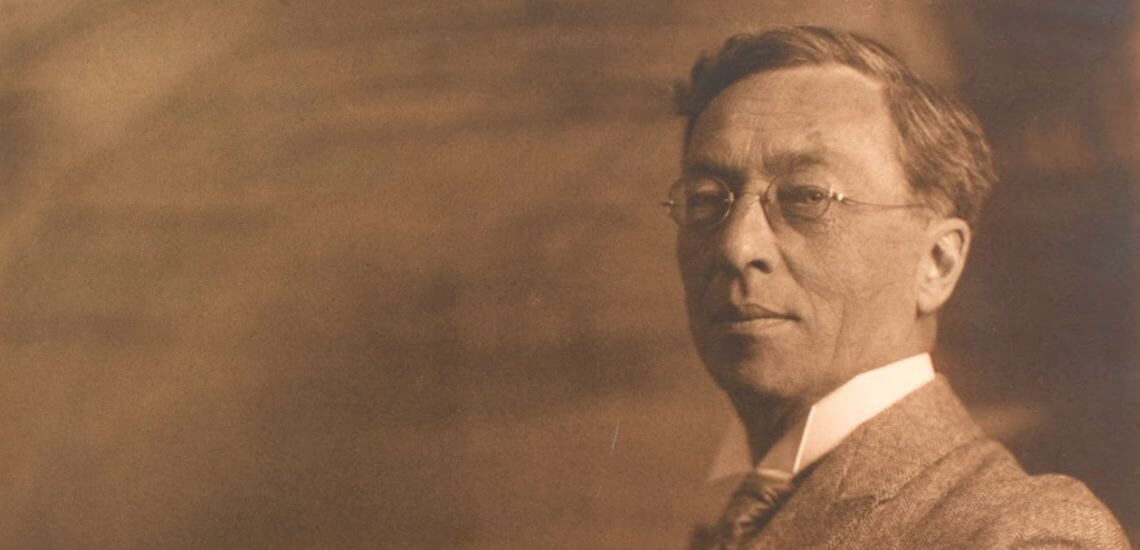
Wassily Kandinsky (1866–1944) was a Russian painter and art theorist, counted among the pioneers of abstract painting. He lectured in law in Moscow before taking up painting at 30, then worked in Munich, Moscow and at the Bauhaus, and spent his last decade outside Paris. His best-known works are the ten Compositions, and his books On the Spiritual in Art and Point and Line to Plane set out a theory linking colour, form and sound.
Wassily Kandinsky at a glance:
- Russian painter and theorist, born in Moscow in December 1866, died in Neuilly-sur-Seine near Paris on 13 December 1944.
- A law lecturer until the age of 30, he moved to Munich in 1896 to study painting.
- His first abstract oil, in his own words, was Picture with a Circle (1911); the same year he and Franz Marc founded Der Blaue Reiter.
- The auction record for his work, £37.2m, was set by Murnau mit Kirche II at Sotheby’s in London in March 2023.
Who was Wassily Kandinsky?
Kandinsky was a Russian painter, printmaker and art theorist who came to painting after a career in law. He was born in Moscow in December 1866, the son of a tea merchant, and one of his great-grandmothers was Princess Gantimurova. The Guggenheim and MoMA spell his first name Vasily, the Centre Pompidou Vassily.

He spent most of his childhood in Odesa, where his father encouraged his interest in art with private drawing classes and piano and cello lessons. In 1886 he enrolled at the University of Moscow to study law and economics. After graduating in 1892 he married his cousin Anja Chimiakina and began lecturing in law at the university. He was offered a chair in Roman law at the University of Dorpat, now Tartu in Estonia, but in 1896 he gave up the academic career and left for Munich to study painting.
Why did Kandinsky give up law for painting?
In his autobiographical Reminiscences (1913) Kandinsky traced his move into painting to experiences of colour and music from his Moscow years.
In 1889 he joined an ethnographic expedition to the Vologda region north of Moscow. The houses and churches there were painted in such shimmering colours that stepping inside felt to him like walking into a picture, and the region’s folk art, with bright colours set on dark grounds, carried over into his early work. In 1896, shortly before leaving Moscow, he saw one of Claude Monet’s Haystacks at an exhibition. He could not tell what it showed until he read the catalogue, yet the colour gripped him and the painting stayed in his memory. A performance of Wagner’s Lohengrin in Moscow had a similar effect: while listening, he saw his colours before his eyes.

What did Kandinsky do in Munich and Murnau?
In Munich Kandinsky first studied at Anton Ažbe’s private school, as the Academy of Fine Arts did not admit him straight away, and in 1900 he joined Franz von Stuck’s class at the Academy. In 1901 he co-founded Phalanx, an artists’ association opposed to the conservative art institutions, which also ran a school. One of his students there was Gabriele Münter, who became his partner for the next 15 years. Kandinsky divorced Anja only in 1911.

He and Münter travelled widely in Europe and North Africa before settling in Bavaria. His painting The Blue Rider (1903), now in a private collection, shows a small cloaked rider on a galloping horse, built from patches of colour rather than drawn detail. In 1909 Münter bought a house in Murnau, a small town south of Munich, where the couple lived and worked for long periods and received fellow artists. Landscapes from this time, such as The Blue Mountain (1908–09), reduce riders, trees and hills to flat areas of strong colour.
In 1909 Kandinsky also became president of the newly founded Neue Künstlervereinigung München (NKVM), an association of Munich artists set up as an alternative to the established exhibition venues.
How did Kandinsky arrive at abstract painting?
Kandinsky reached abstraction step by step around 1910, by loosening the link between colour and the objects it described until the objects disappeared. In a letter of 1935 he named Picture with a Circle (1911), now in the Georgian National Museum in Tbilisi, as his very first abstract painting. An untitled watercolour that he signed and dated 1910, long described as the first abstract work, is dated by the Centre Pompidou, which owns it, to 1913 and identified as a study for Composition VII.
He described two moments that cleared the way. Coming back to his studio one day, he saw a painting made only of forms and colours whose subject he could not make out, then realised it was one of his own canvases, turned the wrong way. He concluded that objects were harming his pictures. In Reminiscences he also wrote that the news that the atom could be divided further felt like the collapse of the whole world and shook his faith in science.
In December 1911 he published On the Spiritual in Art, which argued that colour can act on its own, apart from describing objects, and that painters should follow ‘inner necessity’ rather than copy nature. The same month the NKVM jury rejected his Composition V. Kandinsky and Franz Marc left the association and opened a rival exhibition at the same Munich gallery under the name Der Blaue Reiter (the Blue Rider). The group, which also included August Macke and Münter, published The Blue Rider Almanac and held exhibitions until the outbreak of the First World War ended its plans.
What did Kandinsky do in Russia between 1914 and 1921?
When war broke out in 1914, Kandinsky, a Russian citizen, had to leave Germany. He left most of his paintings in Münter’s care and travelled back to Moscow via Switzerland the same year. Their relationship ended in Stockholm in 1916, and in 1917 he married Nina Andreevskaya, born in 1899. Their son Vsevolod, born in 1917, died in 1920.
He painted little in these years, although in 1916 he produced Moscow I, a view of Red Square with the city’s landmarks circling the centre of the canvas. After the October Revolution he worked in the new cultural administration. From 1918 to 1921 he taught and held posts in art education and museum reform, helped Alexander Rodchenko set up 22 museums in the provinces and became the first director of the Institute of Artistic Culture (INKhUK) in Moscow. The institute’s radical members rejected his spiritual view of art as too individualistic. In 1921 Walter Gropius invited him to teach at the Bauhaus, and he left Russia.

What did Kandinsky teach at the Bauhaus?
At the Bauhaus Kandinsky taught the basic course in form and colour, ran the wall-painting workshop and, from 1927 in Dessau, led a free painting class with Paul Klee. He taught there from 1922 until the school closed under Nazi pressure in 1933.
He was prolific at the school: 259 paintings and 289 watercolours date from his Bauhaus years. His teaching on the basic elements of a picture went into Point and Line to Plane, published in 1926 in the Bauhaus book series. In 1924, at the initiative of the dealer Galka Scheyer, he formed Die Blaue Vier (the Blue Four) with Klee, Lyonel Feininger and Alexej von Jawlensky, and Scheyer promoted their work in the United States.

After the school moved to Dessau, Kandinsky and Klee shared one of the semi-detached Masters’ Houses designed by Gropius, from 1926. Kandinsky became a German citizen in 1928. In July 1930 the American collector Solomon R. Guggenheim visited him in Dessau with the artist Hilla Rebay and began buying his work.
How did Kandinsky spend his last years in Paris?
Kandinsky spent his last 11 years in Neuilly-sur-Seine, on the western edge of Paris, where he moved with Nina at the end of 1933. Marcel Duchamp found them a three-room flat on the sixth floor of a new building at 135 boulevard de la Seine, overlooking the river, and Kandinsky turned the living room into his studio.

His Paris paintings replace the hard geometry of the Bauhaus with soft, biomorphic shapes that recall microscopic organisms, and he sometimes mixed sand into the paint to give it a grainy texture. He now preferred to call his painting ‘concrete’ rather than ‘abstract’. Recognition in France came slowly, as Surrealism and Cubism set the tone of the Paris avant-garde.
In Germany, the Nazis confiscated 57 of his works in 1937 during their purge of ‘degenerate art’, and some were shown in the Degenerate Art exhibition in Munich. Kandinsky became a French citizen in 1939. From 1942, when prepared canvas could no longer be found in occupied Paris, he painted on cardboard and wooden boards. He kept working until his last year and died of a stroke in Neuilly-sur-Seine on 13 December 1944.

What is Kandinsky’s colour theory?
Kandinsky treated colour as a force that acts directly on the viewer’s emotions, independent of the objects it describes, and he explained its effects through music. In On the Spiritual in Art he compared colours with instruments: light blue with the flute, darker blue with the cello, a deeper blue with the double bass and the deepest blue with the organ, yellow with a high trumpet and vermilion with the tuba. Following Goethe, he treated yellow and blue as the strongest pair of opposites.
The same musical thinking shaped his titles. He divided his paintings into Impressions, based on a direct impression of the outside world; Improvisations, which recorded sudden inner reactions; and Compositions, which he developed slowly and deliberately. He painted Impression III (Concert) (1911) the day after a concert of Arnold Schoenberg’s music that he attended with Franz Marc in Munich on 2 January 1911.

At the Bauhaus he tied colour to form. In his scheme the triangle was yellow, the square red and the circle blue, and in 1923 his wall-painting workshop handed out a questionnaire asking Bauhaus members to match the three shapes with the three colours and give their reasons. He gave the circle special weight, describing it as the shape that points most clearly to a fourth dimension, and wrote that he now loved the circle as he had once loved the horse.
Behind all of this lay what he called ‘inner necessity’: the inner, spiritual impulse that he believed should guide every decision a painter makes.
Was Kandinsky a synaesthete?
Kandinsky described experiences typical of synaesthesia, in which a stimulus to one sense also produces a sensation in another. As a child he heard a hissing sound when he mixed the colours in his paintbox, and at Lohengrin he saw colours while hearing the music.
Dyedra Just, who examined his writings against modern diagnostic criteria, notes that the scientific literature disagrees on whether his synaesthesia was genuine, and concludes that it was inborn. Sean Rainbird, curator of the Kandinsky exhibition at Tate Modern in 2006, thought he was ‘quite a natural’ at it, and pointed out that Composition VII, the largest canvas he ever painted, took him just three days.
What are Kandinsky’s most famous paintings?
The two paintings singled out by the museums that hold them are Composition VII (1913) and Gelb-Rot-Blau (‘Yellow-Red-Blue’, 1925). MoMA’s 1995 exhibition of Kandinsky’s ten Compositions presented Composition VII as the culmination of his shift from depicting the outside world to expressing an inner, spiritual one, and the Centre Pompidou counts Gelb-Rot-Blau as the most important painting of his Bauhaus period.
Composition VII, now in the State Tretyakov Gallery in Moscow, was preceded by more than 30 drawings, watercolours and studies. Its colours swirl across the canvas without a recognisable subject, although small signs for boats, mountains and figures are hidden among them. Composition 8 (1923), part of Solomon R. Guggenheim’s founding collection, belongs to the Bauhaus years: flat planes of colour, circles, triangles and a chequerboard, drawn with clear lines.

Gelb-Rot-Blau, two metres wide, sets a vertical yellow rectangle and an inclined red cross against a large dark blue circle. Nina Kandinsky later called the years 1925 to 1928 his circle period, and Several Circles (1926) belongs to it. The last two Compositions came in Paris: Composition IX (1936) and Composition X (1939), whose coloured shapes float on a black ground.
| Painting | Year | Collection |
|---|---|---|
| The Blue Rider | 1903 | private collection |
| The Blue Mountain | 1908–09 | Solomon R. Guggenheim Museum, New York |
| Picture with a Circle | 1911 | Georgian National Museum, Tbilisi |
| Impression III (Concert) | 1911 | Lenbachhaus, Munich |
| Composition VII | 1913 | State Tretyakov Gallery, Moscow |
| Moscow I | 1916 | State Tretyakov Gallery, Moscow |
| Composition 8 | 1923 | Solomon R. Guggenheim Museum, New York |
| Gelb-Rot-Blau | 1925 | Centre Pompidou, Paris |
| Swinging | 1925 | Tate |
| Several Circles | 1926 | Solomon R. Guggenheim Museum, New York |
| Composition IX | 1936 | Centre Pompidou, Paris |
| Composition X | 1939 | Kunstsammlung Nordrhein-Westfalen, Düsseldorf |
Kandinsky and design: from the Bauhaus to the Wassily chair
Kandinsky’s link with design runs through the Bauhaus, where he worked on walls, rooms and a stage as well as on canvas. In 1922 he designed painted wall panels for a room at the Juryfreie Kunstschau in Berlin, prepared by Bauhaus students. In 1923 the wall-painting workshop he led as master of form applied his yellow triangle, red square and blue circle to compositions on the walls of the school.
In Dessau the residents of the Masters’ Houses chose their own interior colour schemes, and the difference is most visible in the semi-detached house that Kandinsky shared with Klee. In 1928 he designed the sets and staging for Mussorgsky’s Pictures at an Exhibition at a Dessau theatre, the only one of his theatre works to reach the stage. In 1932 Ludwig Mies van der Rohe commissioned him to design a ceramic wall decoration for a music room.
The tubular steel club chair B3, designed by Marcel Breuer in the mid-1920s while he ran the Bauhaus furniture workshop, is known today as the Wassily chair. It was not designed for Kandinsky. He admired it, and Breuer made one for his rooms, but the name appeared only in the 1960s, when the Italian manufacturer Gavina reissued the chair from 1962. Knoll took over Gavina in 1968 and still produces it.
What is the most expensive Kandinsky painting?
The auction record for Kandinsky is £37.2m, paid for Murnau mit Kirche II (‘Murnau with Church II’, 1910) at Sotheby’s in London on 1 March 2023. The painting comes from the Murnau years, when he was moving towards abstraction.

It belonged to Johanna Margarete Stern-Lippmann and Siegbert Stern, textile manufacturers and collectors, from whom the Nazis seized it; Johanna was murdered at Auschwitz. From 1951 the painting hung in the Van Abbemuseum in Eindhoven, and after a long legal case it was returned in 2022 to the family, whose 13 descendants shared the proceeds of the sale. The previous record, £33m, was set in 2017 by Bild mit weissen Linien (‘Painting with White Lines’, 1913), also at Sotheby’s. In October 2026 Christie’s in London sold Das bunte Leben (‘The Colourful Life’, 1907), another painting returned to its owners’ heirs, for about $42.5m, below the record.
Where can you see Kandinsky’s paintings?
Three museums hold large groups of Kandinsky’s work, each built around one person: the Lenbachhaus in Munich, the Solomon R. Guggenheim Museum in New York and the Centre Pompidou in Paris. Several key canvases hang elsewhere, in Moscow, Tbilisi and Düsseldorf.
The Lenbachhaus owes its collection to Gabriele Münter, who on her 80th birthday in 1957 gave the museum more than a thousand works by the Blue Rider artists, among them 90 oil paintings and around 330 watercolours and drawings by Kandinsky. The Guggenheim holds more than 150 of his works, built from Solomon R. Guggenheim’s purchases, and describes its group as the largest in the United States and the third largest in the world. The Centre Pompidou received the bequest of Nina Kandinsky, who outlived her husband by 36 years. Its Paris building closed for renovation on 22 September 2025 and is due to reopen in 2030. In the meantime works from its collection travel to other venues, and its programme includes the exhibition Kandinsky at Palazzo Bonaparte in Rome, on view until 14 February 2027.
| Work | Where |
|---|---|
| Composition VII (1913), Moscow I (1916) | State Tretyakov Gallery, Moscow |
| Picture with a Circle (1911) | Georgian National Museum, Tbilisi |
| Impression III (Concert) (1911) and much of the work made before 1914 | Lenbachhaus, Munich |
| The Blue Mountain (1908–09), Composition 8 (1923), Several Circles (1926) | Solomon R. Guggenheim Museum, New York |
| Gelb-Rot-Blau (1925), Composition IX (1936) | Centre Pompidou, Paris (building closed until 2030) |
| Composition IV (1911), Composition X (1939) | Kunstsammlung Nordrhein-Westfalen, Düsseldorf |
| Circles in a Circle (1923) | Philadelphia Museum of Art |
| Swinging (1925) | Tate, shown at Tate St Ives |
| Kandinsky/Klee Masters’ House | Dessau, part of the Bauhaus UNESCO World Heritage Site |

Facts and myths about Wassily Kandinsky
Kandinsky is often called the first abstract painter, yet the Swedish artist Hilma af Klint was making non-objective paintings by 1906, years before his first abstract works. Her pictures stayed largely unseen for decades, and the Guggenheim’s 2018 exhibition of her work became the most visited in the museum’s history.
His first abstract pictures did not win over the critics, who took him for a madman. Much of his early work survived thanks to Münter, who hid the paintings he had left in Murnau in the cellar of her house during the Nazi years.
The Guggenheim, so closely tied to his name, sold about 50 of its Kandinsky paintings in 1964 to free up space. Kandinsky was also the uncle of the Russian-French philosopher Alexandre Kojève.
Wassily Kandinsky – frequently asked questions
What is Wassily Kandinsky famous for?
He is known as one of the first painters to work in pure abstraction, for his ten Compositions, for a theory that links colour, form and music, and for his teaching at the Bauhaus.
How many Compositions did Kandinsky paint?
Ten. The first seven date from 1910 to 1913, and the last three from 1923, 1936 and 1939. The first three were destroyed during the Second World War and are known only from black-and-white photographs taken by Gabriele Münter.
Why did Kandinsky call his art ‘concrete’?
In Paris he came to prefer ‘concrete’ to ‘abstract’ for his own painting. In several texts of 1938, including ‘Abstract or Concrete?’, he applied the term to his whole non-objective work.
Where does the name Der Blaue Reiter come from?
Kandinsky had already painted The Blue Rider in 1903. When he and Franz Marc named their group in 1911, the name joined Marc’s love of horses, Kandinsky’s interest in the figure of the rider and their shared liking for the colour blue.
What nationality was Kandinsky?
He was born Russian, became a German citizen in 1928 and took French citizenship in 1939, five years before his death.
A large abstract painting changes how a whole room reads, because it sets the palette and draws the eye. How to pair one with wall colour, lighting and furniture is a question worth taking to a specialist. Find architects, interior designers and interior photographers in the PLNDesign directory.
See also:
- Claude Monet: life, paintings and the garden at Giverny
- Rafal Olbinski: the Polish poster artist of poetic surrealism