

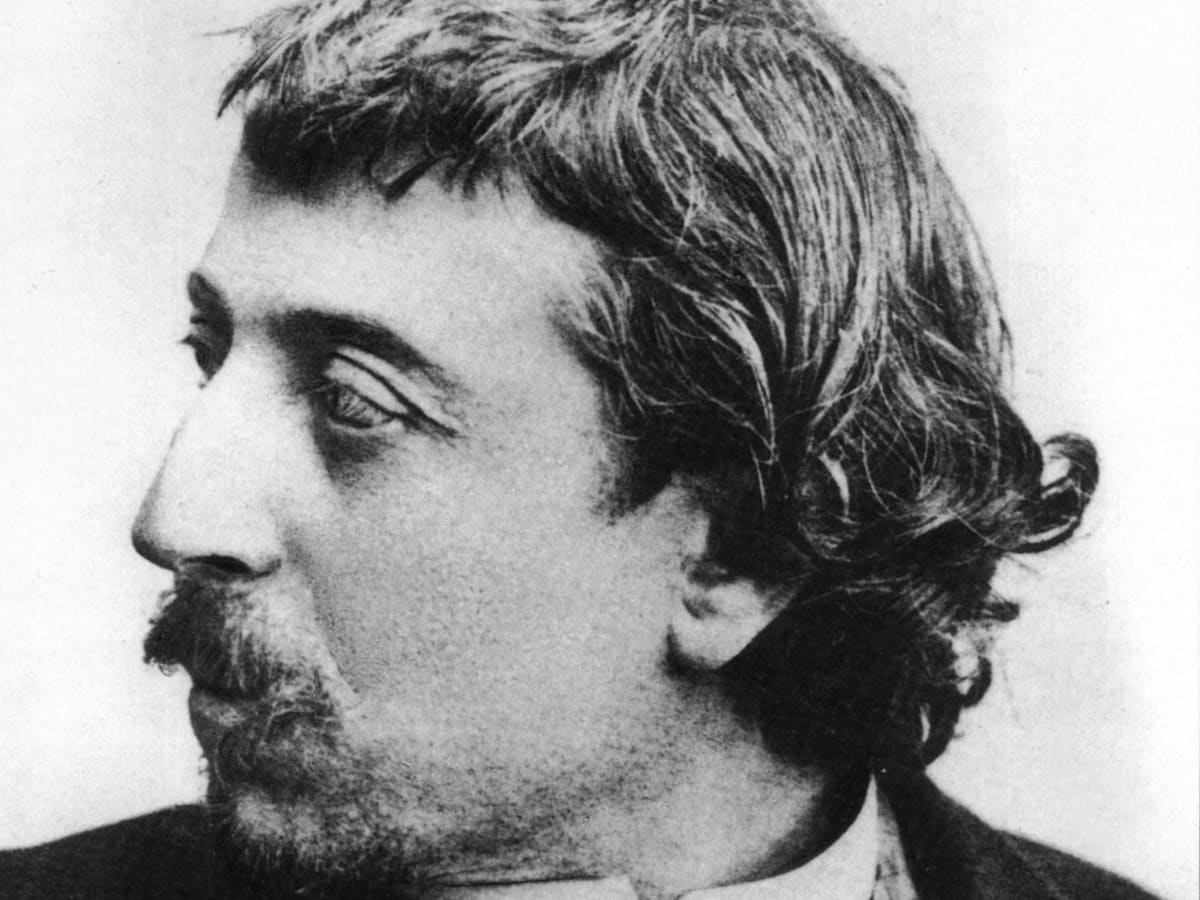
Paul Gauguin (1848–1903) was a French painter, sculptor and printmaker, a leading figure of Post-Impressionism and one of the founders of Synthetism. A Paris stockbroker until his mid-thirties, he worked in Brittany, Martinique and Arles before spending most of his last 12 years in French Polynesia, where he painted his best-known canvases.
Paul Gauguin at a glance:
- Born in Paris in 1848, he spent part of his childhood in Peru, served at sea and worked as a stockbroker before turning to painting full-time in 1883.
- A leading figure of the Pont-Aven School in Brittany, he painted in flat areas of strong colour inside dark outlines, borrowing from Japanese prints, Breton crucifixes and Pacific carving.
- His largest painting, Where Do We Come From? What Are We? Where Are We Going? (1897–98), which he considered his greatest work, belongs to the Museum of Fine Arts, Boston.
- He died in Atuona in the Marquesas Islands on 8 May 1903, aged 54, after two long stays in Tahiti.
Who was Paul Gauguin?
Paul Gauguin was a French painter of the Post-Impressionist generation who also carved wood, made ceramics and printed woodcuts. He was born Eugène Henri Paul Gauguin in Paris on 7 June 1848 and came to art late, after careers at sea and on the stock exchange.
His father, Clovis, was a liberal journalist from Orléans. His mother, Aline, was the daughter of Flora Tristan, a writer and early socialist activist whose family, the Tristan Moscosos, was wealthy and powerful in Peru. Gauguin kept copies of his grandmother’s books with him to the end of his life.

When Paul was a small child, the family sailed for Peru, where Clovis hoped to start a newspaper with the help of his wife’s relatives. He died of a heart attack on the voyage. Aline and her two children were taken in by her great-uncle, and Gauguin had a privileged childhood in Lima until about the age of six. In 1854 the family returned to France, and Paul grew up in Orléans with his paternal grandfather, attending schools there and in Paris. After school he signed on as a pilot’s assistant in the merchant navy and later spent two years in the French Navy.
How did Gauguin become a painter?
Gauguin came to painting as a collector. As a well-paid stockbroker in Paris he bought pictures by young artists and painted in his spare time, and in 1883, after a financial crash had cut his income, he decided to paint full-time.
He returned to Paris in 1871, aged 23, and found a job at the Paris Bourse through Gustave Arosa. By 1879 he was earning 30,000 francs a year as a broker and about as much again from dealing in pictures. He befriended Camille Pissarro, who introduced him to the other Impressionists. Edgar Degas was among his early buyers and supporters.

In 1873 he married Mette-Sophie Gad, a Dane, and they had five children. The crash of 1882 hit both the stock market and the art market, and his earnings fell sharply. In October 1883 he told Pissarro that he would paint full-time. The family moved to Rouen in January 1884 and then to Copenhagen, where Gauguin joined them in November and tried to make a living selling tarpaulins. He spoke no Danish, there was little demand for French tarpaulins, and the business failed. Mette, who gave French lessons to trainee diplomats, became the main earner.
In June 1885 Gauguin went back to Paris, partly at Mette’s urging, taking their six-year-old son Clovis with him. The other four children stayed with their mother in Copenhagen, where she worked as a translator and French teacher with the support of her family and friends. Gauguin saw his family for the last time in Copenhagen in 1891, shortly before he sailed for Tahiti, and in 1894 Mette broke with him for good.
What did Gauguin do in Pont-Aven and Martinique?
In Pont-Aven, an artists’ colony in Brittany, Gauguin became the leading figure of a group of young painters, and in 1887 he spent five months painting on Martinique. He first worked in Pont-Aven in the summer of 1886 and was popular with the young students there. With Émile Bernard, Charles Laval and others he formed the circle now known as the Pont-Aven School.
In April 1887 he left with Laval for Panama, where he worked as a labourer on the canal and fell seriously ill. The two painters then moved on to Martinique, where they stayed from June to November, and 11 of Gauguin’s paintings from the island are known.

By December he was back in Paris. That month, at Vincent van Gogh’s suggestion, Vincent’s brother Theo visited Gauguin’s studio to see the new Martinique canvases. Theo managed the Boussod, Valadon & Cie gallery on boulevard Montmartre, where early in 1888 he showed Gauguin’s paintings and ceramics, and he bought one of the Martinique pictures for 400 francs.
Back in Brittany in 1888, Gauguin painted Vision of the Sermon (Jacob Wrestling with the Angel), now in the Scottish National Gallery in Edinburgh. Breton women in regional dress watch the biblical fight on a flat red ground, divided by a diagonal tree trunk.
What happened between Gauguin and van Gogh in Arles?
Gauguin and Vincent van Gogh were friends and fellow painters who lived and worked together in Arles for nine weeks at the end of 1888. The stay ended on 23 December, when, after a quarrel, van Gogh mutilated his own left ear.
Gauguin arrived in Arles on 23 October 1888, at Theo’s instigation, and moved into the Yellow House, where Vincent lived and worked. Several of the canvases he painted there are on coarse jute, among them Washerwomen (1888), now at the Museum of Modern Art in New York.
Years later Gauguin wrote that on the night of the quarrel Vincent had first confronted him with a razor. Gauguin left Arles soon afterwards, but the two painters went on writing to each other, and in 1890 Gauguin proposed setting up an artists’ studio in Antwerp.
Why did Gauguin go to Tahiti?
Gauguin went to Tahiti to get away from European civilisation and, in his own words, ‘everything that is artificial and conventional’. He sailed in April 1891, stayed two years, and returned for good in 1895.
A sale of his work at the Hôtel Drouot auction house in Paris in February 1891 paid for the journey, and he left France on 1 April. He spent his first three months in Papeete, the colonial capital, which disappointed him, and then settled at Mataiea. There he lived with Teha’amana, whom he called Tehura in his book Noa Noa (‘Fragrance’). She posed for Manaò tupapaú (‘Spirit of the Dead Watching’, 1892), in which a girl lies face down on a bed, watched by the dark figure of a spirit of the dead.

The first stay produced Ia Orana Maria (‘Hail Mary’, 1891), in which an angel reveals Mary and the infant Jesus as Tahitians. The Metropolitan Museum of Art describes it as his first major Tahitian canvas. Tahitian Women (Femmes de Tahiti, 1891) dates from the same year, and Arearea (‘Joyfulness’, 1892) shows two seated women and a red dog in the foreground, with women worshipping a statue behind them.
In August 1893 he was back in France. He received a 13,000-franc inheritance from his uncle Isidore, which he at first refused to share with Mette. The Durand-Ruel gallery showed his Tahitian work in November 1893 to mixed reviews: Degas praised the show and bought a painting, while Monet, Renoir and Pissarro mocked it. In 1894, between the two Tahitian stays, he painted Breton Peasant Women (Paysannes bretonnes) in Pont-Aven.
He arrived back in Tahiti in September 1895 and lived near Papeete. In April 1897 he learnt that his daughter Aline had died of pneumonia. Later that year he began Where Do We Come From? What Are We? Where Are We Going?, which at 139.1 by 374.6 centimetres is the largest painting he attempted. It reads from right to left, from a sleeping infant to an old woman nearing death, and Gauguin himself considered it his greatest work. At the end of 1897, after finishing it, he attempted suicide, as he told his friend Daniel de Monfreid in a letter.
In 1898–99 he took a clerical job in Papeete. Around 1899 the dealer Ambroise Vollard gave him a contract: 300 francs a month and materials in return for at least 25 paintings a year at 200 francs each. Gauguin also turned to journalism. He wrote for Les Guêpes (‘The Wasps’), which he edited from February 1900 to September 1901, founded his own paper, Le Sourire (‘The Smile’), and used both to attack the colonial governor.
How did Gauguin die?
Gauguin died at his house in Atuona, on Hiva Oa in the Marquesas Islands, on 8 May 1903, aged 54, after months of illness and pain. He is buried in Calvary Cemetery, which overlooks the town.
He reached Atuona on 16 September 1901 and, with the help of his neighbour Tioka, built a two-storey house and studio that he called the Maison du Jouir (‘House of Pleasure’). In the Marquesas he painted landscapes, still lifes and figure studies, partly with Vollard’s clients in mind.

His last two years were spent in open conflict with the colonial administration and the Catholic mission. In April 1902 he refused to pay his taxes and urged other settlers to do the same. In November he published an open letter attacking Governor Petit, and he kept up a long quarrel with Bishop Martin over the mission schools, mocking the bishop in carved figures.
His health failed through 1902. Pain in his ankle drove him to inject morphine from September and later to take laudanum, his eyesight was weakening, and by December he could barely paint. He began a memoir, Avant et après (‘Before and After’). When he died, Breton Village in the Snow stood on the easel in his studio.
What is Gauguin’s style?
Gauguin painted in flat areas of saturated colour enclosed by dark contours and used simplified forms to express spiritual and emotional states. He is classed as a Post-Impressionist, a Synthetist and a Symbolist.
The critic Édouard Dujardin coined the term Cloisonnism for the method of Émile Bernard, with its flat colour and bold outlines, which Gauguin admired. Synthetism, the style that Gauguin and his circle developed in Brittany, gave form and colour equal weight. Gauguin owned prints by Hiroshige and Hokusai, and the wrestling figures in Vision of the Sermon come from Hokusai’s Manga.

Many of his compositions start from existing images. The Yellow Christ (Le Christ jaune, 1889), now in the Buffalo AKG Art Museum, is based on a 17th-century painted wooden crucifix in the nearby Trémalo Chapel. Gauguin set the crucifixion in the Breton landscape, with local women in regional dress kneeling at the hour of the Angelus. In Tahiti he based Ia Orana Maria on a photograph of a relief from the temple of Borobudur in Java, and for Arearea he enlarged a small Maori motif into the idol in the background and invented the rite around it.
He also painted himself among his own works. In Self-Portrait with the Yellow Christ (Portrait de l’artiste au Christ jaune, 1890–91), now in the Musée d’Orsay, the crucified Christ on the left takes on his features, and on the right stands a stoneware pot in the form of a grotesque head, which he called the head of ‘Gauguin the savage’. The Musée d’Orsay reads the picture as Gauguin placing himself between the angel and the beast.
Where can you see Gauguin’s most famous paintings today?
Most of Gauguin’s best-known paintings belong to public museums in Paris, Boston, New York, Buffalo, Edinburgh and London, and the Musée d’Orsay holds four of those listed below. The exception is When Will You Marry? (Nafea faa ipoipo?, 1892), which was sold in 2015 to a buyer in Qatar.
| Work | Year | Collection | City |
|---|---|---|---|
| Vision of the Sermon (Jacob Wrestling with the Angel) | 1888 | Scottish National Gallery | Edinburgh |
| Washerwomen | 1888 | Museum of Modern Art | New York |
| The Yellow Christ | 1889 | Buffalo AKG Art Museum | Buffalo |
| Self-Portrait with the Yellow Christ | 1890–91 | Musée d’Orsay | Paris |
| Tahitian Women | 1891 | Musée d’Orsay | Paris |
| Ia Orana Maria | 1891 | Metropolitan Museum of Art | New York |
| Arearea | 1892 | Musée d’Orsay | Paris |
| Manaò tupapaú | 1892 | Buffalo AKG Art Museum | Buffalo |
| When Will You Marry? | 1892 | sold in 2015 to a buyer in Qatar | Qatar |
| Breton Peasant Women | 1894 | Musée d’Orsay | Paris |
| Nevermore | 1897 | Courtauld Gallery | London |
| Te Rerioa (‘The Dream’) | 1897 | Courtauld Gallery | London |
| Where Do We Come From? What Are We? Where Are We Going? | 1897–98 | Museum of Fine Arts | Boston |
| Faa Iheihe | 1898 | Tate, on loan to the National Gallery | London |
| Three Tahitians | 1899 | Scottish National Gallery | Edinburgh |
What sculpture, ceramics and prints did Gauguin make?
Gauguin made stoneware ceramics, carved and painted wood reliefs, decorated his last house with carved panels and produced a suite of woodcuts. His best-known sculpture, Oviri, is a stoneware figure he wanted on his grave.
In 1886 the engraver Félix Bracquemond introduced him to the ceramicist Ernest Chaplet, who taught him to work in stoneware in his Vaugirard workshop over the winter of 1886–87. Together they made about 55 stoneware pots.
Oviri (‘Savage’, 1894), now in the Musée d’Orsay, is a partially glazed stoneware figure 75 centimetres high, standing on a dead she-wolf, which the museum links to themes of death and wildness. It was fired in Chaplet’s kiln in December 1894. When Gauguin submitted it to the Salon in 1895, the poet Charles Morice said it was ‘literally expelled’, while Vollard later claimed it was admitted only after Chaplet threatened to withdraw his own work. In 1900 Gauguin asked Daniel de Monfreid to send the figure for his tomb, but Monfreid did not send it. A bronze cast was placed on his grave in Atuona in 1973.

Be In Love and You Will Be Happy (Soyez amoureuses vous serez heureuses, 1889), carved in Pont-Aven and now in the Museum of Fine Arts, Boston, is a painted linden-wood relief measuring 95 by 72 centimetres. Gauguin called it ‘the best and strangest thing’ he had done in sculpture.
In Atuona he carved the lintel and door panels of the Maison du Jouir in redwood and painted them. The lintel is 244 centimetres long, and the lower panels carry the mottoes ‘Soyez mystérieuses’ (‘Be mysterious’) and ‘Soyez amoureuses et vous serez heureuses’, which echoes the title of the 1889 relief. The Musée d’Orsay bought the panels in 1953 from the heirs of the writer Victor Segalen.
Back in France in 1893–94 he made Noa Noa (‘Fragrance’), a suite of ten woodcuts intended for an illustrated book about Tahiti that was never realised. The impressions vary in inking, and some are slightly off register. Louis Roy printed the first impressions and Gauguin’s son Pola made later ones. The Museum of Modern Art holds the suite, and the Metropolitan Museum of Art owns one of the woodblocks.
Why is Gauguin controversial?
Gauguin is controversial above all because of his relationships with teenage girls in Tahiti and the Marquesas. By his own account, Teha’amana was 13 when they began living together. During his second stay in Tahiti he began a relationship with Pau’ura when she was 14, and in Atuona he lived with Vaeoho, also 14. The Buffalo AKG Art Museum, which owns Manaò tupapaú, presents the painting as the work of an artist projecting primitivist preconceptions onto his model and of a much older man in a position to take advantage of her. His campaigns against the colonial administration have their critics as well: the biographer Bengt Danielsson attributed some of Gauguin’s complaints about the authorities to wounded vanity.

How did Gauguin influence later artists?
Gauguin’s reputation grew after his death, helped by Vollard and by two posthumous exhibitions in Paris, and his work influenced the French avant-garde, including Pablo Picasso and Henri Matisse. In Britain, Tate Modern showed Gauguin: Maker of Myth in 2010–11, organised with the National Gallery of Art in Washington, and the National Gallery followed with The Credit Suisse Exhibition: Gauguin Portraits in 2019–20, which it presented as the first exhibition devoted to his portraits.
The influence began in his lifetime. In October 1888 in Pont-Aven he directed the young Paul Sérusier as he painted a small landscape. Sérusier’s fellow students named the picture The Talisman and made it the emblem of the group they went on to form, the Nabis. It is now in the Musée d’Orsay.
Paul Gauguin – frequently asked questions
How do you pronounce Gauguin?
In French the name is pronounced [ɡoɡɛ̃]: ‘au’ sounds like the o in ‘go’, the u in ‘guin’ only hardens the g, and the final syllable is nasal. English speakers usually say ‘go-GAN’. The correct spelling is Gauguin, not ‘Gaugin’.
How many children did Gauguin have?
Gauguin had five children with Mette-Sophie Gad: Émile (born 1874), Aline (1877), Clovis (1879), Jean René (1881) and Paul Rollon (1883). Aline died of pneumonia in 1897 and Clovis in 1900. Paul Rollon, known as Pola, became a painter, art critic and biographer and in 1937 published My Father Paul Gauguin.
What illness did Gauguin have?
On Martinique in 1887 he caught dysentery and marsh fever. In his last years he suffered from sores, which he called eczema, as well as erysipelas and heart trouble. The biographer Nancy Mowll Mathews links his heart condition to syphilis, but four teeth found in 2000 in a well behind his house in Atuona, matched by DNA to his grandson, showed no trace of mercury, the most common treatment for syphilis at the time.

What is the most expensive Gauguin painting?
The most expensive is When Will You Marry? (1892). The collector Rudolf Staechelin bought it in 1917, and his family lent it to the Kunstmuseum Basel for almost 50 years before selling it in 2015 to a buyer in Qatar. Documents from a 2017 lawsuit in London put the price at $210 million, $90 million less than the figure reported at the time of the sale.
Planning an interior around strong, saturated colour of the kind Gauguin used means balancing it against light, materials and furniture, and an interior designer can help find that balance. Find architects, interior designers and interior photographers in the PLNDesign directory.
See also:
- Salvador Dalí: life, famous paintings and where to see them
- Vincent van Gogh: life, illness, death and most famous paintings