

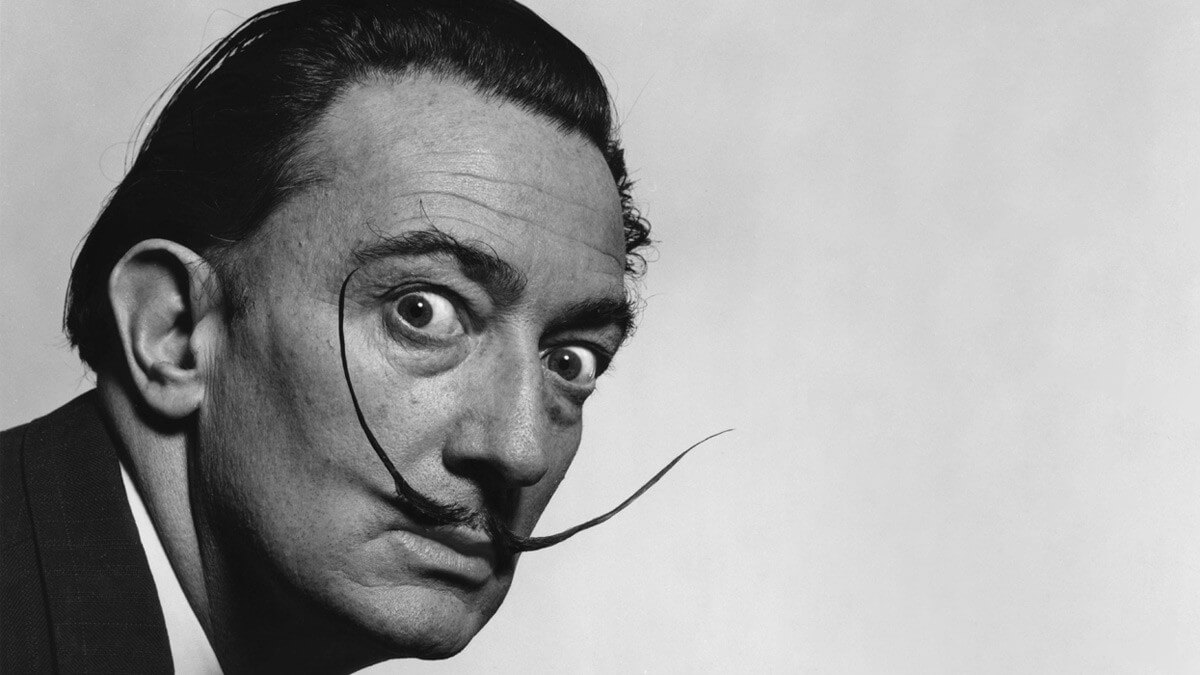
Salvador Dalí (1904–1989) was a Spanish painter, sculptor, designer and writer from Figueres in Catalonia, the best-known figure of Surrealism and the author of The Persistence of Memory, the painting with the melting clocks. Beyond painting, he made films with Luis Buñuel, worked with Elsa Schiaparelli and drew the Chupa Chups logo. From the early 1960s he worked on his own museum in Figueres, which opened in 1974 and where he is buried.
Salvador Dalí at a glance:
- A Catalan painter born in Figueres in 1904, he painted The Persistence of Memory in 1931, and MoMA in New York has owned it since 1934.
- The paranoiac-critical method, which he formulated around 1930, gave his paintings their double images, in which one set of shapes reads as two different things.
- The Surrealists put him on trial in 1934 over his alleged sympathy for Hitler and expelled him from the group in 1939.
- The Dalí Theatre-Museum in Figueres, opened in 1974, holds more than 1,500 works and had 710,297 visitors in 2025.
Who was Salvador Dalí and what is he famous for?
Salvador Dalí is famous for painting dreams and the subconscious with the precision of an old master. A handful of images identify him at once: the soft clocks of The Persistence of Memory, elephants on spindly legs, a giraffe in flames and a crucified Christ seen from above, floating over the earth.

He was born on 11 May 1904 in Figueres, in the north of Catalonia, as Salvador Dalí i Domènech. His father, Salvador Dalí Cusí, was a notary, an anti-clerical atheist and a Catalan federalist. His mother, Felipa Domènech, encouraged his drawing from childhood. In 1982 King Juan Carlos made him Marquis of Dalí de Púbol.
The other half of his fame was self-promotion. The upturned moustache, the capes, the paradoxical interviews and the public stunts made him a figure of popular culture within his own lifetime.
How did Dalí become a painter?
Dalí grew up in the shadow of a brother he never knew. The first Salvador, born in 1901, died on 1 August 1903, nine months before the painter was born. When Dalí was five, his parents took him to the grave and told him he was his brother’s reincarnation, a theme he returned to in Portrait of My Dead Brother (1963).
His talent showed early. The Catalan painter Ramon Pichot introduced him to Impressionism, and in 1917 his father organised a show of his charcoal drawings at the family home. In 1919, aged 14, he took part in his first public exhibition, at the Municipal Theatre in Figueres, the building he would later turn into his museum. His mother died in February 1921.

In 1922 he moved to Madrid to study at the Real Academia de Bellas Artes de San Fernando, the city’s royal academy of fine arts, and lived at the Residencia de Estudiantes, where he became friends with Federico García Lorca and Luis Buñuel. He spent long hours with the old masters at the Prado and cultivated the image of an eccentric. The academy suspended him in 1923 after a student protest over a teaching appointment and expelled him for good in 1926, after he declared the examining board incompetent to judge him.
That year he made his first trip to Paris, where he met Pablo Picasso. He had already had his first solo exhibition, at the Galeries Dalmau in Barcelona in 1925. In 1927 he painted Honey is Sweeter than Blood, now lost, which he described as ‘equidistant between Cubism and Surrealism’.
Why was Dalí expelled from the Surrealist group?
The break came in two stages: a ‘trial’ in 1934 over his alleged sympathy for Hitler, and expulsion in 1939. André Breton, who led the group, was his chief opponent throughout.
Dalí came into contact with the Paris Surrealists in 1929 through Joan Miró, who introduced him to Breton, the author of the first Manifesto of Surrealism (1924). It was a decisive year. Un Chien Andalou, the film he made with Buñuel, had its premiere, the Goemans gallery gave him his first solo show in Paris that November, and in the summer, in Cadaqués, he met Gala. A second film with Buñuel, L’Âge d’or, followed in 1930.

On 5 February 1934 the group held a ‘trial’ in Breton’s flat. Dalí was accused of sympathy for Hitler, and his painting The Enigma of William Tell was read as an insult to Lenin. He was not expelled that day. The final break came in 1939, when Breton attacked him in print and the group expelled him. Breton also rearranged the letters of his name into the anagram ‘Avida Dollars’ (greedy for dollars), a jibe at his commercial commissions. Dalí’s public support for Franco came later, after he settled back in Spain in 1948. Years after the split, in Diary of a Genius (1964), he wrote: ‘Le surréalisme, c’est moi’ (‘Surrealism is me’).
What did Dalí do in the United States?
Dalí spent eight years in the United States. He left Europe with Gala in 1940 to escape the war, spent the winter of 1940–41 at Hampton Manor, Caresse Crosby’s house in Virginia, and returned to Portlligat in 1948.
The high point came at the Museum of Modern Art in New York, which from 19 November 1941 to 11 January 1942 ran parallel solo exhibitions of Dalí and Joan Miró. The Dalí show then toured eight American cities. In 1942 he published his autobiography, The Secret Life of Salvador Dalí, and in 1944 the novel Hidden Faces.
He also worked in film. For Alfred Hitchcock’s Spellbound (1945) he designed a dream sequence of five scenes, three of which reached the screen after revisions made without Dalí or Hitchcock. The sequence, planned to run for around 20 minutes, was cut to about two. In 1946 he worked at the Disney studio with the artist John Hench on the short Destino, but only about 18 seconds were filmed at the time, and the film was completed in 2003.
Who was Gala?
Gala, born Elena Ivanovna Diakonova in Kazan in 1894, was Dalí’s wife, model and business manager. They met in Cadaqués in the summer of 1929, when she was ten years older than him and still married to the poet Paul Éluard.
They married in a civil ceremony in Paris on 30 January 1934, and in a Catholic ceremony on 8 August 1958 at the Els Àngels shrine near Girona. Gala ran the business side of his career, and from around 1931 Dalí signed many works with both their names, as ‘Gala Salvador Dalí’.

In 1969 Dalí gave her the castle of Púbol, which he could visit only with her written invitation. Gala died at Portlligat on 10 June 1982, aged 87, and was buried in the crypt at Púbol.
How did Salvador Dalí die?
Dalí died of heart failure on 23 January 1989, aged 84, in hospital in Figueres. His last decade was marked by illness. From 1980 his health declined sharply, with a severe tremor in his right arm and Parkinson-like symptoms, and he was treated for depression.

Gala’s death in 1982 deepened the crisis. He moved to Púbol, and from early 1984 he refused food and became severely undernourished. His last paintings, made around 1983, belong to the Catastrophes series inspired by René Thom’s mathematical catastrophe theory. At the end of August 1984 a fire in the bedroom at Púbol left him with severe burns, and he moved to Torre Galatea in Figueres. He had a pacemaker fitted in 1986 and was taken to hospital with heart failure in November 1988, the first of several admissions in his final months.
What is the paranoiac-critical method?
The paranoiac-critical method was Dalí’s way of seeing one thing in another: he cultivated delirious, irrational associations and then fixed them on canvas with academic precision. He formulated it around 1930 and defined it as a ‘spontaneous method of irrational knowledge’.

The method drew on Freud’s writing on dreams, and it produced his double images, in which the same shapes read as two different things. In Swans Reflecting Elephants (1937), now in a private collection, the swans on a lake are mirrored in the water as elephants. Tate describes Metamorphosis of Narcissus (1937) as the first painting Dalí made entirely according to the method.
This approach set him apart from much of the movement. The Metropolitan Museum of Art distinguishes two strands of Surrealist painting: the visual automatism of André Masson and Joan Miró, who let images emerge without conscious control, and the illusionistic Surrealism of Dalí, Paul Delvaux and Yves Tanguy, who painted dream scenes in a realistic manner.
After the Second World War Dalí developed what he called nuclear mysticism, set out in his Mystical Manifesto (1951). He approached religious subjects through atomic physics and geometry and, after the discovery of the structure of DNA in 1953, through genetics.
What are Dalí’s most famous paintings and where are they now?
The Persistence of Memory (1931) is the most famous, and the next section looks at it on its own. The paintings that made his name date from 1929 to 1937. Face of the Great Masturbator (1929) shows a distorted head in profile from which a female figure emerges. Soft Construction with Boiled Beans (Premonition of Civil War) (1936), a giant figure tearing itself apart above a Spanish landscape, was finished about six months before the war broke out, and the Philadelphia Museum of Art considers the subtitle likely to have been added after the coup. In Burning Giraffe (c. 1936–37), female figures with drawers in their bodies stand in front of a giraffe on fire.
One Second Before the Awakening from a Dream Provoked by the Flight of a Bee Around a Pomegranate shows Gala asleep, two tigers, a bayonet and an elephant on long, thin legs. The Temptation of St. Anthony (1946) sets a kneeling saint against a procession of elephants on stilt-like legs, and The Disintegration of the Persistence of Memory (1952–54) floods the landscape of the 1931 painting and breaks it into fragments.
After his return to Europe in 1948 Dalí turned to religious subjects. Christ of St John of the Cross (1951) shows the crucifixion from above, and Glasgow bought it in 1952 for £8,200. In Crucifixion (Corpus Hypercubus) (1954) Christ hangs on the unfolded net of a four-dimensional cube, and The Sacrament of the Last Supper followed in 1955. Gala posed for Madonna of Port Lligat (1949), and the same approach shapes Leda Atomica (1947–49) and Galatea of the Spheres (1952), a portrait of Gala built from spheres. The Hallucinogenic Toreador (1969–70) grew out of an image of the Venus de Milo on a box of pencils.
| Painting | Museum | City |
|---|---|---|
| The Persistence of Memory | Museum of Modern Art (MoMA) | New York |
| Face of the Great Masturbator | Museo Reina Sofía | Madrid |
| Soft Construction with Boiled Beans (Premonition of Civil War) | Philadelphia Museum of Art | Philadelphia |
| Burning Giraffe | Kunstmuseum Basel | Basel |
| Metamorphosis of Narcissus | Tate Modern | London |
| One Second Before the Awakening from a Dream Provoked by the Flight of a Bee Around a Pomegranate | Museo Nacional Thyssen-Bornemisza | Madrid |
| The Temptation of St. Anthony | Royal Museums of Fine Arts of Belgium | Brussels |
| Christ of St John of the Cross | Kelvingrove Art Gallery and Museum | Glasgow |
| The Disintegration of the Persistence of Memory | The Dalí Museum | St Petersburg, Florida |
| Crucifixion (Corpus Hypercubus) | Metropolitan Museum of Art | New York |
| The Sacrament of the Last Supper | National Gallery of Art | Washington |
| Madonna of Port Lligat (1949 version) | Haggerty Museum of Art, Marquette University | Milwaukee |
| Leda Atomica, Galatea of the Spheres | Fundació Gala-Salvador Dalí | Figueres |
| Portrait of My Dead Brother, The Hallucinogenic Toreador | The Dalí Museum | St Petersburg, Florida |
The highest price paid for a Dalí at auction remains the £13,481,250 that Portrait de Paul Eluard (1929) fetched at Sotheby’s in London in February 2011.
What does The Persistence of Memory mean?
Dalí linked the soft clocks to food rather than to theory. By his own account, the idea came to him after a meal, as he looked at a Camembert melting on the plate, and in a 1935 text he wrote of the ‘Camembert of time and space’. MoMA curator Anne Umland describes the clocks as ‘sagging, limpid, loose, floppy time pieces’. Britannica notes that some art historians connect the painting with Einstein’s theory of relativity, a link Dalí rejected.
The canvas is small, 24.1 by 33 cm. Dalí described the setting as a landscape near Portlligat, and the cliffs in the background are those of Cap de Creus on the Catalan coast. The painting sold for $250 and was shown at the Julien Levy Gallery in New York in 1932. MoMA has owned it since 1934, when it was given anonymously.
What did Dalí design beyond painting?
Dalí designed objects, jewellery, fashion motifs, magazine covers and a logo, and several of these pieces are now in museum collections. Among the most recognisable are the objects he made for the British patron Edward James. The Lobster Telephone (1938), produced by Green & Abbott in 11 receivers, seven white and four red, is held by Tate and the National Galleries of Scotland, among others. The Mae West Lips sofa (1938–39), made in five versions, is in the collections of the V&A in London and Museum Boijmans Van Beuningen in Rotterdam.
With Elsa Schiaparelli he worked on fashion. Dalí drew the lobster for her 1937 lobster-print evening dress, which Schiaparelli later gave to the Philadelphia Museum of Art, and her shoe hat of 1937–38 came from a photograph Gala took of him with a shoe on his head. Drawer pockets based on a 1936 drawing by Dalí appeared on Schiaparelli suits. Coco Chanel worked on the costumes for his ballet Bacchanale (1939), for which Dalí wrote the libretto and designed the sets.

His jewellery, made of gold and precious stones, includes The Eye of Time (1949), Ruby Lips (1949), with pearls for teeth, and The Royal Heart (1953), whose ruby heart pulses thanks to a mechanism inside. A set of 37 pieces from the former Owen Cheatham collection has been on show in the Dalí·Jewels rooms in Figueres since 2001. He also designed covers for American Vogue in 1939, 1944 and 1946, created the December 1971/January 1972 issue of Vogue Paris, and in 1969 drew the daisy-shaped logo for the Spanish lollipop maker Chupa Chups.
What is the Dalí Theatre-Museum in Figueres?
The Dalí Theatre-Museum is the museum Dalí designed for himself in his home town. It opened on 28 September 1974 in the former Municipal Theatre of Figueres, which had burnt down at the end of the Spanish Civil War, and the Fundació Gala-Salvador Dalí calls it his last great work.
The project began in the early 1960s, when the mayor, Ramon Guardiola, asked Dalí for a painting and Dalí offered a whole museum instead. He gave three reasons for the site: he saw himself as an eminently theatrical painter, the theatre stands opposite the church where he was baptised, and its entrance hall had hosted his first exhibition.

The route follows no chronology. Visitors move from the Rainy Taxi, a Cadillac in the courtyard in which it rains inside, to the Mae West Room, a three-dimensional version of his 1934–35 work Mae West’s Face which May be Used as a Surrealist Apartment, made with the architect Òscar Tusquets: framed pictures become the eyes, a fireplace the nose and a sofa the lips. Dalí painted the ceiling of the Palace of the Wind Room, 5.79 by 11.5 metres, in 1970–73. The museum also holds Gala Nude Looking at the Sea Which at 18 Metres Appears President Lincoln (c. 1975), 4.45 metres high, which reads as a nude up close and as a portrait of Lincoln from a distance.
The collection numbers more than 1,500 works, including paintings, drawings, sculptures, engravings, installations, holograms, stereoscopic works and photographs, alongside pieces by artists Dalí admired, among them Antoni Pitxot, Evarist Vallès, Ernst Fuchs and Wolf Vostell. The geodesic glass dome by Emilio Pérez Piñero, installed in 1972, is the building’s emblem. In 2025 the museum had 710,297 visitors.
The Fundació also runs Gala’s castle at Púbol, open to the public since 1996, and Dalí’s house at Portlligat in Cadaqués, which grew from a fisherman’s hut he bought in 1930. Outside Spain, The Dalí Museum in St Petersburg, Florida, built on the collection of Reynolds and Eleanor Morse, holds more than 2,400 works, and Dalí Paris in Montmartre shows more than 300. In Poland, a cast of the sculpture Profile of Time, one of eight made in 1984, stands inside the Sky Tower in Wrocław.
Lesser-known facts about Salvador Dalí
At the International Surrealist Exhibition in London in 1936, Dalí gave a lecture in a deep-sea diving suit. He nearly suffocated and had to be freed from the helmet.
He met Sigmund Freud in London on 19 July 1938, on a visit arranged by Stefan Zweig, and brought Metamorphosis of Narcissus with him. By Dalí’s account, Freud told him that in classical paintings he looked for the unconscious and in Dalí’s for the conscious. The next day Freud wrote to Zweig that the young Spaniard, with his ‘undeniable technical mastery’, had made him reconsider his opinion of the Surrealists.
On The Dick Cavett Show in 1970 he arrived with an anteater and talked about the rhinoceros.
In 2015 María Pilar Abel Martínez went to court claiming to be Dalí’s daughter. In June 2017 a Madrid judge ordered the exhumation of his body, and in September the forensic results excluded him as her biological father.
Salvador Dalí – frequently asked questions
Was Salvador Dalí LGBTQ?
Dalí described Gala as the only person with whom he had a complete sexual relationship and wrote of his fear of sexual intimacy. His friendship with Federico García Lorca had a romantic side: Lorca’s Ode to Salvador Dalí was published in 1926, and Dalí later told the biographer Ian Gibson that Lorca had wanted a physical relationship, which he refused.
Who came first, Dalí or Picasso?
Picasso, born in Málaga on 25 October 1881, was 22 years older than Dalí.
How many paintings did Salvador Dalí make?
The catalogue raisonné published by the Fundació Gala-Salvador Dalí lists 1,000 paintings made between 1910 and 1983. It does not include drawings or watercolours.
Where is Salvador Dalí buried?
In the crypt beneath the stage of the Dalí Theatre-Museum in Figueres, where he was buried on 25 January 1989.
Dalí’s objects, from the Mae West Lips sofa to the Lobster Telephone, show how a single strong piece can take over a room. Placing a statement piece like that means decisions about scale, backdrop and light that are hard to make by eye, so it pays to work with a professional. Find architects, interior designers and interior photographers in the PLNDesign directory.
See also:
- Vincent van Gogh: life, illness, death and most famous paintings
- Wassily Kandinsky: life, colour theory and famous paintings