

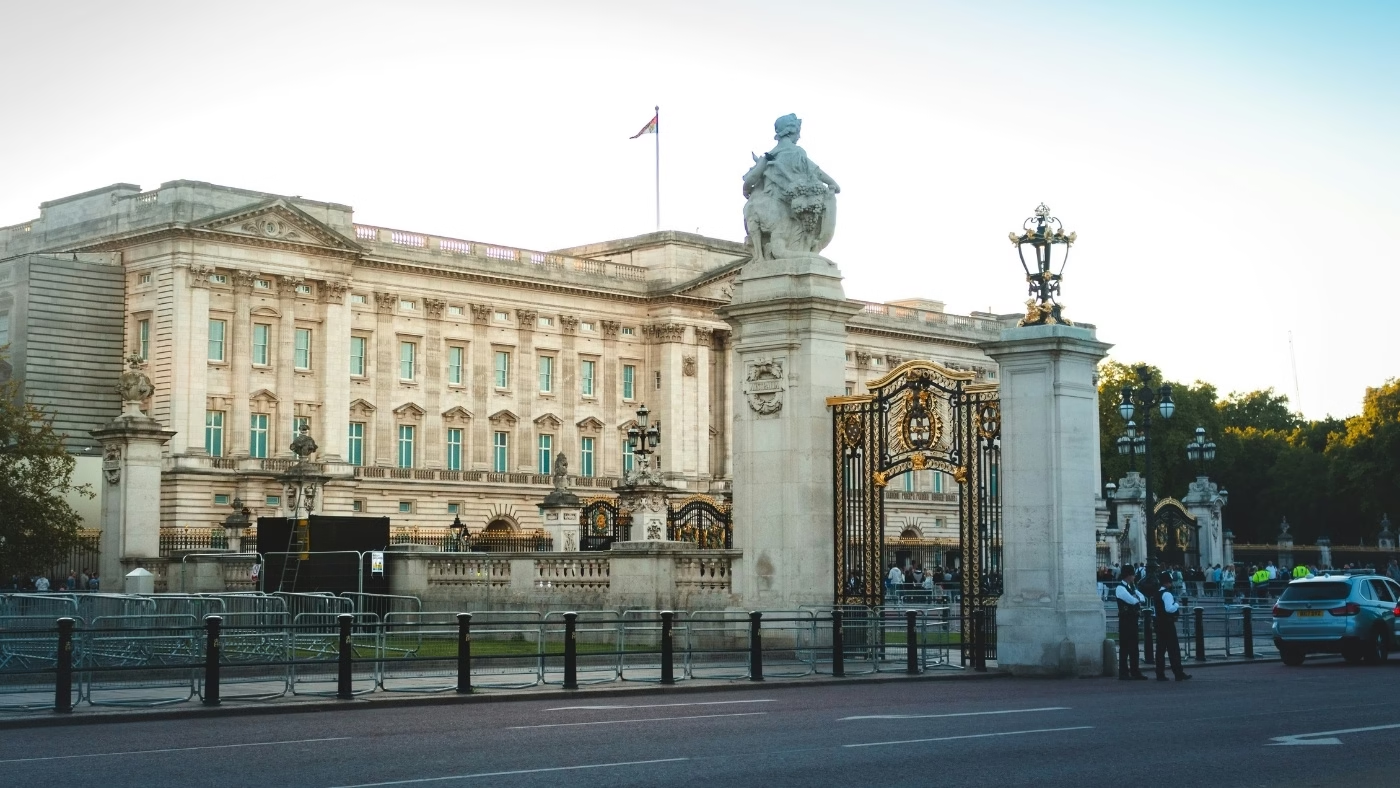
Buckingham Palace became the London residence of the British monarch in 1837 and remains the administrative headquarters of the monarchy. Behind its Portland stone facade on The Mall are 775 rooms, 19 of them State Rooms that open to visitors only in summer. King Charles III works at the palace but lives at nearby Clarence House.
Buckingham Palace at a glance:
- A royal residence since 1837, when Queen Victoria moved in. Its core is Buckingham House, built in 1703 and bought by George III in 1761.
- 775 rooms, including 19 State Rooms, 52 royal and guest bedrooms, 188 staff bedrooms, 92 offices and 78 bathrooms.
- Open to visitors in summer only: in 2027 the State Rooms open from 8 July to 26 September, and a standard adult ticket costs £35 booked in advance.
- Not the King’s home: Charles III and Queen Camilla live at Clarence House and use the palace as the ceremonial and working centre of the monarchy.
What is Buckingham Palace?
Buckingham Palace is a working royal palace: the office of the monarch and the venue for most of the monarchy’s official events. The King holds weekly audiences with the Prime Minister here and receives newly appointed foreign ambassadors, and the palace hosts state banquets, investitures and receptions. More than 50,000 people a year come as guests, to banquets, lunches, dinners, receptions and garden parties. The offices that support the King, the Queen and their immediate family, among them the Private Secretary’s Office and the Privy Purse and Treasurer’s Office, are also based here.

The palace stands in the City of Westminster, between Green Park and St James’s Park, with its private garden to the west. Its public face is the East Front on The Mall, with the central balcony from which the royal family greets crowds, and the building has long been a gathering point at times of national celebration and mourning. In front of the gates stands the Victoria Memorial by Thomas Brock, unveiled by George V on 16 May 1911. The forecourt where Changing the Guard takes place was laid out in the same year as part of the memorial scheme, together with the gates and railings.
Buckingham Palace architecture: Nash, Blore and Webb
The palace is the work of several architects over two centuries, and each of them shaped a different part of it. Its core is Buckingham House, a town house designed by William Winde for John Sheffield, Duke of Buckingham and Normanby, and built in 1703: a three-storey central block with two smaller service wings.
John Nash turned the house into a palace for George IV from the end of 1826. He kept the old main block but doubled its size with a new suite of rooms on the west, garden side, faced in Bath stone in the French neoclassical style the King favoured. The north and south wings were demolished and rebuilt on a larger scale around an enlarged courtyard, with the Marble Arch, a monument to the victories at Trafalgar and Waterloo, as its centrepiece. The State and semi-State Rooms on the garden side have changed little since Nash’s time.
After Nash’s dismissal, Edward Blore completed the building and added an attic storey to the main block, decorated outside with marble friezes made for the Marble Arch. Blore also designed the East Front, built in the late 1840s to close the courtyard into a quadrangle. The Marble Arch was moved to make way for it and now stands at the north-east corner of Hyde Park. In the same period Nash’s pupil James Pennethorne designed the Ballroom wing and a further suite of State Rooms.
By the turn of the 20th century the soft French stone of Blore’s East Front was decaying, largely because of London’s soot. In 1913 Aston Webb redesigned the facade in Portland stone. The stone took 12 months to prepare, and the refacing itself, including the removal of the old stonework, took 13 weeks. Webb had already designed the setting in front of it: The Mall, completed in 1911 as part of the national memorial to Queen Victoria, and the surround of the Victoria Memorial. The palace has been Grade I listed since 1970.
The interiors also date from several periods. Nash’s rooms were finished with brightly coloured scagliola and blue and pink lapis, on the advice of Charles Long. From 1901 Edward VII had the Ballroom, Grand Entrance, Marble Hall, Grand Staircase and galleries redecorated in the cream and gold scheme they still have. In the East Wing, fittings taken from George IV’s Royal Pavilion in Brighton gave several rooms a Chinese character. The Chinese Luncheon Room incorporates parts of the Brighton Banqueting and Music Rooms, and the Yellow Drawing Room has hand-painted Chinese wallpaper supplied in 1817 for the Brighton Saloon. The Centre Room behind the balcony doors received its Chinese scheme from Queen Mary in the late 1920s.
How many rooms does Buckingham Palace have?
Buckingham Palace has 775 rooms: 19 State Rooms, 52 royal and guest bedrooms, 188 staff bedrooms, 92 offices and 78 bathrooms. The building is 108 metres long across the front, 120 metres deep including the central quadrangle and 24 metres high, with more than 77,000 square metres of floor space. It has 1,514 doors and 760 windows, and every window is cleaned once every six weeks.

The principal rooms are on the first floor, behind the garden front. From the Guard Room at the top of the Grand Staircase, the ceremonial route leads through the Green Drawing Room to the Throne Room, where the official coronation portraits of King Charles III and Queen Camilla were taken. At the centre of the suite runs the top-lit Picture Gallery, 50 metres long and hung with paintings including works by Rembrandt, van Dyck, Rubens and Vermeer. The Music Room, whose large bow dominates the garden front, is flanked by the Blue and White Drawing Rooms. The largest room is the Ballroom, 36.6 metres long, 18 metres wide and 13.5 metres high, where state banquets for up to 170 guests are held on the first evening of a state visit.
Behind the State Rooms the palace runs like a small town, with its own post office, cinema, doctor’s surgery and jeweller’s workshop. To the west lies a garden of 16 hectares, the largest private garden in London, with a lake, a tennis court and a helicopter landing area. The King hosts garden parties there each summer.
Who built Buckingham Palace?
Buckingham Palace grew from a private town house into a palace between 1761 and the 1850s, under four monarchs. Before any house stood here, James I planted a mulberry garden on the site to rear silkworms. He chose the wrong kind of mulberry, and silk production never took off in Britain.
The Sheffield family sold Buckingham House in 1761 to George III, who wanted a family home for Queen Charlotte close to St James’s Palace, where many court functions were held. It became known as the Queen’s House, and 14 of the couple’s 15 children were born there.
George IV first planned only to refit the house, but at the end of 1826 he decided to make it a palace. Parliament agreed a budget of £150,000, the King pressed for £450,000, and by 1829 the costs had reached nearly half a million pounds. The overspend cost Nash his post. William IV, who came to the throne in 1830, brought in Blore to finish the work but never moved in. After the Houses of Parliament burned down in 1834 he offered the palace as a new home for Parliament, and the offer was declined.
Queen Victoria was the first sovereign to live at Buckingham Palace, from July 1837, and in June 1838 she became the first to leave it for a coronation. Her marriage to Prince Albert in 1840 exposed its shortcomings: there were no nurseries and too few bedrooms for guests. The new East Front answered that need, and its cost was largely covered by the sale of the Royal Pavilion in Brighton. After Albert’s death in 1861 Victoria lived mostly at Windsor, Balmoral and Osborne, and the palace was little used for years.

What happened at Buckingham Palace?
Most of the palace’s best-known moments took place on the East Front balcony, while the building itself was bombed during the Second World War.
- 1851: Queen Victoria made the first recorded royal appearance on the balcony, during celebrations for the opening of the Great Exhibition.
- 1940: The palace was bombed nine times during the war. On 13 September 1940 a bomb fell into the quadrangle while George VI and Queen Elizabeth were in the building, blew in windows and destroyed the chapel. The Queen declared: ‘I’m glad we have been bombed. Now I can look the East End in the face.’
- 1945: On VE Day, 8 May, the royal family appeared on the balcony eight times, once with Prime Minister Winston Churchill.
- 1962: The Queen’s Gallery, now The King’s Gallery, opened on the site of the destroyed chapel.
- 1981: Prince Charles and Diana, Princess of Wales, kissed on the balcony on their wedding day, 29 July.
- 2002: During the Golden Jubilee concert in the garden, Brian May played ‘God Save The Queen’ on the palace roof.
- 2018: A balcony appearance marked the centenary of the RAF with a flypast of 100 aircraft.
- 2023: After their coronation on 6 May, King Charles III and Queen Camilla watched a flypast from the balcony, scaled down because of bad weather.
Who lives in Buckingham Palace?
No monarch lives at Buckingham Palace today. King Charles III and Queen Camilla live at nearby Clarence House, and in June 2026 the Royal Household announced that they will not make the palace their home once its reservicing is finished. The palace is to remain the ceremonial centre of royal life and the main workplace of the Royal Household, with more of it opened to the public.
The reservicing programme replaces the building’s boilers, electrical cabling and pipes to reduce the risk of fire and flood, and is intended to keep the palace fit for use for the next 50 years. The ten-year programme began in 2017, costs £369 million and is due to be completed in March 2027. It has also added new lifts and accessible toilets. More than 700 people work in the building, including two horological conservators who wind its more than 350 clocks and watches every week.
The flag on the roof shows whether the King is in residence. Until 1997 the only flag flown over the palace was the Royal Standard, raised when the sovereign was there. After the death of Diana, Princess of Wales, Queen Elizabeth II agreed that the Union Flag should fly at half-mast on the day of her funeral. Since then the Union Flag has flown whenever the monarch is away and is lowered to half-mast on the deaths of members of the royal family. While the King lives at Clarence House, the Royal Standard flies over both buildings when he is in either.
Can you visit Buckingham Palace?
Yes, though the State Rooms open only in summer. In 2027 the summer opening runs from 8 July to 26 September. For the rest of the year the palace opens on selected dates for small-group Exclusive Guided Tours. In the winter of 2026–27 these cover the East Wing, run from 6 November 2026 to 31 January 2027 and cost £100 per person.

The summer opening began in 1993, when ticket income went towards rebuilding Windsor Castle after the fire of 1992. Today it supports the Royal Collection Trust, the charity that cares for the Royal Collection.
Tickets are sold for a set date and entry time. The visit is self-guided, with a free multimedia guide in nine languages, also available in British Sign Language and as an audio-descriptive guide. Outside guides are not allowed. The route takes in the 19 State Rooms over two floors and ends with a long gravel path through the garden, past the Garden Café on the West Terrace. A standard visit takes around two to two and a half hours. The standard route is not step-free, so step-free access has to be booked in advance with the Royal Collection Trust. A ticket can be converted into a 1-Year Pass for unlimited standard admission, with a £2 fee when booking a return visit.
How much are Buckingham Palace tickets?
A standard adult ticket for the 2027 summer opening costs £35 booked in advance and £39 on the day. Children under five and the access companion of a disabled visitor enter free. The Royal Day Out combines the State Rooms with the Royal Mews and The King’s Gallery on the same day and costs 10% less than three separate tickets.
| Ticket, summer 2027 | Adult | Ages 18–24 | Ages 5–17 and disabled visitors |
|---|---|---|---|
| Standard admission, in advance | £35 | £23 | £17.50 |
| Standard admission, on the day | £39 | £26 | £19.50 |
| Royal Day Out, in advance | £69.30 | £45.40 | £34.60 |
| Royal Day Out, on the day | £72.90 | £48.10 | £36.40 |
| State Rooms and Garden Highlights Tour | £52 | £34 | £26 |

The Garden Highlights Tour is a 45-minute guided walk in English that starts two hours and 15 minutes after the State Rooms entry time. Tickets combining the State Rooms with a guided tour of the East Wing are also sold in summer. Prices as listed by the Royal Collection Trust on 4 November 2026.
When is Changing the Guard at Buckingham Palace?
Changing the Guard at Buckingham Palace takes place on Mondays, Wednesdays and Fridays and officially begins at 11:00. On Sundays there is a Sunday Parade at 10:00, and on Tuesdays, Thursdays and Saturdays a Captain’s Inspection at 15:00. The ceremony is free to watch.
The soldiers gather from 10:00 at St James’s Palace and Wellington Barracks and march to the palace with a band. The handover itself takes place on the forecourt, inside the railings, so it is worth arriving early for a place at the railings or on the steps of the Victoria Memorial. The schedule changes around state occasions and the guard is sometimes mounted without music, so check the Household Division’s published schedule before you go.
Buckingham Palace facts and myths
Two claims often repeated about the palace are wrong. It is not the largest royal palace in the world: its 77,000 square metres compare with 135,000 square metres and 3,418 rooms at the Royal Palace of Madrid. The figure of 50,000 visitors a year refers to invited guests at banquets, receptions and garden parties, not to tourists. Paying visitors are far more numerous: the 2024 summer opening drew 646,832 people, the highest number since the palace first opened to the public in 1993.
Edward VII is the only monarch so far to have been both born and died at Buckingham Palace, in 1841 and 1910. Queen Elizabeth II gave birth to two of her children here, including King Charles III, and his christening took place in the Music Room, as did those of the Princess Royal and the Prince of Wales. Notices of royal births and deaths are still fixed to the front railings for the public to read. The Ballroom was the first room in the palace to be lit by electricity, in 1883.
The palace has also had uninvited visitors. Between 1838 and 1841 a teenager, Edward Jones, known as the boy Jones, got inside three times. When he was first found, in December 1838, he was carrying a sword and items of clothing, including underwear. On 21 May 1914 suffragettes tried to reach the gates to petition George V, and some chained themselves to the railings. In 1982 Michael Fagan broke in twice and on 9 July reached Queen Elizabeth II’s bedroom. Trespassing on the palace grounds became a specific criminal offence only in 2007.

Buckingham Palace – frequently asked questions
Where is Buckingham Palace?
At the western end of The Mall in the City of Westminster, London SW1A 1AA. The nearest Underground stations are Green Park, St James’s Park, Victoria and Hyde Park Corner.
Is there a swimming pool in Buckingham Palace?
Yes. In 1938 the north-west pavilion, designed by Nash as a conservatory, was converted into a swimming pool.
Who owns Buckingham Palace?
The reigning monarch, in right of the Crown. The palace is not the King’s private property, unlike Sandringham House and Balmoral Castle, and it is not part of the Crown Estate. The government is responsible for its upkeep, in return for the Crown Estate’s profits.
Can you take photos inside Buckingham Palace?
No. Photography and filming are not permitted inside the palace, but visitors can take photographs in the garden at the end of the route.
What else can you see at Buckingham Palace?
The Royal Mews, the working royal stables designed by Nash, where the Gold State Coach is kept, and The King’s Gallery, which shows changing exhibitions from the Royal Collection of more than a million objects. The Royal Mews reopens on 4 March 2027. Queen Elizabeth II: Her Life in Style is on view at The King’s Gallery until 18 April 2027, followed in summer 2027 by Royal Jewellery: From Coronations to Keepsakes.
The reservicing of Buckingham Palace shows how much of the work on an old building is hidden: cabling, pipes and boilers running behind interiors that have to stay intact. Renovating a period house or apartment raises the same question of where new services can go without damaging original details, and planning that is a job for a specialist. Find architects, interior designers and interior photographers in the PLNDesign directory.
See also:
- Big Ben: history, facts and visiting the Elizabeth Tower
- Eiffel Tower: height, history, tickets and facts